

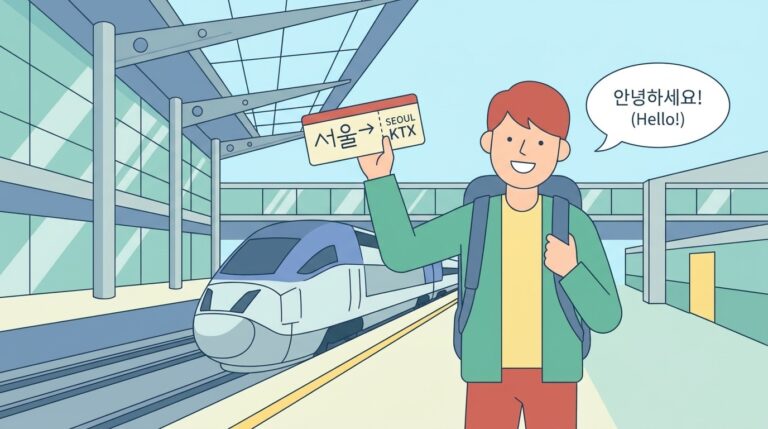
Phase 1: Empathy
Hello! I am your Daily Hangul Editor.
Imagine this: You are standing in the middle of the massive Seoul Station. You’ve binge-watched Train to Busan (부산행) one too many times, and now you want to experience the KTX yourself—minus the zombies, of course. You walk up to the ticket counter. The staff member looks at you expectantly. You know you want to go to Busan, but the textbook phrase “I would like to purchase a ticket to Busan” suddenly feels too long and robotic. The line behind you is growing. The pressure is on!
Does this sound familiar? You’re not alone! Buying a train ticket in Korea can feel intimidating because of the fast-paced Palli-palli (빨리빨리, hurry up) culture. But don’t worry. You don’t need perfect grammar to survive. You just need a few native-sounding “cheat codes.”
This guide is built from the real panics and victories of my A2-level students. Today, we are going to learn how to book a train ticket like a confident local, grab the best seats, and even learn what snacks to buy for the ride!
Phase 2: Core Expressions Deep Dive
1. [목적지] + 행 두 장 주세요.
- Pronunciation: [Mokjeokji] + haeng du jang juseyo. (haeng sounds like ‘hang’, du jang sounds like ‘doo-jahng’)
- Meaning: (Literal) Two tickets bound for [Destination], please. vs (Real nuance) Two tickets to [Destination], please.
- K-Culture Moment: You’ll see the word ‘행’ (haeng) everywhere in Korea—on buses, subway screens, and movie titles (Yes, Train to Busan is originally titled 부산행 – Busanhaeng!). At the ticket counter, just adding ‘행’ makes you sound 10x more natural than saying “I want to go to…”
- Editor’s Insight: Think of ‘주세요’ (please give me) as your magic wand in Korea. It works at restaurants, cafes, and train stations!
- Situation Spectrum:
- Casual with friends: 🚫 (You wouldn’t say this to a friend)
- Service Staff (Ticket agent): ✅ (Perfect and polite)
- 🤔 Think About It: Why do Koreans prefer short, noun-based sentences like “Busan-haeng” at counters instead of full “I want to…” sentences? How does this relate to Korea’s fast-paced society?
2. 제일 빠른 걸로 주세요.
- Pronunciation: Jeil ppareun geollo juseyo. (Je-il sounds like ‘jay-eel’, ppa-reun sounds like a sharp ‘ppa’ + ‘reun’ with a soft r)
- Meaning: (Literal) Please give me the fastest one. vs (Real nuance) I’ll take the earliest available ticket.
- K-Culture Moment: In K-Dramas, when the dramatic lead is chasing after their lover who is leaving the city, they slam their card on the counter and yell this exact phrase!
- Editor’s Insight: This doesn’t just mean “the fastest train” (like KTX over Mugunghwa). It means “the earliest departing train.” It’s the ultimate time-saving phrase.
- Situation Spectrum:
- Casual with friends: ✅ (When choosing what to eat/do)
- Service Staff (Ticket agent): ✅ (Very common)
- 🤔 Think About It: “빨리빨리” (Hurry up) is a core Korean value. Do you think this emphasis on speed makes life more convenient or more stressful?
3. 창가 자리로 할게요.
- Pronunciation: Changga jariro halgeyo. (Chang-ga sounds like ‘chahng-gah’, ja-ri-ro sounds like ‘jah-ree-roh’)
- Meaning: (Literal) I will do the window seat. vs (Real nuance) I’ll take a window seat, please.
- K-Culture Moment: Train travel in Korea isn’t just about moving; it’s about the aesthetic. K-Vloggers always book the changga jari (window seat) to film the beautiful countryside whizzing by.
- Editor’s Insight: “-(으)로 할게요” is a fantastic A2 grammar point. It means “I’ll go with [Choice].” You can use it to choose seats, coffee sizes, or menu items!
- Situation Spectrum:
- Casual with friends: ✅ (e.g., “I’ll go with pizza”)
- Service Staff (Ticket agent): ✅
Phase 3: Textbook vs. Real Korean
[Buying the Ticket]
* 📖 Textbook Korean: 저는 부산에 가는 기차표를 사고 싶습니다. (I would like to buy a train ticket that goes to Busan.)
* 🗣️ Real Korean: 부산행 KTX 두 장 주세요. (Two KTX tickets to Busan, please.)
* 💡 Why the difference?: Efficiency! At a busy station, service workers appreciate direct, polite, and short requests.
[Choosing a Time]
* 📖 Textbook Korean: 가장 일찍 출발하는 기차는 몇 시에 있습니까? (At what time is the train that departs the earliest?)
* 🗣️ Real Korean: 제일 빠른 게 몇 시예요? (What time is the earliest one?)
* 💡 Why the difference?: Spoken Korean drops unnecessary words. “게” is short for “것이” (the thing), making the sentence flow faster.
Bottom Note: For A2 learners, mastering shortened phrases like “~로 할게요” or “~주세요” will make your Korean sound much more natural without needing complex grammar!
Phase 4: Cultural Context — K-Culture Deep Dive
4-1. Non-Verbal Communication: Station Nunchi
When you’re at the ticket counter in Korea, Nunchi (눈치, the ability to read the room) is crucial. Because of the Palli-palli culture, it is considered polite to have your credit card already in your hand before you even reach the front of the line. Don’t dig through your bag at the counter! Also, maintaining soft eye contact is fine, but you don’t need to over-smile; a quick bow of the head when receiving the ticket is the perfect non-verbal “thank you.”
4-2. K-Food Connection: The Train Snack Tradition
If you are taking a train in Korea, you must know the classic K-Train snack combo: 삶은 계란과 사이다 (Boiled eggs and Cider).
Before high-speed KTX trains existed, train rides from Seoul to Busan took over 6 hours. Passengers would buy hard-boiled eggs and Chilsung Cider from a rolling cart to pass the time. It became such a nostalgic cultural staple that even today, in modern dramas (like Reply 1988), you’ll see characters cracking boiled eggs on each other’s heads on the train! If you want the full K-Travel experience, grab these from the convenience store before boarding.
Phase 5: Real-Life Roleplay Scenario
Setting: Saturday morning, 9:00 AM at Seoul Station. The station is echoing with announcements. You’re taking a spontaneous weekend trip to Busan. You’ve practiced your lines, and it’s finally your turn at the counter.
Characters:
– YOU: A foreign traveler eager to see the ocean.
– Agent (역무원): A polite but fast-working station employee.
Dialogue:
Agent: 안녕하세요. 어디로 가시나요?
(Annyeonghaseyo. Eodiro gasinayo?)
[Hello. Where are you heading?]
YOU: 안녕하세요! 부산행 KTX 한 장 주세요.
(Annyeonghaseyo! Busanhaeng KTX han jang juseyo.)
[Hello! One KTX ticket to Busan, please.]
Agent: 네, 시간은 언제가 좋으신가요?
(Ne, siganeun eonjega joeusingayo?)
[Okay, what time is good for you?]
YOU: 제일 빠른 걸로 부탁드려요.
(Jeil ppareun geollo butakdeuryeoyo.)
[The earliest one, please.]
Agent: 9시 30분 기차가 있습니다. 좌석은 어디로 해드릴까요?
(Ahopsi samsipbun gichaga itseumnida. Jwaseogeun eodiro haedeurilkkayo?)
[There is a 9:30 train. Where would you like your seat?]
🔀 YOUR TURN! How do you answer?
– A) “저는 창문 옆에 앉고 싶습니다.” (Textbook, a bit stiff)
– B) “창가 자리로 할게요!” (Natural, decisive)
– C) “아무거나 좋아요!” (Casual, “anything is fine”)✅ Best Choice: B — It uses the natural “-로 할게요” pattern.
⚠️ Choice C Analysis: “아무거나” (Anything) is perfectly fine if you genuinely don’t care, but the agent might still ask if you prefer facing forward or backward!
YOU: 창가 자리로 할게요!
(Changga jariro halgeyo!)
[I’ll take a window seat!]
Agent: 네, 순방향 창가 자리로 해드렸습니다. 59,800원입니다.
(Ne, sunbanghyang changga jariro haedeuryeotseumnida. Oman-gucheon-palbaegwon-imnida.)
[Yes, I’ve given you a forward-facing window seat. It is 59,800 won.]
YOU: 여기 카드요. 감사합니다!
(Yeogi kadeuyo. Gamsahamnida!)
[Here is my card. Thank you!]
(🎭 Stage Direction: You confidently hand over your card, already dreaming of the Busan ocean!)
Phase 6: 10-Second Shadowing Drill
Practice speaking this naturally! Pay attention to the slashes for pausing.
😊 안녕하세요! / 부산행 KTX / 두 장 주세요.
(Annyeonghaseyo! / busanhaeng KTX / du jang juseyo.)
🤔 제일 빠른 기차는 / 몇 시예요?
(Jeil ppareun gichaneun / myeot siyeyo?)
✨ 저는 / 창가 자리로 / 할게요!
(Jeoneun / changga jariro / halgeyo!)
Phase 7: K-Culture Mini Dictionary
1. 눈치
* Romanization: nunchi
* English: Social sense / Reading the room
* Context: The unspoken Korean art of gauging a situation. In transportation, having good nunchi means having your payment ready and not blocking the escalators.
2. 빨리빨리
* Romanization: ppalli-ppalli
* English: Hurry, hurry / Fast-paced
* Context: The driving force behind Korea’s hyper-efficient infrastructure, from lightning-fast KTX trains to same-day deliveries.
3. 매진
* Romanization: maejin
* English: Sold out
* Context: A word you will sadly see often on holidays like Chuseok. If the screen says ‘매진’, you’ll have to wait for the next train!
4. 입석
* Romanization: ipseok
* English: Standing ticket
* Context: If all seats are sold out, you can buy an ipseok ticket. You’ll have to stand in the space between train cars, but it’s a lifesaver when you’re in a hurry.
Phase 8: Traveler Survival Kit
Booking a train involves navigating a busy station. Here are your lifesavers:
🆘 Survival Phrases TOP 3
– 🇰🇷 “타는 곳이 어디예요?” (Taneun gosi eodiyeyo?)
– 🗣️ English: Where is the boarding area (tracks)?
– 📍 Where to use: When you have your ticket but can’t find your platform.
- 🇰🇷 “이 기차 부산행 맞나요?” (I gicha busanhaeng mannayo?)
- 🗣️ English: Is this train bound for Busan?
- 📍 Where to use: Right before stepping onto the train, to double-check.
🇰🇷 “여기 제 자리인 것 같아요.” (Yeogi je jari-in geot gatayo.)
- 🗣️ English: I think this is my seat.
- 📍 Where to use: When someone is accidentally sitting in your assigned seat.
📌 Editor’s Travel Note
– The Ultimate App: Download ‘Korail Talk’ (코레일톡). You can switch it to English, book tickets in advance, and skip the counter entirely!
– SRT vs. KTX: KTX departs from Seoul Station, but if you are staying in the Gangnam area, take the SRT from Suseo Station. It’s faster and cheaper!
– No Ticket Gates! Korea operates on an honor system. There are no turnstiles to scan your ticket when walking to the platforms. Just hop on! (But staff will check their devices to ensure your seat is paid for).
Phase 9: Critical Thinking Corner — “A Step Deeper”
🧠 Think Deeper: Language & Power — “빨리빨리” and Korean Efficiency
Have you noticed how seamlessly the Korean transportation system works? You can buy a ticket 5 minutes before departure and still make it. This reflects Korea’s Palli-palli (hurry-up) culture. While “Palli-palli” is often translated as just “being impatient,” it is actually a reflection of collective consideration. The train agent speaks quickly and uses shortened sentences not to be rude, but to value your time and the time of the 20 people behind you. In Korea, efficiency is a form of politeness.💬 Your Turn: Does your culture value taking things slowly and conversing at the counter, or is speed considered the best customer service? Share your thoughts in the comments!
Phase 10: FAQ & Avoiding Mistakes
Q: “Can I buy train tickets with cash?”
Yes! While Korea is largely a cashless society, train station counters still accept cash. However, ticket vending machines usually only take cards.
Q: “What if the train is sold out?”
You can ask: “입석 있나요?” (Are there standing tickets?). It’s tiring, but you will get to your destination!
❌ Common Mistake #1: Saying “기차 (Train)” instead of the specific train name.
✅ Do this instead: Koreans rarely say “I am taking a train.” They specify the type: “KTX 타요” (I take KTX) or “SRT 타요.” It’s like saying “I’m taking an Uber” instead of “I’m taking a car.”❌ Common Mistake #2: Sitting in any empty seat.
✅ Do this instead: KTX seats are strictly assigned. Even if a seat is empty, someone might board at the next station. Always sit in your assigned seat, or ask the conductor if you wish to move.
Phase 11: Summary & Action Items
One-Liner Summary: Use “[Destination]행 주세요” and “~로 할게요” to book your KTX tickets like a time-saving local!
Action Mission:
– 🥉 Bronze (Solo): Stand in front of your mirror and practice saying “부산행 한 장 주세요!” 3 times with confidence.
– 🥈 Silver (Online): Drop a comment below using “~로 할게요” to tell us what kind of seat you prefer (Window? Aisle?).
– 🥇 Gold (Real Life): Next time you are in Korea, bypass the kiosk and try buying your ticket directly from the counter using today’s phrases!
🎬 K-Culture Mission:
Go to YouTube and search for “KTX Train Journey vlog”. Notice the snacks people eat and listen to the chime sound that plays before the station announcements. It’s iconic!
Are you team Window Seat (창가 자리) or team Aisle Seat (복도 자리)? Let me know in the comments below! 👇
Phase 12: Quiz — Interactive Challenge
1. Fill in the blank:
You want the earliest train. You say: “제일 ( ) 걸로 주세요.”
A) 예쁜 (pretty)
B) 빠른 (fast/early)
C) 느린 (slow)
2. Situational Judgment:
You get on the KTX, but someone is sitting in your seat! What is the most polite, native-sounding way to address this?
A) 일어나세요! (Stand up!)
B) 여기 제 자리인 것 같아요. (I think this is my seat.)
C) 눈치 챙기세요. (Read the room.)
3. True or False – K-Culture Edition:
“You must scan your paper ticket at a gate to enter the KTX platforms in Korea.”
True or False?
Answers (Click to reveal!)
1. B (빠른 – fast/early. “제일 빠른 걸로 주세요” means “The earliest one, please.”)
2. B (Indirectness is polite in Korea. Saying “I think this is my seat” gives them a chance to move without losing face. A is too aggressive, C is just insulting!)
3. False (Korea uses an honor system! Walk straight to your train. The conductor will check digitally.)
Frequently Asked Questions (FAQ)
Q: What does "[목적지] + 행 두 장 주세요." mean in Korean and how do you pronounce it?
A: In Korean, "[목적지] + 행 두 장 주세요." is pronounced [Mokjeokji] and means: (Literal) Two tickets bound for [Destination], please. vs (Real nuance) Two tickets to [Destination], please.
Q: What does "제일 빠른 걸로 주세요." mean in Korean and how do you pronounce it?
A: In Korean, "제일 빠른 걸로 주세요." is pronounced [Jeil ppareun geollo juseyo. (Je-il sounds like 'jay-eel', ppa-reun sounds like a sharp 'ppa' + 'reun' with a soft r] and means: (Literal) Please give me the fastest one. vs (Real nuance) I'll take the earliest available ticket.
Q: What does "창가 자리로 할게요." mean in Korean and how do you pronounce it?
A: In Korean, "창가 자리로 할게요." is pronounced [Changga jariro halgeyo. (Chang-ga sounds like 'chahng-gah', ja-ri-ro sounds like 'jah-ree-roh'] and means: (Literal) I will do the window seat. vs (Real nuance) I'll take a window seat, please.







