

Hello! I’m the Lead Editor of Daily Hangul, your veteran tutor and local cultural navigator.
Phase 1: Empathy (Immersive Opening)
Have you ever watched a K-Drama where the main character awkwardly shoves a beautifully wrapped box into someone’s hands, looks away, and grumbles, “It’s nothing, I just picked it up on the way”? Or maybe you’ve been to a Korean idol fan meeting where fans give mountains of gifts, but always attach a little note saying, “This is just a small preparation…”
Why do Koreans always pretend their perfectly chosen, expensive gifts are just “small things”? And what if you are the one handing over a gift? You want to sound polite, genuine, and maybe a little bit like that cool K-Drama protagonist.
If you don’t know the cultural context behind Korean gift-giving, you might accidentally sound boastful or make the receiver feel burdened (budam). This post is built entirely on real questions from my beginner students who wanted to survive Korean birthdays, housewarming parties, and office farewells without breaking a sweat!
Phase 2: Core Expressions Deep Dive
Let’s master the top 3 expressions you need when giving a gift.
1. 작은 선물이에요 (jageun seonmurieyo)
- Pronunciation: [ja-geun sun-mul-ee-eh-yo] (‘ja’ sounds like jar, ‘geun’ sounds like the ‘good’ but with an ‘n’ at the end)
- Meaning: Literal: “It’s a small gift.” / Real nuance: “I got you something, but I don’t want you to feel burdened by it.”
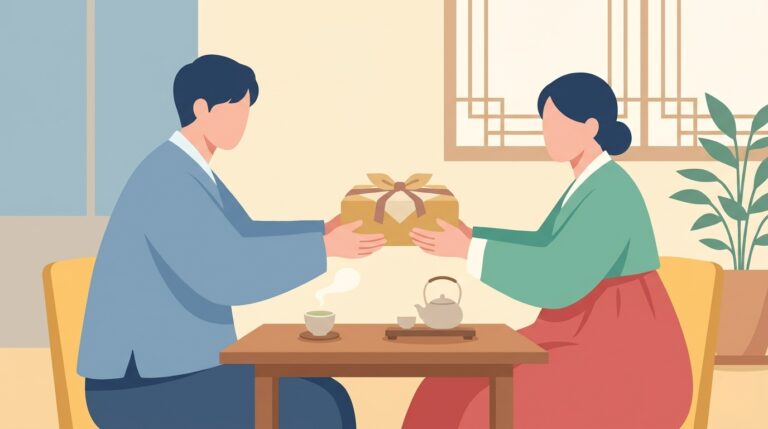
- K-Culture Moment: You bring an expensive bottle of wine to a Korean coworker’s housewarming party (Jibdeuri). Instead of saying “I bought an expensive wine,” you hand it over with two hands and say, “작은 선물이에요.” The modesty instantly elevates your class!
- Editor’s Insight: This isn’t about the actual size or price of the gift. It’s a verbal cushion. It shows you care more about their comfort than showing off your generosity.
- Situation Spectrum:
- Casual (Friends): ✅
- Semi-formal (Coworkers): ✅
- Formal (Boss/Elders): ✅ (Add ‘준비했어요’ – I prepared a small gift)
- 🤔 Think About It: Why does Korean culture value lowering oneself (modesty) to elevate the other person? Does your native culture do something similar, or do you proudly announce the value of your gift?
2. 마음에 들었으면 좋겠어요 (maeume deureosseumyeon jokesseoyo)
- Pronunciation: [ma-eu-meh deu-reo-sseu-myun jo-keh-sseo-yo]
- Meaning: Literal: “It would be good if it enters your mind.” / Real nuance: “I hope you like it.”
- K-Culture Moment: In K-Pop, when an idol writes a letter to their fans revealing a new song or a surprise event, they almost always end it with: “우리 아미/블링크, 마음에 들었으면 좋겠어요!” (I hope you like it!)
- Editor’s Insight: “마음에 들다” (to enter the heart/mind) is the ultimate Korean phrase for “liking” an object or person. It sounds much more natural and emotional than just using “좋아하다” (to like).
- Situation Spectrum:
- Casual (Friends): ✅ (Just drop the ‘요’ -> 좋겠어)
- Semi-formal (Coworkers): ✅
- Formal (Boss/Elders): ⚠️ (Use ‘마음에 드셨으면 좋겠습니다’ instead)
- 🤔 Think About It: “Entering the mind/heart” is a passive action. What does this tell us about how Koreans view feelings of appreciation compared to the active English “I like it”?
3. 축하해요! (chukahaeyo!)
- Pronunciation: [choo-ka-hae-yo] (The ‘k’ has a strong puff of air)
- Meaning: Congratulations!
- K-Culture Moment: Picture an office setting. A team member gets promoted. Someone brings in an ice cream cake from Baskin Robbins (a K-office staple!), everyone claps, and yells “진급 축하해요!” (Congratulations on the promotion!).
- Editor’s Insight: You can put ANY event before this word. 생일 축하해요 (Happy Birthday), 결혼 축하해요 (Happy Wedding), 졸업 축하해요 (Happy Graduation). It’s your Swiss Army knife.
- Situation Spectrum:
- Casual (Friends): ✅ (축하해!)
- Semi-formal (Coworkers): ✅
- Formal (Boss/Elders): 🚫 (Say ‘축하드립니다’ instead)
- 🤔 Think About It: We often mix “congratulations” with giving a gift. If you could only say one, the gift or the verbal congratulation, which holds more weight in your culture?
Phase 3: Textbook vs Real Korean
[Situation 1: Giving a gift you bought for them]
* 📖 Textbook Korean: 이것은 제 선물입니다. (This is my gift.)
* 🗣️ Real Korean: 이거, 작은 선물이에요. / 오다 주웠어요. (This is a small gift. / I picked it up on the way – Playful/Slang)
* 💡 Why the difference?: Textbooks state facts. Real Korean prioritizes the relationship and modesty. (Though “오다 주웠어요” is a fun K-Drama joke, only use it with close friends!)
[Situation 2: Responding when you receive a gift]
* 📖 Textbook Korean: 감사합니다. (Thank you.)
* 🗣️ Real Korean: 헐! 대박! 완전 예뻐요. 잘 쓸게요! (Gasp! Awesome! It’s totally pretty. I’ll use it well!)
* 💡 Why the difference?: Koreans love expressive reactions (리액션). Saying “I will use it well” proves that the gift is practical and deeply appreciated.
Bottom Note: For an
A2 (Beginner)level, sticking to “우와, 감사합니다! 잘 쓸게요!” (Wow, thank you! I will use it well!) is the perfect middle ground between polite and wonderfully expressive!
Phase 4: Cultural Context — K-Culture Deep Dive
4-1. Non-verbal Element: The Magic of Two Hands
Language is only half the battle. In Korea, how you give the gift is just as important as what you say. When you hand over the gift, you must use both hands. If the object is small, use your right hand to give it, and place your left hand lightly under your right elbow or forearm. It shows immense respect. Throwing it with one hand? That’s a huge Nunchi fail.
4-2. K-Drama Connection: The “Tsundere” Gift-Giver
If you watch romantic K-Dramas, you’ve seen this trope. The male lead is slightly arrogant but secretly soft-hearted (Tsundere). He buys the female lead an expensive necklace, but instead of making a grand romantic speech, he casually slides it across the table: “Take it. It was on sale.”
While you shouldn’t exactly be this rude in real life, it perfectly highlights the Korean fear of making the other person feel 부담 (Budam – Burden). By downplaying the gift’s value, the giver allows the receiver to accept it without feeling guilty or obligated to give something equally expensive back.
Phase 5: Practical Role-play Scenario
Setting: Friday night, 8 PM. A cozy, aesthetic cafe in Yeonnam-dong. You are meeting your Korean friend, Min-ji, for her birthday. You have a small, beautifully wrapped hand cream from a popular K-Beauty brand hidden in your bag.
Characters:
– YOU: A foreigner living in Korea, trying hard to use natural Korean.
– Min-ji (28): Your bright, encouraging Korean friend who loves good reactions.
Dialogue:
Min-ji: 와, 여기까지 오느라 고생했어요! 🍰
(Wa, yeogikkaji oneura gosaenghaesseoyo!)
[English] Wow, you went through a lot of trouble to get all the way here!
YOU: 아니에요. 생일 정말 축하해요, 민지 씨! 🎉
(Anieyo. Saeng-il jeongmal chukahaeyo, Minji ssi!)
[English] Not at all. Happy birthday, Min-ji!
Min-ji: 고마워요! 그냥 와도 되는데…
(Gomawoyo! Geunyang wado doeneunde…)
[English] Thank you! You could have just come empty-handed…
YOU: 이거, 제 작은 선물이에요.
(Igeo, je jageun seonmurieyo.)
[English] Here, this is a small gift from me.
(🎭 Stage Direction: You hand over the small paper bag with both hands)
Min-ji: 어머, 이게 뭐예요? 안 줘도 되는데! 열어봐도 돼요?
(Eomeo, ige mwoyeyo? An jwodo doeneunde! Yeoreobwado dwaeyo?)
[English] Oh my, what is this? You really didn’t have to! Can I open it?
YOU: 네, 열어보세요. 마음에 들었으면 좋겠어요.
(Ne, yeoreoboseyo. Maeume deureosseumyeon jokesseoyo.)
[English] Yes, please open it. I hope you like it.
Min-ji: 우와! 핸드크림이네요. 향 너무 좋아요! 😭
(Uwa! Haendeukeu-rimin-eyo. Hyang neomu joayo!)
[English] Wow! It’s hand cream. The scent is so good!
🔀 Your Turn! How should you respond to her great reaction?
– A) “제가 돈 많이 썼어요.” (I spent a lot of money.)
– B) “다행이네요. 잘 쓰세요!” (That’s a relief. Please use it well!)
– C) “오다 주웠어요.” (I picked it up on the way.)✅ Best Choice: B — It’s warm, natural, and polite for an A2 learner.
⚠️ Choice A & C Analysis: Choice A sounds terribly arrogant in Korea! Choice C is funny, but if your pronunciation isn’t perfect, she might be genuinely confused as to why you picked trash off the street for her birthday.
YOU: 다행이네요. 요즘 날씨가 건조하잖아요. 잘 쓰세요!
(Dahaeng-ineyo. Yojeum nalssiga geonjohajanhayo. Jal sseuseyo!)
[English] That’s a relief. The weather is dry lately, you know. Use it well!
Min-ji: 감동이에요. 진짜 잘 쓸게요! 커피는 제가 쏠게요! ☕
(Gamdong-ieyo. Jinjja jal sseulgeyo! Keopineun jaega ssolgeyo!)
[English] I’m touched. I’ll really use it well! I’m treating you to coffee!
Phase 6: 10-Second Shadowing Drill
Practice reading this out loud. Pay attention to the pauses (/) and the emotional tags!
😊 이거 / 제 작은 / 선물이에요.
(igeo / je jageun / seonmurieyo)
🥺 민지 씨가 / 마음에 / 들었으면 / 좋~겠어요!
(Minji ssiga / maeume / deureosseumyeon / jo~kesseoyo!)
Phase 7: K-Culture Mini Dictionary
Here are 4 cultural keywords related to gifts and relationships:
1. 눈치 (Nunchi)
* Romanization: nunchi
* English: Social situational awareness
* Context: The “sixth sense” of reading the room. Knowing exactly what kind of small gift your coworker needs without them explicitly asking is high Nunchi.
2. 부담 (Budam)
* Romanization: budam
* English: Burden / Pressure
* Context: Koreans deeply fear causing budam. Giving an overly expensive gift to someone you just met gives them massive budam because they feel pressured to return the favor.
3. 정 (Jeong)
* Romanization: jeong
* English: Deep emotional bond / Warmth
* Context: Even if you just buy your friend a cheap bottle of hangover drink after a night out, that small gesture is considered an act of Jeong. It’s the invisible string tying people together.
4. 집들이 (Jibdeuri)
* Romanization: jibdeuri
* English: Housewarming Party
* Context: When invited to a new home, you MUST bring a gift. Traditionally, Koreans bring toilet paper (wishing things unroll smoothly) or laundry detergent (wishing wealth bubbles up!).
Phase 8: Traveler Survival Kit
Are you traveling in Korea and need to buy a gift for your host or a souvenir to take back home? Here are the must-know phrases for the store!
🆘 Survival Phrases for Buying Gifts
– 🇰🇷 “선물용으로 포장해 주세요.” (seonmuryong-euro pojanghae juseyo)
– 🗣️ Meaning: Please gift-wrap this.
– 📍 Where to use: Department stores, cosmetic shops like Olive Young.
- 🇰🇷 “가격표 떼 주세요.” (gagyeokpyo tte juseyo)
- 🗣️ Meaning: Please remove the price tag.
- 📍 Where to use: Any gift shop.
🇰🇷 “영수증은 버려주세요.” (yeongsujeung-eun beoryeojuseyo)
- 🗣️ Meaning: Please throw away the receipt.
📌 Editor’s Travel Note:
– Shopping bags: In Korea, due to environmental laws, plastic and paper bags usually cost 100 to 300 won extra. Don’t be surprised if the cashier asks “봉투 필요하세요?” (Do you need a bag?). Just say “네” (Yes)!
Phase 9: Critical Thinking Corner — “Think Deeper”
Media vs Reality: The Danger of K-Drama Tropes
In dramas, friends constantly curse at each other affectionately, and lovers throw expensive gifts with zero polite words. But real Korean society relies heavily on mutual respect and soft boundaries. If a beginner tries to copy the rough “bad boy” or “cool girl” tone from Netflix when handing a gift to a Korean local, it often comes off as incredibly rude rather than “cool.” The beauty of real Korean language lies in its warmth and care for the listener’s comfort.
💬 Your Turn: Has a TV show or movie from your country ever made foreigners misunderstand how people actually speak in real life? Share it in the comments!
Phase 10: FAQ & Mistake Prevention
Q: Should I open a gift immediately when someone gives it to me?
In Western cultures, opening it immediately is expected. In Korea, historically, it was polite to put the gift aside and open it later to avoid looking greedy. However, modern younger Koreans love reactions! The safest bet? Ask politely: “지금 열어봐도 돼요?” (Can I open it now?).
Q: I want to write a fan letter to my favorite K-Pop idol. Can I use casual language (반말)?
Unless you are older and the idol specifically told fans to use casual language, always stick to formal language (해요 or 입니다). It shows respect for their hard work as artists!
❌ Common Mistake #1: Giving shoes to a romantic partner.
✅ Do this instead: In Korean superstition, gifting shoes means the person will put on the shoes and “run away” from you! If you really want to gift sneakers, a fun modern workaround is having your partner give you a small coin (like 100 won) in exchange, so it technically counts as them “buying” it!
Phase 11: Summary & Action Items
One-Liner Summary: Lower the gift, elevate the person—say “작은 선물이에요” (It’s a small gift) to show true Korean politeness!
Your Action Missions:
– 🥉 Bronze (Solo): Stand in front of your mirror, hold a random object with both hands, and say “마음에 들었으면 좋겠어요” 3 times.
– 🥈 Silver (Online): Post a picture of a gift you recently received on your social media and caption it: “너무 예뻐요! 잘 쓸게요!” (It’s so pretty! I’ll use it well!).
– 🥇 Gold (Real World): Next time you meet a Korean friend or language partner, hand them a small snack (like a Choco Pie) and use today’s exact dialogue!
🎬 K-Culture Mission:
Watch one episode of any K-Drama today. Pay close attention to any scene where a gift, food, or drink is handed over. Did they use one hand or two? Did they brag about it, or did they act shy?
Phase 12: Quiz — Interactive Challenge
1. Situational Judgment: You are giving a welcome gift to your new Korean boss. What is the most appropriate thing to say?
A) 오다 주웠어요. (I picked it up on the way)
B) 이거 작은 선물이에요. 마음에 드셨으면 좋겠습니다. (This is a small gift. I hope you like it.)
C) 제가 돈 진짜 많이 썼어요. (I spent a really lot of money.)
(Answer: B. It’s polite, modest, and uses the correct formal ending.)
2. True or False: When receiving a gift in Korea, you must always snatch it quickly with your left hand.
(Answer: False. Always use two hands, or your right hand supported by your left.)
3. Fill in the Blank: “생일 _______! 이거 제 작은 성의예요.” (Happy Birthday! This is my small sincerity.)
(Answer: 축하해요 / chukahaeyo)
How did you do? Giving gifts in Korea is less about the item itself and more about the beautiful invisible exchange of Jeong (warmth). Go out there and spread some joy today!”
Frequently Asked Questions (FAQ)
Q: What does "작은 선물이에요 (jageun seonmurieyo)" mean in Korean and how do you pronounce it?
A: In Korean, "작은 선물이에요 (jageun seonmurieyo)" is pronounced [ja-geun sun-mul-ee-eh-yo] and means: Literal: "It's a small gift." / Real nuance: "I got you something, but I don't want you to feel burdened by it."
Q: What does "마음에 들었으면 좋겠어요 (maeume deureosseumyeon jokesseoyo)" mean in Korean and how do you pronounce it?
A: In Korean, "마음에 들었으면 좋겠어요 (maeume deureosseumyeon jokesseoyo)" is pronounced [ma-eu-meh deu-reo-sseu-myun jo-keh-sseo-yo] and means: Literal: "It would be good if it enters your mind." / Real nuance: "I hope you like it."
Q: What does "축하해요! (chukahaeyo!)" mean in Korean and how do you pronounce it?
A: In Korean, "축하해요! (chukahaeyo!)" is pronounced [choo-ka-hae-yo] and means: Congratulations!







