

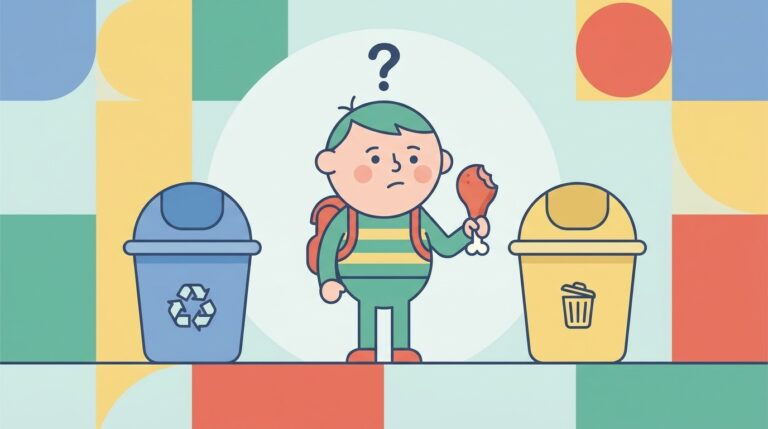
Survive the Korean Trash System! A Beginner’s Guide to Food Waste
Phase 1: Welcome to the K-Garbage Survival Game
Hello! I’m your Daily Hangul Editor, your friendly local guide and veteran tutor.
Picture this: It’s 11 PM on your first weekend in Seoul. You just ordered a massive feast of K-fried chicken and spicy Tteokbokki. You are living your absolute best K-Drama life in your cozy Airbnb. But then… the aftermath. You stare at the greasy chicken bones, the leftover spicy sauce, and that one random eggshell. The imaginary K-Drama subtitles hovering in your room simply read: [Panic].
Where does it all go? In Korea, throwing away trash is basically a high-stakes survival game! If you mix up your trash, you might face the wrath of the neighborhood Ahjumma (auntie) or get a hefty fine.
Don’t worry! I’ve seen countless students freeze in front of Korean trash cans. Today, we are going to master the dreaded Garbage Disposal system, specifically Food Waste. By the end of this guide, you’ll be handling your leftovers like a true Seoulite!
Phase 2: Core Expressions Deep Dive
Here are the absolute must-know phrases for surviving Korean trash sorting at an A1 (Absolute Beginner) level.
1. 음식물 쓰레기
- Pronunciation: eum-sig-mul sseu-re-gi [oom-shig-mool sseu-re-ghee]
- Sound-alike guide: The ‘eu’ in sseu sounds like the disgusted noise you make when stepping in gum (ugh!).
- Meaning: Food waste (Literal: Food-type trash)
- K-Culture Moment: In Korean reality shows like ‘I Live Alone’, you constantly see glamorous celebrities dreading the chore of taking out the eumsigmul sseuregi. It is the great equalizer of Korean society!
- Editor’s Insight: This word is a bit of a mouthful, but it’s the most important word on this list. Memorize the rhythm: eum-sig-mul / sseu-re-gi.
- Situation Spectrum:
- Casual: ✅
- Semi-formal: ✅
- Formal: ✅
- 🤔 Think About It: South Korea recycles nearly 95% of its food waste, turning it into fertilizer or animal feed. Does your home country have a separate system for food waste?
2. 일반 쓰레기
- Pronunciation: il-ban sseu-re-gi [eel-bahn sseu-re-ghee]
- Meaning: General waste / Regular trash
- K-Culture Moment: When you are at a K-Pop concert and finish your bottled water, you have to separate the plastic label from the bottle. The label goes into ilban sseuregi!
- Editor’s Insight: Think of this as the “everything else” bin. If it’s not recyclable and not food, it goes here.
- Situation Spectrum:
- Casual: ✅
- Semi-formal: ✅
- Formal: ✅
- 🤔 Think About It: Why do you think Korea separates trash so strictly? How does this reflect the community mindset over individual convenience?
3. 이거 일반 쓰레기예요?
- Pronunciation: i-geo il-ban sseu-re-gi-ye-yo? [ee-guh eel-bahn sseu-re-ghee-yeh-yo?]
- Meaning: Is this general waste?
- K-Culture Moment: You’re at a street food stall in Myeongdong. You finish your fish cake skewer. You hold up the wooden stick and ask the owner this exact question.
- Editor’s Insight: Adding ‘i-geo’ (this) and ‘-ye-yo?’ (is it?) turns any noun into a useful question. It’s your ultimate survival question pattern!
- Situation Spectrum:
- Casual: ✅
- Semi-formal: ✅
- Formal: ⚠️ (Safe for service staff, but add ‘Excuse me’ for elders)
- 🤔 Think About It: Koreans often use questions not just to get answers, but to show respect by asking for permission or guidance. Have you noticed this indirect politeness?
Phase 3: Textbook vs. Real Korean
[Talking about Food Waste with Friends]
* 📖 Textbook Korean: 음식물 쓰레기 버렸어요? (eumsigmul sseuregi beoryeosseoyo? – Did you throw away the food waste?)
* 🗣️ Real Korean: 음쓰 버렸어? (eum-sseu beoryeosseo?)
* 💡 Why the difference?: Koreans love efficiency and abbreviating long words. “Eum-sseu” is the universally accepted, slightly funny slang for food waste among younger generations.
[Buying Trash Bags at the Convenience Store]
* 📖 Textbook Korean: 음식물 쓰레기 규격 봉투를 주시겠습니까? (Could you please give me a standardized food waste bag?)
* 🗣️ Real Korean: 음식물 쓰레기 봉투 있어요? (eumsigmul sseuregi bongtu isseoyo? – Do you have food waste bags?)
* 💡 Why the difference?: Real-life convenience store interactions are fast. Keep it simple and direct, just using a polite tone.
(Bottom Note: As an A1 learner, stick to the “Real Korean” phrases above. They are perfectly polite but natural!)
Phase 4: Cultural Context — K-Culture Deep Dive
4-1. Non-verbal Cue: The Apologetic Bow
When you are unsure where to throw something away and have to ask a local, don’t just stare at them! Hold the piece of trash slightly up, make brief eye contact, give a tiny head bow, and ask “I-geo… eodi-e…” (This… where…). In Korea, showing a little Nunchi (awareness of others) and a humble attitude will make people instantly want to help you.
4-2. K-Food Connection: The Golden Pig Rule 🐷
Why is Korean food waste so complicated? It’s because K-Food involves a lot of soups, bones, and side dishes (banchan). But here is the ultimate secret to Korean food waste: “Can a pig eat this?”
Since Korean food waste is processed into animal feed or fertilizer, it must be easily chewable by animals.
– Soft K-BBQ lettuce? Food waste!
– Hard chicken bones, clam shells from seafood soup, or onion skins? General waste (ilban sseuregi)!
If a pig would crack its tooth on it, it goes in the regular trash bag. Keep this rule in mind, and you’ll navigate Korean dining like a pro.
Phase 5: Real-life Roleplay Scenario
Setting: Friday night. A Jokbal (Braised Pigs’ Trotters) restaurant in Hongdae. The table is filled with lettuce, spicy sauce, and massive pork bones. You are eating with Minsoo.
Characters:
– YOU (The Reader): An exchange student who has been in Korea for exactly two weeks.
– Minsoo (24): Your Korean language exchange partner. Very helpful but a bit cheeky.
Dialogue:
Minsoo: 아~ 배부르다! 다 먹었죠? 나가요.
(a~ baebureuda! da meogeotjyo? nagayo.)
[English] Ah~ I’m full! We ate everything, right? Let’s go.
(🎭 Stage Direction: Minsoo starts putting on his jacket.)
YOU: 네! (ne!)
[English] Yes!
(🎭 Stage Direction: You look at the giant pig bone on your plate. You want to help clean up the table slightly before leaving, as you saw in K-Dramas.)
YOU: 민수 씨, 이 뼈… 음식물 쓰레기예요?
(Minsoo ssi, i ppyeo… eumsigmul sseuregiyeyo?)
[English] Minsoo, is this bone… food waste?
Minsoo: 아! 그거요?
(A! geugeoyo?)
[English] Ah! That?
🔀 Your Turn! What should you do with the bone?
– A) Throw it in the restaurant’s food waste bin anyway.
– B) Say: “일반 쓰레기예요?” (ilban sseuregiyeyo? – Is it general waste?)
– C) Hide it under a napkin and run away.✅ Best Choice: B — You remembered the Golden Pig Rule! Pig bones are too hard for animals to eat, so they are general waste. Minsoo will be incredibly impressed by your local knowledge.
⚠️ Choice A Analysis: The restaurant owner might get fined for mixing up the trash!
Phase 6: 10-Second Shadowing Drill
Read these out loud to practice your flow and intonation. The slashes (/) show you where to pause slightly.
- 🥺 (Confusedly) 이거 / 일반 쓰레기예요?
(i-geo / il-ban sseu-re-gi-ye-yo?) - 😤 (Confidently) 뼈는 / 일반 쓰레기예요!
(ppyeo-neun / il-ban sseu-re-gi-ye-yo!) - 😊 (Politely) 사장님, / 음식물 쓰레기 봉투 / 있어요?
(sa-jang-nim, / eum-sig-mul sseu-re-gi bong-tu / is-seo-yo?)
Phase 7: K-Culture Mini Dictionary
1. 눈치
* Romanization: nunchi
* English: Situational awareness / Reading the room
* Context: The essential Korean social skill. When throwing away trash, watching what the locals do and copying them is pure nunchi.
2. 종량제 봉투
* Romanization: jongnyangje bongtu
* English: Volume-based garbage bag
* Context: You cannot use random plastic bags for trash in Korea. You MUST buy these specific colored bags from a convenience store or supermarket.
3. 분리수거
* Romanization: bunnisugeo
* English: Separate garbage collection (Recycling)
* Context: The overarching system of sorting paper, plastic, cans, general waste, and food waste.
4. 음쓰
* Romanization: eum-sseu
* English: Slang for food waste
* Context: Short for eumsigmul sseuregi. Used heavily by younger people in casual texts and daily chats.
Phase 8: Traveler Survival Kit
If you are traveling in Korea and staying in an Airbnb, you WILL need to buy trash bags. Here is your cheat sheet for the convenience store (CU, GS25, 7-Eleven).
🆘 Survival Phrases TOP 3
– 🇰🇷 “종량제 봉투 주세요.” (jongnyangje bongtu juseyo.)
– 🗣️ English: Please give me a general waste bag.
- 🇰🇷 “음식물 쓰레기 봉투 주세요.” (eumsigmul sseuregi bongtu juseyo.)
- 🗣️ English: Please give me a food waste bag.
🇰🇷 “가장 작은 거 주세요.” (gajang jageun geo juseyo.)
- 🗣️ English: Please give me the smallest one.
- 💡 Pro Tip: Trash bags are sold by liters (1L, 5L, 10L, 20L). For a short trip, ask for 1L or 2L bags for food waste!
📌 Editor’s Travel Note
– Trash bags are neighborhood-specific! A bag bought in Gangnam cannot be used in Hongdae (Mapo-gu). Always buy them near your accommodation.
– Cash vs Card: You can buy trash bags with a credit card, but some very small mom-and-pop stores prefer cash for them.
Phase 9: Critical Thinking — “One Step Deeper”
🧠 Think Deeper: Food & Identity
Korean food culture is built deeply around community—sharing large pots of stew, grilling K-BBQ together, and sharing numerous side dishes. But with this abundance comes a responsibility: cleaning up together. The strict recycling and food waste laws reflect a modern Korean value: what we consume collectively must be managed collectively to protect our shared environment. It’s a fascinating balance between traditional generosity and modern civic duty.💬 Your Turn: Does your culture have dishes meant to be shared by a whole table? How do you handle the leftovers? Let me know in the comments!
Phase 10: FAQ & Avoiding Misunderstandings
Q: Can I use the word “음쓰 (eum-sseu)” to my boss or teacher?
* No! It is strictly slang for friends or family. Stick to eumsigmul sseuregi for anyone older than you or in a professional setting.
Q: What do I do with food waste if I’m staying in a hotel?
* Good news! Hotels handle the sorting for you. Just leave leftovers neatly on the table or in the provided bin. This guide is mostly for Airbnbs, residences, or eating out at self-service spots.
❌ Common Mistake #1: Throwing eggshells or tea bags into the Food Waste bag.
✅ Do this instead: Put them in the General Waste (ilban sseuregi)! Remember the Golden Pig Rule!
Phase 11: Summary & Action Items
One-Liner Summary: Remember the words ‘Eumsigmul sseuregi’ for food waste, ‘Ilban sseuregi’ for general waste, and always ask yourself, “Can a pig eat this?”
Your 3-Step Action Mission:
– 🥉 Bronze (Solo): Look at your dinner plate tonight and categorize your leftovers into Eumsigmul or Ilban sseuregi in your head.
– 🥈 Silver (Online): Write “오늘 밤엔 치킨! 뼈는 일반 쓰레기!” (Chicken tonight! Bones are general waste!) on your social media or a Korean study group.
– 🥇 Gold (Real Life): Next time you are in Korea, boldly walk into a convenience store and buy a food waste bag using Korean!
K-Culture Mission:
Next time you watch a K-Drama and they are eating K-BBQ or takeout chicken, look closely at the table when they finish. Can you spot what belongs in the general trash?
Let’s chat: Have you ever made a funny mistake while throwing away trash in a foreign country? Tell me your story!
Phase 12: Interactive Quiz
Test your new K-Garbage skills!
1. Situational Judgment: You are eating a juicy peach in your Seoul apartment. You finish it. What do you do with the large, hard peach pit?
– A) Put it in the Eumsigmul sseuregi (Food waste) bag.
– B) Put it in the Ilban sseuregi (General waste) bag.
– C) Throw it out the window. (Please no!)
2. True or False — K-Culture Edition:
You can use the trash bags from your Seoul Airbnb if you travel to Busan the next day. (T / F)
3. Fill in the Blank:
Excuse me, do you have food waste bags?
“사장님, [ _______ ] 봉투 있어요?”
(Answers: 1. B – Pigs can’t chew peach pits! / 2. False – Bags are strictly by district/city. / 3. 음식물 쓰레기)
Frequently Asked Questions (FAQ)
Q: What does "음식물 쓰레기" mean in Korean and how do you pronounce it?
A: In Korean, "음식물 쓰레기" is pronounced [eum-sig-mul sseu-re-gi [oom-shig-mool sseu-re-ghee] and means: Food waste (Literal: Food-type trash)
Q: What does "일반 쓰레기" mean in Korean and how do you pronounce it?
A: In Korean, "일반 쓰레기" is pronounced [il-ban sseu-re-gi [eel-bahn sseu-re-ghee] and means: General waste / Regular trash
Q: What does "이거 일반 쓰레기예요?" mean in Korean and how do you pronounce it?
A: In Korean, "이거 일반 쓰레기예요?" is pronounced [i-geo il-ban sseu-re-gi-ye-yo? [ee-guh eel-bahn sseu-re-ghee-yeh-yo?] and means: Is this general waste?







