

Phase 1: Empathy (Welcome to the Panic Zone)
안녕하세요! (Annyeonghaseyo!) I am your Daily Hangul Editor, your local Korean friend and cultural navigator.
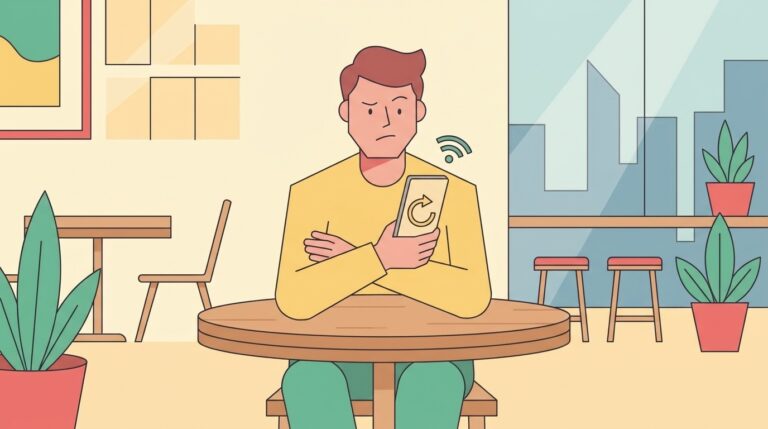
Imagine this: You are sitting in a beautifully aesthetic, minimalist cafe in Seongsu-dong. You just filmed the perfect video of a croffle being sliced, and you are about to post it on your Instagram Story. Or maybe, you are sitting in your hotel room, heart pounding, right in the middle of a fierce online ticketing war for your favorite K-Pop group’s concert. You click ‘Reserve’ and… nothing happens. The loading circle of doom appears. The Wi-Fi is acting up.
In Korea, the land of the world’s fastest internet and the famous 빨리빨리 (Ppali-ppali / Hurry up) culture, a dropping internet connection isn’t just a minor inconvenience; it’s a sheer crisis! If you just use an online translator, it might give you a robotic “The internet is disconnected.” But how do Koreans actually express this urgent frustration? Today, we are going to learn the real, authentic phrases so you can get your connection fixed and get back to your K-Drama binge-watching or concert ticketing without missing a beat!
Phase 2: Deep Dive into Core Expressions
1. 인터넷 연결이 자꾸 끊겨요.
- Pronunciation: inteonet yeongyeori jakku kkeungyeoyo. [in-tuh-net yuhn-gyuhl-ee jah-kkoo kkeun-gyuh-yo]
(Tip: The ‘ㄲ’ in 끊 sounds like the sharp, tense ‘k’ you make when you are slightly annoyed!)- Meaning:
- Literal: The internet connection keeps getting cut off.
- Real Nuance: My internet keeps dropping and it’s driving me crazy!
- K-Culture Moment: You will see this in a K-Drama when an office worker is trying to send a crucial file to their boss right before the deadline, and they hit the keyboard in frustration shouting this exact phrase.
- Editor’s Insight: The magic word here is 자꾸 (jakku), which means ‘repeatedly’ or ‘keeps on (doing something negative)’. It instantly adds that feeling of “I’ve been trying and it’s getting on my nerves, please help!”
- Situation Spectrum:
- Friends (Casual): ✅ (Say “인터넷 자꾸 끊겨!”)
- Cafe Staff/Colleagues (Semi-formal): ✅
- Formal/Elders: ⚠️ (Use “인터넷 연결이 원활하지 않습니다” for highly formal situations)
- 🤔 Think About It: Notice how the Korean sentence uses the passive verb “끊겨요” (is cut off) rather than saying “The router isn’t working.” Korean often focuses on the state of the situation rather than placing direct blame on the object or person. Does your language do this too?
2. 와이파이가 안 터져요.
- Pronunciation: waipaiga an teojyeoyo. [wai-pai-gah ahn tuh-jyuh-yo]
- Meaning:
- Literal: The Wi-Fi doesn’t explode/burst.
- Real Nuance: I can’t get a Wi-Fi signal / The Wi-Fi isn’t working here.
- K-Culture Moment: If you are traveling to a remote island in Jeju and trying to look up a map, you’ll hear young Koreans complaining, “아, 데이터 안 터져! (Ah, my data isn’t catching!)”
- Editor’s Insight: This is the ultimate local slang that has become standard everyday Korean. We use the verb 터지다 (to burst/explode) for signals (Wi-Fi, mobile data, cell service). If the signal is strong, it “bursts” well. If it doesn’t, it “doesn’t burst.”
- Situation Spectrum:
- Friends (Casual): ✅
- Service Staff (Semi-formal): ✅
- Highly Formal: 🚫
- 🤔 Think About It: Using the word “explode/burst” for an invisible digital signal—doesn’t that perfectly capture the dynamic, energetic vibe of Korean society?
3. 와이파이 비밀번호 다시 한 번만 알려주시겠어요?
- Pronunciation: waipai bimilbeonho dasi han beonman allyeojusigesseoyo?
- Meaning:
- Literal: Could you let me know the Wi-Fi password one more time?
- Real Nuance: I’m sorry to bother you, but I need the Wi-Fi password again.
- K-Culture Moment: You are in a busy cafe, the barista is making 5 Americanos per minute. You need to ask politely without disrupting their flow.
- Editor’s Insight: Using 다시 한 번만 (just one more time) softens the request tremendously. It shows you know they are busy, and you are being considerate. It’s the verbal equivalent of a polite little bow.
- Situation Spectrum:
- Friends: 🚫 (Too formal)
- Cafe Staff/Hotel Reception: ✅
- Formal/Elders: ✅
Phase 3: Textbook vs. Real Korean
[Situation: Telling the cafe staff your internet is dropping]
* 📖 Textbook Korean: 인터넷 연결 상태가 좋지 않습니다. (The state of the internet connection is not good.)
* 🗣️ Real Korean: 저기요, 와이파이가 자꾸 끊겨서요. (Excuse me, the Wi-Fi keeps dropping…)
* 💡 Why the difference?: Adding “~서요” at the end leaves the sentence slightly open-ended. It is a polite way to state your problem and wait for them to offer a solution, rather than demanding “Fix it now.”
[Situation: Asking a friend if they have a signal]
* 📖 Textbook Korean: 너는 와이파이가 잘 작동하니? (Does the Wi-Fi operate well for you?)
* 🗣️ Real Korean: 너 와이파이 터져? (Is your Wi-Fi bursting/working?)
* 💡 Why the difference?: Efficiency! Young Koreans drop particles and use the highly descriptive “터지다” for everything signal-related.
Phase 4: Cultural Context — K-Culture Deep Dive
4-1. Non-Verbal Elements & 눈치 (Nunchi)
When complaining about the internet at a cafe or hotel, remember the art of 눈치 (Nunchi – situational awareness). Don’t shout across the room. Walk quietly up to the counter, make brief eye contact, slightly tilt your phone to show the loading screen, and say the phrase with an apologetic smile. The staff will immediately feel your pain (because slow internet is a shared national trauma) and help you quickly.
4-2. The “Kagongjok” (Cafe Study Tribe) Culture
Why is cafe Wi-Fi so important in Korea? Enter the 카공족 (Kagongjok). This is a blend word for “Cafe (카페) + Study (공부) + Tribe (족)”. In Korea, cafes are not just for chatting; they are extensions of offices and libraries. People buy a cup of coffee and sit for hours studying, working, or taking online classes. Because of this, every cafe proudly offers free, blazing-fast Wi-Fi. If the Wi-Fi drops, the entire ecosystem of the cafe collapses! That’s why your request to fix the internet will be taken very seriously by the staff.
Phase 5: Real-Life Roleplay Scenario
Setting: Saturday afternoon, 2:00 PM. A beautifully decorated, slightly crowded cafe in Yeonnam-dong. You are trying to FaceTime your family back home, but the video keeps freezing into weird facial expressions. You walk up to the busy barista.
Characters:
– YOU: An exchange student who really wants to show your mom the cafe’s aesthetic.
– Barista Ji-hoon (25): Friendly but currently making three iced Americanos at once.
Dialogue:
YOU: 저기요, 죄송한데 와이파이 비밀번호가 뭐예요?
(jeogiyo, joesonghande waipai bimilbeonhoga mwoyeyo?)
[Excuse me, sorry but what is the Wi-Fi password?]
Ji-hoon: 아, 영수증 하단에 적혀 있습니다!
(a, yeongsujeung hadane jeokhyeo itseumnida!)
[Ah, it’s written at the bottom of the receipt!]
YOU: 아, 네. 그런데 와이파이 연결이 자꾸 끊겨서요.
(a, ne. geureonde waipai yeongyeori jakku kkeungyeoseoyo.)
[Ah, okay. But the Wi-Fi connection keeps dropping…]
(🎭 Stage Direction: You politely show him your phone screen with the spinning wheel of death)
Ji-hoon: 헉, 진짜요? 잠시만요. 공유기 한 번 껐다 켤게요.
(heok, jinjjayo? jamsimanyo. gongyugi han beon kkeotda kyeolgeyo.)
[Gasp, really? Just a moment. I’ll turn the router off and on again.]
🔀 Your Turn! How do you reply while he resets it?
– A) “빨리 해주세요!” (Do it quickly!)
– B) “네, 천천히 하셔도 돼요.” (Okay, you can take your time.)
– C) “기계가 나쁘네요.” (The machine is bad.)✅ Best Choice: B. Even though you are in a hurry, telling a busy Korean service worker “take your time” (천천히 하셔도 돼요) shows excellent manners and instantly wins their respect.
⚠️ Choice A Analysis: Telling someone to hurry up is considered very rude unless you are close friends or in a very specific urgent emergency.
Phase 6: 10-Second Shadowing Drill
Let’s practice saying this naturally! Follow the slashes for pauses, and add the emotion.
🥺 Slightly apologetic but desperate:
저기요, / 와이파이가 / 자꾸 끊겨서요…
(jeo-gi-yo, / wai-pai-ga / ja-kku kkeun-gyeo-seo-yo…)
Excuse me, the Wi-Fi keeps dropping…
Phase 7: K-Culture Mini-Dictionary
Here are some essential digital survival words you need in Korea!
1. 데이터 (De-i-teo)
* English: Cellular Data
* Context: If the Wi-Fi fails, you ask your friend: “너 데이터 무제한이야?” (Do you have unlimited data?)
2. 핫스팟 (Hat-seu-pat)
* English: Mobile Hotspot
* Context: The ultimate act of true friendship in Korea is turning on your hotspot for a friend whose data has run out.
3. 카공족 (Ka-gong-jok)
* English: Cafe-studying tribe
* Context: People who study in cafes. They are the reason Korean cafes have so many power outlets and strong Wi-Fi.
4. 영수증 하단 (Yeong-su-jeung Ha-dan)
* English: Bottom of the receipt
* Context: 90% of the time, the Wi-Fi password and restroom code are printed here. Don’t throw it away immediately!
Phase 8: Traveler’s Survival Kit
Whether you are at a cafe, hotel, or riding the KTX (bullet train), you need these survival phrases when the internet betrays you.
🆘 Survival Phrases TOP 3
– 🇰🇷 “와이파이 비밀번호 영수증에 있나요?” (waipai bimilbeonho yeongsujeunge innayo?)
– Is the Wi-Fi password on the receipt?
– 🇰🇷 “여기 와이파이 잘 터져요?” (yeogi waipai jal teojyeoyo?)
– Does the Wi-Fi work well here? (Great to ask before booking an Airbnb or hostel!)
– 🇰🇷 “데이터가 다 떨어졌어요.” (deiteoga da tteoreojyeosseoyo.)
– I ran out of data. (Literally: My data has all fallen.)📌 Editor’s Travel Note
– Free Public Wi-Fi: Korea has ‘Public WiFi Free’ on most buses and subway stations! Just look for the sticker on the window.
– Password Formats: Korean Wi-Fi passwords are often the cafe’s phone number without dashes (e.g., 021234567) or something simple like ‘a123456789’.
– No Tips: Remember, if a hotel staff member comes to your room to fix the router, do not tip them! Korea is a no-tip culture. A bright “감사합니다! (Thank you!)” is all they need.
Phase 9: Critical Thinking Corner — A Step Deeper
Language & Power: The Indirect Complaint
Why do Koreans use the sentence ending “~서요” (because…) when complaining? For example, saying “와이파이가 자꾸 끊겨서요” (Because the Wi-Fi keeps dropping…) instead of “Fix the Wi-Fi.”
🧠 Think Deeper:
In Korean culture, preserving harmony and ‘face’ (kibun) is essential. Giving a direct command to service staff can sound aggressive and break that harmony. By stating the problem as an incomplete sentence ending with “because…”, you are gently tossing the ball into their court. You present the fact, and you give them the agency to offer the solution (“Oh, let me fix that for you!”). It is a beautiful linguistic dance of mutual respect.💬 Your Turn: In your culture, when you complain at a restaurant or cafe, are you direct (“This is broken, please fix it”) or indirect? Share in the comments below!
Phase 10: FAQ & Avoiding Common Mistakes
- Q: Can I use “안 터져요 (doesn’t burst)” for other things that don’t work?
- A: No. You cannot say the coffee machine “안 터져요.” It is strictly used for invisible signals like Wi-Fi, cell phone data, and sometimes popularity (e.g., “That idol is bursting with popularity!”). For a broken machine, use “고장 났어요 (It’s broken).”
- Q: Can I ask for the Wi-Fi password before ordering a drink?
- A: Technically yes, but culturally frowned upon. It’s an unspoken rule to order your drink first, get the receipt, and check the bottom. If you ask before buying anything, you might get some serious side-eye!
❌ Common Mistake #1: Saying “인터넷 안 돼요 (Internet no work)” aggressively.
✅ Do this instead: Use “자꾸 끊겨요” (keeps dropping) with a slightly troubled expression. It changes the tone from an angry complaint to a request for rescue!
Phase 11: Summary & Action Items
One-Liner Summary: When the Korean internet fails you, gently state the problem using “와이파이가 자꾸 끊겨서요” to get the fastest help!
Action Mission 3 Steps:
– 🥉 Bronze (Solo): Look at your phone’s Wi-Fi symbol and say out loud 3 times: “아, 와이파이 안 터져!”
– 🥈 Silver (Online): Go to your favorite language exchange app or K-pop fandom forum and write: “요즘 인터넷이 자꾸 끊겨서 슬퍼요 ㅠㅠ” (I’m sad because my internet keeps dropping these days.)
– 🥇 Gold (Real Life): Next time you are at a Korean cafe or restaurant, confidently ask the staff for the password in Korean instead of searching for the sign!
K-Culture Mission:
Next time you watch a modern K-Drama, pay close attention to scenes in cafes or offices. I guarantee you will spot a character violently tapping their phone and muttering “왜 이렇게 안 터져?” (Why isn’t it catching?)
Phase 12: Quiz — Interactive Challenge
1. Situational Judgment:
You are at a fancy hotel in Gangnam. Your laptop keeps disconnecting from the Wi-Fi. You call the front desk. What is the BEST way to explain the issue?
– A) 야! 인터넷 안 터져! (Hey! Internet doesn’t burst!)
– B) 인터넷 연결이 자꾸 끊겨서요. (The internet connection keeps dropping…)
– C) 와이파이 고장 났어요. 빨리 오세요. (Wi-Fi is broken. Come quickly.)
2. Fill in the Blank:
You want to ask your Korean friend if they have mobile data because yours is gone.
“너 혹시 ___ 무제한이야?” (Do you happen to have unlimited ___?)
3. True or False – K-Culture Edition:
You should definitely give a tip to the cafe worker who successfully restarted the Wi-Fi router for you.
👀 Click here for Answers!
- B is the best. A is incredibly rude (using “야!”). C is too demanding. B uses polite language and the respectful “~서요” ending.
- 데이터 (data).
- False. Korea does not have a tipping culture. A polite “감사합니다” and a smile is perfect!
Frequently Asked Questions (FAQ)
Q: What does "인터넷 연결이 자꾸 끊겨요." mean in Korean and how do you pronounce it?
A: In Korean, "인터넷 연결이 자꾸 끊겨요." is pronounced [inteonet yeongyeori jakku kkeungyeoyo. [in-tuh-net yuhn-gyuhl-ee jah-kkoo kkeun-gyuh-yo] and means: Literal: The internet connection keeps getting cut off.
Q: What does "와이파이가 안 터져요." mean in Korean and how do you pronounce it?
A: In Korean, "와이파이가 안 터져요." is pronounced [waipaiga an teojyeoyo. [wai-pai-gah ahn tuh-jyuh-yo] and means: Literal: The Wi-Fi doesn't explode/burst.
Q: What does "와이파이 비밀번호 다시 한 번만 알려주시겠어요?" mean in Korean and how do you pronounce it?
A: In Korean, "와이파이 비밀번호 다시 한 번만 알려주시겠어요?" is pronounced [waipai bimilbeonho dasi han beonman allyeojusigesseoyo?] and means: Literal: Could you let me know the Wi-Fi password one more time?







