

How to Get Your Clothes Back: The Magic Phrase at a Korean Dry Cleaner
Hello! I’m the Senior Editor of Daily Hangul.
Picture this: You are having the time of your life in Seoul. Last night, you had an amazing K-BBQ dinner, but oops—a drop of spicy gochujang landed right on your favorite jacket.
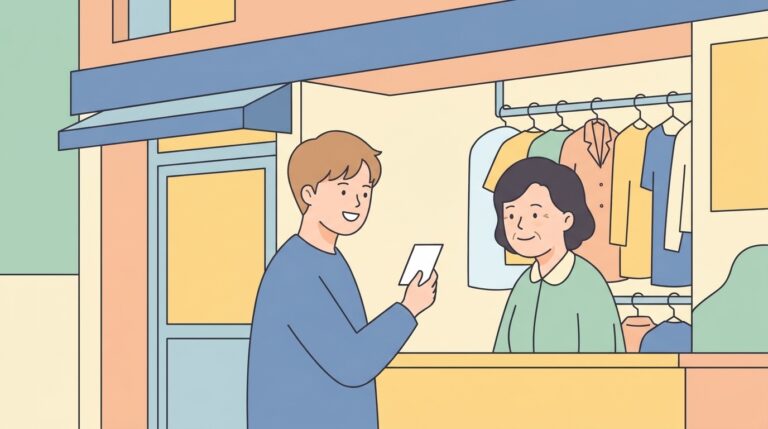
You find a cozy little neighborhood dry cleaner (setakso). You bravely hand over your jacket. The friendly owner nods, takes it, and turns around. Wait… how do you get it back? When is it ready? You need a ticket or a receipt, but your mind goes blank. In K-Dramas, the characters just magically appear in fresh clothes, but real life doesn’t come with a script!
If you don’t know what to say, you might end up pantomiming a piece of paper or, worse, losing your favorite jacket forever. Don’t worry! Today, I’ll teach you the absolute survival phrase you need. This guide is based on real panic moments from my beginner students—so you are not alone!
Core Expressions: Your Survival Toolkit
Let’s look at the most important phrase you need before walking out of that shop.
1. 영수증 주세요
- Pronunciation: [yeong-su-jeung ju-se-yo]
- Sound-alike guide: Young-sue-jung joo-say-yo. (‘yeong’ sounds like ‘young’, ‘su’ like ‘sue’, and ‘jeung’ like the ‘jung’ in jungle.)
- Meaning: Please give me a receipt (Literal: Receipt give-please).
- K-Culture Moment: In small Korean shops, owners often skip giving receipts to save paper and time unless you ask. If you ever watch a K-Drama where a detective is tracking a suspect, what do they always look for? The yeong-su-jeung!
- Editor’s Insight: This is the golden key! “주세요 (ju-se-yo)” means “please give me.” You can attach it to almost any noun when you need something.
- Situation Spectrum:
- Friends (Casual): 🚫 (Too formal for buddies)
- Shop Owners/Strangers (Semi-formal): ✅ (Perfect!)
- Your Boss (Formal): ⚠️ (Use a more polite form for business)
- 🤔 Think About It: Why does Korean have a specific ending like “-yo” just for politeness? Does your native language change the whole verb to show respect to a shop owner?
2. 언제 돼요?
- Pronunciation: [eon-je dwae-yo?]
- Sound-alike guide: un-jeh dway-yo?
- Meaning: When will it be ready? (Literal: When does it become?)
- K-Culture Moment: Koreans love Ppalli-Ppalli (hurry-hurry) culture. Local dry cleaners are incredibly fast, sometimes offering next-day service!
- Editor’s Insight: This phrase is a lifesaver. You can use it at the dry cleaners, when ordering food, or even waiting for a taxi.
- Situation Spectrum:
- Friends (Casual): ⚠️ (Drop the ‘yo’ -> 언제 돼?)
- Shop Owners (Semi-formal): ✅
Textbook vs. Real Korean
[Asking for the receipt]
* 📖 Textbook Korean: 영수증을 주시겠습니까? (Would you kindly provide the receipt?)
* 🗣️ Real Korean: 영수증 주세요! (Receipt, please!)
* 💡 Why the difference?: The textbook version is perfectly polite but sounds like a robot or a butler. “주세요” is efficient, natural, and polite enough for daily life.
[When they don’t print it automatically]
* 📖 Textbook Korean: 영수증을 발행해 주세요. (Please issue a receipt.)
* 🗣️ Real Korean: 영수증이요~ (Just the receipt~)
* 💡 Why the difference?: Adding “~이요 (~i-yo)” to a noun is the ultimate native shortcut. It implies the whole sentence while sounding friendly and soft.
Bottom Note: For A1 beginners, stick to “[Noun] + 주세요”. It is the safest, most magically versatile grammar point you will ever learn!
Cultural Context — K-Culture Deep Dive
The Two-Handed Rule (Non-Verbal Cues)
When the owner hands you the receipt, don’t just snatch it with one hand! In Korea, giving and receiving things (especially money, cards, and receipts) should be done with two hands to show respect. If your other hand is full, gently place your left hand under your right elbow as you take it. It’s a small gesture, but it instantly shows you have Nunchi (social sense)!
The K-Drama Dry Cleaner Trope
If you are a K-Drama fan, you know that the local neighborhood dry cleaner (setakso) is rarely just a laundry shop. It’s the information hub of the village! The owner usually knows everyone’s secrets. Also, notice how characters often walk out carrying their freshly dry-cleaned clothes on a hanger covered in thin plastic, carrying it over their shoulder? That’s exactly how you’ll get your jacket back!
Interactive Roleplay: At the Seoul Dry Cleaners
Setting: A tiny, steam-filled dry cleaner shop in a quiet Seoul alleyway. The smell of fresh detergent fills the air.
Characters:
* YOU: A tourist who needs a clean jacket for tomorrow’s K-Pop concert.
* Owner (Ajusshi): A kindly man in his 60s, currently ironing a mountain of shirts.
Owner: 네, 어서 오세요.
(Ne, eoseo oseyo.)
[Translation] Yes, welcome.
YOU: 안녕하세요. 이거 세탁해 주세요.
(Annyeonghaseyo. Igeo setakae juseyo.)
[Translation] Hello. Please wash this.
Owner: (Examining the BBQ stain) 아이고… 내일 저녁에 오세요. 만 원입니다.
(Aigo… naeil jeonyeoge oseyo. Man wonimnida.)
[Translation] Oh my… come tomorrow evening. It’s 10,000 won.
(🎭 Stage Direction: You tap your credit card and the payment goes through. The owner turns back to his ironing.)
🔀 YOUR TURN! How do you ask for the receipt?
* A) 영수증 내놔! (Give me the receipt!)
* B) 아저씨, 영수증 주세요. (Sir, please give me the receipt.)
* C) 영수증이요~ (Receipt, please~)✅ Best Choice: B or C.
⚠️ Analysis: NEVER choose A! “내놔” is what a villain says in an action movie when demanding the secret code. Choice B is very standard. Choice C is very natural and friendly!
10-Second Shadowing Drill
Let’s practice the flow. Pay attention to the pauses (/) and the emotion!
😊 사장님, / 영수증 / 주세요!
(sa-jang-nim, / yeong-su-jeung / ju-se-yo!)
[Boss (respectful term for owner), / receipt / please give me!]
K-Culture Mini Dictionary
1. 영수증
* Romanization: yeong-su-jeung
* English: Receipt
* Context: Often asked at cafes, restaurants, and shops. Many places now ask “영수증 드릴까요?” (Shall I give you a receipt?) to save paper.
2. 세탁소
* Romanization: se-tak-so
* English: Dry cleaner / Laundry shop
* Context: Unlike coin laundries (코인 빨래방), a setakso is a professional service where an expert handles the cleaning, pressing, and alterations.
3. 사장님
* Romanization: sa-jang-nim
* English: Boss / Shop Owner
* Context: The safest and most polite way to call an owner of a restaurant or shop. It’s much better than shouting “Ajumma” or “Ajusshi.”
4. 눈치
* Romanization: nun-chi
* English: Social sense / Reading the room
* Context: Realizing the owner is super busy and just politely saying “영수증이요~” while holding out your card is having great nunchi.
Traveler Survival Kit
🆘 Top Survival Phrases at the Shop
* 🇰🇷 “이거 얼마예요?” (i-geo eol-ma-ye-yo?)
* 🗣️ How much is this?
* 🇰🇷 “카드 돼요?” (ka-deu dwae-yo?)
* 🗣️ Do you take cards?
* 🇰🇷 “내일 돼요?” (nae-il dwae-yo?)
* 🗣️ Can it be done tomorrow?
📌 Editor’s Travel Note:
* Cash vs. Card: Korea is a cashless society, BUT tiny neighborhood dry cleaners or street markets still prefer physical cash or local bank transfers. Having a 10,000 won bill handy is a smart move!
* Tipping: There is absolutely NO tipping in Korea. If you leave extra money, the owner will run down the street to return it to you!
Critical Thinking — “One Step Deeper”
🧠 Think Deeper: Language & Power
Why is “주세요 (ju-se-yo)” so important? In Korean, language reflects the social relationship between the speaker and the listener. Using the “-yo” ending is a way of showing basic respect to a stranger who is providing you a service. In English, you might just say “Receipt!” with a smile, but in Korean, omitting the “yo” (saying just “줘”) to an older shop owner is considered highly rude. Language isn’t just vocabulary; it’s a map of respect.💬 Your Turn: Does your language have different endings based on who you are talking to? Share your thoughts in the comments!
FAQ & Preventing Mistakes
Q: Can I just say “영수증” without “주세요”?
No. Unless you are pointing at the receipt and asking “Is this the receipt?”, just saying the noun sounds demanding. Always attach “주세요” or “이요”.
Q: How do I call the owner to get their attention?
Say “저기요” (Excuse me/Over here) or “사장님” (Boss/Owner).
❌ Common Mistake #1: Calling the female owner “아줌마 (Ajumma)” loudly.
✅ Do this instead: “Ajumma” can sometimes sound slightly disrespectful depending on the tone. Use “사장님 (Sajangnim)” instead. It makes them feel respected and happy!
Summary & Action Items
One-Liner Summary: When you need a receipt anywhere in Korea, confidently smile and say: “영수증 주세요!”
Action Mission:
* 🥉 Bronze: Stand in front of your mirror and practice handing over an imaginary card with two hands while saying “영수증 주세요.”
* 🥈 Silver: Write “영수증 주세요” in your phone’s notes app so you can point to it if you get nervous!
* 🥇 Gold: Next time you go to a Korean cafe or restaurant in your city, politely try saying “Yeong-su-jeung ju-se-yo” at the register.
Special K-Culture Mission:
Watch one episode of a slice-of-life K-Drama (like Reply 1988 or Hometown Cha-Cha-Cha) and try to spot the neighborhood dry cleaner or a scene where someone hands over an item with two hands!
Interactive Quiz!
1. You are at a dry cleaner and the owner finishes your payment but turns away. What should you say?
* A) 내놔! (Naenwa!)
* B) 영수증 주세요. (Yeong-su-jeung juseyo.)
* C) 안녕히 계세요. (Annyeonghi gyeseyo.)
2. True or False: If the dry cleaning costs 10,000 won, you should give 12,000 won to include a tip for their hard work.
(Answers: 1. B – A is rude, C means goodbye without getting your receipt! 2. False – Tipping is not practiced in Korea and will cause confusion!)
Frequently Asked Questions (FAQ)
Q: What does "영수증 주세요" mean in Korean and how do you pronounce it?
A: In Korean, "영수증 주세요" is pronounced [yeong-su-jeung ju-se-yo] and means: Please give me a receipt (Literal: Receipt give-please).
Q: What does "언제 돼요?" mean in Korean and how do you pronounce it?
A: In Korean, "언제 돼요?" is pronounced [eon-je dwae-yo?] and means: When will it be ready? (Literal: When does it become?)






