

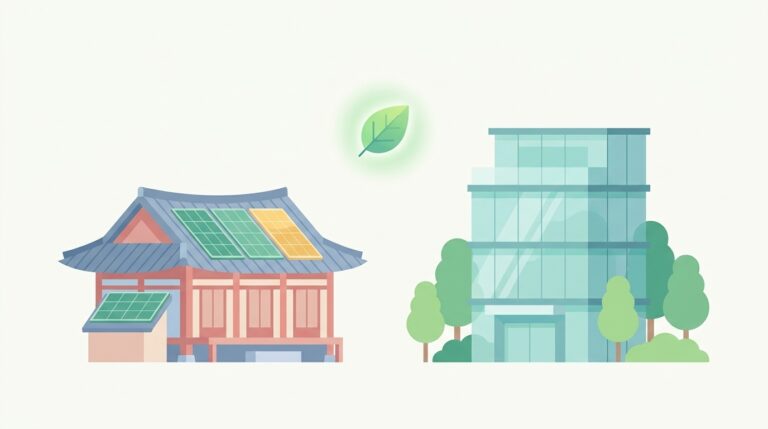
Phase 1: Empathy (Immersive K-Culture Cold Open)
Hello there! I’m your lead editor and cultural navigator at Daily Hangul.
Imagine this: You are watching a classic K-Drama. The struggling protagonist lives in a romanticized rooftop apartment (옥탑방, oktapbang). They are shivering in the winter, wrapped in three layers of blankets, sipping soju. The subtitles just say, “It’s cold.” But as a seasoned expat in Seoul, I can tell you exactly what they are actually terrified of: The Gas Bill (가스비).
When you move to Korea or visit long-term, the romantic K-Drama illusion quickly hits the reality of Korean winters and summers. If you don’t know how to ask about a building’s eco-friendliness, insulation, or energy efficiency, you might end up paying a fortune in utility bills! On the flip side, Korea is currently undergoing a massive Urban Regeneration (도시 재생) boom. Those super-aesthetic, Instagram-famous cafes in Seongsu-dong? They are all renovated factories!
Knowing the vocabulary for eco-friendly architecture and urban regeneration won’t just save your bank account; it will instantly elevate your Korean to a sophisticated C1 level, making you sound like a true Seoul insider. Let’s dive in!
Phase 2: Deep Dive into Core Expressions
Let’s break down the three most crucial expressions you need when navigating Korea’s modern architectural landscape.
1. 단열이 잘 되다 (dan-yeol-i jal doe-da)
- Pronunciation: [dan-yeol-i jal doe-da] (The ‘yeol’ sounds like the English ‘y’ plus ‘all’, combined smoothly: dahn-yuh-ree jal dway-dah).
- Meaning: (Literal) Heat insulation is done well. -> (Real nuance) The building is well-insulated and keeps the draft out.
- K-Culture Moment: You are apartment hunting in Seoul. The real estate agent (부동산 중개인) taps the double-glazed windows of a high-rise officetel and proudly declares this. It means you won’t freeze to death in January, and your “Ondol” (floor heating) won’t have to work overtime.
- Editor’s Insight: This isn’t just about saving the earth; it’s about survival. Old Korean villas are notorious for 외풍 (oe-pung, cold drafts). If a house is “단열이 잘 된다,” it’s a premium feature.
- Situation Spectrum:
- Casual with friends: ✅
- Semi-formal (Real estate agent): ✅
- Formal (Business meeting): ✅
- 🤔 Think About It: Why are Koreans so obsessed with double windows (이중창) and insulation? Think about the extreme temperature difference between a Korean summer (humid and 35°C) and winter (dry and -15°C). Does your home country have specific architectural quirks based on the weather?
2. 에너지 효율 1등급 (e-neo-ji hyo-yul il-deung-geup)
- Pronunciation: [e-neo-ji hyo-yul il-deung-geup] (‘hyo’ sounds like a quick ‘hyo’ from ‘Hyoyeon’ of SNSD, ‘yul’ sounds like ‘yool’).
- Meaning: (Literal) Energy efficiency 1st grade. -> (Real nuance) Top-tier energy saving (appliance or building).
- K-Culture Moment: You are buying a refrigerator at Samsung or LG, or checking the boiler in your new Airbnb. You will see a round sticker with a number from 1 to 5. Number 1 is colored bright green. If it’s a 1, Koreans feel a deep sense of psychological peace.
- Editor’s Insight: This phrase is a flex. “우리 집 세탁기 에너지 효율 1등급이야” (My washing machine is energy efficiency grade 1). It shows you are a smart consumer who cares about the environment (and your wallet).
- Situation Spectrum:
- Casual: ✅
- Semi-formal: ✅
- Formal: ✅
- 🤔 Think About It: The Korean government heavily subsidizes grade 1 appliances. How does institutionalizing “eco-friendliness” change consumer behavior in your culture?
3. 도시 재생 (do-si jae-saeng)
- Pronunciation: [do-si jae-saeng] (‘jae-saeng’ sounds like ‘jay-sang’).
- Meaning: (Literal) City rebirth. -> (Real nuance) Urban regeneration / Gentrification through repurposing.
- K-Culture Moment: You are drinking an overpriced matcha latte in an exposed-brick cafe in Seongsu-dong (often called the Brooklyn of Seoul). A Korean hipster friend explains that this building used to be a shoe factory.
- Editor’s Insight: This is a highly sophisticated C1 vocabulary word. Using this word shows you understand modern Korean social trends, moving away from “tear it all down and build apartments” (재개발) to “preserve and repurpose” (재생).
- Situation Spectrum:
- Casual: ✅ (Usually used when discussing hot spots)
- Semi-formal: ✅
- Formal: ✅ (Used in government policies and news)
- 🤔 Think About It: Urban regeneration preserves the exterior of the past but modernizes the interior. How does this reflect the modern Korean identity?
Phase 3: Textbook vs. Real Korean
How do actual locals talk about these concepts? Let’s upgrade your textbook Korean to real street Korean.
[Situation 1: Looking for a well-insulated apartment]
* 📖 Textbook Korean: 이 방은 에너지가 잘 절약됩니다. (This room saves energy well.)
* 🗣️ Real Korean: 이 집 단열 빵빵해요. 외풍 하나도 없어요. (This house’s insulation is totally packed. There’s zero draft.)
* 💡 Why is it different?: “빵빵하다” is a slang word originally meaning “fully inflated” (like a balloon), but Koreans use it to mean “plentiful” or “powerful” (e.g., 에어컨 빵빵하다 = AC is blasting).
[Situation 2: Discussing a trendy renovated cafe]
* 📖 Textbook Korean: 이 카페는 폐공장을 도시 재생한 곳입니다. (This cafe is a place where an abandoned factory was urban-regenerated.)
* 🗣️ Real Korean: 여기 완전 힙플이잖아. 옛날 공장 개조해서 분위기 미쳤어. (This is a total hip-place. They renovated an old factory, the vibe is crazy.)
* 💡 Why is it different?: Koreans love abbreviating English loan words. “힙플” (Hip-ple) comes from “Hip Place.” Instead of the formal “도시 재생,” everyday conversation prefers the word “개조하다” (to renovate/remodel).
Bottom Note: As a C1 learner, dropping words like “단열” mixed with casual terms like “빵빵하다” will make native speakers’ jaws drop. It shows immense fluency!
Phase 4: Cultural Context — K-Culture Deep Dive
4-1. Non-verbal Elements: The Art of Checking the House
When you go house hunting with a real estate agent, words aren’t enough. You must show your Nunchi (눈치). When discussing 단열 (insulation), a true Korean will silently walk up to the closed window, place the back of their hand near the window frame, and feel for cold air. If they feel a draft, they will give a slight, disappointed “쓰읍…” (inhale sound). Do this, and the agent will know you aren’t an easy target!
4-2. K-Culture Link: K-Travel & Architecture
Let’s talk about Seoullo 7017 (서울로 7017) and Seongsu-dong (성수동).
In the 1970s, Korea was obsessed with rapid industrialization. But fast forward to today, the K-trend is Eco-friendly Urban Regeneration (친환경 도시 재생).
Seoullo 7017 was a dangerous, decaying highway overpass right next to Seoul Station. Instead of tearing it down, the city transformed it into a beautiful elevated public park filled with plants—similar to New York’s High Line. It’s the ultimate symbol of Korea pivoting to energy efficiency and green spaces.
Next time you walk there, you can tell your friend: “이런 게 진짜 성공적인 도시 재생 사업이지!” (This is what you call a truly successful urban regeneration project!).
Phase 5: Real-life Roleplay Scenario
Setting: Saturday morning, 11 AM. A small real estate office (부동산) in Mapo-gu. The smell of instant Maxwell House coffee fills the air. You are looking for a new apartment for your second year in Seoul.
Characters:
– YOU: An expat professional (C1 Korean level), traumatized by last winter’s 200,000 KRW gas bill.
– 소장님 (Director/Agent, 50s): Friendly, calls you ‘학생’ or ‘사장님’ regardless of your actual status, wants to close a deal.
Dialogue:
소장님: 어서 오세요! 집 알아보러 오셨어요? 예산이 어떻게 되시나요? 🏠
(eoseo oseyo! jip araboreo osyeosseoyo? yesani eotteoke doesinayo?)
[Welcome! Are you looking for a house? What’s your budget?]
YOU: 네, 보증금 천에 월세 80 정도 생각하고 있어요.
(ne, bojeunggeum cheone wolse palsip jeongdo saenggakhago isseoyo.)
[Yes, I’m thinking about a 10 million deposit and around 800k monthly rent.]
소장님: 아유, 딱 좋은 매물이 하나 있어요. 역세권 빌라인데, 방도 넓고 아주 예뻐요.
(ayu, ttak joeun maemuri hana isseoyo. yeoksegwon billainde, bangdo neolpgo aju yeppeoyo.)
[Oh, I have the perfect listing. It’s a villa near the station, the room is spacious and very pretty.]
YOU: 빌라요? 아… 제가 작년에 구형 빌라에 살았는데, 난방비 폭탄을 맞았거든요.
(billayo? a… jega jangnyeone guhyeong billae saranneunde, nanbangbi poktaneul majatgeodeunyo.)
[A villa? Ah… I lived in an older villa last year and got hit with a bomb of a heating bill.]
소장님: 에이, 이 집은 리모델링 싹 해서 단열 빵빵해요. 이중창이라 외풍도 없고요.
(ei, i jibeun rimodelling ssak haeseo danyeol ppangppanghaeyo. ijunchangira oepungdo eopgoyo.)
[Hey now, this house was completely remodeled so the insulation is top-notch. It has double windows so there’s no draft.]
YOU: 진짜요? 창문 틈새로 찬바람 들어오는 거 아니죠?
(jinjjayo? changmun teumsaero chanbaram deureooneun geo anijyo?)
[Really? Cold wind isn’t going to come through the window cracks, right?]
소장님: 걱정 마세요. 그리고 보일러도 이번에 에너지 효율 1등급으로 새로 싹 갈았어요!
(geokjeong maseyo. geurigo boilleodo ibeone eneoji hyoyul il-deunggeubeuro saero ssak garasseoyo!)
[Don’t worry. And they just completely replaced the boiler with an energy efficiency grade 1 model!]
🔀 Your Turn! How do you respond?
– A) “그래요? 그럼 바로 계약할게요!” (Really? Then I’ll sign the contract right away!)
– B) “오, 1등급이요? 친환경적이네요. 그래도 일단 집부터 한 번 볼 수 있을까요?”
– C) “거짓말하지 마세요. 한국 빌라는 다 춥잖아요!”✅ Best Choice: B — “Oh, 1st grade? That’s eco-friendly. But could we go see the house first?” It acknowledges the agent’s selling point using advanced vocab (친환경적), but keeps you in control.
⚠️ Choice A & C Analysis: A is too naive; never sign without seeing the house! C is extremely rude and will instantly ruin the agent’s kibun (mood).
(🎭 Stage Direction: The agent smiles, impressed by your smart response, and grabs the car keys.)
소장님: 암요, 암요! 백문이 불여일견이죠. 지금 바로 보러 갑시다!
(amyo, amyo! baengmuni buryeoilgyeonijyo. jigeum baro boreo gapsida!)
[Of course, of course! Seeing is believing. Let’s go see it right now!]
Bonus Scenario: The Airbnb Thermostat
Setting: You check into an eco-friendly Airbnb in a regenerated Hanok village. It’s freezing.
YOU: 호스트님, 방이 너무 추운데 보일러 어떻게 켜나요?
[Host, the room is too cold. How do I turn on the boiler?]
Host: 벽에 있는 온도 조절기에서 ‘외출’ 버튼을 끄고 ‘난방’으로 맞추시면 됩니다!
[Turn off the ‘Outing’ button on the wall thermostat and set it to ‘Heating’!]
YOU: 아, 감사합니다. (Wait… what does 외출 mean?! See FAQ below!)
Phase 6: 10-second Shadowing Drill
Practice this until it flows out naturally. Pay attention to the pauses (/) and the intonation!
😤 작년에 / 난방비 폭탄을 맞아서요, / 이번엔 무조건 / 단열 잘 되는 곳으로 / 구하고 싶어요.
(jangnyeone / nanbangbi poktaneul majaseoyo, / ibeonen mujogeon / danyeol jal doeneun goseuro / guhago sipeoyo.)
[I got hit with a massive heating bill last year, so this time I unconditionally want to find a place with good insulation.]
Phase 7: K-Culture Mini Dictionary
Here are 4 essential C1 keywords related to building, space, and energy in Korea:
1. 난방비 폭탄 (nanbangbi poktan)
* English: Heating bill bomb.
* Context: When you leave the Korean floor heating (Ondol) on high all month and receive a gas bill over 200,000 KRW. A rite of passage for expats.
2. 힙플 (hippeul)
* English: Hip place (Trendy spot).
* Context: Heavily associated with urban regeneration (도시 재생). Usually an old factory, bathhouse (목욕탕), or Hanok that has been gutted and turned into an espresso bar.
3. 외출 (oe-chul)
* English: Going out / Away mode.
* Context: The most crucial button on a Korean boiler thermostat. It keeps the pipes from freezing while using minimal energy when you are not home.
4. 오피스텔 (opiseutel)
* English: Officetel (Office + Hotel).
* Context: A modern multi-purpose building with residential and commercial units. Usually highly energy-efficient (에너지 효율이 높음) with great insulation, unlike older villas.
Phase 8: Traveler Survival Kit
Even if you are just traveling and not renting an apartment, you will deal with Korean architecture and energy systems!
🆘 Survival Expressions for Hotels/Airbnbs
– 🇰🇷 “에어컨/보일러 어떻게 틀어요?” (eeokeon/boilleo eotteoke teureoyo?)
– 🗣️ Pronunciation: [eh-uh-con / boy-ler uh-dduh-kay teu-ruh-yo?]
– 📍 Where to use: Airbnb, Hotel reception, Guesthouses.
– 💡 Pro Tip: Korean boilers heat the floor (Ondol), not the air. It takes about 30 minutes to feel the heat. Don’t crank it to 40°C immediately, or you will literally roast like a sweet potato on the floor!📌 Editor’s Travel Note
– Navigating Urban Regeneration Spots: Apps like Naver Map or KakaoMap are essential. Google Maps does not work well in Korea!
– Cafe Etiquette: In those hip, regenerated cafes in Seongsu-dong, space is limited. It’s common courtesy to leave your tray at the return counter (반납구) when you leave, as a nod to shared space efficiency.
Phase 9: Critical Thinking Corner — “한 발 더 깊이”
🧠 Think Deeper: Space, Identity, and the Shift in Korean Urban Planning
For decades after the Korean War, the symbol of success in Korea was the shiny, brand-new Apartment (아파트). Old neighborhoods were ruthlessly bulldozed under the banner of “재개발” (Redevelopment). However, as Korea entered the global era and became a fully developed nation, a cultural shift occurred. Millennials and Gen Z started craving “authenticity” and “history.”
This birthed the 도시 재생 (Urban Regeneration) movement. By upgrading the energy efficiency (에너지 효율) of old Hanoks in Ikseon-dong or factories in Seongsu-dong rather than destroying them, Korea is reconciling its rapid, traumatic modernization with a desire for sustainable, historical roots. The language evolved too: we no longer just say “부수다” (destroy); we say “개조하다” (renovate) and “보존하다” (preserve).💬 Your Turn: Has your home city gone through a similar “Urban Regeneration” phase? What did they transform, and what is it called in your language? Tell us in the comments!
Phase 10: FAQ & Common Mistakes
Q: Is it rude to ask a real estate agent or landlord to fix the insulation?
A: Not at all! In Korea, renters have strong rights regarding basic living conditions. If the draft (외풍) is severe, you can politely say: “단열이 너무 안 되는데, 창문 수리해 주실 수 있나요?” (The insulation is too poor, could you fix the windows?).
Q: If I leave the house, should I turn the boiler completely off to save energy?
A: NO! This is the biggest mistake foreigners make. In the dead of Korean winter, if you turn it completely off, the water pipes will freeze and burst (동파). Always use the “외출” (Away) mode. It saves energy while keeping the pipes safe.
❌ Common Mistake #1: Confusing “환경 보호” (Environmental Protection) with “에너지 효율” (Energy Efficiency) in daily conversation.
✅ How to fix it: If you are talking about saving polar bears, use 환경 보호. If you are buying a TV or renting a house and want to save electricity, strictly use 에너지 효율.
Phase 11: Summary & Action Items
One-Liner Summary: Mastering words like 단열 (insulation) and 도시 재생 (urban regeneration) won’t just save your utility bills; it proves your Korean is at an advanced, culturally-aware C1 level.
Action Mission 3 Steps:
– 🥉 Bronze (Solo): Look at your own windows right now and say out loud: “우리 집은 단열이 잘 되나?” (Is my house well-insulated?)
– 🥈 Silver (Online): Go to Naver Real Estate (네이버 부동산) and try reading the description of an Officetel. Spot the words “단열” or “에너지”.
– 🥇 Gold (Real Life): Next time you visit a cool cafe in Korea with exposed bricks, casually tell your friend: “이런 도시 재생 공간 너무 좋지 않아?” (Aren’t urban regeneration spaces like this so great?)
K-Culture Mission:
Go on Instagram and search the hashtag #성수동카페 (Seongsu-dong cafe). Look at the architecture. Try to find a picture of a cafe that clearly used to be an old factory and drop a comment using today’s vocabulary!
Phase 12: Quiz — Interactive Challenge
1. Situational Judgment:
You are checking out a new apartment in winter. The agent says, “이 집은 리모델링해서 아주 따뜻해요.” Which is the most natural C1-level response to verify this?
– A) “그래요? 에너지가 절약되네요.”
– B) “오, 이중창이네요? 단열은 빵빵하겠어요.”
– C) “보일러를 끄고 살아야겠네요.”
2. True or False — K-Culture Edition:
To save energy and prevent high bills in a Korean winter, you should turn the boiler completely OFF when you go to work. (T/F)
3. Fill in the Blank:
요즘 낡은 공장을 허물지 않고 멋진 카페로 바꾸는 ____ 사업이 유행입니다.
(Lately, the ____ project, which turns old factories into cool cafes instead of tearing them down, is trending.)
🚨 Click here for the answers!
1. B (Using “단열 빵빵하다” and noticing the double windows shows high cultural fluency! A is too textbook, C will cause your pipes to burst.)
2. False (Never turn it off completely in winter! Always use the 외출 (Away) setting to prevent frozen pipes.)
3. 도시 재생 (Urban regeneration)
Did you survive your first Korean winter bill? Share your “Ondol” stories in the comments below!
Frequently Asked Questions (FAQ)
Q: What does "단열이 잘 되다 (dan-yeol-i jal doe-da)" mean in Korean and how do you pronounce it?
A: In Korean, "단열이 잘 되다 (dan-yeol-i jal doe-da)" is pronounced [dan-yeol-i jal doe-da] and means: (Literal) Heat insulation is done well. -> (Real nuance) The building is well-insulated and keeps the draft out.
Q: What does "에너지 효율 1등급 (e-neo-ji hyo-yul il-deung-geup)" mean in Korean and how do you pronounce it?
A: In Korean, "에너지 효율 1등급 (e-neo-ji hyo-yul il-deung-geup)" is pronounced [e-neo-ji hyo-yul il-deung-geup] and means: (Literal) Energy efficiency 1st grade. -> (Real nuance) Top-tier energy saving (appliance or building).
Q: What does "도시 재생 (do-si jae-saeng)" mean in Korean and how do you pronounce it?
A: In Korean, "도시 재생 (do-si jae-saeng)" is pronounced [do-si jae-saeng] and means: (Literal) City rebirth. -> (Real nuance) Urban regeneration / Gentrification through repurposing.







