

Hello! I’m your Lead Editor from Daily Hangul.
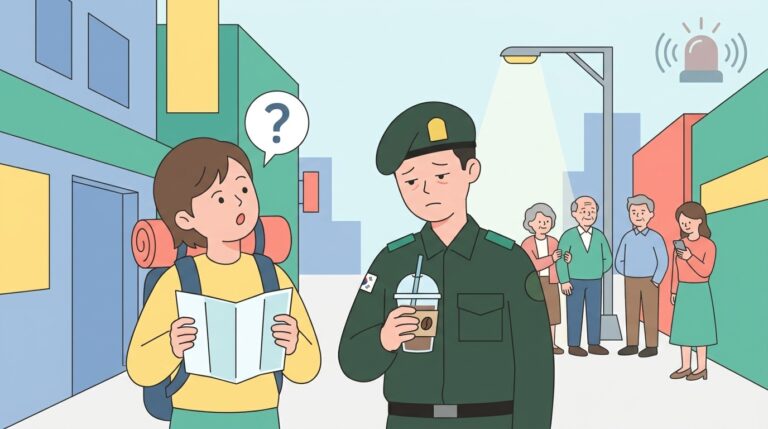
Imagine this: You are happily walking down the vibrant streets of Hongdae, or perhaps you’re on a bus heading to a K-Pop concert. Suddenly, a loud, eerie air-raid siren echoes across the entire city. Cars stop abruptly. People stand still. Did a war just break out?! Should you run to a bunker?
Or maybe you’re sitting in a university cafe, and you see a group of young, usually stylish Korean guys walking in wearing full camouflage military uniforms. They look incredibly tired, holding iced Americanos like their lives depend on it. Are they on a secret mission?
Welcome to the reality of Korean Military Service, specifically Yebigun (예비군, Reserve Forces) and Minbangwi (민방위, Civil Defense)!
If you don’t know these terms, you might panic during a national drill or feel confused when your favorite K-Pop idol is suddenly spotted looking like a sleepy soldier on a random Tuesday. Today, we’re going to dive into this unique aspect of Korean culture. No textbooks—just the real, raw Korean life.
Phase 2: Core Expressions Deep Dive
1. 예비군 (Yebigun)
- Pronunciation: [ye-bi-gun] / Sounds like “Yeah, be goon.”
- Meaning: (Literal) Reserve army / (Real nuance) The annoying mandatory training Korean men must attend for 8 years after finishing their active military duty.
- K-Culture Moment: You will often see K-Pop idols or actors get spotted by fans wearing their military uniforms long after they’ve been discharged. Fans love seeing them in uniform, but the idols themselves usually look completely drained. It’s a universal rule: no matter how handsome you are, putting on a Yebigun uniform instantly makes you feel tired and hungry.
- Editor’s Insight: This word carries a heavy sigh. When a Korean man says he has “Yebigun” tomorrow, he is silently asking for your pity.
- Situation Spectrum:
- Friends (Casual): ✅ “아, 내일 예비군 가야 돼… (Ugh, I have to go to Yebigun tomorrow…)”
- Co-workers (Semi-formal): ✅ “과장님, 저 내일 예비군 훈련이 있습니다. (Manager, I have reserve training tomorrow.)”
- Boss/Elders (Formal): ✅ (It’s a legal obligation, so it’s totally fine to state it formally!)
- 🤔 Think About It: Why do you think Korean society accepts the disruption of work and studies for millions of men every year to attend this training? How does this reflect the unique geopolitical situation of South Korea?
2. 조기 퇴소 (Jogi Toeso)
- Pronunciation: [jo-gi toe-so] / “Jo-gee” (like Yogi bear but with a J) + “Tweh-so”
- Meaning: (Literal) Early dismissal / (Real nuance) Hitting the absolute jackpot. The ultimate flex of Yebigun training.
- K-Culture Moment: In Yebigun training, if your squad performs well in shooting or tactical drills, you get to go home a few hours early. When a guy achieves this, he will brag about it to his friends as if he just won an Olympic gold medal.
- Editor’s Insight: Use this phrase when your Korean male friend finishes his Yebigun. If you ask him, “Did you get Jogi Toeso?”, he will be genuinely impressed by your cultural knowledge.
- Situation Spectrum:
- Friends (Casual): ✅
- Co-workers (Semi-formal): ⚠️ (Fine among close colleagues, but maybe don’t brag too loudly to the boss who is still working!)
- Boss/Elders (Formal): 🚫
- 🤔 Think About It: Does your language have a specific word for getting off work or duty early as a reward?
3. 민방위 (Minbangwi)
- Pronunciation: [min-bang-wi] / Sounds like “Min-bang-we”
- Meaning: (Literal) Civil defense / (Real nuance) The stage after Yebigun (usually ages 30-40) where training is mostly just sitting in a hall watching safety videos, or the nationwide air-raid drills that pause the entire country for 15 minutes.
- K-Culture Moment: For travelers, the “Minbangwi drill (민방위 훈련)” is a crucial survival term. Usually held on the 15th of the month at 2 PM (though the schedule varies), sirens wail, and everyone must take cover or stay put. It’s not a real emergency!
- Editor’s Insight: This word is your anti-panic button when traveling in Korea.
- Situation Spectrum: All situations ✅
Phase 3: Textbook vs. Real Korean
[Talking about going to Reserve Training]
* 📖 Textbook Korean: 저는 내일 예비군 훈련에 참석합니다. (I am attending the reserve forces training tomorrow.)
* 🗣️ Real Korean: 아… 내일 예비군 가야 돼. 개귀찮아. (Ugh… gotta go to Yebigun tomorrow. Freaking annoying.)
* 💡 Why the difference?: Yebigun is universally viewed as a tedious chore by those who have to do it. Expressing mild annoyance (“개귀찮아” – super annoying) is practically a cultural bonding ritual among Korean men.
[Celebrating finishing the training]
* 📖 Textbook Korean: 훈련이 일찍 끝났습니다. (The training ended early.)
* 🗣️ Real Korean: 나 조기 퇴소했어! 폼 미쳤다. (I got early dismissal! My form is crazy/I’m awesome.)
* 💡 Why the difference?: “폼 미쳤다” (My form is crazy/insane) is a trendy slang used when someone performs exceptionally well. Getting out of Yebigun early is definitely considered “crazy form.”
Bottom Note: For B2 level learners, “개귀찮아” (freaking annoying) is great with close friends, but avoid it in professional settings. Stick to “너무 귀찮아요” (It’s so bothersome) for a safer bet!
Phase 4: Cultural Context — K-Culture Deep Dive
4-1. Non-verbal Nuances: The Yebigun Transformation
It’s a running joke in Korea: put a brilliant doctor, a sharp lawyer, or a charismatic K-Pop star into a Yebigun uniform, and they will instantly slouch, put their hands in their pockets, and look completely unmotivated. This “bored posture” is the unofficial dress code of Yebigun. It’s not out of disrespect; it’s a collective sigh of having to wear the uniform again.
4-2. K-Travel Connection: The Siren Shock
If you are traveling in Korea and hear the Minbangwi (Civil Defense) siren, do not run. Look around you. If Koreans are just calmly standing on the sidewalk looking at their phones, or if cars are peacefully stopped at intersections, it is a scheduled drill.
During this 15-minute period, subway station exits might be temporarily blocked, and police officers might guide you off the streets. Just smile, follow their gestures, and wait it out. It’s a unique “only in Korea” travel experience!
Phase 5: Real-Life Roleplay Scenario
Setting: A bustling Samgyeopsal (pork belly) restaurant near Gangnam Station. Friday, 7 PM. You are meeting your Korean friend, Min-su. He just arrived wearing his camouflage military uniform, looking exhausted, smelling slightly of dirt and mountain air.
Characters:
* YOU: An international student/expat who knows a bit about Korean culture.
* Min-su (28): Your close Korean friend. Usually energetic, but today… not so much.
Min-su: 아, 진짜 죽겠다… 배고파. 🥩
(A, jinjja jukgetda… baegopa.)
[Ugh, I’m seriously dying… I’m hungry.]
(🎭 Stage Direction: Min-su collapses into the chair and aggressively pours himself a glass of water)
YOU: 예비군 훈련 다녀왔어? 고생했네!
(Yebigun hunryeon danyeowasseo? Gosaenghaenne!)
[Did you go to reserve training? You worked hard!]
Min-su: 어. 근데 나 오늘 사격 만점 받아서 조기 퇴소했어!
(Eo. Geunde na oneul sagyeok manjeom badaseo jogi toesohaesseo!)
[Yeah. But I got a perfect score in shooting today so I got early dismissal!]
(🎭 Stage Direction: Min-su suddenly sits up straight, looking incredibly proud of himself)
🔀 Your Turn! How should you react?
* A) “오, 조기 퇴소? 대박인데! 고기는 내가 쏠게!” (Oh, early dismissal? That’s awesome! I’ll buy the meat!)
* B) “군인 아저씨, 나라를 지켜주셔서 감사합니다.” (Mr. Soldier, thank you for protecting the country.)
* C) “빨리 끝나서 좋았겠다. 근데 옷은 왜 안 갈아입었어?” (Must’ve been nice to finish early. But why didn’t you change your clothes?)✅ Best Choice: A — Acknowledging the “Jogi Toeso” (early dismissal) and offering to buy food is the ultimate bro-move in Korea. You’ve recognized his greatest achievement of the day!
⚠️ Choice B Analysis: While “Thank you for your service” is common in Western countries, saying this to a friend in Yebigun sounds extremely awkward and slightly sarcastic in Korea. (We’ll cover this in the FAQ!)
Phase 6: 10-Second Shadowing Drill
Practice expressing that exhausted yet proud “Yebigun vibe” with proper intonation!
- 😤 Sighing heavily: 아… / 내일 / 예비군 가야 돼. / 진짜 / 귀찮다.
(Ah… / naeil / yebigun gaya dwae. / jinjja / gwichanta.)
[Ugh… I have to go to reserve training tomorrow. So annoying.] -
😎 Proudly: 야! / 나 오늘 / 조기 퇴소 / 했어! / 폼 / 미쳤지?
(Ya! / na oneul / jogi toeso / haesseo! / pom / micheotji?)
[Hey! I got early dismissal today! Isn’t my form crazy?]
Phase 7: K-Culture Mini Dictionary
1. 눈치 (Nunchi)
* Romanization: Nunchi
* Meaning: The subtle art of gauging others’ moods and reading the room.
* Context: In the military (and Yebigun), nunchi is survival. Knowing when to step up and when to blend in with the background is the most important skill a Korean soldier learns.
2. 짬밥 (Jjambbap)
* Romanization: Jjambbap
* Meaning: Military food / Seniority
* Context: Originally slang for military meals, it has evolved to mean “years of experience.” If someone says “내가 짬밥이 몇 년인데” (Given my years of Jjambbap…), they mean “I have too much experience to fall for that.”
3. 군필 (Gunpil)
* Romanization: Gunpil
* Meaning: A man who has fulfilled his mandatory military service.
* Context: A crucial status in Korean society. You will often see “군필 우대” (Gunpil preferred) on part-time job postings, implying the person is mature and responsible.
4. 고무신 (Gomusin)
* Romanization: Gomusin
* Meaning: Rubber shoes / A woman waiting for her boyfriend to finish military service.
* Context: “Wearing rubber shoes” means waiting for a soldier. K-Pop fans also use this term when their favorite idols enlist, calling themselves “Gomusin fans.”
Phase 8: Traveler Survival Kit
Since Minbangwi (Civil Defense) directly affects travelers, here is what you need to know when the sirens start wailing!
🆘 Survival Phrases for the Siren
* 🇰🇷 “이거 민방위 훈련이에요?” (igeo minbangwi hunryeonieyo?)
* 🗣️ Pronunciation: Ee-geo min-bang-we hoon-ryeon-ee-eh-yo?
* 📍 Where to use: On the street, in a taxi, or at a cafe when the sirens go off.
* 💡 Pro Tip: If you ask this, locals will immediately understand you are a savvy traveler and smile, saying “Ne! (Yes!)” to reassure you.📌 Editor’s Travel Note
* What to do: If you are outside, authorities might direct you to an underground subway station. If you are in a car/taxi, the driver will pull over to the side of the road for 15 minutes.
* Apps to use: The “Emergency Ready App (안전디딤돌)” by the Korean government provides disaster and drill alerts in English!
Phase 9: Critical Thinking Corner — “A Step Deeper”
Media vs. Reality: The Romanticized Soldier
🧠 Think Deeper:
If you watch K-Dramas like Descendants of the Sun or Crash Landing on You, Korean soldiers are portrayed as flawlessly romantic, heroic, and incredibly well-groomed. However, the reality of mandatory conscription and Yebigun is quite different. For most Korean men, the military is seen as a necessary sacrifice—a suspension of their youth, career, and freedom. The “tired uncle” look of Yebigun is a stark contrast to the dramatic heroes on screen. This shared hardship, however, creates a powerful unspoken camaraderie among Korean men, influencing everything from drinking culture to workplace hierarchies.💬 Your Turn: Does your country have mandatory military service? How are soldiers portrayed in your media versus how they are treated in real life? Share your thoughts below!
Phase 10: FAQ & Avoiding Misunderstandings
Q: Should I say “Thank you for your service” to a Korean soldier?
A: Usually, no. In countries with a volunteer military, thanking soldiers is common. In Korea, because every able-bodied man must serve, it’s considered an ordinary civic duty rather than an extraordinary volunteer act. Saying “수고하셨습니다” (You worked hard/Good job) is much more natural. Saying a literal translation of “Thank you for your service” (복무해주셔서 감사합니다) sounds very unnatural, almost like a politician giving a speech.
Q: Can I take photos of Korean soldiers or Yebigun guys on the street?
A: No! Unless they are your friends, taking photos of people without permission is illegal in Korea due to strict privacy laws (Portrait Rights). Also, photographing active military personnel or military installations is strictly forbidden.
❌ Common Mistake #1: Panicking and running during a Minbangwi siren.
✅ Do This Instead: Look at the locals. If they are calm, just stop walking, take a break, and wait 15 minutes.
Phase 11: Summary & Action Items
- One-Liner Summary: Yebigun (Reserve) and Minbangwi (Civil Defense) are the true, unfiltered realities of Korean men’s post-military life—and knowing about them helps you understand K-Culture on a much deeper level!
Action Mission 3 Steps:
* 🥉 Bronze (Solo): Look in the mirror, slouch your shoulders, and sigh “아… 예비군 개귀찮아…” to practice the authentic vibe.
* 🥈 Silver (Online): Find a photo of a K-Pop idol in their reserve uniform and leave a comment in your mind: “조기 퇴소 기원!” (Praying for your early dismissal!)
* 🥇 Gold (Real Life): If you are in Korea and a friend complains about Yebigun, ask them “조기 퇴소 했어?” (Did you get out early?) and watch their face light up.
Special K-Culture Mission:
The next time you watch a K-Drama featuring a male lead in his late 20s or 30s, try to spot the episode where he randomly wears a military uniform for a day. Now you know exactly where he was!
Phase 12: Quiz — Interactive Challenge
1. Situational Judgment: Your Korean friend Ji-hoon texts you: “나 오늘 예비군 가서 조기 퇴소함 ㅋㅋㅋ” (I went to Yebigun today and got Jogi Toeso lol). What is the BEST reply?
* A) 전쟁 났어? 조심해! (Did war break out? Be careful!)
* B) 헐 대박! 폼 미쳤다! (Oh wow! Your form is crazy!)
* C) 나라를 지켜주셔서 감사합니다. (Thank you for protecting the country.)
Click for the Answer
Answer: B! “Jogi Toeso” (Early dismissal) is a proud moment. Reacting enthusiastically with “대박!” and “폼 미쳤다!” will make you sound exactly like a native Korean in their 20s or 30s.
2. True or False – Travel Edition:
You are walking in Seoul and a loud air-raid siren goes off. Traffic stops. You should immediately run to the nearest subway bunker.
Click for the Answer
False! It is most likely a scheduled Minbangwi (Civil Defense) drill. Just look at the locals—if they are calm and simply stopping their cars or standing still, do exactly the same. It will be over in 15 minutes.
Did you enjoy diving into the hidden reality of Korean military culture? If you’ve ever experienced a Minbangwi drill or seen someone in a Yebigun uniform, share your story in the comments below! 😊
Frequently Asked Questions (FAQ)
Q: What does "예비군 (Yebigun)" mean in Korean and how do you pronounce it?
A: In Korean, "예비군 (Yebigun)" is pronounced [ye-bi-gun] and means: (Literal) Reserve army / (Real nuance) The annoying mandatory training Korean men must attend for 8 years after finishing their active military duty.
Q: What does "조기 퇴소 (Jogi Toeso)" mean in Korean and how do you pronounce it?
A: In Korean, "조기 퇴소 (Jogi Toeso)" is pronounced [jo-gi toe-so] and means: (Literal) Early dismissal / (Real nuance) Hitting the absolute jackpot. The ultimate flex of Yebigun training.
Q: What does "민방위 (Minbangwi)" mean in Korean and how do you pronounce it?
A: In Korean, "민방위 (Minbangwi)" is pronounced [min-bang-wi] and means: (Literal) Civil defense / (Real nuance) The stage after Yebigun (usually ages 30-40) where training is mostly just sitting in a hall watching safety videos, or the nationwide air-raid drills that pause the entire country for 15 minutes.







