

Phase 1: Empathy (Immersive Opening)
Hello! I’m the Lead Editor of Daily Hangul.
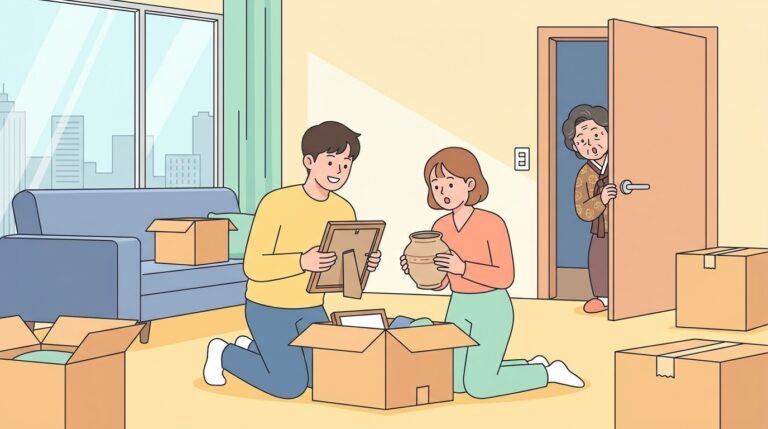
Imagine this: You’re watching a K-Drama. The main couple is happily cooking dinner in their shared apartment. Suddenly, the doorbell rings. It’s the protagonist’s mother, dropping by unannounced with side dishes (banchan). Panic ensues! The couple frantically hides extra toothbrushes, men’s shoes, and shaving cream before opening the door.
Why this comedy of errors? Because in Korea, 결혼 전 동거 (premarital cohabitation) is still undergoing a massive paradigm shift. While the younger MZ generation increasingly views it as a practical ‘test drive’ before marriage, the older generation often still sees it as a cultural taboo.
For C2 advanced learners, simply knowing the word ‘동거’ (cohabitation) isn’t enough. You need to understand the social weight behind the words, how couples actually talk about moving in together without sounding overly formal, and the intricacies of setting boundaries. Today, we’re diving deep into the sophisticated language of dating, cohabitation, and the reality checks that sometimes lead to breakups. Let’s master the true nuances of modern Korean romance!
Phase 2: Core Expressions Deep Dive
1. 집을 합치다
- Pronunciation: [jibeul hapchida] + [jee-bul hap-chee-da]
- Meaning: Literal: To combine houses. / Real nuance: To move in together (a softer, more socially acceptable way to say ‘cohabit’).
- K-Culture Moment: If you bluntly say “우리는 동거해요” (We cohabit) at a company dinner, older colleagues might raise their eyebrows. Instead, millennials say “저희 먼저 집을 합쳤어요” (We combined our households first), which subtly frames it as a practical, marriage-oriented financial decision.
- Editor’s Insight: The word 동거 (dong-geo) has a slightly scandalous, clinical, or rebellious undertone in traditional Korean society. ‘합치다’ sounds much more responsible and naturally implies a serious commitment, usually preceding marriage.
- Situation Spectrum:
- 친구 사이(Casual): ✅
- 직장 동료(Semi-formal): ✅
- 직장 상사·어른(Formal): ⚠️ (Better to say “결혼을 전제로 같이 지내고 있습니다” – We are living together with marriage in mind.)
- 🤔 Think About It: Why do Koreans prefer using a spatial term (‘combining houses’) rather than a relationship term (‘living as a couple’)? How does your native language soften culturally sensitive topics?
2. 결이 다르다
- Pronunciation: [gyeoli dareuda] + [gyeol-ee da-reu-da]
- Meaning: Literal: The grain/texture is different. / Real nuance: Our core values, vibes, or lifestyles fundamentally clash.
- K-Culture Moment: When a K-Drama character breaks off an engagement after living together, they rarely say “I hate you.” They sit at a cafe, looking melancholic, and say, “우린 좀 결이 안 맞는 것 같아” (I don’t think our grains match).
- Editor’s Insight: This is a highly sophisticated, C2-level expression. It implies that neither person is ‘wrong,’ but their fundamental nature (like the grain of wood) doesn’t align. It’s the ultimate graceful breakup line when cohabitation reveals irreconcilable daily habits.
- Situation Spectrum:
- 친구 사이(Casual): ✅
- 직장 동료(Semi-formal): ✅ (Can be used to describe differing work styles too!)
- 직장 상사·어른(Formal): ✅
- 🤔 Think About It: Korean culture values harmony (기분/눈치). How does blaming a breakup on ‘differing grains’ rather than ‘your faults’ preserve the other person’s 체면 (face/dignity)?
3. 현타가 오다
- Pronunciation: [hyeontaga oda] + [hyon-ta-ga oh-da]
- Meaning: Literal: To experience ‘Reality Awareness Time’ (Slang). / Real nuance: A sudden, sobering reality check or feeling of disillusionment.
- K-Culture Moment: You move in with your partner expecting a rom-com life. On day 3, you’re arguing over who forgot to separate the recycling (분리수거) properly. That sobering moment? That’s when ‘현타’ hits.
- Editor’s Insight: Derived from ‘현실 자각 타임’ (Time to realize reality), this is an essential slang term for the modern Korean experience. It beautifully captures the jarring transition from romantic fantasy to mundane reality.
- Situation Spectrum:
- 친구 사이(Casual): ✅
- 직장 동료(Semi-formal): ⚠️ (Only with close peers)
- 직장 상사·어른(Formal): 🚫
- 🤔 Think About It: Does your language have a specific word for the exact moment the ‘honeymoon phase’ ends and reality crashes in?
Phase 3: Textbook vs Real Korean
[Telling friends you moved in together]
* 📖 교과서 한국어: 저는 남자친구와 동거 중입니다. (I am cohabiting with my boyfriend.)
* 🗣️ 진짜 한국어: 저희 이번에 전세 끝나면서 그냥 집 합쳤어요. (Our Jeonse lease ended so we just combined houses.)
* 💡 왜 다를까?: Connecting the decision to practical reasons like ‘Jeonse’ (Korea’s unique housing lease system) removes the social stigma and makes it sound like a smart life choice rather than a rebellion.
[Explaining why you broke up after living together]
* 📖 교과서 한국어: 우리는 생활 방식이 달라서 헤어졌습니다. (We broke up because our lifestyles are different.)
* 🗣️ 진짜 한국어: 같이 살아보니까 서로 결이 너무 다르더라고요. (Living together, we realized our vibes/values are just too fundamentally different.)
* 💡 왜 다를까?: ‘결이 다르다’ is metaphorically richer and softer, showing a high level of emotional intelligence and linguistic maturity.
[Experiencing the unromantic side of cohabitation]
* 📖 교과서 한국어: 현실을 깨달아서 실망했습니다. (I realized reality and was disappointed.)
* 🗣️ 진짜 한국어: 아침에 화장실 쟁탈전 할 때 진짜 찐으로 현타 오더라. (I got a massive reality check when we were fighting over the bathroom in the morning.)
* 💡 왜 다를까?: Utilizing ‘찐으로’ (truly/for real) and ‘현타’ instantly elevates your Korean from a textbook robot to a relatable Seoulite.
Phase 4: Cultural Context — K-Culture Deep Dive
4-1. 비언어적 요소 (Non-verbal Cues & Nunchi)
When discussing cohabitation in Korea, 눈치 (Nunchi) is everything. If a Korean friend tells you they moved in with their partner, observe their tone. Are they whispering it? They might be hiding it from their traditional parents. Your non-verbal reaction should be a supportive, unshocked nod, not a loud “OMG, do your parents know?!” Let them guide the openness of the topic.
4-2. K-Drama Connection: The ‘Shoe Hiding’ Trope
If you’ve watched K-Dramas like Because This Is My First Life or Love Next Door, you’ll notice a recurring theme: The frantic apartment sweep. When conservative parents visit unexpectedly, the couple scrambles to hide any evidence of the opposite sex living there.
비판적 관점 (Critical View): While dramas play this for laughs, in reality, it highlights a heavy generational burden. Many couples in Korea maintain two separate addresses on paper (주민등록) just to keep up appearances or for complex real estate loan benefits, even if they sleep in the same bed every night.
Phase 5: Real-Life Roleplay Scenario
Setting: Friday night, 8 PM. A moody Izakaya in Yeonnam-dong. The rain is tapping against the window. You are grabbing drinks with your close Korean colleague, Minsoo (32, thoughtful but currently stressed about housing).
Characters:
– YOU: An expat working in Seoul, highly fluent in Korean but still navigating the cultural nuances of dating.
– 민수 (Minsoo): Your Korean coworker who has been dating his girlfriend for two years.
Dialogue:
민수: 아, 다음 달에 오피스텔 전세 만기인데, 집 구하기 진짜 빡세다. 🍶
(A, daeum dal-e opiseutel jeonse mangi-inde, jip guhagi jinjja ppakseda.)
[Ah, my officetel Jeonse lease expires next month, finding a house is so tough.]
(🎭 Stage Direction: Minsoo sighs heavily and pours himself a shot of Soju)
YOU: 벌써 2년 됐어요? 요새 금리도 높아서 대출받기도 쉽지 않잖아요.
(Beolsseo inyeon dwaesseoyo? Yosae geumlido nopaseo daechulbatgido swipji anchanayo.)
[Has it already been 2 years? Interest rates are high these days, so getting a loan isn’t easy either.]
민수: 내 말이. 그래서 말인데… 그냥 지은이랑 집을 먼저 합칠까 고민 중이야.
(Nae mal-i. Geuraeseo mal-inde… geunyang Jieun-irang jib-eul meonjeo hapchilkka gomin jung-iya.)
[Tell me about it. So… I’m debating if I should just combine houses with Jieun first.]
🔀 당신의 차례! 어떻게 대답할까요? (Your Turn! How do you respond?)
– A) “오, 동거하시게요? 부모님이 허락하셨어요?” (Oh, you’re going to cohabit? Did your parents permit it?)
– B) “진짜요? 결혼 날짜도 안 잡았는데 동거는 좀 위험하지 않아요?” (Really? Isn’t cohabitation dangerous when you haven’t even set a wedding date?)
– C) “아, 요새 다들 그렇게 많이 하더라고요. 지은 씨 생각은 어때요?”
(Ah, a lot of people are doing that these days. What does Jieun think?)✅ Best Choice: C — Reason: It provides validation (“다들 그렇게 많이 하더라고요”) and uses the socially smooth approach. It avoids the culturally heavy word ‘동거’ and shows empathetic Nunchi.
⚠️ Choice A & B 분석: Using the exact word ‘동거’ or asking about parents immediately puts immense pressure on Minsoo. Judging the decision (B) crosses personal boundaries in modern Korean friendship.
(Assuming you chose C)
민수: 지은이도 월세 아낄 겸 긍정적이긴 한데… 사실 좀 걱정돼.
(Jieun-ido wolse akkil gyeom geungjeongjeok-igin hande… sasil jom geokjeongdwae.)
[Jieun is also positive about it to save on monthly rent, but… honestly, I’m a bit worried.]
YOU: 어떤 게 제일 걱정인데요?
(Eotteon ge jeil geokjeong-indeyo?)
[What are you most worried about?]
민수: 같이 살아보면 진짜 생활 패턴부터 다 드러나잖아. 혹시라도 생활하다가 너무 결이 달라서 현타 올까 봐.
(Gachi salabomyeon jinjja saenghwal paeteun-buteo da deureonajana. Hokshirado saenghwalhadaga neomu gyeol-i dallaseo hyeonta olkka bwa.)
[When you live together, your true daily routines are totally exposed. I’m worried we might realize our vibes are too different and experience a massive reality check.]
YOU: 에이, 그래도 결혼 전에 미리 맞춰보는 게 낫죠. 나중에 파혼하는 것보단 낫잖아요!
(Ei, geuraedo gyeolhon jeon-e miri matchwoboneun ge natjyo. Najung-e pahonhaneun geotbodan natjanhayo!)
[Hey, it’s still better to align things before getting married. Better than breaking off an engagement later!]
민수: (웃으며) 그건 그렇지. 일단 이번 주말에 부모님 눈치 좀 슬쩍 봐야겠다.
(Geugeon geureochi. Ildan ibeon jumal-e bumonim nunchi jom seuljjeok bwayagetda.)
[(Laughs) That’s true. I guess I’ll have to subtly read my parents’ mood this weekend.]
Phase 6: 10-Second Shadowing Drill
Listen to the rhythm of this mature C2-level sentence and shadow the phrasing. Pay attention to the pauses (/)!
🥺 “같이 살아보니까 / 생각보다 결이 너무 달라서 / 찐으로 / 현타가 왔어요.”
(gachi salabonikka / saenggakboda gyeol-i neomu dallaseo / jjin-euro / hyeontaga wasseoyo.)
“Living together, I realized our values are vastly different than I thought, so I got a real reality check.”
Phase 7: K-Culture Mini Dictionary
1. 눈치
* Romanization: nunchi
* English: Social intelligence / Reading the room
* 맥락 설명: The quintessential Korean social sense. In dating, it’s knowing when to bring up marriage to parents, or sensing your partner’s mood without them saying a word.
2. 전세
* Romanization: jeonse
* English: Lump-sum housing deposit lease
* 맥락 설명: A unique Korean housing system where you give the landlord a massive deposit (often hundreds of thousands of dollars) instead of monthly rent. It’s a huge financial hurdle that drastically affects timeline decisions for Korean couples moving in together or marrying.
3. 자취
* Romanization: jachwi
* English: Living independently (usually as a student or young adult)
* 맥락 설명: Living alone away from parents. A partner’s 자취방 (studio apartment) is often where unofficial, weekend cohabitation begins.
4. 파혼
* Romanization: pahon
* English: Breaking off an engagement / Canceling a wedding
* 맥락 설명: A severe social event in Korea. Many MZ generation Koreans advocate for premarital cohabitation specifically to avoid 파혼 after realizing incompatible lifestyles post-wedding.
Phase 8: Traveler’s Survival Kit (Airbnb & Housing Edition)
If you and your partner are traveling to Korea long-term or moving here, finding an Airbnb or short-term rental is your first step to ‘합치다’. Here are the ultimate C2 survival phrases for dealing with Korean real estate/housing.
🆘 서바이벌 표현 #1: Utilities
– 🇰🇷 “관리비에 가스랑 전기도 포함된 건가요?”
– 🗣️ Pronunciation: [gwallibie gaseurang jeongido pohamdoen geongayo?]
– 📍 쓰는 곳: Real estate agencies (부동산), speaking with Airbnb hosts.
– 💡 Pro Tip: ‘관리비’ (Maintenance fee) in Korea can be tricky. Sometimes it includes internet and water, but excludes gas (which covers the Ondol floor heating). Always confirm!🆘 서바이벌 표현 #2: Noise Boundaries
– 🇰🇷 “여기 층간소음은 좀 어떤 편이에요?”
– 🗣️ Pronunciation: [yeogi cheunggan-soeum-eun jom eotteon pyeon-iyeyo?]
– 📍 쓰는 곳: Viewing an apartment.
– 💡 Pro Tip: ‘층간소음’ (noise between floors) is a massive social issue in densely packed Seoul. Asking this shows you truly understand Korean living conditions.
📌 Editor’s Travel Note
– Apps to Use: 직방 (Zigbang) or 다방 (Dabang) to understand market prices, though they require Korean fluency.
– Deposit Culture: Even short-term rentals require a ‘보증금’ (Deposit). Always ensure you have a clear contract!
Phase 9: Critical Thinking Corner — “한 발 더 깊이”
📺 미디어 vs 현실 (Media vs Reality)
🧠 Think Deeper:
K-Dramas often portray cohabitation as a string of romantic mishaps—accidentally bumping into each other after a shower or late-night ramen sessions. However, the reality of premarital cohabitation in Korea is deeply intertwined with economics and societal pressure. The astronomical cost of real estate (the Jeonse system) is forcing young people to pool their resources earlier than previous generations. Yet, because the conservative societal stigma remains, many couples live a ‘double life’—sharing a home to save money, but maintaining separate official addresses to keep their parents’ ‘체면’ (face) intact. It is a fascinating clash where modern economic necessity forces a quiet rebellion against traditional Confucian values.💬 Your Turn: In your culture, is moving in together driven more by romantic progression or economic necessity? Are parents usually involved in the decision? Share in the comments!
Phase 10: FAQ & 오해 방지 (Avoiding Mistakes)
Q: “Can I ask an older colleague if they lived with their spouse before marriage?”
NO. For anyone over 45, premarital cohabitation was highly stigmatized in their youth. Asking this can be seen as highly invasive and disrespectful. Keep this topic among peers in their 20s and 30s.
Q: “If a Korean friend says they are going to someone’s ‘자취방’, does that mean they are moving in together?”
Maybe. Going to a partner’s ‘자취방’ (studio) is often the precursor to moving in. It implies spending a lot of private time together, but not officially combining households.
❌ 흔한 실수 #1: Using the word “동거” (Cohabitation) bluntly in professional or formal settings.
✅ 이렇게 하세요: Use “집을 합치다” (We combined houses) or “결혼을 전제로 같이 지내고 있습니다” (We are staying together with marriage in mind) to sound mature, respectful, and culturally aware.
Phase 11: Summary & Action Items
- One-Liner Summary: Premarital cohabitation in Korea is a complex dance between modern practicality and traditional boundaries, best expressed not as “cohabiting,” but as “combining households” (집을 합치다) to test if your “grains match” (결이 맞다).
-
Action Mission 3단계:
- 🥉 Bronze: Say “우리 결이 참 잘 맞는 것 같아” to yourself in the mirror with a warm smile.
- 🥈 Silver: Leave a comment below using the word 현타 to describe a funny reality-check moment in your past relationships.
- 🥇 Gold: Next time a Korean friend discusses a difference of opinion, smoothly drop “아, 서로 좀 결이 달랐군요!” in the conversation.
- K-Culture Mission:
Watch an episode of the K-Drama Because This Is My First Life (이번 생은 처음이라) and spot how the characters negotiate their living arrangements, boundaries, and the massive Jeonse deposit!
Phase 12: 퀴즈 — 인터랙티브 챌린지
1. Situational Judgment:
Your Korean friend tells you she is breaking up with her boyfriend after living together for 6 months. She says, “그 사람은 나쁜 사람은 아닌데…” (He’s not a bad person, but…). How should you complete her sentence like a native C2 speaker?
A) “동거가 불법이잖아.”
B) “우린 결이 너무 달랐어.”
C) “월세를 안 냈어.”
(Answer: B. It beautifully implies fundamental lifestyle/value differences without harsh blame.)
2. Fill in the Blank:
드라마 같은 로맨스를 기대하고 집을 합쳤는데, 매일 청소 문제로 싸우다 보니 진짜 _____가/이 왔어.
(Answer: 현타 – The sudden realization of mundane reality.)
3. True or False — K-Culture Edition:
Older, traditional Korean parents generally encourage couples to move in together to “test the waters” before spending money on a wedding.
(Answer: False. The older generation largely views premarital cohabitation as taboo. The MZ generation is the one shifting this narrative.)
4. Roleplay Application:
If in Phase 5 you had chosen Option A (“동거하시게요? 부모님이 허락하셨어요?”), how would Minsoo likely have reacted?
(Answer: He would likely have become defensive, embarrassed, or quickly changed the subject, as you would have shattered his ‘Nunchi’ and highlighted the exact societal pressure he was trying to vent about!)
Frequently Asked Questions (FAQ)
Q: What does "집을 합치다" mean in Korean and how do you pronounce it?
A: In Korean, "집을 합치다" is pronounced [jibeul hapchida] and means: Literal: To combine houses. / Real nuance: To move in together (a softer, more socially acceptable way to say 'cohabit').
Q: What does "결이 다르다" mean in Korean and how do you pronounce it?
A: In Korean, "결이 다르다" is pronounced [gyeoli dareuda] and means: Literal: The grain/texture is different. / Real nuance: Our core values, vibes, or lifestyles fundamentally clash.
Q: What does "현타가 오다" mean in Korean and how do you pronounce it?
A: In Korean, "현타가 오다" is pronounced [hyeontaga oda] and means: Literal: To experience 'Reality Awareness Time' (Slang). / Real nuance: A sudden, sobering reality check or feeling of disillusionment.







