

Phase 1: Empathy (Immersion Open)
Hello! I’m the Lead Editor at Daily Hangul.
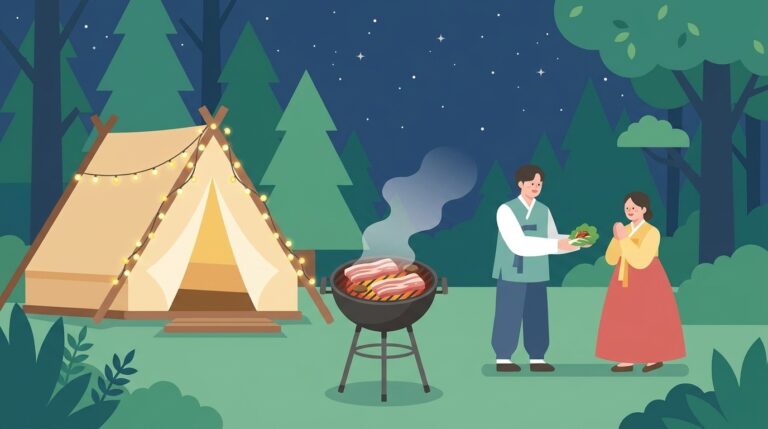
Picture this: It’s 7 PM on a crisp autumn evening. You are at a luxury glamping site in Gapyeong, surrounded by fairy lights and the scent of pine trees. The campfire is crackling, and right in front of you, thick slices of pork belly (Samgyeopsal) are sizzling on the charcoal grill. You’re with your Korean friends, and the vibe is straight out of an episode of Hospital Playlist.
Suddenly, the designated grill-master of the group points at the grill with their tongs and yells, “야, 고기 탄다 타! 불판 좀 갈아야겠다!”
You freeze. Tanda? Bulpan? Are we in danger? Do we need to run?
If you’ve ever felt completely lost amidst the beautiful chaos of a Korean BBQ party—especially in the upgraded, trendy setting of a glamping site—you are not alone. While textbooks teach you “저는 고기를 좋아합니다” (I like meat), they rarely teach you the intense, high-stakes vocabulary of real-life Korean grilling.
At the C1 level, mastering the language isn’t just about ordering food; it’s about understanding the unspoken hierarchy, the communal bonding, and the witty banter that happens over a hot grill. This guide is built from the exact panic moments my advanced students have shared with me. Grab your tongs, and let’s dive into the real Korean BBQ survival guide!
Phase 2: Core Expressions Deep Dive
1. 고기부심이 있다 (Meat-grilling Pride)
- Pronunciation: gogi-busim-i it-da [go-gee boo-sheem-ee eet-da]
- Meaning: (Literal) To have meat pride. (Real nuance) To be extremely proud and protective of one’s meat-grilling skills.
- K-Culture Moment: You’ll see this in almost every Korean drama featuring a dinner gathering. There’s always that one person who refuses to hand over the tongs. If someone else tries to flip the meat, they get genuinely offended. That person has massive gogibusim.
- Editor’s Insight: Busim is a slang suffix derived from jabusim (pride). It’s used playfully to tease someone who takes something a bit too seriously. Calling out your friend’s gogibusim is a fantastic way to show off your advanced Korean slang skills.
- Situation Spectrum:
- Casual (Friends): ✅
- Semi-formal (Colleagues): ⚠️ (Only if you are close!)
- Formal (Boss/Elders): 🚫
- 🤔 Think About It: Why does gogibusim even exist? In Korea, feeding others well is the ultimate expression of care (Jeong). Taking charge of the grill isn’t just about cooking; it’s about taking responsibility for the group’s happiness. Do you have a similar concept of ‘host pride’ in your culture?
2. 불판 좀 갈아주세요 (Please change the grill pan)
- Pronunciation: bul-pan jom ga-ra-ju-se-yo [bull-pahn johm gah-rah-joo-seh-yo]
- (Note: the ‘r’ in ‘ga-ra’ is a soft flap, like the ‘dd’ in ‘ladder’ or ‘butter’ in American English. Make it quick!)
- Meaning: (Literal) Please grind the fire plate. (Real nuance) Please change the charred grill grate to a new one.
- K-Culture Moment: The marinade from your spicy pork (Jeyuk) has turned into black crust on the grill. You cannot cook the next batch of meat on this! Raising your hand and confidently asking the glamping staff to change the grill is the ultimate “I know what I’m doing” power move.
- Editor’s Insight: The verb galda here means ‘to replace/change’. Don’t use bakkuda (바꾸다) for grill pans; galda sounds infinitely more native.
- Situation Spectrum:
- Casual (Friends): 🚫 (You wouldn’t say this to friends, but to the staff)
- Semi-formal (Glamping Staff): ✅
- Formal (Glamping Staff): ✅
- 🤔 Think About It: Notice the word “좀” (jom – a little). Koreans use jom constantly in requests, not to mean “a small amount,” but to soften the demand. It’s a linguistic cushion. Why is softening a request so critical in Korean society?
3. 겉바속촉으로 구워주세요 (Grill it crispy outside, soft inside)
- Pronunciation: geot-ba-sok-chog-eu-ro gu-wo-ju-se-yo [gut-bah-sok-choke-eu-roh goo-woh-joo-seh-yo]
- (Note: ‘eu’ sounds like the disgusted sound you make when stepping in gum. ‘Ugh/Eu’.)
- Meaning: (Literal) Grill it with outer-crispy-inner-moist. (Real nuance) Grill it to perfection (crispy on the outside, juicy on the inside)!
- K-Culture Moment: Your friend with gogibusim is showing off. You playfully challenge them by requesting the ultimate texture: Geot-ba-sok-chok. It’s a widely used acronym (겉은 바삭, 속은 촉촉) born from internet culture, now heavily used in food commercials and everyday life.
- Editor’s Insight: Knowing acronyms (줄임말) is the true mark of a C1 speaker. This phrase proves you don’t just speak Korean; you speak modern Korean.
- Situation Spectrum:
- Casual (Friends): ✅
- Semi-formal (Colleagues): ✅ (Often brings a laugh!)
- Formal (Boss/Elders): 🚫
- 🤔 Think About It: Koreans love texture-based descriptions. Food isn’t just ‘good’ or ‘bad’; it’s chewy (jjolgit), crispy (basak), or soft (chokchok). How important is texture in your native cuisine’s vocabulary?
Phase 3: Textbook vs. Real Korean
[Situation 1: The meat is burning!]
* 📖 Textbook Korean: 고기가 타고 있습니다. 불을 줄이십시오. (The meat is burning. Please reduce the fire.)
* 🗣️ Real Korean: 야, 고기 탄다! 빨리 뒤집어! (Hey, meat’s burning! Flip it quick!)
* 💡 Why the difference?: Barbecuing is a fast-paced sport. We drop honorifics and full sentences when the precious pork belly is in danger of being ruined.
[Situation 2: Staring at the campfire after dinner]
* 📖 Textbook Korean: 우리는 불을 보며 명상을 합니다. (We meditate while looking at the fire.)
* 🗣️ Real Korean: 아~ 불멍 때리기 딱 좋은 날씨네. (Ah~ Perfect weather to space out looking at the fire.)
* 💡 Why the difference?: “불멍” (Bul-meong: Fire + Spacing out) is a mega-trend in Korean camping culture, reflecting modern society’s desperate need to unplug and do absolutely nothing.
[Situation 3: Moving to the “Dessert”]
* 📖 Textbook Korean: 식사 후에 후식을 먹읍시다. (Let’s eat dessert after the meal.)
* 🗣️ Real Korean: 고기 다 먹었으니까 이제 K-디저트 볶음밥 가야지? (We finished the meat, so we gotta go for K-Dessert fried rice, right?)
* 💡 Why the difference?: Calling carbohydrate-heavy dishes (like fried rice or cold noodles) a “K-Dessert” after a heavy meat meal is a popular self-deprecating, humorous slang term.
Bottom Note for C1 Learners: Slang like Bulmeong and Geot-ba-sok-chok are universally understood and considered witty, even among different generations. They are safe to use and will make you sound incredibly culturally attuned!
Phase 4: Cultural Context — K-Culture Deep Dive
4-1. Non-Verbal Elements: The Tongs, The Scissors, and Nunchi
At a glamping BBQ, your Nunchi (눈치 – the subtle art of gauging others’ moods and reading the room) is tested.
– The Tool Rule: The person holding the tongs (집게) is the captain. The one with the scissors (가위) is the first mate. If you are the youngest (Maknae), your nunchi should tell you to grab the tongs before the older members do.
– Handing Things Over: If you must pass the tongs to someone older, do not toss them! Use two hands, or support your right arm with your left hand.
– The Ssam Etiquette: Never double-dip your meat into the communal Ssamjang (dipping sauce) if you’ve already bitten it!
4-2. K-Drama & K-Food Connection: The “Ssam” Offering
In almost every Korean drama involving a team dinner (Hoesik) or a camping trip, you will see a character carefully constructing a Ssam (a lettuce wrap with meat, garlic, and sauce).
Here is the C1-level K-Food secret: Who do you give the Ssam to?
Wrapping a ssam and feeding it to someone is a highly intimate gesture of affection.
– In Dramas: The male lead awkwardy stuffs a giant ssam into the female lead’s mouth to show he cares (or to stop her from talking).
– In Reality: You wrap it for your significant other, a very close friend, or your child.
– Critical Viewpoint: Do NOT wrap a ssam and try to feed it to your boss or an older colleague you just met. It breaks the professional boundary and will result in a very awkward chewing experience!
Phase 5: Real-life Roleplay Scenario
Setting: Friday, 8 PM. A luxury glamping site in the mountains. The charcoal is glowing orange. You are sitting in a premium camping chair with your Korean friend, Min-su.
Characters:
– YOU: An expat who has lived in Korea for a year. You love Korean food but usually eat at restaurants where the staff grills for you.
– Min-su (32): Your close friend. He takes his grilling very seriously. He even brought his own special pink Himalayan salt.
Dialogue:
Min-su: 야, 오늘 삼겹살 퀄리티 미쳤다. 내가 기가 막히게 구워줄게.
(Ya, oneul samgyeopsal kwolliti micheotda. Naega giga makige guwojulge.)
[Translation: Wow, the pork belly quality is crazy today. I’ll grill it amazingly for you.]
(🎭 Stage Direction: Min-su clicks his tongs together twice like a cowboy drawing his guns)
YOU: 오~ 민수 고기부심 발동? 믿어도 돼?
(O~ Minsu gogibusim baldong? Mideodo dwae?)
[Translation: Oh~ Min-su’s meat-pride activated? Can I trust you?]
Min-su: 당연하지! 겉바속촉 알지? 육즙 가둬서 구울 테니까 넌 먹기만 해.
(Dangyeonhaji! Geotbasokchok alji? Yukjeup gadwoseo guul tenikka neon meoggiman hae.)
[Translation: Of course! You know crispy-outside-soft-inside, right? I’ll lock in the juices, so you just focus on eating.]
YOU: 땡큐! 아, 근데 연기가 다 그쪽으로 가는데? 내가 구울까?
(Ttaengkyu! A, geunde yeongiga da geujjogeuro ganeunde? Naega guulkka?)
[Translation: Thank you! Ah, but the smoke is all going your way. Should I grill?]
Min-su: 에이, 괜찮아. 고기는 흐름이 끊기면 안 돼. 내가 할게.
(Ei, gwaenchana. Gogineun heureumi kkeun-gimyeon an dwae. Naega halge.)
[Translation: Hey, it’s fine. The flow of meat shouldn’t be interrupted. I’ll do it.]
(🎭 Stage Direction: 10 minutes later. The grill pan starts turning black from the marinade.)
YOU: 야, 고기 탄다! 불판 좀 갈아야 할 것 같은데?
(Ya, gogi tanda! Bulpan jom garaya hal geot gateunde?)
[Translation: Hey, the meat is burning! I think we need to change the grill pan.]
Min-su: 앗, 그러네. 저기 스태프 분 계신다. 네가 한 번 불러볼래?
(At, geureone. Jeogi seutaepeu bun gyesinda. Nega han beon bulleobollae?)
[Translation: Oops, you’re right. The staff is over there. Do you want to try calling them over?]
🔀 Your Turn! How will you respond to Min-su and the staff?
– A) “저기요! 불판 좀 바꿔주세요!” (Safe, but slightly unnatural vocabulary)
– B) “사장님! 여기 불판 좀 갈아주세요~” (Natural, respectful, high Nunchi)
– C) “어이! 고기 탄다! 불판 체인지!” (Absolute disaster)✅ Best Choice: B — Using “사장님” (Boss/Owner) or “여기요” is the standard way to get attention. Using “갈아주세요” (change) instead of “바꿔주세요” is exactly how natives speak at a BBQ.
⚠️ Choice A Analysis: While technically correct, natives rarely use the verb 바꾸다 (bakkuda) for grill grates.
Phase 6: 10-Second Shadowing Drill
Let’s practice your BBQ party timing! Read these aloud with feeling.
😤 장난스럽게 / 야! / 너 혹시 / 고기부심 있냐?
(Ya! / neo hoksi / gogi-busim innya?)- Tone: Playfully teasing your friend.
🙋♂️ 크고 또렷하게 / 사장님~ / 여기 불판 좀 / 갈아주세요!
(Sajangnim~ / yeogi bulpan jom / ga-ra-ju-se-yo!)- Tone: Projecting your voice over the sound of sizzling meat.
🤤 기대에 차서 / 고기 다 먹었으면 / K-디저트 / 가야죠?
(Gogi da meogeosseumyeon / K-dijeoteu / gayajyo?)- Tone: Excited, looking forward to the fried rice.
Phase 7: K-Culture Mini Dictionary
1. 눈치 (Nunchi)
* Romanization: nunchi
* English: Situational awareness / Social intelligence
* Context: The quintessential Korean social skill. At a BBQ, having nunchi means knowing exactly when to refill a friend’s empty glass or pass the scissors without being asked.
2. 회식 (Hoesik)
* Romanization: hoesik
* English: Company dinner / Get-together
* Context: The bedrock of Korean corporate culture, almost exclusively involving grilled pork belly and Soju. Surviving a hoesik requires top-tier BBQ vocabulary.
3. 고기 굽는 자 (Gogi gupneun ja)
* Romanization: gogi gupneun ja
* English: The Grill Master
* Context: A highly respected (and burdened) role at any gathering. This person dictates the pace of the meal.
4. 불멍 (Bulmeong)
* Romanization: bul-meong
* English: Zoning out by the fire
* Context: The ultimate luxury glamping activity. Combining bul (fire) and meong (blanking out). It’s the Korean equivalent of cozying up by the fireplace, but usually done outdoors after eating.
Phase 8: Traveler Survival Kit (Glamping Edition)
If you’re visiting Korea, booking a luxury glamping site in Gapyeong or Jeju is highly recommended. Here are your absolute survival phrases:
🆘 Survival Phrases: The Glamping BBQ
– 🇰🇷 “숯 좀 더 넣어주세요.” (Sut jom deo neo-eo-ju-se-yo)
– 🗣️ English guide: Please add more charcoal.
– 📍 Where to use: When the fire is dying, and you still have half a kilo of meat left.
- 🇰🇷 “집게 하나 더 주실 수 있나요?” (Jipge hana deo jusil su innayo?)
- 🗣️ English guide: Could we get one more pair of tongs?
- 📍 Where to use: When your friend’s gogibusim is too slow, and you want to help grill.
🇰🇷 “이거 다 익은 건가요?” (Igeo da igeun geongayo?)
- 🗣️ English guide: Is this fully cooked?
- 📍 Where to use: When you want to eat, but you’re afraid of undercooked pork.
📌 Editor’s Travel Note
– Meat Shopping: Don’t buy meat at convenience stores. Look for “Hanaro Mart” (하나로마트) near your glamping site. It’s the holy grail of fresh, locally sourced Korean meat and BBQ supplies.
– Mosquitoes: Say “모기향 있어요?” (Do you have mosquito coils?). You will desperately need this from May to October.
– Tipping: There is ZERO tipping culture at glamping sites or BBQ restaurants in Korea. Even if the staff grills for you perfectly, a warm “감사합니다” is all they expect. Giving money might actually cause confusion!
Phase 9: Critical Thinking Corner — “Going One Step Deeper”
🧠 Think Deeper: Food & Identity (The Communal Grill)
In many Western cultures, a BBQ involves one person standing away from the group at a large grill, flipping burgers, and bringing plates of finished food to the table. In Korea, the grill is built into the center of the table. The cooking process is communal, simultaneous, and shared. You are cooking, eating, talking, and drinking all at once. This isn’t just an architectural choice; it’s a physical manifestation of Korea’s collective identity (Woori – Us). Sharing a hot pot or a single grill reinforces the idea that we are one community sharing the same experience in real-time.
💬 Your Turn: How does your culture handle communal eating? Is the kitchen/grill separated from the dining table, or integrated? Share your thoughts below!
Phase 10: FAQ & Mistake Prevention
Q: “Can I use the term ‘K-Dessert’ with older people?”
A: Maybe. While younger generations and millennials will laugh and agree, someone in their 60s might just look confused and wonder why you want cake after eating pork belly.
Q: “My friend keeps putting meat on my plate. I’m full. How do I stop them?”
A: Cross your chopsticks over your bowl or say playfully, “아~ 배 터질 것 같아요!” (Ah~ I feel like my stomach will explode!). If you just say “No thanks,” they might think you’re being overly polite (Nunchi) and give you more.
❌ Common Mistake #1: Pouring your own drink at a BBQ.
✅ Do This Instead: In Korean drinking culture, you pour for others, and they pour for you. If your glass is empty, wait a second. Your friend will likely fill it. If not, pick up their bottle and gesture to their glass first!❌ Common Mistake #2: Flipping the meat constantly like a stir-fry.
✅ Do This Instead: True Gogibusim dictates that pork belly should only be flipped 2 to 3 times to preserve the juices.
Phase 11: Summary & Action Items
- One-Liner Summary: Surviving a Korean glamping BBQ requires not just a big appetite, but knowing when to praise the grill master (Gogibusim), when to change the pan (Bulpan), and saving room for the K-Dessert.
Action Mission 3 Steps:
– 🥉 Bronze (Solo): Stand in front of a mirror and practice yelling “불판 좀 갈아주세요!” with polite confidence.
– 🥈 Silver (Online): Post a picture of your next meal on your social media or a language learning app and describe it as “겉바속촉” (Geot-ba-sok-chok).
– 🥇 Gold (Real-world): Next time you go to a Korean BBQ restaurant, be the one to ask the waiter to change the grill pan using today’s phrase!
🇰🇷 K-Culture Mission:
Go to YouTube and search for “슬기로운 의사생활 고기방패” (Hospital Playlist Meat Shield) or “응답하라 1988 회식” (Reply 1988 Hoesik). Watch how aggressively, yet affectionately, Koreans behave around the BBQ grill!
Phase 12: Quiz — Interactive Challenge
1. Situational Judgment:
Your Korean colleague is grilling meat, but it’s clearly burning. He looks stressed. What is the most C1-appropriate, natural thing to say?
– A) 고기가 타고 있습니다.
– B) 제가 좀 도와드릴까요? (Shall I help a bit?)
– C) 사장님! 여기 불판 좀 갈아주세요!
(Answer: C is the most proactive and culturally savvy. You don’t embarrass your colleague by pointing out their failure; you just solve the problem by getting the staff to change the pan!)
2. True or False – K-Culture Edition:
“Wrapping a piece of meat in lettuce (Ssam) and feeding it to your boss is a great way to show respect for a promotion.”
(Answer: FALSE! Hand-feeding someone is a gesture of extreme intimacy (romantic partners or children). Doing this to your boss would be completely inappropriate and shocking!)
3. Fill in the Blank:
“삼겹살 다 먹었으니까 이제 _______ 먹어야지? 볶음밥 시키자!”
(Since we finished the pork belly, we should eat _______, right? Let’s order fried rice!)
(Answer: K-디저트 / K-Dessert)
Let me know your quiz results in the comments below! Stay hungry, stay curious, and see you in the next lesson of Daily Hangul! 🏕️🥩
Frequently Asked Questions (FAQ)
Q: What does "고기부심이 있다 (Meat-grilling Pride)" mean in Korean and how do you pronounce it?
A: In Korean, "고기부심이 있다 (Meat-grilling Pride)" is pronounced [gogi-busim-i it-da [go-gee boo-sheem-ee eet-da] and means: (Literal) To have meat pride. (Real nuance) To be extremely proud and protective of one's meat-grilling skills.
Q: What does "불판 좀 갈아주세요 (Please change the grill pan)" mean in Korean and how do you pronounce it?
A: In Korean, "불판 좀 갈아주세요 (Please change the grill pan)" is pronounced [bul-pan jom ga-ra-ju-se-yo [bull-pahn johm gah-rah-joo-seh-yo] and means: (Literal) Please grind the fire plate. (Real nuance) Please change the charred grill grate to a new one.
Q: What does "겉바속촉으로 구워주세요 (Grill it crispy outside, soft inside)" mean in Korean and how do you pronounce it?
A: In Korean, "겉바속촉으로 구워주세요 (Grill it crispy outside, soft inside)" is pronounced [geot-ba-sok-chog-eu-ro gu-wo-ju-se-yo [gut-bah-sok-choke-eu-roh goo-woh-joo-seh-yo] and means: (Literal) Grill it with outer-crispy-inner-moist. (Real nuance) Grill it to perfection (crispy on the outside, juicy on the inside)!







