

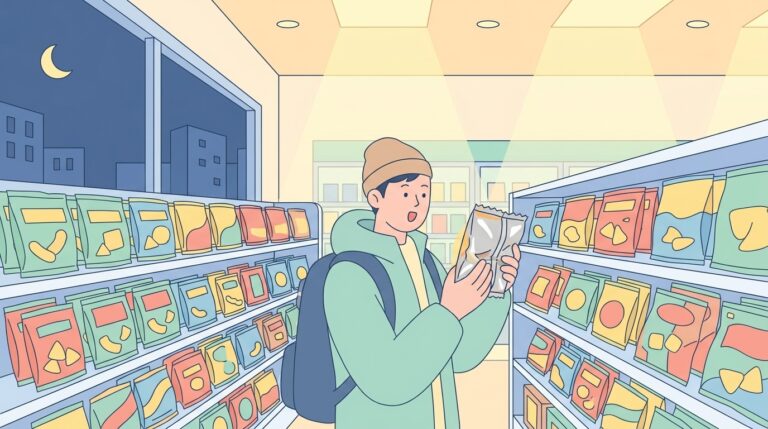
Phase 1: Empathy & The “Convenience Store” Magic
Hello there! I’m your Daily Hangul Editor.
Picture this: You’re watching your favorite K-Drama, and the main characters just had a dramatic argument. Where do they go to cool off? They end up sitting at those iconic green plastic tables outside a convenience store (편의점, pyeonuijeom), cracking open a canned coffee and tearing into a brightly colored bag of chips. Or maybe you’ve seen K-Pop idols on V-Live excitedly unboxing a “viral” new snack that sold out everywhere in Seoul.
Walking into a Korean convenience store like CU, GS25, or Seven Eleven isn’t just about grabbing water; it’s a cultural experience. It is the frontline of Korea’s fast-paced food trends! But when you finally spot that new “spicy sweet corn” chip everyone on TikTok is talking about, how do you ask if it’s the right one? How do you navigate the magical “2+1” deals without standing at the counter in a panic?
If you don’t know the specific convenience store lingo, you might end up paying full price for items that are on sale, or miss out on the hottest snack of the month. Don’t worry! This guide is built from the real experiences (and minor embarrassments) of my students. Let’s make you a true K-Convenience Store Insider!
Phase 2: Core Expressions Deep Dive
Here are the top three expressions you need to confidently hunt down new snacks.
1. 혹시 이거 신상이에요?
- Pronunciation: Hoksi igeo sinsang-ieyo? [Hok-shee ee-geo shin-sang-ee-eh-yo?]
- Meaning: (Literal) By any chance, is this a new product? / (Real nuance) Is this the new arrival everyone is talking about?
- K-Culture Moment: You’re standing in front of the snack aisle, holding a bizarre flavor of potato chips (like “Truffle Jjajang”). You want to know if it’s the newest release. Asking the part-timer this phrase instantly makes you sound like a trendy local.
- Editor’s Insight: “신상 (sinsang)” is an abbreviation for “신상품 (sinsangpum),” meaning “new product.” Koreans love new trends, so this word is used constantly, not just for snacks, but for fashion, makeup, and K-Pop merch!
- Situation Spectrum:
- Casual with friends (신상이야?): ✅
- Convenience store staff (Semi-formal): ✅
- Formal business meetings: 🚫
- 🤔 Think About It: Why do you think Korea has such a strong culture of chasing “신상” (new products)? How often do snack flavors change in your home country compared to Korea?
2. 요즘 제일 잘 나가는 게 뭐예요?
- Pronunciation: Yojeum jeil jal naganeun ge mwoyeyo? [Yo-jeum jeh-eel jal na-ga-neun geh mwo-yeh-yo?]
- Meaning: (Literal) What is the thing that goes out the best these days? / (Real nuance) What’s the best-seller right now?
- K-Culture Moment: When a K-Pop idol mentions a snack on a livestream, it causes a “품절대란” (sold-out crisis). If you want to try what’s popular but don’t know the name, use this phrase. The staff will point you straight to the “It” snack.
- Editor’s Insight: The verb “잘 나가다 (to go out well)” is a super useful slangy expression meaning “to sell well” or “to be popular/successful.” You can even use it for a person: “요즘 그 배우 잘 나가요” (That actor is doing really well these days).
- Situation Spectrum:
- Casual with friends: ✅
- Convenience store staff (Semi-formal): ✅
- Formal/Elders: ⚠️ (A bit too casual for a strict boss)
- 🤔 Think About It: “잘 나가다” literally means moving forward or outward well. It reflects a very dynamic, fast-paced view of success. Does your language have a physical metaphor for popularity?
3. 투플러스원, 교차 되나요?
- Pronunciation: Tu-peulleoseu-won, gyocha doenayo? [Too-peul-luh-seu-won, gyo-cha dweh-na-yo?]
- Meaning: (Literal) Two plus one, does crossing work? / (Real nuance) Can I mix and match flavors for the 2+1 deal?
- K-Culture Moment: You see a “2+1” tag on Pepero. You want one almond, one chocolate, and one strawberry flavor. If you just take them to the counter, the barcode scanner might beep aggressively. Asking this saves the day.
- Editor’s Insight: “교차 (gyocha)” means “intersection” or “crossing.” In the convenience store world, “교차 가능” (mixing allowed) is the holy grail of saving money while trying multiple new snack flavors.
- Situation Spectrum:
- Casual with friends: 🚫 (You wouldn’t ask a friend this)
- Convenience store staff (Semi-formal): ✅
- Formal: 🚫
- 🤔 Think About It: Korean convenience stores rarely do straight discounts; instead, they push 1+1 or 2+1 deals. How does this encourage sharing food with friends or colleagues?
Phase 3: Textbook vs. Real Korean
Let’s upgrade your textbook Korean to “Convenience Store Insider” Korean.
[Looking for a Specific Item]
* 📖 Textbook: 이것이 있습니까? (Igeosi itseumnikka? – Do you have this?)
* 🗣️ Real Korean: 혹시 이거 있어요? (Hoksi igeo isseoyo? – By any chance, do you have this?)
* 💡 Why the difference?: Starting with “혹시 (Hoksi – by any chance)” softens the question. It shows nunchi (consideration) because the staff might be busy stocking shelves.
[Asking about 1+1 Deals]
* 📖 Textbook: 한 개 사면 한 개를 무료로 줍니까? (Han gae samyeon han gaereul muryoro jumnikka? – If I buy one, do you give one for free?)
* 🗣️ Real Korean: 이거 원플원(1+1) 맞아요? (Igeo won-peul-won majayo? – Is this one-plus-one right?)
* 💡 Why the difference?: Efficiency! Koreans shorten “One Plus One” to “원플원 (Won-peul-won)” or “투플원 (Tu-peul-won)” for 2+1.
Bottom Note: At a B1 level, mastering these abbreviations (원플원, 신상) instantly bridges the gap between sounding like a tourist and sounding like a resident.
Phase 4: Cultural Context — K-Culture Deep Dive
4-1. Non-Verbal Cues (The Convenience Store Nunchi)
When buying a highly sought-after viral snack, there’s a subtle nunchi involved. If you grab the very last bag of the viral “Matcha Choco Pie,” try not to gloat too loudly if someone else is looking for it! Also, when paying, place your items on the counter with the barcodes facing up. The part-timer will silently thank you. When receiving your items, a slight head nod is the perfect non-verbal “Thank you.”
4-2. K-Food Connection: The “Modisumer” Trend
Korean convenience stores are the birthplace of the “Modisumer” (Modify + Consumer) trend. This is when people combine different snacks or instant foods to create a new recipe—like mixing fiery Buldak ramen with string cheese and a triangular kimbap (삼각김밥). When trying new snacks, Koreans often buy a sweet snack and a salty snack together. This is called “단짠단짠 (Dan-jjan-dan-jjan – Sweet and Salty).” Next time you hit the snack aisle, try making your own dan-jjan combo!
Phase 5: Real-Life Roleplay Scenario
Setting: 10:00 PM. A brightly lit GS25 in Hongdae. K-pop is playing softly from the store’s speakers. You’ve been searching three different stores for the viral “Truffle Potato Chips” your favorite idol ate on a livestream.
Characters:
– YOU: A determined K-snack hunter.
– Minji (22): The part-timer, sorting beverages. She looks tired but friendly.
Dialogue:
YOU: 저기요, 혹시 트러플 감자칩 있어요?
(Jeogiyo, hoksi teureopeul gamjachip isseoyo?)
[Excuse me, by any chance do you have the Truffle Potato Chips?]
(🎭 Stage Direction: You show Minji a screenshot on your phone)
Minji: 아, 그거 오늘 다 나갔는데요.
(A, geugeo oneul da naganneundeyo.)
[Ah, those are all sold out today.]
YOU: 아… 진짜요? 혹시 언제 다시 들어와요?
(A… jinjjayo? Hoksi eonje dasi deureowayo?)
[Ah… really? By any chance, when do they come back in stock?]
Minji: 내일 밤 9시쯤 물류 들어올 때 아마 있을 거예요.
(Naeil bam ahopsijjeum mullyu deureool ttae ama isseul geo-yeyo.)
[They’ll probably be here tomorrow night around 9 PM when the delivery arrives.]
YOU: 아, 네! 감사합니다. 그럼 요즘 제일 잘 나가는 과자가 뭐예요?
(A, ne! Gamsahamnida. Geureom yojeum jeil jal naganeun gwajaga mwoyeyo?)
[Ah, okay! Thank you. Then what is the best-selling snack these days?]
(🎭 Stage Direction: Minji walks over to the snack aisle and points to a pink bag)
Minji: 이거 어제 나온 신상인데, 엄청 잘 나가요. 지금 투플원 행사 중이에요.
(Igeo eoje naon sinsang-inde, eomcheong jal nagayo. Jigeum tu-peul-won haengsa jung-ieyo.)
[This is a new product that came out yesterday, it’s selling really well. It’s on a 2+1 promotion right now.]
YOU: 오! 그럼 이거 교차 되나요?
(O! Geureom igeo gyocha doenayo?)
[Oh! Then can I mix and match?]
Minji: 네, 딸기맛이랑 초코맛 교차 가능해요.
(Ne, ttalgi-masirang choko-mat gyocha ganeunghaeyo.)
[Yes, you can mix the strawberry and chocolate flavors.]
🔀 Your Turn! How do you reply?
– A) “딸기맛 두 개, 초코맛 한 개 할게요.” (I’ll do two strawberry and one chocolate.)
– B) “깎아주세요!” (Give me a discount!)
– C) “원플원으로 해주세요.” (Make it 1+1 for me.)✅ Best Choice: A — Reason: In Korean convenience stores, prices are fixed by the POS system. You cannot haggle (Choice B) or change the promotion type (Choice C). Just state which flavors you are taking to the counter!
K-Culture Bonus Scenario: The Plastic Table Experience
You bought the snacks! You sit at the plastic table outside with your friend.
Friend: 야, 이거 구하기 힘든 건데 어떻게 샀어?
(Ya, igeo guhagi himdeun geonde eotteoke sasseo?)
[Hey, this is hard to get, how did you buy it?]
YOU: 알바생한테 꿀팁 얻었지! 단짠단짠으로 먹어보자.
(Alba-saenghante kkultip eodeotji! Dan-jjan-dan-jjaneuro meogeoboja.)
[I got a great tip from the part-timer! Let’s try it sweet and salty style.]
Phase 6: 10-Second Shadowing Drill
Practice this sentence until it flows naturally. Pay attention to the pauses!
🥺 저기요, / 혹시 이거 / 신상이에요? (jeogiyo, / hoksi igeo / sinsang-ieyo?)
Emotion Tag: 🥺 Slightly polite and curious, raising the pitch at the end.
😊 우와! / 투플원 / 교차 되나요? (uwa! / tu-peul-won / gyocha doenayo?)
Emotion Tag: 😊 Brightly and excitedly.
Phase 7: K-Culture Mini Dictionary
1. 신상
* Romanization: Sinsang
* English: New Arrival / New Product
* Context: A highly sought-after word in Korea. Whether it’s the newest ramen flavor or a designer bag, Koreans love being the first to try “신상.”
2. 품절대란
* Romanization: Pumjeoldaera
* English: Sold-out crisis
* Context: When a celebrity eats a snack, or it goes viral on social media, resulting in empty shelves nationwide (e.g., The famous Honey Butter Chip craze of 2014).
3. 원플원 / 투플원
* Romanization: Won-peul-won / Tu-peul-won
* English: Buy 1 Get 1 Free / Buy 2 Get 1 Free
* Context: The lifeline of convenience store shopping. Always check the price tags for the “1+1” or “2+1” logo!
4. 단짠단짠
* Romanization: Dan-jjan-dan-jjan
* English: Sweet and Salty
* Context: The ultimate Korean snacking philosophy. Eating something sweet (단), then something salty (짠), then sweet again. An infinite loop of deliciousness.
Phase 8: Traveler Survival Kit
Convenience stores are a traveler’s best friend in Korea. Here is what you need to survive.
🆘 Survival Phrase #1
– 🇰🇷 “봉투 필요하세요?” (Bongtu piryohaseyo?)
– 🗣️ English guide: [Bong-too pee-ryo-ha-seh-yo?]
– 📍 Context: You won’t say this; the cashier will ask YOU! It means “Do you need a bag?”
– 💡 Pro Tip: By law, plastic bags cost about 50 to 100 won. Answer “네 (Ne – Yes)” or “아니요, 괜찮아요 (Aniyo, gwaenchanayo – No, it’s okay).”🆘 Survival Phrase #2
– 🇰🇷 “영수증 버려주세요.” (Yeongsujeung beoryeojuseyo.)
– 🗣️ English guide: [Yeong-soo-jeung buh-ryuh-joo-seh-yo.]
– 📍 Context: Use this when you don’t need the receipt.📌 Editor’s Travel Note
– Payment: Korea is a cashless society. You can tap your credit card or use your T-money transit card to pay for snacks!
– Eating Inside: Most stores have a microwave and hot water dispenser. You CAN eat inside, but please clean up your trash into the specific recycling bins (일반쓰레기, 플라스틱) before leaving.
Phase 9: Critical Thinking — “One Step Deeper”
Media vs Reality: The Obsession with “Viral” Snacks
🧠 Think Deeper:
If you watch Korean variety shows or YouTube, you might think Koreans eat entirely new snacks every week. In 2014, the “Honey Butter Chip” caused such a pumjeoldaera (sold-out crisis) that people were tracking delivery trucks! This reflects Korea’s incredibly fast “Palli-Palli” (hurry-hurry) culture. Trends catch on like wildfire, and companies constantly release limited-edition flavors to keep up. However, the reality is that while the youth chase the “신상” (new products), the all-time best-sellers in Korea are usually classic snacks like Shrimp Crackers (새우깡) that have been around for 50 years. The media highlights the hype, but comfort food remains classic.💬 Your Turn: Does your country have a culture of “viral foods” that sell out instantly? What is a classic snack in your country that never goes out of style? Share in the comments!
Phase 10: FAQ & Avoiding Misunderstandings
- “Can I just say ‘요기요(Yogiyo)’ instead of ‘저기요(Jeogiyo)’ to get attention?”
- No! “요기요 (Yogiyo)” is the name of a famous food delivery app in Korea. To say “Excuse me,” always use “저기요 (Jeogiyo).”
- “Can I use these casual phrases with an older part-timer?”
- Maybe. “혹시 이거 신상이에요?” is perfectly fine and polite because it ends in “~요”. However, remember to use polite body language (handing your card with two hands) if the cashier is significantly older.
❌ Common Mistake #1: Taking just TWO items to the counter during a “2+1” sale.
✅ Do this instead: The POS system automatically deducts the price of the 3rd item. If you only bring two, the cashier has to tell you to go get one more. Save time by bringing all THREE to the counter from the start!
Phase 11: Summary & Action Items
One-Liner Summary: Use “혹시 이거 신상이에요?” to find viral snacks and “교차 되나요?” to master the art of 2+1 deals!
Action Mission:
– 🥉 Bronze (Solo): Stand in your kitchen and practice saying “원플원 (Won-peul-won)” and “투플원 (Tu-peul-won)” out loud 3 times.
– 🥈 Silver (Online): Look up a Korean convenience store tour on YouTube. Leave a comment in Korean: “저도 신상 과자 먹어보고 싶어요!” (I want to try new snacks too!)
– 🥇 Gold (Real Life): Next time you are in Korea (or at a local H-Mart), ask a staff member, “요즘 제일 잘 나가는 게 뭐예요?”
K-Culture Mission:
Go to Google Street View, drop yourself in the middle of Hongdae or Gangnam, and try to spot as many CU, GS25, or 7-Eleven signs as you can in 3 minutes. You’ll be amazed at how many there are!
Phase 12: Quiz — Interactive Challenge
1. Situational Judgment:
You see a “1+1” tag on a bag of spicy chips. You want two bags. What should you do?
– A) Bring one bag to the counter and say “Give me my free one!”
– B) Bring two bags to the counter and pay normally.
– C) Bring one bag, pay, and go back to get the other.
2. Fill in the Blank:
You want to mix flavors for a 2+1 promotion.
“투플원, ____ 되나요?” (Can I mix and match?)
3. True or False – K-Culture Edition:
“In Korean convenience stores, it is normal to negotiate the price of a snack if you buy a lot.”
(Scroll down for answers)
(Answers: 1: B – Always bring the total promotional amount to the counter. The system will discount it automatically! / 2: 교차 / 3: False – Prices are fixed!)
Frequently Asked Questions (FAQ)
Q: What does "혹시 이거 신상이에요?" mean in Korean and how do you pronounce it?
A: In Korean, "혹시 이거 신상이에요?" is pronounced [Hoksi igeo sinsang-ieyo? [Hok-shee ee-geo shin-sang-ee-eh-yo?] and means: (Literal) By any chance, is this a new product? / (Real nuance) Is this the new arrival everyone is talking about?
Q: What does "요즘 제일 잘 나가는 게 뭐예요?" mean in Korean and how do you pronounce it?
A: In Korean, "요즘 제일 잘 나가는 게 뭐예요?" is pronounced [Yojeum jeil jal naganeun ge mwoyeyo? [Yo-jeum jeh-eel jal na-ga-neun geh mwo-yeh-yo?] and means: (Literal) What is the thing that goes out the best these days? / (Real nuance) What's the best-seller right now?
Q: What does "투플러스원, 교차 되나요?" mean in Korean and how do you pronounce it?
A: In Korean, "투플러스원, 교차 되나요?" is pronounced [Tu-peulleoseu-won, gyocha doenayo? [Too-peul-luh-seu-won, gyo-cha dweh-na-yo?] and means: (Literal) Two plus one, does crossing work? / (Real nuance) Can I mix and match flavors for the 2+1 deal?







