

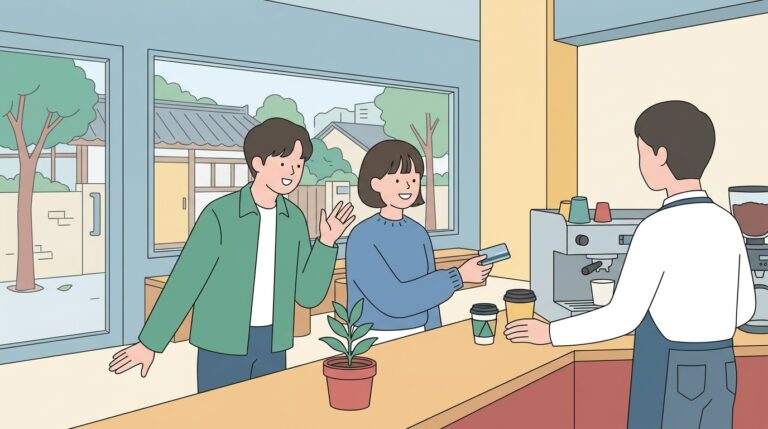
Phase 1: Empathy (Immersive Open)
Hello! Daily Hangul Editor here.
Picture this: You are watching a K-Drama. The main couple has just finished a romantic meal at a high-end restaurant. While the female lead is fixing her makeup in the restroom, the male lead stealthily walks to the counter, slips his matte black credit card to the cashier, and pays the bill in secret. When she returns, he smiles and says, “Let’s go.”
Very romantic, right? But what happens when you step out of the drama and into a bustling BBQ joint in Hongdae on a real date? The bill arrives, and suddenly, you are caught in the middle of a polite but intense “Card Battle” (카드 배틀). You pull out your card, they pull out theirs, and you both insist on paying.
Navigating dating costs in Korea—especially during the talking stage (썸, sseom)—can be a cultural minefield. It is not just about money; it is about Nunchi (눈치), politeness, and reading the room. If you don’t know the unwritten rules and the right phrases, you might end up looking either stingy or stubbornly aggressive.
Do not worry! This guide is built from the real-life panic moments of my B2-level expat students. Today, we will learn exactly how to handle the check like a true Seoulite.
Phase 2: Deep Dive into Core Expressions
1. 제가 낼게요 (I will pay)
- Pronunciation: je-ga nael-ge-yo [sounds like: jeh-gah nel-geh-yo]
- Meaning: Literal: I will pay. / Real nuance: “Let me get this one.”
- K-Culture Moment: This is the magic phrase used right as you stand up to leave. Imagine you are at a cozy cafe in Yeonnam-dong. The date went perfectly. As you grab your coat, you smoothly say, “제가 낼게요.” It is assertive but polite.
- Editor’s Insight: The verb ‘내다’ (to pay/give money) is much more natural here than ‘계산하다’ (to calculate/pay). It sounds generous without being overly formal.
- Situation Spectrum:
- Casual dates/Friends: ✅
- Someone you just met (Polite): ✅
- Formal business: ⚠️ (Better to use “제가 계산하겠습니다”)
- 🤔 Think About It: In many Western cultures, asking “Should we split it?” is the default polite move. In Korea, offering to pay the whole bill first is often considered the polite default, even if you end up splitting it later. Why do you think showing generosity upfront is so crucial in Korean relationships?
2. 1차는 제가, 2차는 그쪽이 내세요 (I’ll get the 1st round, you get the 2nd)
- Pronunciation: il-cha-neun je-ga, i-cha-neun geu-jjog-i nae-se-yo
- Meaning: Literal: For the 1st round, I pay; for the 2nd round, you pay.
- K-Culture Moment: Korean socializing rarely stops at one location. You eat dinner (1차 – 1st round), then move to a cafe or pub (2차 – 2nd round). Instead of awkwardly calculating 50/50 for a 50,000 KRW dinner, one person buys dinner, and the other person says, “Then I’ll buy the coffee!” (그럼 커피는 제가 살게요!).
- Editor’s Insight: This is the holy grail of Korean dating etiquette. It creates a natural excuse to go to a second location together. It is practically a flirting technique!
- Situation Spectrum:
- Casual dates/Friends: ✅
- Semi-formal (Co-workers): ✅
- Formal: 🚫
- 🤔 Think About It: How does the “1차/2차” culture encourage longer, more flowing interactions compared to staying in one restaurant for a 3-hour date?
3. 반반 나눠서 내요 / 더치페이 해요 (Let’s split it)
- Pronunciation: ban-ban na-nwo-seo nae-yo / deo-chi-pe-i hae-yo
- Meaning: Literal: Let’s pay divided in half / Let’s do Dutch pay.
- K-Culture Moment: You are on a date, but there are no sparks flying. You know there will not be a 2차 (2nd round), and you do not want to owe them anything. Saying “반반 나눠서 내요” is a polite way to keep things completely equal (and sometimes, a subtle way to friendzone someone).
- Editor’s Insight: “더치페이” (Dutch pay) is Konglish! Everyone understands it. However, pushing too hard to split a bill when the other person genuinely wants to treat you can be seen as rejecting their goodwill.
- Situation Spectrum:
- University students/Casual: ✅
- First dates in your 30s: ⚠️ (Can feel a bit cold depending on the vibe)
- 🤔 Think About It: In Korea, treating someone to a meal is a primary way to show affection (Jeong, 정). When you insist on paying exactly for what you ate, are you protecting your boundaries, or blocking their affection?
Phase 3: Textbook vs. Real Korean
[Situation 1: Splitting the Bill at the Counter]
* 📖 Textbook Korean: 각자 계산하겠습니다. (We will calculate individually.)
* 🗣️ Real Korean: 따로 결제할게요. (We’ll pay separately.) / 카카오페이로 보낼게요! (I’ll send it via KakaoPay!)
* 💡 Why is it different?: “각자 계산하겠습니다” sounds like you are at a corporate accounting meeting. Young Koreans often just let one person pay at the counter and then quickly transfer their half using KakaoPay or Toss, saying “계좌번호 알려주세요” (Let me know your bank account number).
[Situation 2: Insisting on Paying]
* 📖 Textbook Korean: 제가 비용을 지불하겠습니다. (I will pay the expenses.)
* 🗣️ Real Korean: 에이, 제가 살게요! (Hey~ I’ll buy it!) / 오늘 고기는 제가 쏠게요! (I’ll shoot/treat the meat today!)
* 💡 Why is it different?: Using ‘쏘다’ (to shoot) as slang for ‘treating someone’ is incredibly common and adds a fun, energetic vibe to the conversation.
Bottom Note: For B2 learners, using “제가 낼게요” or “제가 살게요” is the perfect sweet spot. It is natural, polite, and doesn’t sound overly slangy like “내가 쏜다!” which should be reserved for closer friends.
Phase 4: Cultural Context — K-Culture Deep Dive
4-1. Non-verbal Element: The “Card Slap” and Nunchi
In Korea, the physical act of paying involves Nunchi. If you genuinely want to pay, you do not just say it; you have your card ready in your hand before you even reach the counter. Handing the card to the cashier with two hands (or supporting your right arm with your left hand) shows respect to the worker. Also, if your date pays for dinner, the highest form of Nunchi is to immediately step up at the cafe and say, “아까 밥 사셨으니까 커피는 제가 살게요” (Since you bought dinner earlier, I will buy the coffee).
4-2. K-Culture Connection: Media vs Reality
In K-Dramas, wealthy CEOs rent out entire amusement parks and hand over black cards without looking at the price tag. But for regular 20s and 30s Koreans, dating can be expensive.
This is where the “데이트 통장” (Date Tongjang – Shared Dating Bank Account) culture comes in. Couples who have been dating for a while will open a joint bank account. They each deposit a set amount (e.g., 200,000 KRW) every month and use a debit card linked to that account for all their dates. It completely eliminates the stress of “who pays today?” and is a very practical, modern Korean dating trend!
Phase 5: Real-Life Roleplay Scenario
Setting: Friday night, 8:30 PM. You just finished eating delicious Samgyeopsal in Gangnam. You are on a second date, and things are going really well. You both walk up to the cash register.
Characters:
– YOU: An expat working in Seoul. You want to make a good impression.
– Min-su (30): Your Korean date. Friendly, polite, and already reaching for his wallet.
Dialogue:
Min-su: 배부르게 잘 먹었네요. 계산합시다.
(baebu-reuge jal meogeon-neyo. gyesan-hapsida.)
[Translation: I ate well and am so full. Let’s pay.]
(🎭 Stage Direction: Min-su pulls out his credit card and steps toward the cashier.)
YOU: 어, 잠깐만요. 제가 낼게요!
(eo, jamkkan-manyo. je-ga nael-ge-yo!)
[Translation: Oh, wait a second. I will pay!]
Min-su: 에이, 아니에요. 첫 만남도 아니고 두 번째 만남인데 제가 살게요.
(e-i, a-ni-e-yo. cheon man-nam-do a-ni-go du beon-jjae man-nam-in-de je-ga sal-ge-yo.)
[Translation: Hey, no. It’s not our first meeting, it’s our second date, so I will buy.]
YOU: 저번에도 민수 씨가 냈잖아요. 이번엔 진짜 제가 낼게요.
(jeo-beon-e-do min-su ssi-ga naet-ja-na-yo. i-beon-en jin-jja je-ga nael-ge-yo.)
[Translation: You paid last time too, Min-su. I will really pay this time.]
Min-su: 괜찮아요, 진짜. 제가 먼저 밥 먹자고 했잖아요.
(gwaen-cha-na-yo, jin-jja. je-ga meon-jeo bap meok-ja-go haet-ja-na-yo.)
[Translation: It’s really fine. I asked you out to eat first, remember?]
(🎭 Stage Direction: Min-su quickly hands his card to the cashier before you can block him.)
🔀 Your Turn! How should you respond?
– A) “아, 그럼 돈 반반 보내드릴게요. 계좌번호 주세요.” (Ah, then I’ll send you half the money. Give me your account number.)
– B) “그럼 2차는 제가 쏠게요! 맛있는 디저트 먹으러 가요.” (Then I’ll treat for the 2nd round! Let’s go eat some delicious dessert.)
– C) “아싸! 감사합니다. 잘 먹었습니다!” (Yay! Thank you. I ate well!)✅ Best Choice: B — Reason: Since he insisted on paying for the heavy meal, suggesting to pay for the 2nd round (cafe/drinks) perfectly balances the Nunchi. It shows gratitude and guarantees you spend more time together!
⚠️ Choice A Analysis: Insisting on splitting via bank transfer after he already paid can feel like you are rejecting his gesture and drawing a strict line.
Phase 6: 10-Second Shadowing Drill
Practice your tone! Slurring slightly and using a warm, upbeat voice makes it sound much more natural.
- 😤 단호하게 (Assertively but playfully):
아니에요! / 이번에는 / 제가 낼게요!(a-ni-e-yo! / i-beon-e-neun / je-ga nael-ge-yo!) - 😊 밝고 고맙게 (Brightly and thankfully):
우와~ / 그럼 / 2차는 제가 / 쏠게요!(u-wa~ / geu-reom / i-cha-neun je-ga / ssol-ge-yo!)
Phase 7: K-Culture Mini Dictionary
1. 썸 (Sseom)
* Romanization: sseom
* English: Talking stage / Situationship
* Context: From the English word “something.” The delicate phase before officially dating where you have “something” going on. Who pays during ‘Sseom’ is a massive topic of debate on Korean internet forums.
2. 1차 / 2차 (Il-cha / I-cha)
* Romanization: il-cha / i-cha
* English: Round 1 / Round 2
* Context: The Korean culture of hopping from one venue to another in a single outing. Dinner is 1차, Cafe/Pub is 2차, Noraebang (Karaoke) might be 3차!
3. 더치페이 (Dutch Pay)
* Romanization: deo-chi-pe-i
* English: Going Dutch / Splitting the bill
* Context: Widely used Konglish. However, among couples, literal 50/50 splitting at the register is rare; usually, one person pays, and the other transfers money, or they alternate paying.
4. 데이트 통장 (Date Tongjang)
* Romanization: de-i-teu tong-jang
* English: Shared Dating Bank Account
* Context: A pragmatic solution for established couples to share dating expenses equally without the awkwardness of calculating every single meal.
Phase 8: Traveler’s Survival Kit
Even if you are not on a date, paying is a huge part of traveling in Korea. Here is how to handle the bill seamlessly anywhere in Seoul.
🆘 Survival Phrases TOP 3
– 🇰🇷 “따로 결제할게요.” (tta-ro gyol-je-hal-ge-yo)
– 🗣️ English: We will pay separately.
– 📍 Where to use: Restaurants, cafes, convenience stores.
- 🇰🇷 “영수증은 버려주세요.” (yeong-su-jeung-eun beo-ryeo-ju-se-yo)
- 🗣️ English: Please throw away the receipt.
- 📍 Where to use: After paying anywhere (cashiers will almost always ask if you need the receipt).
🇰🇷 “카드 되나요?” (ka-deu doe-na-yo?)
- 🗣️ English: Do you accept credit cards?
- 📍 Where to use: Traditional markets, small food stalls.
📌 Editor’s Travel Note
– Card vs Cash: Korea is a cashless society! You can use a credit card for a 1,000 KRW pack of gum. However, at street food stalls (like Myeongdong or Gwangjang Market), bring some cash or ask for their bank transfer QR code.
– Tipping: There is NO tipping culture in Korea! Do not leave cash on the table; the server will literally run out to the street to return your “forgotten” change.
Phase 9: Critical Thinking Corner — “One Step Deeper”
Media vs Reality: The Illusion of the “Rich CEO Treat”
If you watch K-Dramas, you might think every Korean man drives a luxury car, buys out the entire restaurant, and never lets his date touch her wallet. This media portrayal created a stereotype about traditional gender roles in Korean dating.
However, the reality for Millennials and Gen Z in Korea is vastly different. Faced with high living costs and changing gender dynamics, young Koreans prioritize fairness and practicality. The rise of the Date Tongjang (Shared Account) and the instant KakaoPay transfer culture shows a society shifting away from patriarchal “chivalry” toward egalitarian partnerships. The language hasn’t fully caught up—we still playfully say “내가 쏠게!” (I’ll treat!)—but the mechanics of who actually funds the date have become much more balanced.
💬 Your Turn: How are dating costs usually handled in your culture? Is it strictly 50/50, or is there an expectation for one person to pay? Let us know in the comments!
Phase 10: FAQ & Avoiding Misunderstandings
- Q: Is it okay to ask for their bank account to send half the money on a first date?
- A: Maybe. If the date was just okay and you don’t plan to see them again, it is a polite way to clear the slate. But if you liked them, it’s better to say, “오늘 너무 잘 먹었어요! 다음에는 제가 맛있는 거 살게요” (I ate so well today! Next time, I will buy something delicious). This secures a second date!
- Q: Can I use “내가 쏠게” (I’ll treat) to my boss?
- A: NO! ‘쏘다’ is slang. To your boss or a senior colleague, you should humbly say, “제가 대접하고 싶습니다” (I would like to treat/serve you) or just “오늘은 제가 계산하겠습니다.”
❌ Common Mistake #1: Literally calculating down to the last won (e.g., sending exactly 14,350 KRW).
✅ Do this instead: Koreans usually round up or just take turns buying whole meals. Being too calculative (계산적이다) can be seen as cold and lacking Jeong (warm affection).
Phase 11: Summary & Action Items
- One-Liner Summary: In Korean dating, don’t fight over the exact math; let them buy the dinner (1차), and you smoothly buy the coffee (2차)!
Action Mission:
* 🥉 Bronze (Solo): Look in the mirror, pull out an imaginary credit card, and confidently say, “오늘은 제가 낼게요!”
* 🥈 Silver (Online): Tag your best friend in the comments and write: “다음에 만나면 밥은 내가 쏠게!” (Next time we meet, I’ll treat you to food!)
* 🥇 Gold (Real Life): Next time you go to a Korean cafe or restaurant with a friend, step up to the counter first and use “제가 낼게요!”
K-Culture Mission: Watch a K-Drama episode today. Pay close attention to the restaurant scenes. Do they split the bill, or does one person secretly pay? Notice the body language at the counter!
Phase 12: Quiz — Interactive Challenge
1. Situational Judgment: You are on a great first date. The other person pays for the 60,000 KRW dinner. What is the most culturally savvy response to show you are interested?
– A) “저기요, 각자 계산합시다.” (Excuse me, let’s calculate individually.)
– B) “우와 감사합니다! 안녕히 가세요.” (Wow thank you! Goodbye.)
– C) “잘 먹었습니다! 2차로 커피는 제가 살게요.” (I ate well! I will buy the coffee for the 2nd round.)
2. True or False – K-Culture Edition:
– If you receive great service on a date at a nice Korean restaurant, you should leave a 15% tip on the table. (T / F)
3. Fill in the Blank:
To say “I will pay” smoothly, you say: “제가 ( ________ )요.”
(Answers: 1. C / 2. False – no tipping in Korea! / 3. 낼게 or 살게)
Frequently Asked Questions (FAQ)
Q: What does "제가 낼게요 (I will pay)" mean in Korean and how do you pronounce it?
A: In Korean, "제가 낼게요 (I will pay)" is pronounced [je-ga nael-ge-yo [sounds like: jeh-gah nel-geh-yo] and means: Literal: I will pay. / Real nuance: "Let me get this one."
Q: What does "1차는 제가, 2차는 그쪽이 내세요 (I'll get the 1st round, you get the 2nd)" mean in Korean and how do you pronounce it?
A: In Korean, "1차는 제가, 2차는 그쪽이 내세요 (I'll get the 1st round, you get the 2nd)" is pronounced [il-cha-neun je-ga, i-cha-neun geu-jjog-i nae-se-yo] and means: Literal: For the 1st round, I pay; for the 2nd round, you pay.
Q: What does "반반 나눠서 내요 / 더치페이 해요 (Let's split it)" mean in Korean and how do you pronounce it?
A: In Korean, "반반 나눠서 내요 / 더치페이 해요 (Let's split it)" is pronounced [ban-ban na-nwo-seo nae-yo / deo-chi-pe-i hae-yo] and means: Literal: Let's pay divided in half / Let's do Dutch pay.







