

Hello! I am the Lead Editor of Daily Hangul.
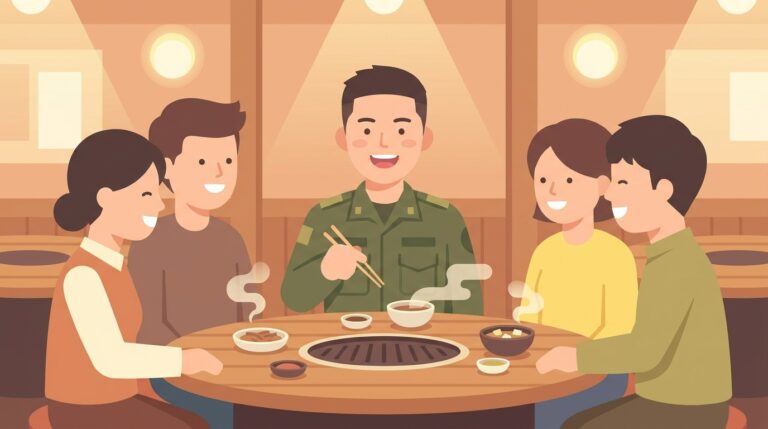
Imagine this: You are watching a K-Drama. The handsome male lead suddenly appears with incredibly short hair. He’s wearing a military uniform, sitting in a Pojangmacha (street tent), and drinking soju with his friends. He looks wildly happy but also slightly heartbroken.
Or maybe you are at a K-Pop concert, and your favorite idol finally stands on stage after an 18-month hiatus, saying, “I missed you all so much.”
If you love K-Culture, you already know that Military Service (군대 – Gundae) is a massive part of a Korean man’s life. But what happens when they get a few precious days off? They come out on “Hyuga” (Leave/Vacation). Knowing how to talk about this isn’t just about learning vocabulary; it’s about understanding the tears, joy, and the massive amounts of Korean BBQ involved in a young Korean man’s life.
Today, we are going to learn how to talk about being on military leave. Let’s dive in!
Phase 2: Core Expressions Deep Dive
1. 저 휴가 나왔어요! (I came out on leave!)
- Pronunciation: jeo hyu-ga na-wat-sseo-yo!
- Sound-alike guide: ‘jeo’ (like juh), ‘hyu’ (like hew), ‘wat’ (rhymes with hot).
- Meaning: Literal: “I came out on vacation.” / Real nuance: “I’m finally free from the military base for a few days! Let’s celebrate!”
- K-Culture Moment: This is the text message every Korean guy sends to his friends, family, and girlfriend the moment he steps out of the military base.
- Editor’s Insight: Notice we use the verb 나왔어요 (came out). It gives a strong feeling of escaping or being released into the wild.
- Situation Spectrum:
- Close friends (Casual): ✅ (Just drop the ‘yo’ -> 나 휴가 나왔어!)
- Co-workers (Semi-formal): ✅
- Elders/Bosses (Formal): ⚠️ (Better to use “휴가 받았습니다” – I received leave)
- 🤔 Think About It: Why do Koreans say they “came out” (나왔다) for a vacation instead of just saying “I have a vacation”? How does location shape the way we view freedom in language?
2. 언제 들어가요? (When do you go back in?)
- Pronunciation: eon-je deul-eo-ga-yo?
- Sound-alike guide: ‘eon’ (like un in under), ‘je’ (like jeh), ‘ga’ (like gah).
- Meaning: Literal: “When do you go in?” / Real nuance: “When is your leave over? (When do you return to base?)”
- K-Culture Moment: This is the most depressing question you can ask a soldier on leave. In K-Dramas, when the girlfriend asks this, the soldier usually sighs and looks at his watch.
- Editor’s Insight: Just like they “come out” (나오다) for leave, they must “go in” (들어가다) to the base. It’s a spatial way of speaking.
- Situation Spectrum:
- Close friends (Casual): ✅ (언제 들어가?)
- Co-workers (Semi-formal): ✅
- Elders/Bosses (Formal): 🚫 (Use “언제 복귀하십니까?”)
- 🤔 Think About It: Does your language have specific verbs for entering and exiting mandatory societal duties?
3. 저 군인이에요. (I am a soldier.)
- Pronunciation: jeo gu-ni-ni-e-yo.
- Sound-alike guide: ‘gu-nin’ sounds like goo-neen.
- Meaning: I am a soldier.
- K-Culture Moment: If a guy with extremely short hair is trying to get a discount at a movie theater or an amusement park in Korea, he will show his ID and say this.
- Editor’s Insight: It’s a straightforward identity statement. Many Korean restaurants actually give extra food for free if they know you are a Gunin!
- Situation Spectrum:
- Close friends (Casual): 🚫 (They already know!)
- Strangers/Clerks (Semi-formal): ✅
- Elders/Bosses (Formal): ✅
- 🤔 Think About It: In Korea, being a soldier is seen as a universal rite of passage for men. How is the military viewed in your home country?
Phase 3: Textbook vs. Real Korean
[Telling friends you are on leave]
* 📖 Textbook Korean: 저는 군대에서 휴가를 받았습니다. (I received a vacation from the military.)
* 🗣️ Real Korean: 나 휴가 나왔어! 만나자! (I came out on leave! Let’s meet!)
* 💡 Why the difference?: Textbooks use passive “received” (받았다), but young Koreans use the active, dynamic “came out” (나왔다) to express their excitement.
[Asking about returning to the base]
* 📖 Textbook Korean: 언제 군대로 돌아갑니까? (When do you return to the military?)
* 🗣️ Real Korean: 언제 들어가? (When do you go in?)
* 💡 Why the difference?: Efficiency! Koreans love short phrases. “Go in” perfectly captures the feeling of returning to an enclosed space.
Bottom Note: At the A2 (Beginner) level, stick to verbs like 나오다 (come out) and 들어가다 (go in). They are super easy to remember and make you sound incredibly native!
Phase 4: Cultural Context — K-Culture Deep Dive
4-1. Non-Verbal Elements
When a soldier is on leave, you will immediately notice the “까까머리” (Kkakka-meori)—the very short buzz cut. Also, when soldiers meet their older friends or elders, they might playfully do a military salute and shout “충성!” (Chung-seong! – Loyalty!). But as a foreigner, you don’t need to salute them! Just give them a warm smile.
4-2. The K-Food Connection
Why do soldiers eat so much on leave?
In the military, soldiers eat standard mess hall food. So, when they come out on Hyuga, they have a “Must-Eat List.”
Usually, it starts with Samgyeopsal (Pork Belly) and Soju with friends, followed by their mom’s home-cooked Doenjang-jjigae (Soybean Paste Stew). If you are at a Korean restaurant and the owner (usually an older lady called Imo-nim) notices a young man with short hair in a uniform, she will often bring out a free plate of steamed egg or soda and say, “고생이 많네, 서비스야!” (You’re working hard, this is on the house!).
Critical View: Food in Korea isn’t just calories; it’s Jeong (정 – affection/connection). Feeding a hungry soldier is a collective cultural way of saying, “Thank you for your service.”
Phase 5: Real-Life Roleplay Scenario
Setting: Friday evening, 7 PM. A noisy Korean BBQ restaurant in Gangnam. The smell of roasting pork belly fills the air. You are waiting for your Korean language exchange partner, Minho, whom you haven’t seen in 6 months.
Characters:
– YOU: A foreign student in Korea who loves K-Culture.
– Minho (21): Your Korean friend. He walks in wearing a military uniform with a buzz cut.
Dialogue:
YOU: 민호 씨! 머리가 왜 그래요? 😲
(Minho ssi! meoriga wae geuraeyo?)
[Minho! What happened to your hair?]
Minho: 하하, 저 군인이에요. 오늘 휴가 나왔어요! 🎖️
(Haha, jeo guninieyo. oneul hyuga nawasseoyo!)
[Haha, I am a soldier. I came out on leave today!]
YOU: 우와, 진짜요? 축하해요! 고기 많이 먹어요. 🥩
(Uwa, jinjjayo? chukahaeyo! gogi mani meogeoyo.)
[Wow, really? Congratulations! Eat a lot of meat.]
Minho: 네, 군대 밥 맛없어요… 삼겹살 너무 먹고 싶었어요.
(Ne, gundae bap maseopseoyo… samgyeopsal neomu meokgo sipeosseoyo.)
[Yeah, military food isn’t tasty… I really wanted to eat pork belly.]
(🎭 Stage Direction: Minho eats three pieces of meat at once)
YOU: 천천히 먹어요! 그런데… 휴가 며칠이에요?
(Cheoncheonhi meogeoyo! geureonde… hyuga myeochirieyo?)
[Eat slowly! By the way… how many days is your leave?]
Minho: (suddenly looks sad 😢) 3박 4일이요…
(Sambak sa-iriyo…)
[3 nights and 4 days…]
🔀 Your Turn! How should you reply to his sad news?
– A) “언제 들어가요?” (When do you go back in?)
– B) “너무 짧아요! 오늘 제가 살게요!” (That’s too short! I’ll pay today!)
– C) “수고하세요!” (Keep up the good work!)✅ Best Choice: B — Buying food for a soldier on leave is the ultimate Korean flex. It shows great empathy (눈치 – Nunchi).
⚠️ Choice A Analysis: It’s grammatically correct, but reminding him of his return right now might make him cry into his lettuce wrap!
Bonus K-Culture Scenario: At the Cafe
(You are working part-time at a cafe. A soldier orders a drink.)
– Soldier: 아이스 아메리카노 한 잔 주세요. (One iced Americano, please.)
– YOU: 네, 군인이시네요! 사이즈 업 무료로 해드릴게요. (Yes, you’re a soldier! I’ll upgrade your size for free.)
– Soldier: 헉, 진짜요? 감사합니다! (Gasp, really? Thank you!)
Phase 6: 10-Second Shadowing Drill
Let’s practice the excitement of coming out on leave!
😆 저 / 오늘 / 휴가 / 나~~왔어요!
(jeo / o-neul / hyu-ga / na~~wat-sseo-yo!)
Tip: Stretch out the “na~~” to emphasize how long you’ve waited for this moment! Make your voice bright and excited.
🥺 아... / 내일 / 들어가요.
(a... / nae-il / deul-eo-ga-yo.)
Tip: Drop your shoulders. Make the “ah…” sound like a deep sigh of regret.
Phase 7: K-Culture Mini Dictionary
1. 군대 (Gundae)
* Romanization: gun-dae
* English: The Military
* Context: Mandatory for all able-bodied Korean men, usually lasting 18-21 months.
2. 휴가 (Hyuga)
* Romanization: hyu-ga
* English: Leave / Vacation
* Context: Can be used for both military leave and normal office worker vacations.
3. 복귀 (Bokgwi)
* Romanization: bok-gwi
* English: Return (to base)
* Context: The most dreaded word for a Korean soldier. It means their freedom is over.
4. 고무신 (Gomusin)
* Romanization: go-mu-sin
* English: Rubber shoes
* Context: A slang term for a girlfriend waiting for her boyfriend to finish his military service.
Phase 8: Traveler’s Survival Kit
Even if you aren’t in the military, if you travel to Korea, you will see soldiers everywhere—especially at Seoul Station or bus terminals on Friday evenings.
🆘 Survival Phrases for K-BBQ (Where you will see them!)
– 🇰🇷 “사장님, 여기 주문할게요!” (Sajangnim, yeogi jumunhalgeyo!)
– 🗣️ English: Boss, I’d like to order here!
– 📍 Where to use: Any bustling Korean restaurant.
– 💡 Pro Tip: Don’t be shy! You have to raise your hand and speak loudly in a Korean BBQ place, or you’ll never get your meat.📌 Editor’s Travel Note
– Trains: On Friday nights and Sunday afternoons, KTX trains are packed with soldiers going on leave or returning. Book your tickets early!
– Discounts: If you are a foreign military member visiting Korea, some places might still offer you a military discount if you show ID, but it depends on the owner’s “Jeong.”
Phase 9: Critical Thinking — “One Step Deeper”
Language & Power: The Brotherhood of Honorifics
In the Korean military, rank is everything. This rigid hierarchy spills over into the Korean language. Soldiers use an extreme form of formal language called “다/까 (Da/Kka) speech” (ending all sentences in -mnida or -mnikka). However, once they “come out” on leave and take off the uniform, they switch back to casual “요 (Yo)” or “반말 (Banmal)” with friends.
This switching of speech styles based on clothes and location shows how deeply Korean language is tied to social roles and hierarchy.
💬 Your Turn: In your culture, do people change the way they speak when they put on a uniform? Share your thoughts in the comments!
Phase 10: FAQ & Avoiding Misunderstandings
Q: Can I use “휴가 (Hyuga)” for my normal office job vacation?
Yes, absolutely! “휴가” is the standard word for taking days off from work. (For school vacations, use “방학” – Banghak).
Q: If I meet a K-Pop idol at a fan sign and he just finished his service, what should I say?
Say, “제대 축하해요!” (Congratulations on your discharge!). Je-dae means finishing military service completely, not just a short leave.
❌ Common Mistake #1: Saying “방학 나왔어요!” (I came out on school vacation!)
✅ Do this instead: Use “방학” only for school, and “휴가” for military or work. Also, students “do” vacation (방학 했어요), but soldiers “come out” (휴가 나왔어요).
Phase 11: Summary & Action Items
One-Liner Summary: When a Korean man is on military leave, remember the magic words: “휴가 나왔어요!” (I came out on leave!) and prepare to buy him lots of K-Food!
Action Mission 3 Steps:
– 🥉 Bronze (Solo): Stand in front of the mirror, give a cool salute, and say “저 오늘 휴가 나왔어요!” 3 times.
– 🥈 Silver (Online): Go to a K-Pop idol’s YouTube video who recently finished their military service and leave a comment: “오빠 군인 끝! 수고하셨어요!” (Oppa, military is done! Great job!).
– 🥇 Gold (Real-world): Next time you watch a K-Drama and see a soldier eating Jajangmyeon (Black bean noodles), shout at the screen: “휴가 나왔어요?”
K-Culture Mission: Watch an episode of the K-Drama D.P. or Crash Landing on You. Can you spot the difference between how they speak inside the base versus outside?
Engagement: Have you ever tried Korean military food (like MREs or Bogeul-Bogeul Ramen)? Let me know in the comments below!
Phase 12: Interactive Quiz — K-Culture Challenge
1. Fill in the Blank:
Minho just walked out of the military base. He calls his mom and says:
“엄마! 저 오늘 ____ 나왔어요! 고기 구워주세요!”
(A) 방학 (Banghak)
(B) 휴가 (Hyuga)
(C) 출장 (Chuljang)
2. True or False – K-Culture Edition:
“If you see a soldier in a K-BBQ restaurant, you must salute them.”
3. Situational Judgment:
Your friend is returning to the military base tomorrow. What is the BEST thing to say?
(A) “언제 들어가요?” (When do you go in?)
(B) “빨리 들어가요!” (Go in quickly!)
(C) “오늘 맛있는 거 많이 먹어요!” (Eat lots of delicious things today!)
👀 Click here for Answers!
1. (B) 휴가 (Hyuga) – Remember, 방학 is for school, 출장 is a business trip!
2. False – Please don’t salute them! A warm smile or offering to buy them a drink is much better.
3. (C) – Treat them well on their last day of freedom!
Frequently Asked Questions (FAQ)
Q: What does "저 휴가 나왔어요! (I came out on leave!)" mean in Korean and how do you pronounce it?
A: In Korean, "저 휴가 나왔어요! (I came out on leave!)" is pronounced [jeo hyu-ga na-wat-sseo-yo!] and means: a key conversational Korean expression covered in this lesson.
Q: What does "언제 들어가요? (When do you go back in?)" mean in Korean and how do you pronounce it?
A: In Korean, "언제 들어가요? (When do you go back in?)" is pronounced [eon-je deul-eo-ga-yo?] and means: a key conversational Korean expression covered in this lesson.
Q: What does "저 군인이에요. (I am a soldier.)" mean in Korean and how do you pronounce it?
A: In Korean, "저 군인이에요. (I am a soldier.)" is pronounced [jeo gu-ni-ni-e-yo.] and means: a key conversational Korean expression covered in this lesson.







