

Wanna Get Some Fresh Air? How to Propose a Spontaneous Trip to the East Sea in Korean
Phase 1: Empathy (The K-Culture Cold Open)
Hello! I’m the Lead Editor at Daily Hangul.
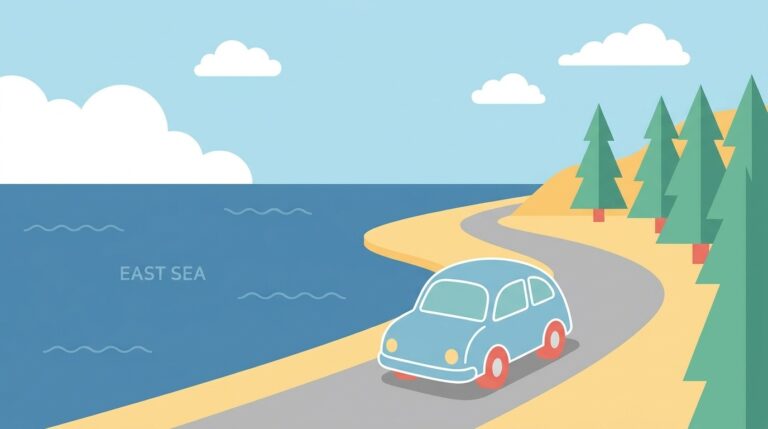
Picture this: You are watching a K-Drama. The male lead looks at the exhausted female lead who just had a terrible day at work. He doesn’t ask her to go to a fancy restaurant. Instead, he simply says, ‘바람 쐬러 갈래?’ (Wanna go get some fresh air?). Cut to the next scene: They are driving down a stunning coastal road, eating grilled clams, and staring out at a deep, infinitely blue ocean.
That ocean? It’s almost always the East Sea (동해 – Donghae).
In Korea, suggesting a trip to the East Sea isn’t just a geographical choice. It’s the ultimate ‘insider’ move that means, ‘Let’s escape the suffocating city, clear our minds, and heal.’ If you only know textbook Korean, you might sound like a robot planning a geography field trip. Today, based on real questions from my students, I will teach you how to propose a trip to the East Sea exactly like a Seoulite!
Phase 2: Core Expressions Deep Dive
Here are the top 3 ways to propose an East Sea getaway, from casual to K-Drama romantic.
1. 우리 동해 바다 보러 갈래?
- Pronunciation: uri donghae bada boreo gallae? [oo-ri dong-hae ba-da bo-reo gal-lae? – ‘gae’ sounds like the ‘ga’ in gap, but add an ‘l’ at the end]
- Meaning: (Literal) Shall we go to see the East Sea? / (Real nuance) Let’s go check out the East Sea!
- K-Culture Moment: You are sitting in a café with a close friend on a Friday afternoon, completely burned out. You suddenly check the KTX train schedule and drop this line. It’s the ultimate spontaneous travel trigger.
- Editor’s Insight: Notice how Koreans say ‘to see the sea’ (바다 보러) rather than ‘to go to the sea’ (바다에 가러). In Korea, beach trips aren’t always for swimming. We go just to look at the waves and eat seafood!
- Situation Spectrum:
- Close Friends (Casual): ✅
- Co-workers (Semi-formal): ⚠️ (Change to: 가실래요? – gasillaeyo?)
- Boss/Elders (Formal): 🚫
- 🤔 Think About It: Why do you think looking at the ocean (바다 물멍 – spacing out at the sea) is such a popular ‘healing’ activity in fast-paced Korean society?
2. 주말에 강릉으로 드라이브 갈까요?
- Pronunciation: jumare gangneungeuro deuraibeu galkkayo? [joo-ma-re gang-neung-eu-ro deu-ra-i-beu gal-kka-yo?]
- Meaning: (Literal) Shall we go for a drive to Gangneung on the weekend? / (Real nuance) Let’s take a road trip to Gangneung this weekend.
- K-Culture Moment: This is a classic semi-polite proposal, often used between colleagues who are close, or during the early ‘some’ (썸 – talking/dating) stage when you want to spend a few hours together in a car.
- Editor’s Insight: Gangneung (강릉) and Sokcho (속초) are the two most famous cities on the East Coast. Saying ‘Let’s go to Gangneung’ automatically implies ‘Let’s go to the East Sea, drink coffee at the beach, and eat good food.’
- Situation Spectrum:
- Close Friends (Casual): ⚠️ (Too polite, say 갈까? instead)
- Co-workers/Dates (Semi-formal): ✅
- Boss/Elders (Formal): 🚫
- 🤔 Think About It: In English, ‘drive’ usually implies just riding in a car. In Korean, ‘드라이브’ (drive) implies a scenic leisure trip to a specific beautiful destination. Does your language have a borrowed word that changed its meaning slightly?
3. 답답한데 바람이나 쐬러 갈래?
- Pronunciation: dapdapande baramina ssoereo gallae? [dap-da-pan-de ba-ra-mi-na sswe-reo gal-lae?]
- Meaning: (Literal) I’m feeling stuffy, wanna go get some wind? / (Real nuance) I need to escape the city, let’s go get some fresh air.
- K-Culture Moment: The ultimate K-Drama line. ‘답답하다’ (dapdapada) is a B1 level word meaning you feel suffocated, either physically or emotionally.
- Editor’s Insight: This is an indirect, charming way to propose a trip. You aren’t explicitly saying ‘Let’s travel!’ which might feel burdensome. You’re just asking to ‘get some wind,’ which eventually leads to the East Sea!
- Situation Spectrum:
- Close Friends/Partner (Casual): ✅
- Co-workers (Semi-formal): ⚠️
- Boss/Elders (Formal): 🚫
- 🤔 Think About It: Korean culture values Nunchi (reading the room). How does using an indirect proposal like ‘getting fresh air’ protect both people’s feelings if the answer is ‘no’?
Phase 3: Textbook vs. Real Korean
Let’s see how native speakers actually talk when planning a trip.
[Suggesting a spontaneous trip]
* 📖 Textbook Korean: 바다에 같이 가고 싶습니다. (I want to go to the sea with you.)
* 🗣️ Real Korean: 주말에 강릉 쏠까? (Should we shoot over to Gangneung this weekend?)
* 💡 Why is it different?: Young Koreans use the verb ‘쏘다’ (to shoot) to describe going somewhere quickly and spontaneously, emphasizing the excitement of the trip.
[Expressing the need to escape]
* 📖 Textbook Korean: 저는 지금 스트레스가 많아요. (I have a lot of stress right now.)
* 🗣️ Real Korean: 아, 바다 마렵다. (Ah, I’m craving the sea.)
* 💡 Why is it different?: ‘마렵다’ originally means needing to go to the bathroom, but internet culture turned it into a funny slang meaning you desperately want to do something right now (use only with close friends!).
Bottom Note: At the
B1 (Intermediate)level, it’s great to understand slang like ‘마렵다’, but for your own speaking, sticking to ‘답답해서 훌쩍 떠나고 싶어’ (I feel stuffy, I want to suddenly leave) is the perfect balance of natural and polite!
Phase 4: Cultural Context — K-Culture Deep Dive
4-1. Non-verbal Cues: The Art of the ‘Casual’ Suggestion
When suggesting an East Sea trip, don’t make it sound like a massive project with Excel spreadsheets. In Korea, this specific trip is about spontaneity. Say it while scrolling through your phone looking at beach pictures, or while letting out a deep sigh of exhaustion (아~ 답답해!). Keep your tone light and breezy.
4-2. Geography & K-Drama Tropes: East vs. West vs. South Sea
Why always the East Sea? Korea is surrounded by water on three sides, but each has a distinct ‘personality’.
* West Sea (서해): Mudflats, beautiful sunsets, family clam-digging trips.
* South Sea (남해): Thousands of islands (like Jeju), warm weather, emerald water.
* East Sea (동해): Deep, freezing, incredibly blue water, crashing waves, and the sunrise (일출).
In K-Dramas, when characters need to make a big life decision or heal from a breakup, they go to the East Sea to watch the sunrise (specifically at Jeongdongjin – 정동진). It symbolizes a fresh start. So, when you invite a Korean friend to the East Sea, you are inviting them to ‘reset’ their mind!
Phase 5: Real-Life Roleplay Scenario
Setting: A Friday night at a busy Samgyeopsal (pork belly) restaurant in Gangnam. You and your Korean coworkers just finished a brutal week of overtime.
Characters:
– YOU: A foreign employee who wants to experience a real Korean weekend getaway.
– Min-su (32): Your friendly, slightly overworked Korean coworker.
Dialogue:
Min-su: 아… 이번 주 진짜 하얗게 불태웠다. 너무 피곤해요. 🍺
(a… ibeon ju jinjja hayake bultaewotda. neomu pigonhaeyo.)
[Ah… I really burned my soul to white (worked too hard) this week. I’m so tired.]
(🎭 Stage Direction: Min-su takes a shot of Soju and sighs heavily)
YOU: 맞아요. 매일 야근했잖아요. 우리 주말에 푹 쉬어야 해요.
(majayo. maeil yageunhaetjanayo. uri jumare puk swieoya haeyo.)
[You’re right. We worked overtime every day. We need to rest well this weekend.]
Min-su: 집에서 자는 것도 좋지만, 좀 답답하네요. 어디로 훌쩍 떠나고 싶어요.
(jibeseo janeun geotdo jochiman, jom dapdaphaneyo. eodiro huljjeok tteonago sipeoyo.)
[Sleeping at home is good, but I feel a bit stifled. I want to suddenly leave for somewhere.]
YOU: 오? 그럼 우리 바다 보러 갈까요? 🌊
(o? geureom uri bada boreo galkkayo?)
[Oh? Then shall we go see the ocean?]
Min-su: 바다요? 좋죠! 서해 갈까요? 대천 해수욕장?
(badayo? jochyo! seohae galkkayo? daecheon haesuyokjang?)
[The ocean? Sounds great! Shall we go to the West Sea? Daecheon Beach?]
YOU: 에이~ 스트레스 풀 때는 동해 바다죠!
(ei~ seuteureseu pul ttaeneun donghae badajyo!)
[Hey~ When relieving stress, it has to be the East Sea!]
Min-su: 오, 한국 사람 다 됐네요! 그럼 내일 강릉으로 쏠까요?
(o, hanguk saram da dwaenneyo! geureom naeil gangneungeuro ssolkkayo?)
[Oh, you’ve become totally Korean! Then shall we shoot over to Gangneung tomorrow?]
🔀 Your Turn! How should you respond?
– A) 네! 제가 수영복 챙길게요! (Yes! I will pack my swimsuit!)
– B) 콜! 제가 KTX 표 알아볼게요. (Call! I’ll look up KTX tickets.)
– C) 죄송해요, 저는 동해를 모릅니다. (Sorry, I don’t know the East Sea.)✅ Best Choice: B — ‘콜’ (Call) means ‘I’m in/Deal!’ in Korean slang. Also, volunteering to book the KTX shows great initiative.
⚠️ Choice A Analysis: Unless it’s mid-summer (late July-August), Koreans rarely swim in the East Sea because it’s freezing. They go just to look at it, drink coffee, and eat raw fish (회)!
Min-su: 좋아요. 가서 바다 보면서 회 한 접시 합시다!
(joayo. gaseo bada bomyeonseo hoe han jeopsi hapsida!)
[Great. Let’s go look at the ocean and have a plate of raw fish!]
YOU: 완벽한 계획이에요. 내일 아침에 서울역에서 만나요!
(wanbyeokan gyehoegieyo. naeil achime seoullyeogeseo mannayo!)
[It’s a perfect plan. See you at Seoul Station tomorrow morning!]
Phase 6: 10-Second Shadowing Drill
Time to speak like a K-Drama lead! Pay attention to the pauses (/) and the emotion.
😤 (Sighing deeply) 아, / 요즘 너무 / 답답한데... (a, / yojeum neomu / dapdaphande...)
😊 (Brightening up) 이번 주말에 / 강릉으로 / 바다 보러 갈래? (ibeon jumare / gangneungeuro / bada boreo gallae?)
Tip: Drag out the ‘아~’ at the beginning to really show your exhaustion before dropping the exciting proposal!
Phase 7: K-Culture Mini Dictionary
1. 당일치기
* Romanization: dang-il-chigi
* English: A day trip
* Context: The East Sea is about 2 hours from Seoul via the KTX train. Many Koreans do a ‘당일치기’ trip—leaving early in the morning, having lunch by the beach, and returning to Seoul by night.
2. 물멍
* Romanization: mul-meong
* English: Zoning out while looking at the water
* Context: A combination of ‘물’ (water) and ‘멍때리다’ (to space out). The main activity when visiting the East Sea in winter.
3. 회
* Romanization: hoe
* English: Korean sliced raw fish
* Context: Unlike Japanese sushi or sashimi, Korean ‘hoe’ is often eaten wrapped in lettuce with garlic and spicy Ssamjang paste. It’s a must-eat at the East Sea.
4. 일출
* Romanization: il-chul
* English: Sunrise
* Context: The East Coast is famous for sunrises. Many people drive there on New Year’s Eve to watch the first sunrise of the year for good luck.
Phase 8: Traveler Survival Kit (East Sea Edition)
Heading to Gangneung or Sokcho? You need these survival phrases!
🆘 Survival Phrase #1: Booking Tickets
– 🇰🇷 “강릉행 KTX 편도 한 장 주세요.” (gangneunghaeng KTX pyeondo han jang juseyo.)
– 🗣️ English: One one-way KTX ticket to Gangneung, please.
– 📍 Where to use: Seoul Station, Cheongnyangni Station.🆘 Survival Phrase #2: Taking a Taxi at the Station
– 🇰🇷 “경포대 해수욕장으로 가주세요.” (gyeongpodae haesuyokjangeuro gajuseyo.)
– 🗣️ English: Please take me to Gyeongpodae Beach.
– 📍 Where to use: Taxi stands outside the station.🆘 Survival Phrase #3: Ordering at a Beachside Restaurant
– 🇰🇷 “여기 모둠회 소(小) 자 하나 주세요!” (yeogi modumhoe so ja hana juseyo!)
– 🗣️ English: We’ll have one small assorted raw fish platter here, please!
– 📍 Where to use: Any ‘횟집’ (Raw fish restaurant) along the coast.📌 Editor’s Travel Note
– KTX vs. Bus: The KTX to Gangneung takes about 2 hours, but tickets sell out weeks in advance for weekends. If sold out, take an Express Bus (고속버스) from Seoul Express Bus Terminal.
– Sokcho: Sokcho does not have a KTX station yet! You MUST take a bus if you want to go there.
Phase 9: Critical Thinking Corner — ‘One Step Deeper’
Media vs. Reality: The K-Drama Illusion of the ‘Spontaneous Trip’
🧠 Think Deeper:
In K-Dramas, the handsome CEO suddenly grabs the heroine’s hand, puts her in his luxury sponsored car, and they arrive at the empty East Sea an hour later to watch the sunset.Here is the reality check:
1) The sun sets in the West, not the East! (Dramas often film sunsets on the West coast and pretend it’s the East coast).
2) If you drive to Gangneung on a Saturday morning, it won’t take 2 hours. Thanks to massive traffic on the Yeongdong Expressway, it can take 4 to 5 hours!
This is why real Koreans highly value booking KTX tickets in advance. The ‘spontaneous’ car trip is highly romanticized in media, but true locals know that planning is the real secret to a stress-free East Sea getaway.💬 Your Turn: Do movies and TV shows in your country romanticize a specific travel destination? Does reality match the movie? Share in the comments!
Phase 10: FAQ & Avoiding Misunderstandings
Q: Can I use “갈래?” (gallae?) to my Korean boss?
A: Absolutely NOT! ‘갈래?’ is strict informal language (반말 – banmal). If you want to suggest a trip or team workshop to your boss, say: “이번 워크숍은 강릉으로 가는 게 어떨까요?” (How about going to Gangneung for this workshop?).
Q: Why do Koreans ask me to go to the beach in November? Are they crazy?
A: In Korea, ‘겨울 바다’ (Winter Sea) is a huge cultural vibe. We bundle up in long padding jackets, hold hot cups of coffee, and just stare at the freezing waves. It’s romantic and peaceful. No swimming involved!
❌ Common Mistake #1: Packing a swimsuit when someone says ‘바다 보러 가자’ in Spring/Fall.
✅ Do This Instead: Dress nicely! You are going to take Instagram photos at seaside cafes, not swim.
Phase 11: Summary & Action Items
- One-Liner Summary: To propose a romantic or healing trip like a local, ask your friend, “답답한데 동해 바다 보러 갈래?” (Feeling stuffy? Wanna go see the East Sea?).
Your Action Missions for Today:
* 🥉 Bronze (Solo): Look at a map of South Korea and locate the East Sea (동해) and the city of Gangneung (강릉).
* 🥈 Silver (Online): Go to YouTube and search ‘강릉 바다 VLOG’ (Gangneung Sea Vlog) to see what a Korean beach trip actually looks like.
* 🥇 Gold (Real World): Text a Korean friend: “요즘 답답한데, 바다 마렵다!” (I feel stifled lately, I’m craving the ocean!). Watch their impressed reaction!
Phase 12: Quiz — Interactive Challenge
1. Situational Judgment: Your close Korean friend says they are super stressed from final exams. What is the most natural B1-level response to suggest a trip?
– A) 저는 지리를 좋아합니다. 동해로 가시죠.
– B) 답답한데 우리 주말에 강릉으로 바다나 보러 갈래?
– C) 동해 바다에서 수영합시다!
2. True or False – K-Culture Edition:
– “When a Korean suggests going to the East Sea in December, they expect you to bring a swimsuit and towel.”
3. Fill in the Blank:
– Ah, I feel so stifled right now.
– 아, 너무 ( ______ )한데 바람 좀 쐬고 싶다.
👀 Click here for Answers!
1. B – It perfectly uses ‘답답하다’ (stifled) and suggests ‘seeing’ the sea casually.
2. False – Winter sea trips are for ‘물멍’ (spacing out looking at water) and eating seafood, not swimming!
3. 답답 (dapdap) – The essential B1 vocabulary word for feeling suffocated or frustrated!
Did you enjoy this lesson? Where is your favorite place to go when you need ‘fresh air’ in your country? Let me know below! 🌊🚗
Frequently Asked Questions (FAQ)
Q: What does "우리 동해 바다 보러 갈래?" mean in Korean and how do you pronounce it?
A: In Korean, "우리 동해 바다 보러 갈래?" is pronounced [uri donghae bada boreo gallae? [oo-ri dong-hae ba-da bo-reo gal-lae? - 'gae' sounds like the 'ga' in gap, but add an 'l' at the end] and means: (Literal) Shall we go to see the East Sea? / (Real nuance) Let's go check out the East Sea!
Q: What does "주말에 강릉으로 드라이브 갈까요?" mean in Korean and how do you pronounce it?
A: In Korean, "주말에 강릉으로 드라이브 갈까요?" is pronounced [jumare gangneungeuro deuraibeu galkkayo? [joo-ma-re gang-neung-eu-ro deu-ra-i-beu gal-kka-yo?] and means: (Literal) Shall we go for a drive to Gangneung on the weekend? / (Real nuance) Let's take a road trip to Gangneung this weekend.
Q: What does "답답한데 바람이나 쐬러 갈래?" mean in Korean and how do you pronounce it?
A: In Korean, "답답한데 바람이나 쐬러 갈래?" is pronounced [dapdapande baramina ssoereo gallae? [dap-da-pan-de ba-ra-mi-na sswe-reo gal-lae?] and means: (Literal) I'm feeling stuffy, wanna go get some wind? / (Real nuance) I need to escape the city, let's go get some fresh air.







