

Phase 1: Empathy (Immersive Open)
Hello! I’m your Daily Hangul editor.
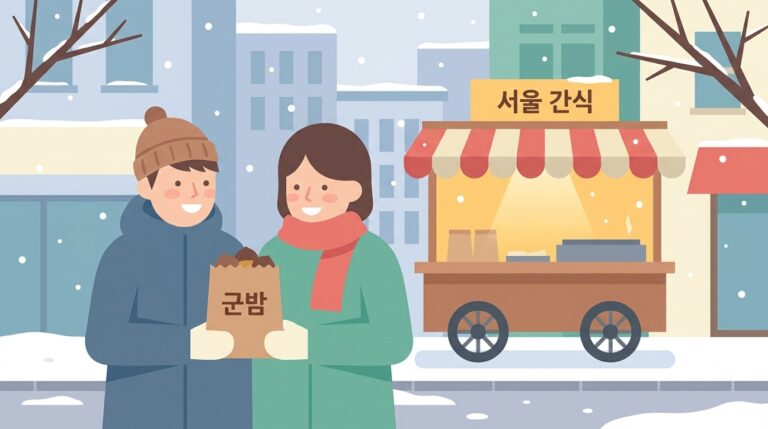
Picture this: It’s December in Seoul. The wind is freezing, but you’re walking down the vibrant streets of Myeongdong or Hongdae. Suddenly, a sweet, smoky aroma fills the air. You look over and see an Ahjussi (older man) turning a large iron drum. Inside? Plump, golden roasted chestnuts (Gunbam).
If you’ve watched any winter-themed K-Drama (think Goblin or Reply 1988), you know this scene. The male lead buys a small brown paper bag, burns his fingers a little, and peels a warm chestnut to hand to the female lead. It’s the ultimate winter romance trope.
But wait—when you actually step up to that cart, your mind goes blank. How do you ask for a bag? What if it’s too hot to hold? And how do you navigate the tricky business of peeling them without looking silly? Today, we are diving deep into the cozy, smoky world of Gunbam. Knowing these phrases won’t just get you a snack; they will earn you a warm smile from the vendor and make you feel like a true Seoulite.
Phase 2: Deep Dive into Core Expressions
1. 한 봉지 주세요 (han bongji juseyo)
- Pronunciation: [han bong-jee joo-se-yo]
- Meaning: Literal = “One bag give me, please.” / Real nuance = “I’ll take one bag, please.”
- K-Culture Moment: Unlike a supermarket where you weigh produce, Korean street food like Gunbam or Bungeoppang (fish-shaped pastry) is usually sold by the bongji (bag). You’ll often see signs saying “5,000 won per bag.”
- Editor’s Insight: The word bongji refers to the brown paper bag they serve it in. If you want two bags, simply say du bongji (두 봉지). It’s the standard, polite way to order from any street vendor.
- Situation Spectrum:
- Friends (Casual): 🚫 (You wouldn’t order from a friend)
- Street Vendors/Staff (Semi-formal): ✅
- Formal/Elders (Formal): ✅
- 🤔 Think About It: Korean heavily relies on “counter words” (like bongji for bags, gae for items, myeong for people). Why do you think the language categorizes objects so specifically when counting?
2. 앗, 뜨거워요! (at, tteugeowoyo!)
- Pronunciation: [at, tteu-geo-wo-yo!] (For ‘뜨’, imagine the sharp ‘dd’ sound mixed with an ‘eu’ sound of stepping in gum.)
- Meaning: Literal = “Ah, it’s hot!” / Real nuance = “Ouch, this is burning hot!”
- K-Culture Moment: You grab a freshly roasted chestnut, and it burns your fingertips. You drop it back into the bag and instinctively yell, “앗 뜨거!” (At tteugeo!). The vendor might chuckle and tell you to wait a minute.
- Editor’s Insight: A crucial B1 distinction! In English, “hot” means both spicy and high temperature. In Korean, spicy is maepda (맵다), but temperature hot is tteugeopda (뜨겁다). Never say your chestnut is maepda!
- Situation Spectrum:
- Friends (Casual): ✅ (앗 뜨거!)
- Co-workers (Semi-formal): ✅ (뜨겁네요!)
- Formal/Elders (Formal): ⚠️ (Try to keep your composure, but reflexes happen!)
- 🤔 Think About It: Why does English use the same word for spicy and high temperature, while Korean separates them? How does your native language handle this?
3. 껍질 까 주세요 (kkeopjil kka juseyo)
- Pronunciation: [kkeop-jil kka joo-se-yo]
- Meaning: Literal = “Peel the skin, please.” / Real nuance = “Could you peel this for me?”
- K-Culture Moment: Peeling food for someone (chestnuts, tangerines, or the famous perilla leaf/shrimp debate in K-Pop fandoms) is a profound act of affection in Korea. If you ask a friend to peel a chestnut for you, you’re either being playful or very close.
- Editor’s Insight: Kkada (까다) means to peel. Often, we combine it with eat: Kka meokda (까 먹다 – to peel and eat). If the chestnuts are hard to peel, you might pout to your Korean friend and say, “이거 까 줘” (Peel this for me).
- Situation Spectrum:
- Romantic Partner/Close Friend (Casual): ✅ (까 줘~)
- Co-workers (Semi-formal): 🚫 (A bit too intimate!)
- Street Vendor: ⚠️ (Some vendors sell pre-peeled ones, known as Kkambam (깐밤).)
- 🤔 Think About It: Feeding someone or doing the physical labor of peeling their food is considered a “love language” in Korea. Do you have similar food-related love languages in your culture?
Phase 3: Textbook vs. Real Korean
[Situation 1: When the chestnut is impossible to peel]
* 📖 Textbook Korean: 껍질을 벗기기 매우 어렵습니다. (It is very difficult to remove the peel.)
* 🗣️ Real Korean: 아, 이거 안 까져요! (Ah, this won’t peel!)
* 💡 Why is it different?: Koreans often use passive forms (안 까져요 – it doesn’t get peeled) to express frustration with inanimate objects, taking the blame off themselves!
[Situation 2: Asking the vendor for a little extra]
* 📖 Textbook Korean: 조금 더 주실 수 있나요? (Could you possibly give me a little more?)
* 🗣️ Real Korean: 사장님~ 두 개만 더 주세요~ 😊 (Boss~ just give me two more please~)
* 💡 Why is it different?: Asking for Deom (덤 – an extra freebie) is part of Korean street market charm. Being specific (“just two more”) with a bright smile works better than a formal, textbook request.
Bottom Note: At the B1 level, try using passive structures like “안 까져요” (It won’t peel) or “안 열려요” (It won’t open) instead of saying “I cannot peel it.” It sounds 10x more natural!
Phase 4: Cultural Context — K-Culture Deep Dive
4-1. Non-Verbal Cues: The Art of the Winter Shiver
When buying Gunbam, language is only half the battle. To truly blend in, you need the “Winter Vibe.” Stand close to the roasting drum, rub your hands together, and blow on your fingertips. When you receive the bag, accept it with both hands (a standard sign of respect) and immediately use it as a hand warmer.
4-2. The K-Drama Trope: The Peeling Romance
Have you noticed in K-Dramas that the male lead never just hands over the bag of chestnuts or sweet potatoes? He always burns his own fingers to peel the first piece perfectly and feeds it to the female lead.
* Critical View: While this is incredibly romantic on screen, in reality, your fingers will be covered in black soot from the roasting drum! If you want to recreate this K-Drama moment with your crush, be prepared: carry wet wipes, or buy the pre-peeled chestnuts (깐밤)!
Phase 5: Real-Life Roleplay Scenario
Setting: A freezing Friday night near Hongdae Station Exit 9. The streets are bustling. You see a vendor roasting Gunbam. You walk up, rubbing your hands together.
Characters:
– YOU: An international student experiencing your first real Korean winter.
– Ahjussi (Vendor): A friendly man in his 50s wearing a thick padded jacket and ear muffs.
Dialogue:
YOU: 사장님, 군밤 한 봉지에 얼마예요?
(sajangnim, gunbam han bongjie eolmayeyo?)
[Boss, how much is one bag of roasted chestnuts?]
Ahjussi: 한 봉지에 오천 원이에요. 방금 구워서 엄청 맛있어!
(han bongjie ocheon wonieyo. banggeum guwoseo eomcheong masisseo!)
[It’s 5,000 won a bag. I just roasted them, so they are super delicious!]
YOU: 우와, 냄새가 너무 좋아요. 한 봉지 주세요!
(uwa, naemsaega neomu joayo. han bongji juseyo!)
[Wow, the smell is so good. I’ll take one bag, please!]
(🎭 Stage Direction: The Ahjussi fills a brown paper bag to the brim and hands it to you.)
Ahjussi: 자, 여기 있어요. 조심해, 뜨거워요!
(ja, yeogi isseoyo. josimhae, tteugeowoyo!)
[Here you go. Be careful, it’s hot!]
YOU: (Grabs a chestnut immediately) 앗 뜨거!
(at tteugeo!)
[Ouch, hot!]
Ahjussi: 거봐, 내가 뜨겁다고 했지! 호호 불어서 까 먹어.
(geobwa, naega tteugeopdago haetji! hoho bureoseo kka meogeo.)
[See, I told you it was hot! Blow on it ‘ho-ho’ and peel it to eat.]
(🎭 Stage Direction: The Ahjussi smiles, grabs tongs, and tosses two extra chestnuts into your bag.)
Ahjussi: 자, 이건 서비스!
(ja, igeon seobiseu!)
[Here, this is on the house/service!]
🔀 Your Turn! How do you respond to the extra chestnuts?
– A) “아뇨, 괜찮습니다.” (No, I’m fine.)
– B) “우와, 사장님 최고! 잘 먹겠습니다!” (Wow, Boss you’re the best! I will eat it well!)
– C) “더 주세요.” (Give me more.)✅ Best Choice: B — Recognizing the Deom (extra) with enthusiastic gratitude (“사장님 최고!” – You’re the best!) is the perfect way to respond to street vendor hospitality.
⚠️ Choice A & C Analysis: Refusing it (A) might hurt the vendor’s feelings, as it rejects his Jeong (warmth). Asking for more bluntly (C) is considered rude.
Phase 6: 10-Second Shadowing Drill
Practice reading these out loud, following the pauses (/) and the emotional tags!
- 😊 밝게: 사장님~ / 군밤 / 한 봉지만 / 주세요!
(sajangnim~ / gunbam / han bongjiman / juseyo!) - 🥵 놀라서: 앗 뜨거! / 이거 / 너무 / 뜨거워요!
(at tteugeo! / igeo / neomu / tteugeowoyo!) - 🥺 애교 섞어서: 나 손 아파. / 껍질 좀 / 까 줘~
(na son apa. / kkeopjil jom / kka jwo~)
Phase 7: K-Culture Mini Dictionary
1. 덤 (Deom)
* Romanization: deom
* English: Extra / Freebie
* Context: A little extra given for free by merchants out of generosity. It’s a key symbol of traditional Korean market culture.
2. 서비스 (Seobiseu)
* Romanization: seobiseu
* English: On the house / Complimentary
* Context: Derived from “service,” but in Korea, it means “free stuff.” If a restaurant gives you a free soda, they will say “이건 서비스예요!” (This is service!).
3. 정 (Jeong)
* Romanization: jeong
* English: Affection / Emotional connection
* Context: The deep, invisible bond of warmth and community among Koreans. Giving Deom or peeling food for someone are expressions of Jeong.
4. 포장마차 (Pojangmacha)
* Romanization: pojangmacha
* English: Street food tent / cart
* Context: Traditional street stalls. Sometimes they sell snacks like Gunbam, and sometimes they sell alcohol and hearty meals late into the night.
Phase 8: Traveler Survival Kit
Since buying street food is a must-do in Korea, here are the absolute essentials for navigating a street stall.
🆘 Survival Expression #1
– 🇰🇷 “계좌이체 되나요?” (gyejwa-iche doenayo?)
– 🗣️ English Pronunciation: [gye-jwa-ee-che doe-na-yo?]
– 📍 Where to use: Any street market or stall.
– 💡 Meaning: “Do you accept bank transfers?” Many street vendors don’t accept credit cards. If you don’t have cash, you can transfer money directly to their bank account displayed on a sign.🆘 Survival Expression #2
– 🇰🇷 “휴지 있어요?” (hyuji isseoyo?)
– 🗣️ English Pronunciation: [hyoo-jee isseo-yo?]
– 📍 Where to use: When your fingers are covered in chestnut soot or tteokbokki sauce.
– 💡 Meaning: “Do you have tissues/napkins?”📌 Editor’s Travel Note
– Cash vs Card: Korea is a cashless society, but street food is the one exception! Always carry a few 1,000 KRW bills in winter (often jokingly called “cash in your heart for street food”).
– Trash: Finding trash cans on Korean streets is notoriously difficult. Vendors will happily take back your empty paper bag or chestnut shells if you ask nicely: “이거 버려주실 수 있나요?” (Could you throw this away for me?).
Phase 9: Critical Thinking Corner — “One Step Deeper”
🧠 Think Deeper: Food & Identity
Why is peeling a chestnut, a shrimp, or holding down a perilla leaf for someone considered such a huge deal in Korea? Korean culture is deeply rooted in communal living and taking care of the collective group. Showing affection isn’t always done through words like “I love you.” Historically, ensuring someone is well-fed and saving them from physical inconvenience (like burning their fingers on a hot chestnut) is the ultimate proxy for emotional care. It’s love translated into action.
💬 Your Turn: How do people in your culture show “silent affection” through food? Is peeling food for someone considered romantic, or just weird? Let us know in the comments!
Phase 10: FAQ & Avoiding Misunderstandings
Q: Is it okay to eat street food while walking in Korea?
Yes and no! For small snacks like Gunbam, ice cream, or skewers, it’s generally fine. However, eating a full meal or messy food while walking on a crowded street is frowned upon. Most people stand next to the cart to eat.
Q: Can I bargain for a lower price at a street food stall?
No. Unlike clothing markets (like Namdaemun), street food prices are fixed. However, if you are polite, you might naturally receive Deom (extra) without asking!
Q: Can I use “앗 뜨거” to my boss?
Reflexes are reflexes! If you accidentally touch something hot, blurting out “앗 뜨거!” is perfectly natural, even in front of the CEO. Just follow it up with a polite, “생각보다 많이 뜨겁네요” (It’s hotter than I thought).
❌ Common Mistake #1: Saying “맵다” (Maepda – Spicy) when touching a hot cup of coffee or a hot chestnut.
✅ Do this instead: Always use “뜨겁다” (Tteugeopda) for high temperatures!
Phase 11: Summary & Action Items
- One-Liner Summary: Master the art of ordering Gunbam (한 봉지 주세요), dodging the burn (앗 뜨거!), and peeling with love (까 먹다) to truly survive a Korean winter.
Action Mission:
* 🥉 Bronze (Solo): Read the Shadowing Drill sentences 3 times out loud, pretending your fingers are burning.
* 🥈 Silver (Online): Comment below using today’s phrase: “(Your favorite winter food) 먹고 싶어요!”
* 🥇 Gold (Real Life): Go to a Korean market or street vendor, order food by saying “하나 주세요” (Give me one), and try to pay with cash!
🎬 K-Culture Mission:
Next time you watch a winter K-Drama, look closely at the street scenes. Can you spot the roasting drum? Does the main character peel the sweet potato or chestnut for their crush?
Phase 12: Quiz — Interactive Challenge
1. Situational Judgment:
You buy a bag of roasted chestnuts, and the vendor hands it to you. It’s incredibly hot. What is the most natural thing to say?
– A) “아, 매워요!” (Ah, maewoyo!)
– B) “앗 뜨거!” (At tteugeo!)
– C) “껍질 까 주세요.” (Kkeopjil kka juseyo.)
2. Fill in the Blank:
When you want to order one bag of Bungeoppang (or Gunbam), you say: “사장님, 한 ( ) 주세요.”
– A) 마리 (mari)
– B) 개 (gae)
– C) 봉지 (bongji)
3. True or False — K-Culture Edition:
If a street vendor gives you an extra chestnut, you should leave a tip to show your appreciation. (T/F)
4. Roleplay Consequence:
If you ask your Korean co-worker whom you just met to “이거 까 줘” (Peel this for me), what will likely happen?
– A) They will think you are very polite.
– B) They will be slightly confused or think you are flirting/crossing a boundary.
👀 Click here for answers!
1. B (A means spicy, C is asking to peel it which you wouldn’t say to the vendor immediately).
2. C (Bongji means bag. Gae is for individual pieces, but street food is often ordered by the bag).
3. False (There is no tipping culture in Korea! A bright “감사합니다” is all you need).
4. B (Peeling food is an intimate act, and using casual language ‘까 줘’ to a co-worker is a double mistake!).
Frequently Asked Questions (FAQ)
Q: What does "한 봉지 주세요 (han bongji juseyo)" mean in Korean and how do you pronounce it?
A: In Korean, "한 봉지 주세요 (han bongji juseyo)" is pronounced [han bong-jee joo-se-yo] and means: Literal = "One bag give me, please." / Real nuance = "I'll take one bag, please."
Q: What does "앗, 뜨거워요! (at, tteugeowoyo!)" mean in Korean and how do you pronounce it?
A: In Korean, "앗, 뜨거워요! (at, tteugeowoyo!)" is pronounced [at, tteu-geo-wo-yo!] and means: Literal = "Ah, it's hot!" / Real nuance = "Ouch, this is burning hot!"
Q: What does "껍질 까 주세요 (kkeopjil kka juseyo)" mean in Korean and how do you pronounce it?
A: In Korean, "껍질 까 주세요 (kkeopjil kka juseyo)" is pronounced [kkeop-jil kka joo-se-yo] and means: Literal = "Peel the skin, please." / Real nuance = "Could you peel this for me?"







