

Phase 1: Empathy & The Cold Open
Hello! This is your Daily Hangul Editor.
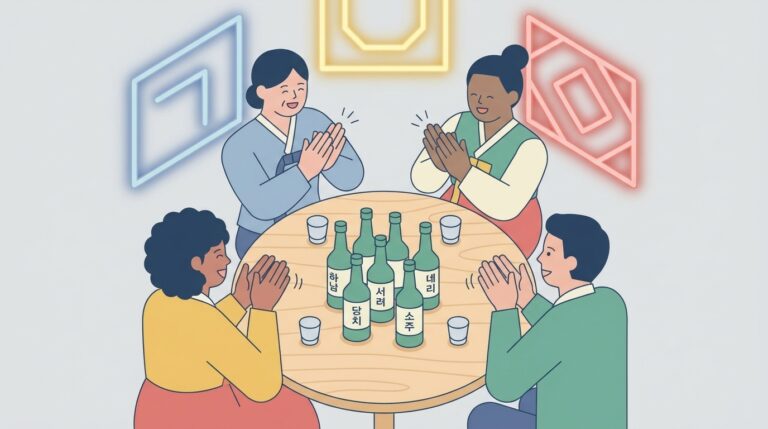
Picture this K-Drama scene: The university students or office workers are sitting around a round stainless-steel table at a lively Pocha (포차, Korean street pub). The table is full of green Soju bottles. Suddenly, they all start clapping their hands rhythmically and chanting, “Baskin~ Robbins~ Thirty-One!” You might be sitting behind your screen wondering, Why on earth are they talking about ice cream at a bar?
If you’ve ever been to a Korean university MT (Membership Training) or a casual company dinner, you know exactly what I’m talking about. Korean drinking culture isn’t just about pouring drinks; it’s an extreme sport of ice-breaking games, rhythmic chants, and lightning-fast reflexes. If you don’t know the rules, you’ll be drinking a lot of penalty shots!
But don’t worry. As a veteran tutor who has survived countless Seoul nights, I’m here to give you the ultimate cheat sheet. Today, we’re diving into the legendary 369 Game and Baskin Robbins 31. Let’s turn you into a true insider!
Phase 2: Core Expressions Deep Dive
Before we play, you need to know the basic vocabulary. These are the magic words that control the vibe of the table.
1. 술이 들어간다 쭉 쭉쭉쭉! (suri deureoganda jjuk jjukjjukjjuk!)
- Pronunciation: [suri deureoganda jjuk jjukjjukjjuk!]
- Tip: ‘쭉’ sounds like a sharp ‘jjook’, mimicking the sound of liquid going down your throat.
- Meaning:
- Literal: The alcohol is going in, jjuk jjukjjukjjuk!
- Real nuance: “Chug! Chug! Chug!”
- K-Culture Moment: This is the most famous penalty chant. When someone loses a game and has to drink their penalty shot (벌칙주), everyone else claps and sings this song to cheer them on.
- Editor’s Insight: You don’t just say this; you sing it with energy. It’s a supportive chant to make the penalty feel like a celebration rather than a punishment.
- Situation Spectrum:
- Casual (Friends): ✅
- Semi-formal (Close colleagues): ⚠️ (Only if the vibe is wild)
- Formal (Boss/Elders): 🚫
- 🤔 Think About It: Why do Koreans sing a cheerful song when someone makes a mistake and has to drink? How does this reflect the Korean emphasis on group harmony (정, Jeong)?
2. 귀엽고 깜찍하게! (gwiyeopgo kkamjjikhage!)
- Pronunciation: [gwiyeopgo kkamjjikhage!]
- Tip: Say ‘깜’ with a strong, tight ‘kk’ sound, like snapping a twig.
- Meaning:
- Literal: Cutely and cheerfully!
- Real nuance: “Act cute and lively!”
- K-Culture Moment: This is the mandatory intro chant for the Baskin Robbins 31 game. The full chant goes: “Beseukin~ Rabinseu~ Sseori won! Gwiyeopgo kkamjjikhage sseori won!” (Baskin Robbins 31! Cutely and cheerfully 31!).
- Editor’s Insight: When you chant this, you usually make cute poses with your hands. Even the toughest, most serious guy in the room has to act cute during this intro. It’s hilarious!
- Situation Spectrum:
- Casual (Friends): ✅
- Semi-formal (Colleagues): ✅ (Great for team bonding)
- Formal (Boss/Elders): 🚫
- 🤔 Think About It: Breaking your usual image to act silly is a common ice-breaker in Korea. Do you have games in your culture that force you to step out of your comfort zone?
3. 흑기사 / 흑장미 (heukgisa / heukjangmi)
- Pronunciation: [heukgisa / heukjangmi]
- Meaning:
- Literal: Black Knight / Black Rose
- Real nuance: Someone who volunteers to drink your penalty shot for you.
- K-Culture Moment: You lost the game, but you really can’t drink anymore. You shout, “Is there a Black Knight?” A handsome guy (or a cool girl – Black Rose) takes your glass and drinks it. But beware: they now get one “wish” (소원) you must grant!
- Editor’s Insight: This is a classic romantic trope in K-Dramas! Many drama couples have their first kiss or confession because of a “Black Knight’s wish.”
- Situation Spectrum:
- Casual (Friends): ✅
- Semi-formal (Colleagues): ✅
- Formal (Boss/Elders): ⚠️
Phase 3: Textbook vs. Real Korean
Let’s see how textbook Korean changes when the Soju is poured.
[Situation 1: Telling someone to drink their penalty]
* 📖 Textbook Korean: 술을 마시세요. (Please drink the alcohol.)
* 🗣️ Real Korean: 원샷! (One shot!) or 반샷 안돼요~ 반샷 안돼요~ (No half-shots! No half-shots!)
* 💡 Why is it different?: Drinking games are fast-paced and high-energy. Borrowing the English “One shot” became the ultimate standard for “bottoms up” in Korea.
[Situation 2: Pointing out whose turn it is]
* 📖 Textbook Korean: 제 차례입니다. (It is my turn.)
* 🗣️ Real Korean: 아싸 내 차례! (Ah-ssa, my turn!) or 아싸 너! (Ah-ssa, you!)
* 💡 Why is it different?: ‘아싸’ (Ah-ssa) is an exclamation of joy or excitement. Using it keeps the game’s rhythm flowing perfectly.
Phase 4: Cultural Context — K-Culture Deep Dive
4-1. The Non-Verbal Magic: Clapping & Rhythm
In Korean drinking games, words are only 50% of the game. The other 50% is rhythm. Before any game starts, everyone must drum on the table or clap their hands to a specific 4/4 beat. If you mess up the intro rhythm, you lose immediately! This requires intense 눈치 (Nunchi – reading the room). You have to watch everyone’s hands and match their speed.
4-2. K-Drama Connection: The University MT
If you watch university dramas like Cheese in the Trap or My ID is Gangnam Beauty, you will definitely see an MT (Membership Training) scene. Students go to a pension in the countryside, sit in a massive circle, and play games all night.
Critical View: In dramas, the main characters always seem perfectly sober while having deep romantic conversations outside after the games. In reality? Most people are fast asleep on the floor by 2 AM! Also, while older dramas showed older students forcing freshmen to drink, modern Korean culture has changed drastically. Forcing drinks is now highly frowned upon.
Phase 5: Real-Life Roleplay Scenario
Setting: Friday night, 8 PM. A smoky, bustling pork belly (Samgyeopsal) restaurant in Gangnam. You are with your Korean coworkers. The Soju is flowing, and everyone is in a great mood.
Characters:
– YOU: A foreign employee trying your best to fit in.
– Min-su (30s): Your friendly, slightly loud coworker.
– Ji-yeon (20s): The energetic junior who loves games.
[The 3-6-9 Game (삼육구 게임)]
Rule check: You count numbers in a circle. But if your number contains a 3, 6, or 9, you MUST NOT say the number. Instead, you just clap! (e.g., for 3, you clap once. For 33, you clap twice).
Ji-yeon: 자, 삼육구 삼육구! 삼육구 삼육구! 👏
(ja, samyukgu samyukgu! samyukgu samyukgu!)
(Alright, 3-6-9! 3-6-9!)
Min-su: 일! (il!)
(One!)
Ji-yeon: 이! (i!)
(Two!)
🔀 Your Turn! What do you do?
– A) Say “삼! (sam!)”
– B) Clap once 👏
– C) Say “Clap!”✅ Best Choice: B — You must stay completely silent and just clap! If you chose A, congratulations, you just lost!
(Let’s say you chose A by mistake…)
Min-su: 아 마셔라 마셔라 마셔라 마셔라! 🍻 masyeora masyeora masyeora masyeora!)
(A
(Ah Drink, drink, drink, drink!)
Ji-yeon: 술이 들어간다 쭉 쭉쭉쭉! 벌칙주 당첨!
(suri deureoganda jjuk jjukjjukjjuk! beolchikju dangcheom!)
(The alcohol is going down, jjuk jjukjjukjjuk! You won the penalty shot!)
YOU: 아, 저 진짜 술 약한데… 혹시 흑기사 있나요? 🥺
(A, jeo jinjja sul yakhande… hoksi heukgisa innayo?)
(Ah, I’m really a lightweight… Is there a Black Knight by any chance?)
Min-su: 오케이, 내가 마실게! 대신 소원 하나 들어주기!
(Okei, naega masilge! daesin sowon hana deureojugi!)
(Okay, I’ll drink it! But you have to grant me one wish!)
Phase 6: 10-Second Shadowing Drill
Let’s practice the Baskin Robbins 31 intro chant! Focus on the rhythm and the bouncy intonation.
😊 베스킨~ / 라빈스~ / 써리 원! (beseukin~ / rabinseu~ / sseori won!)
🥺 귀엽고~ / 깜찍하게~ / 써리 원! (gwiyeopgo~ / kkamjjikhage~ / sseori won!)
Tip: Bounce your shoulders to the beat as you say it! Make your voice go slightly higher on the ‘~’ symbols.
Phase 7: K-Culture Mini Dictionary
1. 회식 (Hoesik)
* Romanization: hoesik
* English: Company Dinner
* Context: It’s not just a meal; it’s considered an extension of work where colleagues bond over food and drinks. Games are sometimes played to break the ice.
2. 눈치 (Nunchi)
* Romanization: nunchi
* English: Reading the room / Social sense
* Context: In drinking games, nunchi is everything. For example, in the “Nunchi Game,” players must stand up and call out numbers in order. If two people stand up at the same time, they both drink!
3. 원샷 (Won-syat)
* Romanization: won-syat
* English: Bottoms up / One shot
* Context: The standard cheer to encourage someone to finish their drink in one gulp.
4. 안주 (Anju)
* Romanization: anju
* English: Bar food / Drinking snacks
* Context: Koreans rarely drink alcohol without food. Ordering good anju (like fried chicken, spicy stews, or savory pancakes) is crucial for a successful drinking session.
Phase 8: Traveler Survival Kit (Pocha Edition)
Even if you don’t play games, you’ll likely visit a Korean pub or Pocha during your trip. Here is your survival guide.
🆘 Survival Phrases at a Bar
– 🇰🇷 “사장님, 여기 소주 한 병 더 주세요!” (sajangnim, yeogi soju han byeong deo juseyo!)
– 🗣️ English: “Boss, one more bottle of Soju here, please!”
– 📍 Where to use: Any local restaurant or pub.
– 💡 Pro Tip: Raise your hand high and make eye contact when saying this, or press the call button on the table!📌 Editor’s Travel Note
– Call Buttons: Look at your table! Most Korean pubs have a small bell button. Press it, and the staff will come running. No need to shout!
– Pouring Etiquette: Never pour your own drink! Pour for your friends, and let them pour for you. When receiving a drink from someone older, hold your glass with two hands.
– Water is Self-Service: In many casual pubs, you’ll see a sign that says “물은 셀프” (Water is self-service). You have to go to the fridge and grab a water bottle yourself.
Phase 9: Critical Thinking Corner — “One Step Deeper”
🧠 Think Deeper: Food, Games & Identity
Why are Koreans so obsessed with drinking games, even into adulthood? In Korean society, hierarchy (based on age and job title) dictates daily interactions. You must use formal language (존댓말) and bow to your seniors. However, drinking games create a temporary “carnival space.” During a fast-paced game of 3-6-9, the hierarchy dissolves. A 22-year-old junior can gleefully chant the penalty song while their 40-year-old manager drinks a penalty shot. These games serve as a societal pressure valve, allowing Koreans to bond, release workplace stress, and build communal affection (정) before returning to the strict rules of reality the next morning.
💬 Your Turn: Does your culture have a way to temporarily break down social hierarchies? Share it in the comments!
Phase 10: FAQ & Avoiding Common Mistakes
Q: Can I suggest playing these games with my boss?
A: Maybe. It heavily depends on the boss. Usually, it’s safer to wait for an older colleague or the boss to suggest playing games first. If the vibe is very casual and everyone is laughing, you can carefully suggest, “Should we play a game?”
Q: Do I have to drink alcohol as a penalty? I don’t drink.
A: No! Modern Korean drinking culture is much more respectful of personal boundaries. You can fill your shot glass with Cola, Cider (Sprite), or even water. Just announce beforehand, “저는 오늘 음료수로 할게요!” (I’ll stick to soda today!).
❌ Common Mistake #1: Saying the number ‘3’ out loud in the 369 Game.
✅ How to fix it: Your mouth stays closed! Your hands do the talking. Clap once for 3, 6, 9. Clap twice for 33, 36, 39!
Phase 11: Summary & Action Items
One-Liner Summary: To survive a Korean drinking party, remember to read the room (Nunchi), clap to the rhythm, and shout “Black Knight!” if you need help.
Action Mission 3 Steps:
– 🥉 Bronze (Solo): Practice counting from 1 to 10 in Korean, but clap instead of saying 3, 6, and 9.
– 🥈 Silver (Online): Find a K-Drama clip on YouTube of an MT scene. Can you spot who messes up the game?
– 🥇 Gold (Real Life): Teach the 3-6-9 game to your friends at your next gathering and use the “마셔라” penalty chant!
🎯 Special K-Culture Mission:
Search “Seventeen Drinking Games” or “BTS Drinking Games” on YouTube. K-Pop idols love playing these on their variety shows. Watch their hand gestures closely!
Phase 12: Quiz — Interactive Challenge
Q1. You are playing the 3-6-9 game. The person before you said “12”. What is your move?
A) Say “십삼! (13!)”
B) Clap once 👏
C) Clap twice 👏👏
Q2. True or False: If you need water at a Korean pub, you should always wait for the waiter to bring it to you.
Q3. Fill in the blank: Someone drinks your penalty shot for you. They are your _______ (Korean term).
*
(Answers)
Q1: B) Clap once! The number 13 contains one ‘3’, so you must not say it and clap instead!
Q2: False! Many casual pubs have a “물은 셀프” (Water is self) rule. Grab it from the fridge!
Q3: 흑기사 (Heukgisa – Black Knight) or 흑장미 (Heukjangmi – Black Rose).
*
Frequently Asked Questions (FAQ)
Q: What does "술이 들어간다 쭉 쭉쭉쭉! (suri deureoganda jjuk jjukjjukjjuk!)" mean in Korean and how do you pronounce it?
A: In Korean, "술이 들어간다 쭉 쭉쭉쭉! (suri deureoganda jjuk jjukjjukjjuk!)" is pronounced [suri deureoganda jjuk jjukjjukjjuk!] and means: a key conversational Korean expression covered in this lesson.
Q: What does "귀엽고 깜찍하게! (gwiyeopgo kkamjjikhage!)" mean in Korean and how do you pronounce it?
A: In Korean, "귀엽고 깜찍하게! (gwiyeopgo kkamjjikhage!)" is pronounced [gwiyeopgo kkamjjikhage!] and means: a key conversational Korean expression covered in this lesson.
Q: What does "흑기사 / 흑장미 (heukgisa / heukjangmi)" mean in Korean and how do you pronounce it?
A: In Korean, "흑기사 / 흑장미 (heukgisa / heukjangmi)" is pronounced [heukgisa / heukjangmi] and means: Literal: Black Knight / Black Rose







