

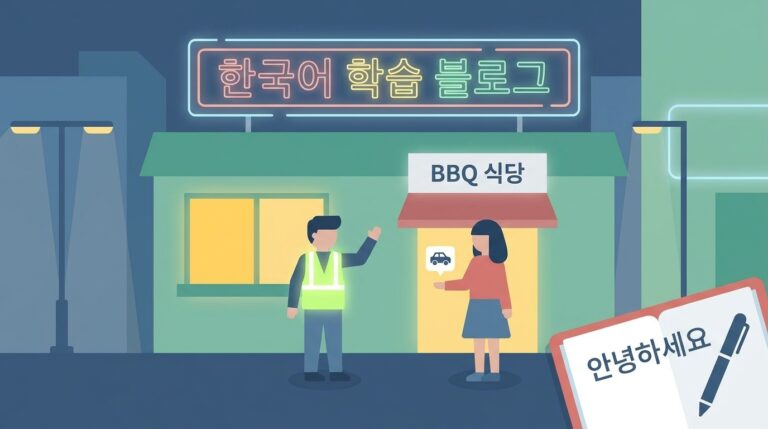
Phase 1: Empathy — The K-Drama Moment in Real Life
Greeting! I’m the Lead Editor at Daily Hangul.
Picture this: You are watching a classic K-Drama. The main characters have just finished a team dinner at a smoky pork belly (samgyeopsal) restaurant. Empty green soju bottles are everywhere. They walk out into the cool night air, but instead of calling a taxi, one character makes a quick phone call. Ten minutes later, a complete stranger arrives, takes their car keys, and drives their car for them!
If you are from a country where you either have to take an Uber or draw straws for a designated driver, this might look like magic. In Korea, this magic is called 대리운전 (Daeri-unjeon), or “substitute driving.”
If you work in Korea, go on business trips, or just happen to rent a car and end up drinking at a Hoesik (company dinner), knowing how to navigate the Daeri system is a total lifesaver. It saves you from awkward situations, keeps you safe, and instantly gives you major “Insider” points with your Korean colleagues.
Don’t worry! This guide is based on real questions from my A2 beginner students who panicked outside a restaurant at 11 PM. Let’s learn the exact phrases you need!
Phase 2: Core Expressions Deep Dive
Here are the top 3 expressions you need to survive the end of a company dinner when cars are involved.
1. 대리 불러주세요. (Please call a designated driver.)
- Pronunciation: [dae-ri bul-leo-ju-se-yo] ‘dae-ri’ sounds like ‘dairy’, and ‘ju-se-yo’ sounds like ‘ju-say-yo’.
- Meaning: (Literal) Please call a substitute. / (Real Nuance) Please call a designated driver for me.
- K-Culture Moment: You are paying the bill at the restaurant counter. If you drank but drove your car there, you can ask the restaurant owner this phrase. They often have speed-dial numbers for local driver agencies!
- Editor’s Insight: We rarely say the full word Daeri-unjeon. We just say Daeri. It’s short, quick, and everyone understands it immediately.
- Situation Spectrum:
- Friends (Casual): ⚠️ (To friends, you’d say “대리 불러줘” without ‘yo’)
- Co-workers (Semi-formal): ✅
- Boss/Elders/Strangers (Formal): ✅
- 🤔 Think About It: In Korea, asking a restaurant owner for this favor is completely normal. How does the restaurant culture in your home country handle patrons who have had too much to drink?
2. 어플로 불렀어요. (I called one via an app.)
- Pronunciation: [eo-peul-lo bul-leot-seo-yo] ‘eo-peul’ sounds like ‘uh-pull’.
- Meaning: (Literal) I called with an app. / (Real Nuance) I already requested a driver on my phone app (so you don’t need to worry about me).
- K-Culture Moment: Your caring senior colleague asks, “Did you call a Daeri?” You wave your smartphone with the Kakao T app open and say this proudly.
- Editor’s Insight: Eopeul is Konglish for “App” (Application). Young people and modern workers almost exclusively use apps instead of calling by phone.
- Situation Spectrum:
- Friends (Casual): ⚠️
- Co-workers (Semi-formal): ✅
- Boss/Elders (Formal): ✅
- 🤔 Think About It: Why do Koreans prefer saying “I used an app” rather than explaining the whole process? It shows efficiency, a highly valued trait in Korean corporate culture (Palli-palli or “hurry up” culture).
3. 차 놓고 갈게요. (I’ll leave my car here.)
- Pronunciation: [cha no-ko gal-ge-yo] ‘no-ko’ sounds like ‘no-co’.
- Meaning: (Literal) I will put the car and go. / (Real Nuance) I’m going to leave my car parked here and go home (by taxi/bus).
- K-Culture Moment: Sometimes, calling a driver is too expensive because you live very far away. Instead, you tell the restaurant owner or your boss that you are leaving your car at the office or restaurant parking lot overnight.
- Editor’s Insight: This shows you are making a responsible choice. “Noko” means to put down or leave behind.
- Situation Spectrum:
- Friends (Casual): ⚠️
- Co-workers (Semi-formal): ✅
- Boss/Elders (Formal): ✅
- 🤔 Think About It: In dense cities like Seoul, parking is tough. Leaving a car overnight at a restaurant sometimes requires the owner’s permission. Always combine this with a polite bow!
Phase 3: Textbook vs. Real Korean
Let’s see how the textbook differs from what you will actually hear on the streets of Gangnam after a Hoesik.
[Situation 1: Asking someone to call a driver]
* 📖 Textbook: 대리운전 기사님을 호출해 주시겠습니까? (Would you please summon a substitute driver?)
* 🗣️ Real Korean: 대리 좀 불러주세요. (Please call a Daeri.)
* 💡 Why the difference?: Koreans love efficiency. Dropping the formal “summon” and just using “call” (bulleojuseyo) with the shortened noun (Daeri) sounds 100x more natural.
[Situation 2: Telling colleagues the driver is arriving]
* 📖 Textbook: 대리운전 기사님이 곧 도착하십니다. (The substitute driver will arrive shortly.)
* 🗣️ Real Korean: 대리 거의 다 왔대요. (The Daeri says they’re almost here.)
* 💡 Why the difference?: Using “거의 다 왔대요” (literally “said they almost all came”) is the most common conversational way to announce an arrival in Korea, showing you are actively tracking them.
Phase 4: Cultural Context — K-Culture Deep Dive
4-1. Non-Verbal Cues: The Art of “Nunchi”
When calling a Daeri, your Nunchi (social sense) is key. If your boss is heavily drunk, it is often the junior employee’s unspoken job to use their app to call a Daeri for the boss, input the boss’s home address, and even pay for it in advance. Also, when handing over your car keys to the driver, use two hands and a slight bow—it shows respect to the driver who is working late at night.
4-2. The K-Drama Connection: The “Drunk CEO” Trope
If you watch romantic K-Dramas like Business Proposal or What’s Wrong with Secretary Kim, the Daeri service is a massive plot device. The rich, handsome CEO gets drunk at a pojangmacha (street tent). He can’t drive his luxury car. The female lead, who might be his employee, acts as his Daeri driver, leading to a romantic conversation in the car!
Critical View: In reality, regular office workers don’t have their junior staff drive their cars. They use the app! Acting like a drama CEO and demanding a coworker drive you is a massive HR violation in modern Korea.
Phase 5: Real-life Roleplay Scenario
Setting: Friday, 10 PM. Outside a BBQ restaurant near Gangnam Station. The air is slightly smoky, and the street is filled with people waiting for taxis. You are standing with your Korean coworkers after a fun team dinner.
Characters:
* YOU: An expat on a business trip. You rented a car today but ended up drinking a few glasses of beer.
* Min-su: (32, your friendly Korean coworker). He’s holding his phone, checking a taxi app.
Dialogue:
Min-su: 아, 배부르다. 오늘 진짜 많이 먹었네요!
(A, baebureuda. oneul jinjja mani meogeonneyo!)
[Ah, I’m full. We really ate a lot today!]
YOU: 네, 너무 맛있었어요.
(Ne, neomu masisseosseoyo.)
[Yes, it was so delicious.]
Min-su: 이제 집에 가야죠. 차 가져오셨죠?
(Ije jibe gayajyo. Cha gajyeoosyeotjyo?)
[We should go home now. You brought your car, right?]
YOU: 네, 근처에 주차했어요.
(Ne, geuncheoe juchahaesseoyo.)
[Yes, I parked nearby.]
Min-su: 맥주 드셨는데, 운전하면 안 돼요. 대리 부르셨어요?
(Maekju deusyeonneunde, unjeonhamyeon an dwaeyo. Daeri bureusyeosseoyo?)
[You had beer, you shouldn’t drive. Did you call a Daeri?]
(🎭 Stage Direction: Min-su looks concerned and opens his Kakao T app to help you.)
🔀 Your Turn! How should you respond?
– A) “아니요, 제가 운전할 수 있어요!” (No, I can drive!)
– B) “대리가 뭐예요?” (What is a Daeri?)
– C) “아, 어플로 불렀어요. 걱정 마세요!” (Ah, I called one via an app. Don’t worry!)✅ Best Choice: C — It shows you understand Korean culture and are being responsible.
⚠️ Choice A Analysis: NEVER choose A. Korea has incredibly strict DUI laws (often resulting in immediate visa cancellation for foreigners). Even one sip means you must call a Daeri.
YOU: 아, 어플로 불렀어요. 걱정 마세요!
(A, eopeullo bulleosseoyo. geokjeong maseyo!)
[Ah, I called one via an app. Don’t worry!]
Min-su: 오~ 역시! 한국 사람 다 됐네요! 기사님 오시면 조심히 들어가세요.
(O~ yeoksi! hanguk saram da dwaenneyo! gisanim osimyeon josimhi deureogaseyo.)
[Oh~ as expected! You’re basically Korean now! Get home safely when the driver arrives.]
Bonus Roleplay: Meeting the Driver
(The driver calls your phone to find you)
* Driver: 고객님, 어디 계세요? (Customer, where are you?)
* YOU: 식당 앞이에요. 비상깜빡이 켰어요. (I’m in front of the restaurant. I turned on the hazard lights.)
* Driver: 네, 바로 갈게요! (Yes, I’ll be right there!)
Phase 6: 10-Second Shadowing Drill
Practice this sentence to sound natural when reassuring your boss you have a safe ride!
😊 저 / 대리 / 불렀어요! (jeo / dae-ri / bul-leot-seo-yo!)
Tip: Pause slightly after ‘jeo’ (I), emphasize ‘dae-ri’, and say the last part with a bright, reassuring tone.
Phase 7: K-Culture Mini Dictionary
1. 눈치
* Romanization: nunchi
* English: Social sense / reading the room
* Context: The Korean superpower. Knowing when to pour a drink, or knowing when to secretly call a Daeri for your drunk boss without them asking.
2. 회식
* Romanization: hoesik
* English: Company dinner
* Context: It’s not just a meal; it’s an extension of work. Bonding over food and drinks is deeply ingrained in Korean corporate culture.
3. 대리기사
* Romanization: daeri-gisa
* English: Designated driver
* Context: The actual person who comes to drive your car. Gisa means driver or engineer. Always address them as Gisa-nim (adding the polite ‘-nim’).
4. 2차
* Romanization: i-cha
* English: The second round
* Context: Hoesik rarely ends at the first restaurant. Moving to a bar or karaoke for round 2 (i-cha) is common. You wait to call your Daeri until the final round is over!
Phase 8: Traveler Survival Kit
Even if you aren’t driving, this culture is vital for travelers using taxis or renting cars in Jeju Island!
🆘 Survival Expression #1: Locating your car/taxi
– 🇰🇷 “비상깜빡이 켰어요.” (bi-sang-kkam-ppa-gi kyeot-seo-yo)
– 🗣️ Pronunciation: [bee-sang-kkam-ppa-ghee kyut-suh-yo]
– 📍 Where to use: On the phone with a Daeri driver or Kakao Taxi driver trying to find you.
– 💡 Pro Tip: “Bisang-kkamppagi” means hazard lights. Turning them on makes you instantly visible at night.📌 Editor’s Travel Note
– Essential App: Download Kakao T. It has an English interface! You can use it to call regular taxis, premium taxis, AND a Daeri driver.
– Payment: Drivers prefer app payments (registered card), but you can select “Pay to the driver” (기사님께 직접 결제) and use cash or a physical credit card.
– No Tipping: Tipping the driver is not required or expected in Korea. Just a polite “Thank you” (감사합니다) when you arrive is perfect!
Phase 9: Critical Thinking — “One Step Deeper”
🧠 Think Deeper: Language & Social Systems
Have you ever wondered why the Daeri (designated driver) system is so massive and affordable in Korea compared to Western countries? It’s a direct reflection of Korea’s high-density urbanization and the traditional Hoesik culture. Because Seoul is so dense, a Daeri driver can drop you off, unfold a motorized scooter from their backpack, and zip to their next customer in minutes. The language reflects this social infrastructure: we don’t need a long sentence to explain “I hired a man to drive my car.” The single word Daeri holds the weight of this entire unique, highly efficient ecosystem.💬 Your Turn: Does your country have a unique service that is perfectly adapted to your local culture? How do you say it in your language? Let us know in the comments!
Phase 10: FAQ & Avoiding Mistakes
Q: “Where do I sit when the Daeri driver is driving my car?”
A: Sit in the back right seat, exactly like you would in a taxi! Sitting in the passenger seat next to the driver can make both of you feel a bit awkward, though it’s acceptable if the back seat is full of other coworkers.
Q: “Can I use ‘Daeri bulleojuseyo’ to my boss?”
A: Yes, but with a slight tweak. If you are asking your boss to call one for you (rare), you’d say it. But if you are offering to call one for your boss, you should say: “부장님, 대리 불러드릴까요?” (Manager, shall I call a Daeri for you?).
❌ Common Mistake #1: Thinking “I only had one beer, I can drive.”
✅ Do this instead: Call a Daeri. Korea’s legal blood alcohol limit is 0.03%, which is basically one glass of beer. Police checkpoints are everywhere at night. Don’t risk it!❌ Common Mistake #2: Making small talk with the driver about personal things.
✅ Do this instead: Let them focus on the road. A simple greeting and confirming the destination is enough. Many drivers do this as a second job at night and are tired.
Phase 11: Summary & Action Items
One-Liner Summary: When you’ve had drinks and need your car driven home, simply say “대리 불러주세요” (Daeri bulleojuseyo) to safely end the night.
Action Mission 3 Steps:
* 🥉 Bronze (Solo): Stand in front of a mirror, pretend to hold your car keys, and say “대리 불렀어요!” three times.
* 🥈 Silver (Online): Share this post in your Korean study group and ask if anyone has ever seen a Daeri scene in a K-Drama.
* 🥇 Gold (Real World): Next time you are at a Korean BBQ place, look out the window at 10 PM. Try to spot the drivers in glowing vests arriving on kickboards—they are the Daeri drivers!
K-Culture Mission:
Download the Kakao T app on your phone right now. Open it up and locate the steering wheel icon that says “Daeri” (대리). Even if you don’t use it, knowing where it is will make you feel like a true Seoul local.
Phase 12: Quiz — Interactive Challenge
1. Situational Judgment:
You just had a team dinner. Your manager, Mr. Kim, drank a whole bottle of Soju but is walking toward his car with his keys. What is the most culturally appropriate and safe thing to do?
* A) Let him drive. He’s the boss.
* B) Say “부장님, 대리 부르셨어요?” (Manager, did you call a Daeri?)
* C) Steal his keys and run away.
2. True or False — K-Culture Edition:
* “If you use a Daeri service, you should tip the driver 20%.”
(Answers below!)
…
…
Answers:
1. B is the best choice! It politely checks if he has a driver coming. (Please never choose A!)
2. False. There is no tipping culture in South Korea, even for Daeri drivers. The price on the app is the final price.
Frequently Asked Questions (FAQ)
Q: What does "대리 불러주세요. (Please call a designated driver.)" mean in Korean and how do you pronounce it?
A: In Korean, "대리 불러주세요. (Please call a designated driver.)" is pronounced [dae-ri bul-leo-ju-se-yo] and means: (Literal) Please call a substitute. / (Real Nuance) Please call a designated driver for me.
Q: What does "어플로 불렀어요. (I called one via an app.)" mean in Korean and how do you pronounce it?
A: In Korean, "어플로 불렀어요. (I called one via an app.)" is pronounced [eo-peul-lo bul-leot-seo-yo] and means: (Literal) I called with an app. / (Real Nuance) I already requested a driver on my phone app (so you don't need to worry about me).
Q: What does "차 놓고 갈게요. (I'll leave my car here.)" mean in Korean and how do you pronounce it?
A: In Korean, "차 놓고 갈게요. (I'll leave my car here.)" is pronounced [cha no-ko gal-ge-yo] and means: (Literal) I will put the car and go. / (Real Nuance) I'm going to leave my car parked here and go home (by taxi/bus).







