

Phase 1: Empathy
Hello, learners! I’m your Head Editor at Daily Hangul.
Picture this K-Culture moment: You’re walking down the vibrant, neon-lit streets of Hongdae. Amidst the trendy cafes and indie buskers, you spot a brightly lit glass storefront. Inside, tiny puppies are sleeping in small cubicles. The sign reads: 강아지 분양 (Gangaji Bunyang). You pull out your translation app, and it says… “Dog Distribution” or “Dog Parceling.” What on earth does that mean?
Meanwhile, you go back to your hotel, turn on the TV, and see your favorite K-Pop idol holding a scruffy, adorable mixed-breed dog on a V-Live broadcast. They proudly declare, “사지 말고 입양하세요!” (Don’t buy, adopt!).
Welcome to one of the most intense, rapidly changing cultural shifts in modern South Korea: Pet Culture.
For a long time, pets in Korea were seen as cute toys you bought from a shop. Today, they are beloved family members. If you use the wrong verb to ask a Korean friend how they got their pet, you might accidentally sound incredibly insensitive.
As a tutor who has watched countless foreign students accidentally offend their Korean friends by asking, “How much did you buy your dog for?” I’m here to guide you through this linguistic minefield. Let’s learn the real Korean behind the pet adoption vs. buying debate, so you can sound like a true local who “gets it.”
Phase 2: Deep Dive into Key Expressions
1. 반려동물 vs 애완동물
- Pronunciation: [ban-ryeo-dong-mul] vs [ae-wan-dong-mul]
- Sound-alike guide: ‘ban’ like “banish” + ‘ryeo’ (roll the r slightly, like “ryeo”) + ‘dong’ like the bell sound + ‘mul’ like “mule” without the ‘e’.
- Meaning: Companion Animal (Real nuance: A family member) vs Pet (Real nuance: A toy/plaything).
- K-Culture Moment: You’ll notice that modern Korean news, pet food brands, and K-Drama scripts almost exclusively use 반려동물. If a character in a drama uses 애완동물, they are often portrayed as old-fashioned or lacking empathy.
- Editor’s Insight: 반려 (banryeo) means “companion” (the same word used in ‘life companion’ or spouse). 애완 (aewan) literally contains the Hanja (Chinese character) for “playing with.” Using 애완동물 today feels a bit like calling someone’s child an “it.”
- Situation Spectrum:
- Casual (Friends): ✅ (반려동물 is preferred everywhere)
- Semi-formal (Co-workers): ✅
- Formal (Boss/Elders): ✅
- 🤔 Think About It: How does changing a single word shift an entire society’s mindset? Does your native language have different words for pets that indicate their status in the family?
2. 분양받다
- Pronunciation: [bun-yang-bat-da]
- Meaning: Literal: “To receive a distribution.” Real nuance: To buy/get a pet from a pet shop or breeder.
- K-Culture Moment: This word actually comes from real estate! You “bunyang” a new apartment. Applying this real estate term to living animals shows how pets used to be viewed strictly as property. Today, you’ll see “무료 분양” (free distribution/adoption) signs, which are often controversial loopholes for pet shops.
- Editor’s Insight: If you buy a dog from a shop, Koreans say 분양받았어요 (I got it distributed) instead of 샀어요 (I bought it). It sounds slightly softer than “buying,” but animal rights activists are currently campaigning to abolish both the word and the practice.
- Situation Spectrum:
- Casual: ⚠️ (Be careful, some friends might judge you for using pet shops)
- Semi-formal: ⚠️
- Formal: ⚠️
- 🤔 Think About It: Why do you think the Korean language borrowed a real estate term for getting a pet? What does this say about the historical context of animal ownership in rapid urbanization?
3. 사지 말고 입양하세요
- Pronunciation: [sa-ji mal-go ib-yang-ha-se-yo]
- Meaning: Literal & Real nuance: “Don’t buy, please adopt.”
- K-Culture Moment: This is the ultimate catchphrase of the modern Korean animal rights movement. Superstars like Lee Hyori (famous for adopting her rescue dogs on Jeju Island) and BLACKPINK’s Rosé (who adopted her dog, Hank) have championed this phrase. You’ll see it on eco-bags, phone cases, and bumper stickers.
- Editor’s Insight: 입양 (ibyang) traditionally only meant adopting human children. Using it for animals is a recent, powerful shift in the language.
- Situation Spectrum:
- Casual: ✅
- Semi-formal: ✅
- Formal: ✅
- 🤔 Think About It: “사다” (to buy) vs “입양하다” (to adopt). By making “buying” sound like a negative action, how are celebrities influencing the vocabulary of the younger K-Pop generation?
Phase 3: Textbook vs. Real Korean
[Asking if someone has a pet]
* 📖 Textbook Korean: 집에 애완동물이 있습니까? (Do you have a pet at home? – Very rigid, uses the outdated word).
* 🗣️ Real Korean: 강아지(고양이) 키우세요? / 반려견 있어요? (Do you raise a dog/cat? / Do you have a companion dog?)
* 💡 Why the difference?: Koreans rarely use the umbrella term “companion animal” in casual speech; they directly ask about dogs (강아지) or cats (고양이).
[Asking where they got the pet]
* 📖 Textbook Korean: 개를 어디에서 샀어요? (Where did you buy the dog? – Major red flag!)
* 🗣️ Real Korean: 우리 아이 어디서 데려오셨어요? / 입양하셨어요? (Where did you bring our child from? / Did you adopt?)
* 💡 Why the difference?: Using “사다” (to buy) for a pet is considered very rude now. Notice the use of “아이” (child) to refer to the pet, treating them completely as human children!
Bottom Note: At a B2 level, your goal is to sound empathetic. Avoid “사다” (buy) and “개” (dog – can sound aggressive). Stick to “데려오다” (to bring) and “강아지” (puppy/dog, much cuter).
Phase 4: Cultural Context — K-Culture Deep Dive
4-1. Non-verbal Context: The “Yellow Ribbon” & Eye Contact
When you see a cute dog on the streets of Seoul, your first instinct might be to reach out and pet it. Stop! Korea has recently adopted the “Petiquette” (펫티켓 – Pet + Etiquette) culture. If you see a dog with a yellow ribbon on its leash, it means “I am sensitive, please give me space.” Always ask, “만져봐도 돼요?” (May I pet him/her?) while keeping your hands to yourself and avoiding prolonged, intimidating eye contact with the dog.
4-2. The “Gaemocha” (개모차) Phenomenon
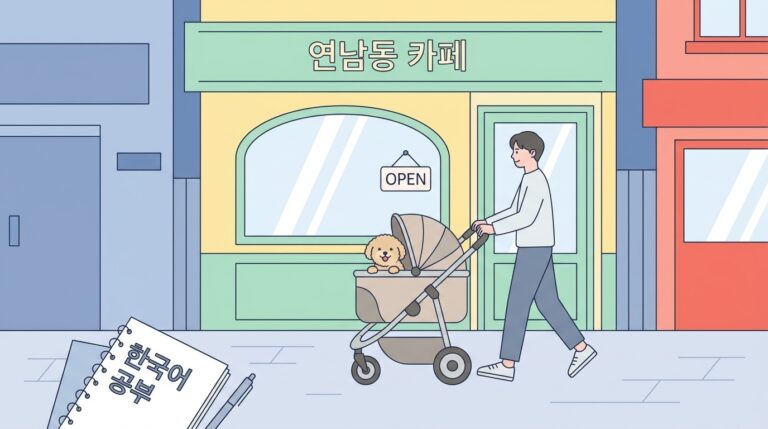
If you visit a trendy cafe area like Seongsu-dong or Yeonnam-dong, you will witness a fascinating K-Culture trope: Pet strollers.
Known as 개모차 (Gae/Dog + Yumocha/Stroller), it is a running joke in Korean society that more dog strollers are sold than baby strollers due to Korea’s record-low birth rate. In many K-Dramas, you’ll see a wealthy character pushing an elegant stroller, only for the camera to pan down and reveal a tiny Pomeranian inside. This visually perfectly encapsulates the shift from “pet” to “precious family heir.”
4-3. K-Pop Influence: “The Rescue Dog Flex”
In the past, K-Pop idols might have flexed expensive, purebred dogs. Now, the ultimate “flex” among idols is adopting a 유기견 (yugigyeon – abandoned dog). When fans see an idol post a picture of a rescue dog on Instagram, the fandom often unites to donate to animal shelters under the idol’s name. This has heavily popularized the word 보호소 (bohoso – shelter).
Phase 5: Real-Life Roleplay Scenario
Setting: A sunny Saturday afternoon at a trendy, pet-friendly cafe in Yeonnam-dong. You are enjoying an iced Americano. You are with Minji, your Korean friend from a language exchange group. Minji walks in pushing a luxury 개모차 (dog stroller). Inside is a fluffy, slightly nervous-looking mixed-breed dog.
Characters:
* YOU: An expat living in Seoul, intermediate in Korean, animal lover.
* Minji (28): Friendly, trendy, treats her new dog like absolute royalty.
Dialogue:
Minji: 안녕! 인사해, 우리 가족 새로 막내 ‘두부’야! 🐶
(Annyeong! Insahae, uri gajok saero mangnae ‘Dubu’ya!)
[Hi! Say hello, this is our family’s new youngest member, ‘Dubu’ (Tofu)!]
(🎭 Stage Direction: Minji carefully lifts Dubu out of the stroller.)
YOU: 와, 진짜 너무 귀엽다! 헉, 근데 두부 겁이 좀 많네요?
(Wa, jinjja neomu gwiyeopda! Heok, geunde dubu geobi jom manneyo?)
[Wow, seriously so cute! Gasp, but Dubu seems a bit scared?]
Minji: 응, 상처가 좀 있는 아이거든.
(Eung, sangcheoga jom inneun aigeodeun.)
[Yeah, he’s a child with some emotional scars.]
🔀 Your Turn! How do you ask where she got Dubu?
– A) “아, 두부 얼마 주고 샀어요?” (Ah, how much did you pay for Dubu?)
– B) “애견샵에서 분양받으셨어요?” (Did you get him distributed from a pet shop?)
– C) “아… 혹시 보호소에서 입양하셨어요?” (Ah… by any chance, did you adopt him from a shelter?)✅ Best Choice: C — Reason: Using “입양하다” (adopt) and “보호소” (shelter) shows immense cultural tact. Recognizing the dog has “scars” implies it’s a rescue.
⚠️ Choice A & B Analysis: Choice A is incredibly rude in modern Korea. Treating a traumatized dog like merchandise will instantly kill the mood. Choice B uses “분양” which implies a pet shop, completely missing Minji’s cue about the dog’s past.
YOU (Choosing C): 아… 혹시 보호소에서 입양하셨어요?
(A… hoksi bohoso-eseo ibyanghasyeosseoyo?)
[Ah… by any chance, did you adopt him from a shelter?]
Minji: 맞아! 사지 말고 입양하자는 캠페인 보고, 유기견 보호소에서 데려왔어.
(Maja! saji malgo ibyanghajaneun kaempein bogo, yugigyeon bohoso-eseo deryeowasseo.)
[Right! I saw the “Don’t buy, adopt” campaign and brought him from an abandoned dog shelter.]
YOU: 와, 민지 씨 정말 대단해요! 두부 이제 행복하겠다.
(Wa, Minji ssi jeongmal daedanhaeyo! Dubu ije haengbokageta.)
[Wow, Minji, you are really amazing! Dubu must be happy now.]
Phase 6: 10-Second Shadowing Drill
Practice your intonation to sound empathetic and natural. Pay attention to the pauses!
🥺 아... / 혹시 / 유기견 보호소에서 / 입양하셨어요?
(Ah... / hoksi / yugigyeon bohoso-eseo / ibyanghasyeosseoyo?)
😊 우리 집 강아지는 / 펫샵에서 안 사고 / 입양했어요!
(uri jip gangajineun / pet-syabeseo an sago / ibyanghaesseoyo!)
Phase 7: K-Culture Mini Dictionary
1. 펫티켓
* Romanization: Pettiket
* English: Pet + Etiquette
* Context: The societal rules for pet owners, such as cleaning up after dogs, keeping them on a leash, and not letting them bark in apartment buildings.
2. 개모차
* Romanization: Gaemocha
* English: Dog Stroller (Gae + Yumocha)
* Context: A symbol of Korea’s luxury pet culture. Widely used to take small dogs into malls or cafes where walking them on a leash isn’t allowed.
3. 무지개다리를 건너다
* Romanization: Mujigaedarireul geonneoda
* English: To cross the rainbow bridge
* Context: A polite, sorrowful idiom used when a pet passes away. Never say a pet “died” (죽었다) to an owner; always use this phrase.
4. 집사
* Romanization: Jipsa
* English: Butler
* Context: A slang term exclusively used for Cat Owners. Because cats rule the house, the human is merely their humble butler. “나만 고양이 없어” (Only I don’t have a cat) is the classic cry of a wannabe Jipsa.
Phase 8: Traveler’s Survival Kit
Even if you don’t live in Korea, you will likely visit a famous Pet Cafe, or encounter dogs while hiking or walking down the Han River.
🆘 Survival Expressions for Animal Lovers
– 🇰🇷 “만져봐도 돼요?” (manjyeobwado dwaeyo?)
– 🗣️ Meaning: “May I pet him/her?”
– 📍 Where to use: Han River parks, cafes, encountering dog walkers.
– 💡 Pro Tip: Point to the dog while asking. If the owner crosses their arms into an ‘X’, smile and back away.🇰🇷 “강아지 동반 되나요?” (gangaji dongban doenayo?)
– 🗣️ Meaning: “Are dogs allowed here?”
– 📍 Where to use: Entering a cafe or restaurant with a pet.📌 Editor’s Travel Note
– Useful Apps: If you are traveling with a pet, use Naver Map and filter for ‘반려동물 동반’ (Pet accompanying allowed).
– Transport: You CANNOT bring a pet onto a Seoul subway or bus unless they are fully enclosed in a carrier. Don’t let their head stick out!
Phase 9: Critical Thinking Corner — “A Step Deeper”
🧠 Think Deeper: Language & Changing Society
The shift from “애완” (loving a toy) to “반려” (life companion) perfectly mirrors South Korea’s rapid demographic shift. As the younger generation faces immense economic pressure, many are opting out of marriage and childbirth (a phenomenon known as the ‘N-po generation’). Instead, they form single-person households and pour their maternal/paternal love into pets. Language had to evolve to reflect this deep emotional weight. When someone says “내 새끼” (my baby) in Korea today, there is a 50% chance they are talking about a Pomeranian. The rejection of the word “분양” (distribution) is basically Gen Z rejecting the commodification of their new chosen family members.
💬 Your Turn: Does your culture have a strong “Adopt, Don’t Shop” movement? What are the common words used for shelter pets in your language? Share in the comments below!
Phase 10: FAQ & Avoiding Mistakes
Q: Is it okay to ask what breed the dog is?
A: Yes! Unlike asking “where did you buy it,” asking the breed is fine. You can ask: “종이 뭐예요?” (jong-i mwoyeyo? – What is the breed?).
Q: Can I call a big dog a ‘강아지’ (puppy)?
A: Yes! Technically ‘개’ is dog and ‘강아지’ is puppy. But Koreans use ‘강아지’ for dogs of ALL ages because ‘개’ (gae) sounds a bit aggressive and is often used in Korean swear words.
❌ Common Mistake #1: Asking “얼마예요?” (How much is it?) about someone’s pet.
✅ Do this instead: Focus on how cute the dog is. “너무 예뻐요!” (So pretty/cute!).❌ Common Mistake #2: Saying “개가 죽었어요?” (Did your dog die?).
✅ Do this instead: Use the compassionate idiom: “무지개다리를 건넜군요…” (He/she crossed the rainbow bridge…).
Phase 11: Summary & Action Items
One-Liner Summary: Treat pets in Korean conversations like human family members—never ask how much they cost, and champion the phrase “사지 말고 입양하세요” (Adopt, don’t shop).
Action Mission 3-Step:
* 🥉 Bronze (Solo): Look in the mirror and practice saying “사지 말고 입양하세요!” with a determined, K-Drama protagonist look.
* 🥈 Silver (Online): Go to YouTube, search “유기견 입양” (Rescue dog adoption), and leave a supportive comment in Korean: “입양해주셔서 감사합니다!” (Thank you for adopting!).
* 🥇 Gold (Real-world): Next time you see a Korean walking a dog, politely ask “만져봐도 돼요?” before approaching.
🌟 Special K-Culture Mission:
Go to your favorite K-Pop idol’s Instagram or Weverse. If they have a pet, see if you can spot fans using the word ‘반려견’ (companion dog) or ‘집사’ (butler) in the comments!
Phase 12: Quiz — Interactive Challenge
1. Situational Judgment:
You meet a coworker who just got a new cat. What is the WORST thing you can say?
A) 고양이 종이 뭐예요? (What breed is the cat?)
B) 우와, 고양이 얼마 주고 샀어요? (Wow, how much did you buy the cat for?)
C) 고양이 이름이 뭐예요? (What is the cat’s name?)
2. Fill in the Blank:
Cat owners in Korea jokingly refer to themselves as “_______” because the cat is the true master of the house.
A) 반려인 (Companion person)
B) 집사 (Butler)
C) 주인 (Owner)
3. True or False – K-Culture Edition:
You can let your dog’s head stick out of its bag while riding the Seoul subway so they can enjoy the view. (T/F)
(Answers: 1. B – Never ask the price of a pet! 2. B – Jipsa! 3. False – They must be completely zipped inside a carrier on public transit.)
Frequently Asked Questions (FAQ)
Q: What does "반려동물 vs 애완동물" mean in Korean and how do you pronounce it?
A: In Korean, "반려동물 vs 애완동물" is pronounced [ban-ryeo-dong-mul] and means: Companion Animal (Real nuance: A family member) vs Pet (Real nuance: A toy/plaything).
Q: What does "분양받다" mean in Korean and how do you pronounce it?
A: In Korean, "분양받다" is pronounced [bun-yang-bat-da] and means: Literal: "To receive a distribution." Real nuance: To buy/get a pet from a pet shop or breeder.
Q: What does "사지 말고 입양하세요" mean in Korean and how do you pronounce it?
A: In Korean, "사지 말고 입양하세요" is pronounced [sa-ji mal-go ib-yang-ha-se-yo] and means: Literal & Real nuance: "Don't buy, please adopt."







