

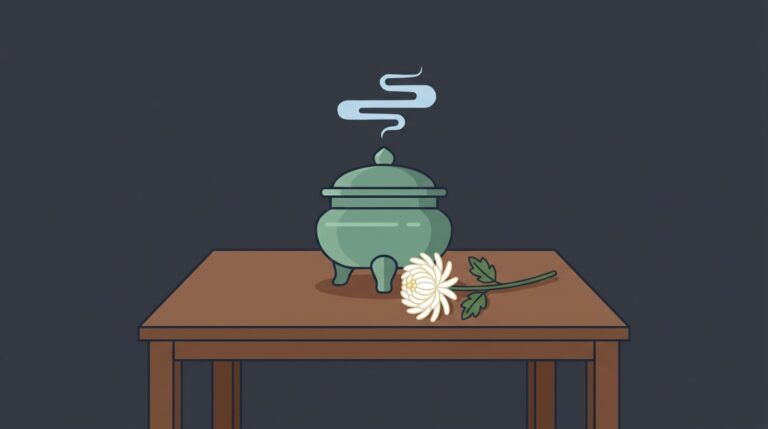
Hello! I’m your Daily Hangul Editor. Have you ever watched a K-Drama where a major character passes away? The scene is always striking: a quiet hospital basement, rows of black suits, the distinct smell of burning incense, and people bowing deeply to a portrait. You might have thought, “If I ever have to attend one, what do I actually do?”
Attending a Korean funeral (장례식 – jangnyesik) is a profound experience, but it’s also a minefield of strict cultural rules. From how you light the incense to how many times you bow, doing it wrong can cause unintended offense. Today, we’re going to navigate this together so you can be a respectful, supportive friend when it matters most.
Phase 2: Core Expressions
1. 삼가 고인의 명복을 빕니다
- Pronunciation: samga goin-ui myeongbogeul bimnida [sahm-gah go-een-eh myung-bohk-eul beem-nee-dah]
- Meaning: Lit. “I humbly pray for the bliss of the deceased in the afterlife.” (May they rest in peace).
- K-Culture Moment: You’ll see this written on envelopes, funeral wreaths, and hear it murmured respectfully to the chief mourner (상주) after bowing.
- Editor’s Insight: This isn’t a conversational phrase. It’s heavy, formal, and almost chanted. Think of it as the ultimate expression of respect.
- Situation Spectrum:
- Casual: 🚫
- Semi-formal: ✅
- Formal: ✅
- 🤔 Think About It: Why is this phrase so formal compared to a simple “RIP”? Korean culture heavily emphasizes formal respect for the transition into the afterlife. Does your culture have a similarly formal grieving phrase?
2. 향을 피우다
- Pronunciation: hyang-eul piuda [hyahng-eul pee-oo-dah]
- Meaning: To light incense.
- K-Culture Moment: The protagonist steps up to the altar, picks up an incense stick, lights it, and then… waits! They never blow it out.
- Editor’s Insight: This is an action-phrase. If someone says “향 피우세요” (Please light the incense), remember the golden rule: NEVER blow it out with your mouth. Wave it gently or pinch it.
- Situation Spectrum:
- All situations: ✅
- 🤔 Think About It: In Korea, blowing out a flame with your breath is considered impure in sacred rituals. How does your culture view fire in religious or memorial settings?
3. 절 두 번 반 하기
- Pronunciation: jeol du beon ban hagi [juhl doo buhn bahn hah-gee]
- Meaning: To bow two and a half times.
- K-Culture Moment: K-Drama fans know that for New Year’s (Seollal), Koreans bow once to their elders. But at a funeral, they bow twice. It’s a stark visual difference representing the world of the living vs. the dead.
- Editor’s Insight: One bow is for the living. Two bows are for the deceased. If you accidentally bow once at a funeral, it means you don’t acknowledge they have passed.
- Situation Spectrum:
- Funerals only: ✅
- 🤔 Think About It: Lowering your body to the floor shows total submission and respect. How do you physically show ultimate respect in your home country?
Phase 3: Textbook vs. Real Korean
[Situation 1: Expressing Condolences]
* 📖 Textbook Korean: “슬픈 일이 생겨서 유감입니다.” (I regret that a sad thing happened – sounds like a robot translated it).
* 🗣️ Real Korean: “얼마나 상심이 크십니까.” (How great your sorrow must be) or simply holding their hands in silence.
* 💡 Why the difference?: Koreans value 눈치 (Nunchi) and emotional resonance (정 – Jeong). Shared silence or recognizing their pain is far more powerful than a clinical “I am sorry.”
[Situation 2: Handing over Condolence Money]
* 📖 Textbook Korean: “제 조의금입니다. 받으세요.” (Here is my condolence money. Take it.)
* 🗣️ Real Korean: (Just silently handing the envelope to the person at the registry desk with a slight nod).
* 💡 Why the difference?: Money is necessary, but talking about it openly at a funeral is considered tacky. Actions speak louder than words.
Phase 4: Cultural Context — K-Culture Deep Dive
4-1. Non-Verbal Cues: Hand Placement Matters!
When standing and bowing, your hand placement (공수 – Gongsu) is critical. For funerals (inauspicious events):
* Men: Right hand over the left hand.
* Women: Left hand over the right hand.
(Note: This is the exact opposite of weddings and New Year’s!)
4-2. K-Drama Connection & K-Food
If you’ve watched My Mister or Reply 1988, you know that a Korean funeral lasts for three days, and it feels a bit like a somber family reunion. Guests are immediately led to a dining area to eat 육개장 (Yukgaejang – Spicy Beef Soup) and drink Soju.
* Why Yukgaejang?: The red color of the chili oil is traditionally believed to ward off evil spirits (잡귀).
* Critical View: Dramas make it look like everyone is casually drinking, but in reality, it’s an exhausting 3-day marathon for the family. The food is there because guests travel far, and the noise of people eating is meant to comfort the mourning family, ensuring they aren’t left alone in the quiet.
Phase 5: Real-Life Roleplay Scenario
Scenario A: The Funeral Hall
Setting: Friday, 9:00 PM. A funeral hall in the basement of a Seoul hospital. You are wearing a black suit. The smell of incense is strong. You are with your Korean coworker, Minsu, attending your manager’s father’s funeral.
YOU: Minsu, I’m so nervous. I’ve never been to a Korean funeral.
민수: 괜찮아요. 내가 하는 대로 따라 하면 돼요.
(Gwaenchanayo. Naega haneun daero ttara hamyeon dwaeyo.)
[Translation] It’s okay. Just follow what I do.
YOU: Okay. Do we go straight to eat? I smell soup.
민수: 아니요! 먼저 인사를 드려야 해요.
(Aniyo! Meonjeo insareul deuryeoya haeyo.)
[Translation] No! We have to pay our respects first.
(🎭 Stage Direction: Minsu leads you into the mourning room. He signs the guestbook and steps up to the altar. He hands you an incense stick.)
민수: 자, 향을 피우세요.
(Ja, hyang-eul piuseyo.)
[Translation] Here, light the incense.
(🎭 Stage Direction: You light the incense from the candle. A small flame is burning on your stick.)
🔀 Your Turn! What do you do next?
* A) Blow the flame out with your mouth quickly.
* B) Shake it gently left and right to extinguish the flame.
* C) Drop the burning stick into the sand immediately.✅ Best Choice: B — Never blow on the incense! Waving it gently or pinching it with your free fingers is the correct way.
⚠️ Choice A Analysis: Blowing on it is a huge taboo because human breath is considered impure in this sacred ritual.
민수: 잘했어요. 이제 두 번 반 절합시다.
(Jalhaesseoyo. Ije du beon ban jeolhapsida.)
[Translation] Good job. Now let’s do the two and a half bows.
(🎭 Stage Direction: You both bow fully twice, then do one small standing bow.)
민수: (To the manager) 얼마나 상심이 크십니까.
(Eolmana sangsimi keusimnikka.)
[Translation] How great your sorrow must be.
YOU: 삼가 고인의 명복을 빕니다.
(Samga goin-ui myeongbogeul bimnida.)
[Translation] May he rest in peace.
매니저: 와주셔서 감사합니다. 식사하고 가세요.
(Wajusyeoseo gamsahamnida. Siksahago gaseyo.)
[Translation] Thank you for coming. Please have a meal before you go.
Scenario B: The Condolence Envelope
Setting: A convenience store near the hospital.
YOU: Do you have envelopes for funerals?
직원: 네, 부의 봉투 저기 있습니다.
(Ne, bu-ui bongtu jeogi itseumnida.)
[Translation] Yes, condolence envelopes are over there.
YOU: Thank you! Wait… do I write my name on the front or back?
직원: 뒷면 왼쪽 아래에 쓰시면 됩니다.
(Dwinmyeon oenjjok araee sseusimyeon doemnida.)
[Translation] You write it on the bottom left of the back side.
Phase 6: 10-Second Shadowing Drill
😊 차분하고 진지하게 (Calmly and seriously)
삼가 / 고인의 / 명복을 / 빕니다.
(samga / goin-ui / myeongbogeul / bimnida.)
Phase 7: K-Culture Mini Dictionary
1. 장례식장
* Romanization: jangnyesikjang
* English: Funeral hall
* Context: Usually located inside large hospital basements, not at churches or separate standalone buildings.
2. 조의금 / 부의금
* Romanization: jouigeum / buuigeum
* English: Condolence money
* Context: Given in a white envelope. The amount is usually an odd number (50k, 70k, 100k won) because odd numbers represent positive energy (Yang).
3. 육개장
* Romanization: yukgaejang
* English: Spicy beef and vegetable soup
* Context: The standard funeral food. Eating it signifies sharing the family’s burden.
4. 상주
* Romanization: sangju
* English: Chief mourner
* Context: Usually the eldest son or closest male relative. They wear a special armband with stripes indicating their relationship to the deceased.
Phase 8: Traveler’s Survival Kit
🆘 Survival Phrases for Funerals
* 🇰🇷 “부의 봉투 있나요?” (Bu-ui bongtu innayo?)
* 🗣️ English Sound-alike: boo-uh bong-too een-nah-yo?
* 📍 Where to use: Convenience stores.
* 💡 Pro Tip: Look for the envelope with black Chinese characters that says 賻儀 (부의).📌 Editor’s Travel Note
* ATMs: You MUST bring cash for the envelope. Thankfully, every funeral hall in Korea has ATMs right in the lobby.
* Dress Code: Black suit and black tie for men. Black conservative dress or suit for women. Bare feet are a strict no-no; wear black socks!
Phase 9: Critical Thinking — “One Step Deeper”
🧠 Think Deeper: Food & Identity
Why is eating at a funeral so important in Korea? In many Western cultures, a funeral is a brief ceremony followed by a quiet reception. In Korea, it’s a 3-day communal event. Sharing a meal (육개장) isn’t just about feeding guests; it’s deeply tied to 정 (Jeong – communal bond). The mourners stay awake for three days, and the continuous arrival of guests, the clinking of spoons, and the chatter are meant to fill the void of death with the warmth of life. It’s a physical manifestation of a community carrying someone through their darkest hours.
💬 Your Turn: Does your culture have specific foods tied to mourning? How does your community support grieving families? Share it in the comments!
Phase 10: FAQ & Avoiding Mistakes
- Q: Can I clink glasses (짠) when drinking Soju at a funeral?
- NO! This is one of the biggest mistakes foreigners make. Clinking glasses is for celebration. Pour drinks for each other, but drink silently.
- Q: I’m Christian/Muslim. Is it okay if I don’t bow to the portrait?
- Yes. It is completely acceptable to step up to the altar, offer a white chrysanthemum flower instead of incense, step back, and simply close your eyes for a silent prayer instead of bowing to the floor. Koreans are very understanding of religious differences.
❌ Common Mistake #1: Smiling brightly when greeting the mourning family to ‘cheer them up.’
✅ Do this instead: Keep a somber, empathetic expression. It’s okay to look sad!❌ Common Mistake #2: Bowing only once to the deceased.
✅ Do this instead: Remember the rule: One for the living, two for the dead. Bow twice fully, plus one small standing nod.
Phase 11: Summary & Action Items
- One-Liner Summary: A Korean funeral requires dark clothes, bowing twice, gently extinguishing incense without blowing, and comforting the family with your silent presence.
- Action Mission 3 Steps:
- 🥉 Bronze (Solo): Practice doing the “half bow” (목례) in the mirror.
- 🥈 Silver (Online): Memorize the phrase “삼가 고인의 명복을 빕니다” and write it down.
- 🥇 Gold (Action): Next time you watch a K-Drama, spot the differences in hand placement between a funeral scene and a wedding scene!
- K-Culture Mission: Search for “Korean Funeral Yukgaejang” online and see how the dining tables are set up right next to the mourning rooms.
- Engagement: Have you ever experienced a culture shock at a foreign wedding or funeral? Let us know below!
Phase 12: Quiz — Interactive Challenge
1. Situational Judgment: You just lit the incense stick at the altar. How do you put out the flame?
* A) Blow on it like a birthday candle.
* B) Shake it gently side to side.
* C) Dunk it in your water cup.
Check Answer
Answer: B. Blowing is considered impure in Korean rituals!
2. True or False — K-Culture Edition: It is polite to shout “Geonbae! (Cheers!)” to lift the mood at a funeral dining table.
Check Answer
Answer: False. Never clink glasses or toast at a funeral. Drink quietly.
3. Fill in the Blank: At a funeral, you should bow to the portrait _____ times.
* A) 1
* B) 2
* C) 3
Check Answer
Answer: B. Two full bows, followed by a slight standing nod.
Frequently Asked Questions (FAQ)
Q: What does "삼가 고인의 명복을 빕니다" mean in Korean and how do you pronounce it?
A: In Korean, "삼가 고인의 명복을 빕니다" is pronounced [samga goin-ui myeongbogeul bimnida [sahm-gah go-een-eh myung-bohk-eul beem-nee-dah] and means: Lit. "I humbly pray for the bliss of the deceased in the afterlife." (May they rest in peace).
Q: What does "향을 피우다" mean in Korean and how do you pronounce it?
A: In Korean, "향을 피우다" is pronounced [hyang-eul piuda [hyahng-eul pee-oo-dah] and means: To light incense.
Q: What does "절 두 번 반 하기" mean in Korean and how do you pronounce it?
A: In Korean, "절 두 번 반 하기" is pronounced [jeol du beon ban hagi [juhl doo buhn bahn hah-gee] and means: To bow two and a half times.







