

Phase 1: Empathy (Immersive Opening)
Hello! Daily Hangul Editor here.
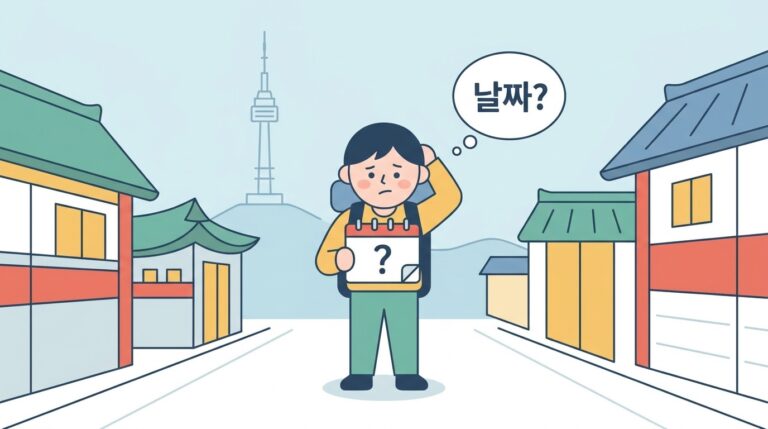
Imagine this: You’ve just landed at Incheon International Airport after a grueling 14-hour flight. You navigate through customs, hop on the Airport Railroad (AREX), and finally arrive in the bustling streets of Seoul. The neon signs are glowing, the smell of street food fills the air, and… you are completely disoriented. Thanks to extreme jet lag, you have absolutely no idea what day or date it is.
Is today the day your favorite K-Pop idol drops their concert tickets? Is it Monday, meaning the Gyeongbokgung Palace is closed? You desperately need to ask someone, but your phone is dead. In a K-Drama, the protagonist might dramatically bump into a handsome stranger and start a conversation. In real life? You just need to know how to ask, “What’s the date today?”
If you don’t know how to ask this simple question, you might miss out on a lot in Korea—from crucial travel itineraries to K-Pop comebacks. Don’t worry! This guide is entirely based on the real struggles of my A1 beginner students who got mixed up with numbers and dates in Seoul.
Phase 2: Core Expressions Deep Dive
Let’s break down the two most important questions you need to survive time-traveling (or just jet-lagging) in Korea.
1. 오늘 며칠이에요? (What date is it today?)
- Pronunciation: [oneul myeochirieyo?]
- Sound-alike guide for English speakers: “Oh-neul myeh-chill-ee-eh-yo?”
- Meaning:
- Literal: Today what day is it?
- Real nuance: “What’s today’s date?”
- K-Culture Moment: Picture a busy office in a K-Drama like Misaeng. A stressed manager rubs his temples and asks his junior, “오늘 며칠이에요?” because a massive project deadline is looming.
- Editor’s Insight: The word ‘며칠’ (myeochil) literally means ‘how many days’ or ‘which date’. It’s super practical. You don’t need to overthink the grammar; just memorize this exact phrase like a magic spell.
- Situation Spectrum:
- Casual with friends: ✅ (Drop the ‘요’ -> 오늘 며칠이야?)
- Office colleagues (Semi-formal): ✅
- Boss / Elders (Formal): ⚠️ (Better to use: 오늘 며칠인가요?)
- 🤔 Think About It: Notice how we don’t ask “What is the number of the day?” like in some languages. Korean asks “How many days?” (며칠). How does your native language structure this question?
2. 무슨 요일이에요? (What day of the week is it?)
- Pronunciation: [museun yoirieyo?]
- Sound-alike guide: “Moo-seun yo-eel-ee-eh-yo?” (Make the ‘moo’ short like a cow’s moo, but cut off quickly).
- Meaning:
- Literal: What weekday is it?
- Real nuance: “What day is it today? (Monday? Tuesday?)”
- K-Culture Moment: You are lining up at a famous bagel shop in Bukchon Hanok Village, but the doors are closed. You ask the person next to you, “오늘 무슨 요일이에요?” Turns out, it’s their rest day!
- Editor’s Insight: ‘무슨’ means ‘what kind of’ or ‘which’, and ‘요일’ means ‘day of the week’. Koreans often combine this with ‘오늘’ (today): “오늘 무슨 요일이에요?”
- Situation Spectrum:
- Casual with friends: ✅ (무슨 요일이야?)
- Office colleagues (Semi-formal): ✅
- Boss / Elders (Formal): ⚠️
- 🤔 Think About It: In Korean, the days of the week are named after the sun, moon, and the five visible planets (representing elements like fire, water, wood, metal, earth). It’s deeply connected to nature!
Phase 3: Textbook vs. Real Korean
[Situation 1: Asking a coworker for the date]
* 📖 Textbook Korean: 오늘은 몇 월 며칠입니까? (What month and day is it today?)
* 🗣️ Real Korean: 오늘 며칠이에요? (What date is it today?)
* 💡 Why the difference?: The textbook version sounds like a news anchor interrogating you. In daily life, we drop the formal “-입니까” (-imnikka) and use the softer, friendlier “-이에요” (-ieyo). Also, we usually skip asking for the month unless it’s genuinely confusing!
[Situation 2: Checking the day of the week with a friend]
* 📖 Textbook Korean: 오늘은 무슨 요일입니까? (What day of the week is it today?)
* 🗣️ Real Korean: 오늘 무슨 요일이지? / 무슨 요일이야? (What day is it today?)
* 💡 Why the difference?: Friends use Banmal (casual language). Adding “-지” (ji) at the end gives a feeling of talking to yourself or thinking out loud, which sounds very natural and un-intimidating.
Bottom Note: As an A1 (Beginner) learner, always stick to the “-요” (-yo) ending when talking to adults or strangers. It’s the ultimate safe zone!
Phase 4: Cultural Context — K-Culture Deep Dive
4-1. Non-Verbal Elements: Approaching a Stranger
If you need to ask a stranger for the date in Korea, don’t just walk up and loudly say, “What date is it!” Tap into your inner 눈치 (Nunchi)—the Korean art of reading the room.
Approach them with a slight bow of the head, make brief eye contact, and start with “저기요…” (Jeogiyo – Excuse me) or “실례합니다…” (Sillyehamnida – Excuse me). Keeping your voice soft and polite will make Koreans much more willing to help!
4-2. K-Culture Connection: The K-Pop “Ticketing” War
Dates and days of the week are a matter of life and death in K-Pop culture. Have you ever heard of 티켓팅 (Ticketing)? It’s the fierce battle to secure concert tickets online. Fans will constantly ask each other: “Is the ticketing today? What date is it?”
Knowing the exact date and day is crucial because ticket sites open right at 8:00 PM KST on specific dates. Also, K-Pop fans celebrate anniversaries like 100 days, 500 days, and 1000 days since debut. In Korea, time isn’t just a number; it’s a milestone to celebrate together!
Phase 5: Real-world Roleplay Scenario
Setting: It’s 2:00 PM on a sunny afternoon in a cozy cafe in Yeonnam-dong, Seoul. You just woke up from a long nap after arriving in Korea yesterday. You are filling out a mandatory travel form on your tablet, but you realize you don’t know today’s date. Your phone is charging at the counter.
Characters:
– YOU: A slightly jet-lagged but enthusiastic traveler on your first trip to Korea.
– Min-ji (25): A local university student sitting at the next table, working on her laptop. She looks friendly.
Dialogue:
YOU: 저기요… 실례합니다. 😅
(Jeogiyo… sillyehamnida.)
[Excuse me… I’m sorry to interrupt.]
(🎭 Stage Direction: You give a small, polite head nod towards Min-ji)
Min-ji: 네? 아, 네!
(Ne? Ah, ne!)
[Yes? Oh, yes!]
YOU: 혹시… 오늘 며칠이에요?
(Hoksi… oneul myeochirieyo?)
[By any chance… what date is it today?]
Min-ji: 아, 잠시만요.
(Ah, jamsimanyo.)
[Ah, just a moment.]
(🎭 Stage Direction: Min-ji checks her smartphone screen)
Min-ji: 오늘 15일이에요.
(Oneul sib-o-irieyo.)
[Today is the 15th.]
YOU: 아, 15일이요! 그럼… 무슨 요일이에요?
(Ah, sib-o-iriyo! Geureom… museun yoirieyo?)
[Ah, the 15th! Then… what day of the week is it?]
Min-ji: 오늘 금요일이에요!
(Oneul geum-yoirieyo!)
[Today is Friday!]
🔀 Your Turn! How should you respond to end the conversation politely?
– A) “오케이! 바이!” (Okay! Bye!)
– B) “감사합니다! 좋은 하루 보내세요!” (Thank you! Have a good day!)
– C) “진짜요? 대박!” (Really? Awesome!)✅ Best Choice: B — Reason: You just asked a favor from a stranger. Thanking them politely with “감사합니다” (Gamsahamnida) and wishing them a good day shows excellent manners.
⚠️ Choice A & C Analysis: “Okay, bye” sounds extremely blunt and slightly rude to a stranger. “대박” (Daebak) is fun, but too informal for someone you just met at a cafe!
Phase 6: 10-Second Shadowing Drill
Read these aloud while mimicking the emotion and pacing! The slashes (/) indicate where you should pause slightly.
- 🥺 Politely asking for help:
저기요, / 혹시 / 오늘 며칠이에요?
(Jeogiyo, / hoksi / oneul myeochirieyo?) -
🤔 Thinking out loud (confused):
오늘 / 무슨 / 요일이에요?
(Oneul / museun / yoirieyo?)
Phase 7: K-Culture Mini Dictionary
1. 눈치 (Nunchi)
* Romanization: nunchi
* English: Social situational awareness / Reading the room.
* Context: The quintessential Korean survival skill. It’s knowing when to ask someone the date and who looks approachable enough to ask.
2. 티켓팅 (Ticketing)
* Romanization: tiketting
* English: Buying concert/event tickets online.
* Context: A highly competitive event in K-Pop culture where knowing the exact date and time down to the millisecond is crucial.
3. 시차 (Sicha)
* Romanization: sicha
* English: Jet lag / Time difference.
* Context: The main reason tourists forget what date or day it is when they land in Seoul!
4. 불금 (Bulgeum)
* Romanization: bulgeum
* English: Fire Friday (TGIF).
* Context: If you ask “무슨 요일이에요?” and the answer is Friday (금요일), you might hear people say “오늘은 불금이에요!” (Today is Fire Friday!), meaning it’s time to drink and party.
Phase 8: Traveler Survival Kit
If you are traveling in Korea, you will need these expressions regarding time and days to avoid finding yourself in front of a closed palace or restaurant!
🆘 Survival Expressions for Dates & Days
– 🇰🇷 “오늘 쉬는 날이에요?” (oneul swineun narieyo?)
– 🗣️ English Pronunciation: Oh-neul shwi-neun nahl-ee-eh-yo?
– 📍 Where to use: Outside a dark, closed restaurant or shop.
– 💡 Meaning: Is today a day off?
- 🇰🇷 “언제 열어요?” (eonje yeoreoyo?)
- 🗣️ English Pronunciation: Eon-jeh yeol-uh-yo?
- 📍 Where to use: When asking a shop owner or a hotel concierge about opening times.
- 💡 Meaning: When does it open?
📌 Editor’s Travel Note
– Museum Mondays: Keep in mind that major tourist sites like Gyeongbokgung Palace are closed on Tuesdays, but many other museums and galleries in Korea are closed on Mondays. Always ask “오늘 무슨 요일이에요?” before planning a museum trip!
– Must-Have Apps: Forget Google Maps in Korea. Download Naver Map or KakaoMap to check the exact opening days and hours of businesses.
Phase 9: Critical Thinking Corner — “One Step Deeper”
🧠 Think Deeper: Language & Power in the ‘Yo’ (요)
You might have noticed that we always attach “-요” (-yo) at the end of our questions when asking strangers: “며칠이에요?” “무슨 요일이에요?” In Korean society, language is a direct reflection of social hierarchy and distance. Dropping the “-yo” implies that you are either close friends or superior in age/status to the listener. When a foreigner uses “-yo” correctly, it immediately signals respect and an understanding of Korean social boundaries, granting you instant likability.
💬 Your Turn: Does your native language have a specific word or ending just to show respect to strangers? Share your thoughts in the comments!
Phase 10: FAQ & Avoiding Misunderstandings
- Q: Can I just point to my watch or calendar to ask the date?
- A: Yes! If you are too nervous, showing your phone screen with a calendar and saying “오늘…?” (Today…?) with an inquisitive look works beautifully. Koreans are generally very quick to catch on (thanks to Nunchi!).
- Q: I see people write ‘몇일’ on the internet. Is that correct?
- A: NO. Even many Koreans get this wrong! Grammatically, it is always spelled 며칠 (myeochil). Never write 몇일.
❌ Common Mistake #1: Asking “오늘 무슨 날이에요?” (What day is it today?) instead of “오늘 무슨 요일이에요?”
✅ How to fix it: “무슨 날” means “What special occasion/holiday is it?” If you just want to know if it’s Monday or Tuesday, you must say “무슨 요일” (museun yo-il).
Phase 11: Summary & Action Items
- One-Liner Summary: To ask for today’s date, say “오늘 며칠이에요?” and for the day of the week, say “오늘 무슨 요일이에요?”
Action Mission 3 Steps:
* 🥉 Bronze (Solo): Look at your calendar right now and ask yourself out loud, “오늘 며칠이에요?”
* 🥈 Silver (Online): Go to a K-Pop or K-Drama fan forum and ask the community, “When is the comeback? 오늘 며칠이에요?”
* 🥇 Gold (Real World): Next time you visit a Korean restaurant or grocery store, ask the staff “오늘 며칠이에요?” just for practice!
K-Culture Mission:
Go to YouTube and search for your favorite K-Pop idol’s “Vlog” or behind-the-scenes video. Turn on the Korean subtitles. I guarantee you will hear them ask a staff member “오늘 며칠이지?” at least once while filming!
Don’t forget to tell us in the comments what day it is where you are reading this! 👇
Phase 12: Quiz — Interactive Challenge
1. Situational Judgment:
You just woke up in your hotel in Seoul and want to know if it’s Friday or Saturday. What should you ask the receptionist?
A) 오늘 며칠이에요? (What date is it today?)
B) 오늘 무슨 요일이에요? (What day of the week is it?)
C) 오늘 생일이에요? (Is it your birthday today?)
2. True or False — K-Culture Edition:
In Korea, it is considered extremely rude to ask a stranger on the street for the time or date. (T/F)
3. Fill in the Blank:
Excuse me, what date is it today?
저기요, 오늘 _____이에요?
(Answers)
Click here to see the answers!
1. B (You want to know the day of the week, not the numerical date!)
2. False. It is totally fine to ask strangers for the time or date, as long as you approach politely with “저기요” (Excuse me).
3. 며칠 (myeochil)
Frequently Asked Questions (FAQ)
Q: What does "오늘 며칠이에요? (What date is it today?)" mean in Korean and how do you pronounce it?
A: In Korean, "오늘 며칠이에요? (What date is it today?)" is pronounced [oneul myeochirieyo?] and means: a key conversational Korean expression covered in this lesson.
Q: What does "무슨 요일이에요? (What day of the week is it?)" mean in Korean and how do you pronounce it?
A: In Korean, "무슨 요일이에요? (What day of the week is it?)" is pronounced [museun yoirieyo?] and means: a key conversational Korean expression covered in this lesson.







