

Phase 1: Empathy & The Concrete Jungle
Hello! I am your Daily Hangul Editor.
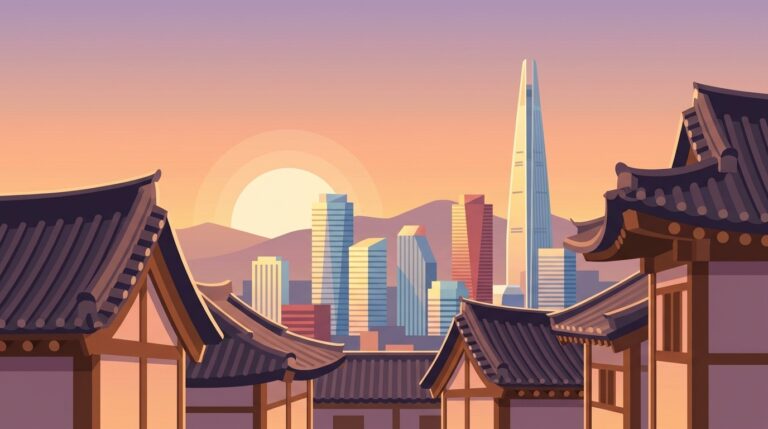
Imagine this: You are standing in the middle of Gwanghwamun Square. To your north, the majestic, centuries-old Gyeongbokgung Palace rests peacefully against the mountains. But turn around, and you are immediately swallowed by a canyon of glittering, ultra-modern skyscrapers. Or perhaps you are wandering through the narrow, gritty alleyways of Euljiro, surrounded by 40-year-old printing shops, only to open a rusty door that leads to the most avant-garde rooftop bar you have ever seen.
Seoul is a city where hyper-futuristic architecture and urban regeneration collide every single day. If you have watched K-Dramas like Queen of Tears or Itaewon Class, you know that buildings in Korea aren’t just structures; they are symbols of power, rebirth, and social status.
But when you want to discuss these magnificent landmarks or trendy revitalized neighborhoods with your Korean friends, do you find yourself stuck saying, “The building is very tall” (건물이 아주 높아요)? At a C1 level, you want to sound like a true Seoulite—someone who understands the pulse of the city’s real estate, the romance of its skyline, and the grit of its urban renewal.
Let’s upgrade your architectural vocabulary and explore the true K-Culture behind Seoul’s concrete jungle.
Phase 2: Core Expressions — Speaking Like an Urban Local
Here are the top 3 expressions you need to discuss skyscrapers and urban landmarks at an advanced level.
1. 스카이라인을 뒤바꾸다 (To completely change the skyline)
- Pronunciation: [seukaillaineul dwibakkuda]
- Sound-alike guide: ‘seukaillain’ is just English ‘skyline’ spoken with Korean phonetics. ‘dwi’ sounds like ‘dwee’, and ‘bakkuda’ sounds like ‘bah-koo-dah’ with a strong, popping ‘b’.
- Meaning:
- Literal: To flip/change the skyline.
- Real Nuance: Used when a massive new skyscraper or development project alters the visual identity of a city.
- K-Culture Moment: You will hear this in Korean news when discussing the Lotte World Tower or the new Hyundai GBC project in Gangnam. If you are having a coffee with a Korean coworker looking out over the Han River, dropping this phrase will make you sound like an urban planning expert.
- Editor’s Insight: The word 뒤바꾸다 is much stronger than just 바꾸다 (to change). The prefix ‘뒤’ adds the feeling of ‘turning something upside down’ or ‘a complete overhaul.’
- Situation Spectrum:
- Casual with friends: ✅
- Semi-formal (Co-workers): ✅
- Formal (Boss/Elders): ✅
- 🤔 Think About It: Korea went through hyper-rapid development known as the “Miracle on the Han River.” Why do you think Korean vocabulary has so many dramatic words like ‘뒤바꾸다’ (completely overturn) when discussing city development?
2. 구도심의 화려한 부활 (The spectacular revival of the old downtown)
- Pronunciation: [gudosimui hwayeohan buhwal]
- Sound-alike guide: ‘gudosim’ (goo-doh-shim). ‘ui’ sounds like ‘uh-ee’ spoken fast (make the ‘uh’ like the disgusted sound you make when stepping in gum). ‘buhwal’ (boo-hwal).
- Meaning:
- Literal: The flashy resurrection of the old city center.
- Real Nuance: This is the ultimate phrase for “Urban Regeneration” (도시 재생). It describes old, rundown neighborhoods transforming into trendy cultural hubs.
- K-Culture Moment: Think of Seongsu-dong (often called the Brooklyn of Seoul). It used to be a neighborhood of handmade shoe factories. Now, it’s filled with Dior concept stores and mega-cafes built inside abandoned warehouses.
- Editor’s Insight: Koreans love the contrast between ‘old/retro’ and ‘modern/flashy’. Using the word 화려한 (spectacular/flashy) next to 구도심 (old downtown) creates a poetic tension that native speakers love.
- Situation Spectrum:
- Casual with friends: ⚠️ (A bit too poetic for casual chatter; friends might use “요즘 뜬대” instead)
- Semi-formal (Co-workers): ✅
- Formal (Boss/Elders): ✅
- 🤔 Think About It: Instead of demolishing old areas, why is “Newtro” (New + Retro) urban regeneration so popular among Gen Z in Korea today?
3. 랜드마크로 자리매김하다 (To establish itself as a landmark)
- Pronunciation: [raendeumakeuro jarimaegimhada]
- Sound-alike guide: ‘raendeumakeu’ is ‘landmark’. ‘jari’ (jah-ree) means ‘seat/place’. ‘maegim’ (meh-gheem).
- Meaning:
- Literal: To mark its place as a landmark.
- Real Nuance: It signifies that a building or location has successfully become the definitive symbol of an area, accepted by the public.
- K-Culture Moment: When Dongdaemun Design Plaza (DDP) was first built, its spaceship-like architecture was controversial. Now? It has completely “자리매김하다” (established itself) as the landmark of Seoul’s fashion district.
- Editor’s Insight: 자리매김하다 is a very sophisticated, C1-level verb. If you use this instead of the basic 되다 (to become), your Korean will instantly sound highly educated and fluent.
- Situation Spectrum:
- Casual with friends: ⚠️ (A bit formal)
- Semi-formal (Co-workers): ✅
- Formal (Boss/Elders): ✅
- 🤔 Think About It: How does a building “earn its seat” (자리) in a city’s culture? Is a landmark decided by the government, or by the people who use it?
Phase 3: Textbook vs. Real Korean
Let’s bridge the gap between your C1 textbook and the streets of Seoul.
[Describing a highly concentrated area of skyscrapers]
* 📖 Textbook Korean: 이곳에는 높은 건물이 아주 많습니다. (There are many tall buildings here.)
* 🗣️ Real Korean: 완전 빌딩 숲이 장난 아니에요. (The concrete jungle [building forest] here is no joke.)
* 💡 Why the difference?: Koreans use “장난 아니다” (It’s no joke) to express awe, and “빌딩 숲” (Building forest) is the standard poetic yet everyday term for a skyscraper district like Yeouido or Gangnam.
[Talking about a gentrified, regenerated neighborhood]
* 📖 Textbook Korean: 이 동네는 옛날 건물을 다시 고쳐서 멋있습니다. (This neighborhood is cool because they fixed old buildings.)
* 🗣️ Real Korean: 여기 완전 레트로 감성 제대로 살렸네요. (They completely brought out the retro vibe here.)
* 💡 Why the difference?: “감성” (vibe/sensibility) is the most critical buzzword in modern Korean lifestyle culture. If an urban space has a good aesthetic, it has “감성.”
[Recommending a high-rise observatory]
* 📖 Textbook Korean: 경치가 좋은 곳을 추천합니다. (I recommend a place with a good view.)
* 🗣️ Real Korean: 거기 완전 뷰맛집이니까 꼭 가보세요! (That place is a total ‘view restaurant’, so you must go!)
* 💡 Why the difference?: “맛집” (famous restaurant) has evolved. Now, any place that is exceptional at something gets “~맛집” attached to it. A landmark with a great view is a “뷰맛집” (View matjib).
Phase 4: Cultural Context — K-Culture Deep Dive
4-1. Non-Verbal Cues: The Architecture of Nunchi
When you are looking up at the Lotte World Tower or pointing out a landmark to a senior colleague, remember Korean pointing etiquette. Do not use a single index finger to point at a building if you are showing it to someone older. Instead, use an open hand, palm facing up, gesturing toward the skyline. It shows respect to the listener, even if you are just talking about concrete!
4-2. The K-Drama Chaebol View (재벌 뷰)
If you watch K-Dramas like Penthouse, Queen of Tears, or Vincenzo, you’ll notice a distinct trope: altitude equals power. The Chaebol (family-owned conglomerate) CEO always has a corner office in a towering glass skyscraper, gazing down at the tiny cars in the “빌딩 숲” (building forest) below.
Critical Viewpoint: While dramas make living in a 100-story penthouse look like the ultimate dream, the reality in Seoul is that real estate (부동산) is a massive source of societal stress. When Koreans talk about skyscrapers and luxury high-rises (like LCT in Busan or Signiel in Seoul), there is often a mix of admiration and a sigh regarding the extreme housing prices. Understanding this bittersweet “Han River view” dream is crucial for reading between the lines of Korean conversations.
Phase 5: Real-Life Roleplay Scenario
Setting: Friday evening, 7:30 PM. You and your Korean coworkers are at a trendy rooftop wine bar in Euljiro (affectionately known as Hip-jiro). The bar is actually on the roof of a dingy 1970s printing factory, but it has fairy lights and a stunning view of the hyper-modern Namsan Tower and Myeongdong skyscrapers in the distance.
Characters:
– YOU: An expat professional who has lived in Seoul for 2 years. You love urban exploration.
– Minji (30, Colleague): A Seoul native who loves discovering hidden ‘Newtro’ spots.
Dialogue:
Minji: 와, 여기 분위기 진짜 미치지 않았어요? 완전 레트로 감성 제대로예요.
(Wa, yeogi bunwigi jinjja michiji anasseoyo? Wanjeon reteuro gamseong jedaero-yeyo.)
[Wow, isn’t the vibe here absolutely crazy? It really captured that retro aesthetic perfectly.]
(🎭 Stage Direction: Minji takes a sip of wine and looks around the exposed brick walls.)
YOU: 맞아요. 구도심의 화려한 부활이네요. 어떻게 이런 인쇄소 골목에 이런 바(bar)를 만들 생각을 했죠?
(Majayo. Gudosim-ui hwaryeohan buhwar-ineyo. Eotteoke ireon inswaeso golmog-e ireon ba-reul mandeul saenggak-eul haetjyo?)
[Right. It’s the spectacular revival of the old downtown. How did they even think of building a bar in a printing shop alley?]
Minji: 그니까요! 옛날에는 이동네 밤되면 무서워서 오지도 못했는데, 이젠 서울의 새로운 랜드마크로 자리매김한 것 같아요.
(Geunikkayo! Yennal-eneun idongne bam-doemyeon museowoseo ojido mot-haenneunde, ijen seoul-ui saeroun raendeumakeu-ro jarimaegimhan geot gatayo.)
[Exactly! In the past, people were too scared to come to this neighborhood at night, but now it seems to have established itself as Seoul’s new landmark.]
YOU: 저기 멀리 보이는 고층 빌딩 숲이랑 여기 옛날 건물들이 대비돼서 스카이라인이 진짜 매력적이에요.
(Jeogi meolli boineun gocheung bilding sup-irang yeogi yennal geonmul-deul-i daebi-dwaeseo seukaillain-i jinjja maeryeokjeog-ieyo.)
[The skyline is truly fascinating because of the contrast between the skyscraper forest in the distance and these old buildings here.]
Minji: ○○씨(You), 진짜 한국 사람 다 됐네요! ‘빌딩 숲’이라는 말도 알고. 근데 ○○씨는 이런 오래된 감성이 좋아요, 아니면 저기 롯데타워 같은 초고층 빌딩이 좋아요?
(OO-ssi, jinjja hanguk saram da dwaenneyo! ‘Bilding sup’-iraneun mal-do algo. Geunde OO-ssi-neun ireon oraedoen gamseong-i joayo, animyeon jeogi rotte-taweo gateun chogocheung bilding-i joayo?)
[You’ve completely become Korean! You even know the term ‘building forest’. By the way, do you prefer this old, retro vibe, or ultra-high skyscrapers like the Lotte Tower over there?]
🔀 Your Turn! How should you answer Minji?
– A) “당연히 초고층 빌딩이 최고죠. 여긴 너무 낡았어요.” (Of course, skyscrapers are the best. It’s too rundown here.)
– B) “둘 다 매력이 다르죠. 옛날 건물은 역사가 있고, 새 건물은 편리하잖아요.” (They both have different charms. Old buildings have history, and new ones are convenient.)
– C) “무조건 레트로죠! 롯데타워는 너무 숨 막혀요.” (Definitely retro! Lotte Tower is too suffocating.)✅ Best Choice: B — Koreans highly value balanced, diplomatic answers, especially in semi-formal workplace relationships. Acknowledging the duality of Seoul’s architecture shows deep cultural understanding.
⚠️ Choice A & C Analysis: While perfectly fine if Minji is a close friend, extreme preferences might kill the poetic mood she was trying to set. Korean conversation often flows best when you harmonize with the other person’s observations.
Phase 6: 10-Second Shadowing Drill
Let’s practice expressing awe at Seoul’s cityscape. Pay attention to the pausing (/) and intonation.
😲 와, / 구도심과 빌딩 숲이 어우러진 스카이라인이 / 진짜 압도적이네요!
(Wa, / gudosim-gwa bilding sup-i eoureojin seukaillain-i / jinjja apdojeog-ineyo!)
[Wow, the skyline where the old downtown and the concrete jungle blend together is truly overwhelming!]
Coach’s Tip: Put a heavy emphasis on 진짜 (jinjja) and drag out the 압 (ap) in 압도적이네요 to sound genuinely impressed.
Phase 7: K-Culture Mini Dictionary (Urban & Real Estate)
1. 임장 (Imjang)
* Romanization: imjang
* English: Real estate scouting / Property tour
* Context: Originally a formal real estate term, young Koreans now use “임장 가다” (going on an Imjang) almost like a hobby, visiting new high-rise developments or gentrifying neighborhoods to study investment potential or just admire the architecture.
2. 뷰맛집 (View matjib)
* Romanization: byu-matjib
* English: A place with an exceptional view
* Context: Used to describe cafes, bars, or observatories located in high-rises or landmarks. If a place has a great view of the Han River, it’s a “한강 뷰맛집.”
3. 힙지로 (Hip-jiro)
* Romanization: hip-jiro
* English: Hip + Euljiro
* Context: The prime example of Seoul’s urban regeneration. The old industrial district of Euljiro was transformed by young artists and chefs, earning the nickname “Hip-jiro.”
4. 빌딩 숲 (Bilding sup)
* Romanization: bilding sup
* English: Concrete jungle (lit. Building forest)
* Context: A highly relatable term for areas like Gangnam, Yeouido, or Jongno where high-rises block the sky. Often used when expressing exhaustion from city life.
Phase 8: Traveler Survival Kit (Landmarks & Observatories)
Are you trying to navigate a massive landmark like Lotte World Tower, N Seoul Tower, or the 63 Building? Here are the survival phrases you need.
🆘 Survival Phrases for Skyscrapers
🇰🇷 1. “전망대 가는 엘리베이터는 어디서 타나요?”
– Pronunciation: jeonmangdae ganeun ellibeiteo-neun eodiseo tanayo?
– Meaning: Where do I catch the elevator to the observatory?🇰🇷 2. “가장 꼭대기 층이 몇 층이에요?”
– Pronunciation: gajang kkokdaegi cheung-i myeot cheung-ieyo?
– Meaning: What floor is the very top floor?🇰🇷 3. “배경에 이 건물 다 나오게 사진 한 장만 찍어주시겠어요?”
– Pronunciation: baegyeong-e i geonmul da naoge sajin han jang-man jjigeo-jusigesseoyo?
– Meaning: Could you take a picture for me with this whole building in the background?
📌 Editor’s Travel Note:
– Finding your way: Mega-landmarks in Korea are practically underground cities. If you use KakaoMap or Naver Map, pay attention to the “Exit Number” (출구 번호). It is your lifeline.
– Taking Photos: Koreans take photography very seriously. If you ask a local to take a photo of you in front of a landmark (Phrase 3), prepare for them to squat down to get your legs looking long and the entire skyscraper in the frame. Return the favor!
Phase 9: Critical Thinking — “One Step Deeper”
Language & Power: The Altitude of Status in Korea
🧠 Think Deeper:
In Korean society, architecture and altitude are deeply intertwined with social class. The phrase “한강 뷰” (Han River view) isn’t just about a pretty scenery; it’s a marker of having “made it” in life, as seen in countless K-Pop lyrics and reality shows. Conversely, the “반지하” (semi-basement), made globally famous by the movie Parasite, represents the opposite end of the spectrum. When urban regeneration (재개발) occurs, old neighborhoods are replaced by luxury high-rises. While the skyline becomes more beautiful (스카이라인을 뒤바꾸다), the original residents are often priced out. Understanding this dynamic will help you grasp why Koreans discuss real estate, landmarks, and skyscrapers with such intense passion and sometimes, anxiety.💬 Your Turn: How is urban gentrification or “living high up” viewed in your home country? Does a penthouse hold the same cultural weight? Share your thoughts in the comments!
Phase 10: FAQ & Avoiding Misunderstandings
Q: “Can I use ‘랜드마크 (Landmark)’ exactly like I do in English?”
– Yes, but pronounce it the Korean way! Do not say “Land-mark.” You must say “Raen-deu-ma-keu.” Also, in Korea, even a local famous bakery can be jokingly called “our neighborhood’s landmark.” It is used much more loosely than in the West.
Q: “Is it rude to ask a Korean how much their apartment in a high-rise costs?”
– Maybe. While Koreans talk about real estate broadly, asking a direct colleague “How much is your house?” is invasive unless you are very close friends discussing investment strategies (임장).
❌ Common Mistake #1: Confusing native Korean numbers with Sino-Korean numbers for building floors.
✅ How to fix it: Always use Sino-Korean numbers (일, 이, 삼…) for floors (층).
Wrong: 하나 층 (Hana cheung) -> Right: 일 층 (Il cheung – 1st floor).❌ Common Mistake #2: Translating “skyscraper” literally as “하늘을 긁는 건물”.
✅ How to fix it: Use 초고층 빌딩 (Ultra-high-rise building) or 마천루 (Skyscraper – formal/literary).
Phase 11: Summary & Action Items
One-Liner Summary: To master advanced Korean architecture talk, embrace the poetic contrast between the glittering “빌딩 숲” (concrete jungle) and the “구도심의 화려한 부활” (revival of the old downtown).
Action Mission 3 Steps:
– 🥉 Bronze (Solo): Look out your window and describe the skyline using today’s shadowing phrase in front of a mirror.
– 🥈 Silver (Online): Find a photo of the Lotte World Tower or DDP on Instagram and leave a comment: “서울의 랜드마크! 뷰가 장난 아니네요.”
– 🥇 Gold (Real-world): Next time you are in Seoul (or talking to a Korean friend), ask them about a neighborhood that has undergone urban regeneration (like Seongsu or Euljiro).
K-Culture Special Mission:
Open Naver Map or Google Street View and drop your little avatar right in the middle of “Seongsu-dong Cafe Street.” Look at the mix of old brick factories and sleek new cafes. Can you spot the urban regeneration?
Phase 12: Interactive Challenge — Quiz
1. Situational Judgment: You are on the 118th floor of the Seoul Sky Observatory with your Korean boss. The view of the Han River and the thousands of buildings below is breathtaking. What is the most appropriate C1-level thing to say?
– A) 건물이 진짜 많네요. (There are a lot of buildings.)
– B) 빌딩 숲 스카이라인이 정말 압도적입니다. (The skyline of the concrete jungle is truly overwhelming.)
– C) 대박. 뷰맛집이네. (Jackpot. It’s a view matjib.)
2. True or False – K-Culture Edition:
In Korea, the phrase “임장 (Imjang)” is only used by professional real estate agents, and regular people do not go on property tours.
3. Fill in the Blank:
낡은 공장 지대였던 성수동이 트렌디한 카페 거리로 변신하며, 완벽한 _______의 부활을 보여주고 있습니다.
(Hint: The old downtown)
Click to see answers!
- B is perfect. It is sophisticated and appropriate for a boss. A is too basic (A1 level). C is too slangy to use with your boss, though perfect for a close friend.
- False. “Imjang” has become a common hobby and study topic for young Korean adults looking to invest or understand the housing market.
- 구도심 (Old downtown).
Did you enjoy today’s journey through Seoul’s skyline? Which architectural style do you prefer: the ultra-modern skyscraper or the retro regenerated cafe? Let me know in the comments below!
Frequently Asked Questions (FAQ)
Q: What does "스카이라인을 뒤바꾸다 (To completely change the skyline)" mean in Korean and how do you pronounce it?
A: In Korean, "스카이라인을 뒤바꾸다 (To completely change the skyline)" is pronounced [seukaillaineul dwibakkuda] and means: a key conversational Korean expression covered in this lesson.
Q: What does "구도심의 화려한 부활 (The spectacular revival of the old downtown)" mean in Korean and how do you pronounce it?
A: In Korean, "구도심의 화려한 부활 (The spectacular revival of the old downtown)" is pronounced [gudosimui hwayeohan buhwal] and means: a key conversational Korean expression covered in this lesson.
Q: What does "랜드마크로 자리매김하다 (To establish itself as a landmark)" mean in Korean and how do you pronounce it?
A: In Korean, "랜드마크로 자리매김하다 (To establish itself as a landmark)" is pronounced [raendeumakeuro jarimaegimhada] and means: a key conversational Korean expression covered in this lesson.






