

Phase 1: Empathy (Immersive Open)
Hello there! I’m the lead editor of Daily Hangul.
Picture this: You’re standing in the middle of a bustling Seoul street, rain pouring down like a dramatic scene from a K-Drama. You try to catch a taxi by waving your hand frantically, but every car with a red light just zooms past you. Or maybe it’s 11 PM, you’re craving that crispy late-night Korean fried chicken your favorite K-Pop idol just posted on Instagram, but staring at the delivery app feels like trying to decipher an ancient code.
Sound familiar? You’re not alone. Living in or visiting Korea without mastering local smartphone apps is like trying to eat Gukbap (국밥, hot soup with rice) with a fork. It’s possible, but incredibly frustrating! Korea is a hyper-connected, “smart” society. While textbooks teach you how to ask for directions by saying “실례합니다, 우체국이 어디에 있습니까?” (Excuse me, where is the post office?), in reality, everyone just stares at Naver Map.
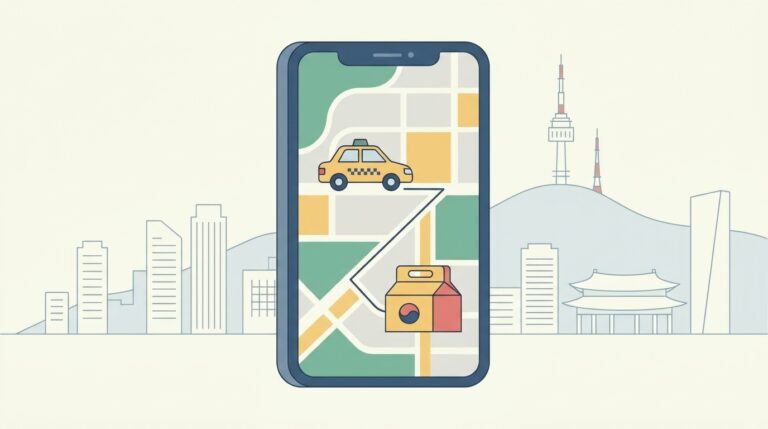
Today, we are diving deep into the essential vocabulary and cultural nuances of Korea’s holy trinity of apps: Delivery (배달), Taxi (택시), and Maps (지도). By the end of this B2-level guide, you won’t just survive; you’ll navigate Seoul like a true Inssa (인싸, insider).
Phase 2: Core Expressions Deep Dive
1. 문 앞에 두고 벨 눌러주세요.
- Pronunciation: mun ape dugo bel nulleojuseyo. [moon ah-peh doo-go bell nool-luh-joo-say-yo]
- Meaning: (Literal) Leave it in front of the door and press the bell. / (Real nuance) Please leave the food at my door and ring the doorbell.
- K-Culture Moment: You’ll see this phrase as a default option in the “요청사항” (Requests) section of Baedal Minjok (Baemin) or Yogiyo apps. It’s the ultimate introvert-friendly feature. You don’t have to make eye contact; just wait for the bell, peek out to ensure the coast is clear, and grab your food!
- Editor’s Insight: This isn’t just about convenience; it reflects Korea’s incredibly high-trust society. People confidently leave packages and food in hallways without fear of theft.
- Situation Spectrum:
- App Request Note (Written): ✅
- Speaking to the Rider (Phone): ✅
- Speaking to a Boss: 🚫 (Irrelevant context)
- 🤔 Think About It: How does this “contactless delivery” culture reflect the modern Korean lifestyle, particularly the rise of single-person households (1인 가구)? Does your home country have a similar high-trust delivery culture?
2. 도착지를 설정해 주세요.
- Pronunciation: dochakjireul seoljeonghae juseyo. [doh-chak-jee-reul sul-jung-hae joo-say-yo]
- Meaning: (Literal) Please set the destination. / (Real nuance) Where do you want to go?
- K-Culture Moment: When you open Kakao T (the Uber of Korea), this is the first thing you must do. Unlike some countries where you get in a taxi and then tell the driver where to go, Korean taxi apps require you to pin your exact destination before hailing the ride.
- Editor’s Insight: The word 설정하다 (to set/configure) is a B2-level tech vocabulary staple. You will see it in your phone settings, game menus, and app profiles.
- Situation Spectrum:
- App UI (Text): ✅
- Casual Conversation: ⚠️ (Sounds too robotic)
- 🤔 Think About It: Why is setting the destination beforehand so crucial in Korea’s “Ppalli-ppalli” (hurry up) culture?
3. 기사님, 만나서 결제할게요.
- Pronunciation: gisanim, mannaseo gyeoljehalgeyo. [gee-sah-nim, man-nah-suh gyul-jeh-hal-geh-yo]
- Meaning: (Literal) Driver, I will meet and pay. / (Real nuance) Driver, I will pay in person (with cash or my physical card).
- K-Culture Moment: You don’t have a Korean bank account yet? No problem. Both delivery and taxi apps have a “만나서 결제” (pay in person) or “직접 결제” (pay directly) option. 기사님 (Gisa-nim) is the polite and standard way to address a taxi driver or a delivery rider.
- Editor’s Insight: Never call a driver “아저씨” (Ajeossi, middle-aged man) unless you want to sound slightly rude or overly informal. 기사님 is the golden word that shows respect for their profession.
- Situation Spectrum:
- Addressing a Driver/Rider (Formal): ✅
- Addressing a Store Clerk: 🚫 (Use 사장님 or 직원분 instead)
- 🤔 Think About It: The Korean language uses specific titles based on professions (기사님, 사장님, 선생님). How does this differ from the English use of “Sir” or “Ma’am”?
Phase 3: Textbook vs. Real Korean
[Calling a Taxi]
* 📖 Textbook Korean: 택시를 부르다. (To call a taxi.)
* 🗣️ Real Korean: 카택 잡다. (To catch Ka-Taek.)
* 💡 Why so different?: Koreans love abbreviations. “Kakao T” is commonly shortened to 카택 (Ka-Taek). Also, we use the verb 잡다 (to catch) rather than 부르다 (to call) when referring to hailing a ride via an app.
[Ordering Food]
* 📖 Textbook Korean: 음식을 배달하다. (To deliver food.)
* 🗣️ Real Korean: 배민 시키다. (To order Baemin.)
* 💡 Why so different?: 배달하다 is what the rider does. As a customer, you use 시키다 (to order/make someone do something). Using the app name “Baemin” has become synonymous with ordering delivery, much like saying “to Google” instead of “to search online.”
[Looking at the Map]
* 📖 Textbook Korean: 지도를 확인하다. (To check the map.)
* 🗣️ Real Korean: 네이버지도 찍고 가다. (To put it in Naver Map and go.)
* 💡 Why so different?: 찍다 literally means “to stamp” or “to dot.” In tech slang, it means to drop a pin or enter a location into a GPS.
Bottom Note: At a B2 level, start incorporating these natural verbs (잡다, 시키다, 찍다) instead of formal textbook equivalents. It instantly upgrades your Korean from “student” to “resident.”
Phase 4: Cultural Context — K-Culture Deep Dive
4-1. Non-verbal Communication & Context
When receiving a delivery or taking a taxi, the ultimate non-verbal cue is efficiency. The “Ppalli-ppalli” (빨리빨리, speed) culture dictates that you shouldn’t keep the driver waiting. If you selected “pay in person,” have your card physically in your hand before the rider arrives. If you are getting into a Kakao Taxi, the driver already knows your destination; you just need to give a slight nod, say “안녕하세요,” and let them drive. Over-explaining the route (unless asked) can disrupt their flow.
4-2. K-Culture Connections
🍗 K-Food & K-Drama Connection: The Han River Delivery Scene
If you’ve watched any modern K-Drama (like Hospital Playlist or Crash Landing on You), you’ve seen the iconic Han River (한강) scene. Characters sit on a picnic mat, and magically, a delivery rider appears out of nowhere holding a bag of Chimaek (Chicken and Beer).
The Reality Check: It’s not magic; it’s the Delivery Zone (배달존). Because parks don’t have exact street addresses, you must order to designated numbered zones (e.g., Yeouido Hangang Park Delivery Zone 2). Knowing how to use the app to select these specific landmarks is a crucial survival skill for enjoying K-Culture to the fullest!
🗺️ K-Travel Connection: The “No Google Maps” Rule
Many tourists arrive in Seoul, open Google Maps, and get hopelessly lost. Due to national security laws regarding North Korea, foreign servers (like Google) cannot store high-resolution map data of South Korea. Therefore, Google Maps cannot provide walking or driving directions! You must download Naver Map or Kakao Map. Knowing how to type Korean addresses or phone numbers into these apps is your lifeline.
Phase 5: Interactive Roleplay Scenario
Setting: Friday, 8:00 PM. Yeouido Hangang Park. The cool evening breeze is blowing, buskers are singing K-Pop acoustics in the background. You and your Korean friend are starving.
Characters:
– YOU: A B2-level Korean learner, excited to experience your first “Han River Chimaek.”
– Min-ji (28): Your energetic Korean friend who expects you to show off your Korean skills.
Min-ji: 배고프다! 우리 치킨 배달시킬까? 내가 앱 켤게.
(baegopeuda! uri chikin baedalsikilkka? naega aep kyeolge.)
[I’m hungry! Should we order chicken delivery? I’ll open the app.]
(🎭 Stage Direction: Min-ji hands you her phone, showing the Baemin app.)
YOU: 좋아! 내가 주소 입력할게… 어? 여기 주소가 뭐야?
(joa! naega juso imnyeokalge… eo? yeogi jusoga mwoya?)
[Great! I’ll enter the address… Huh? What is the address here?]
Min-ji: 한강공원은 주소 말고 배달존으로 찍어야 돼. ‘여의도 배달존 2’로 설정해 봐.
(hanganggongwoneun juso malgo baedaljoneuro jjigeoya dwae. ‘yeouido baedaljon i’ro seoljeonghae bwa.)
[For Han River Park, you have to pin a Delivery Zone, not an address. Set it to ‘Yeouido Delivery Zone 2’.]
YOU: 아, 그렇구나. (Typing…) 요청사항에 뭐라고 적을까?
(a, geureokuna. yocheongsahange mworago jeogeulkka?)
[Ah, I see. What should I write in the requests?]
Min-ji: 그냥 기본으로 해. 근데 기사님 오시면 전화 올 거야.
(geunyang giboneuro hae. geunde gisanim osimyeon jeonhwa ol geoya.)
[Just leave it as default. But the rider will call when he arrives.]
(10 minutes later… 📱 Ring Ring! It’s the delivery rider.)
Rider: 여보세요, 기사인데요. 배달존 2번 도착했습니다. 어디 계세요?
(yeoboseyo, gisaindeyo. baedaljon ibeon dochakaetseumnida. eodi gyeseyo?)
[Hello, this is the driver. I’ve arrived at Delivery Zone 2. Where are you?]
🔀 Your Turn! How do you answer?
– A) “저기요! 배달존 2번이에요. 오세요!”
– B) “네 기사님! 지금 배달존 2번 앞 편의점 쪽으로 가고 있습니다!”
– C) “치킨입니까? 감사합니다!”✅ Best Choice: B — Reason: It uses the polite title “기사님” (Driver) and clearly gives a landmark (편의점 – convenience store) while stating your action (가고 있습니다 – I am going).
⚠️ Choice A Analysis: “저기요” (Excuse me/Hey you) sounds a bit aggressive and rude over the phone to a worker. It lacks the respect that “기사님” conveys.
Phase 6: 10-Second Shadowing Drill
Practice this sentence to use when a taxi driver or delivery rider calls you to find your exact location. Follow the pauses (/) and intonation!
😊 네 기사님! / 저 지금 / 편의점 앞에 / 서 있어요!
(ne gisanim! / jeo jigeum / pyeonijeom ape / seo isseoyo!)
[Yes, Driver! / I am right now / in front of the convenience store / standing!]
Tip: Say the “네 기사님!” brightly to show respect, and slightly emphasize “편의점” (convenience store) so they can spot you easily!
Phase 7: K-Culture Mini Dictionary
1. 배민 (Baemin)
* Romanization: baemin
* English: Short for Baedal Minjok (Delivery Nation).
* Context: The dominant food delivery app in Korea. The brand is famous for its witty, B-grade humor marketing and signature mint-green color.
2. 카택 (Ka-Taek)
* Romanization: kataek
* English: Short for Kakao Taxi.
* Context: The go-to ride-hailing app. It syncs with your KakaoTalk account, making it incredibly convenient for sharing your live location with friends for safety.
3. 안심번호 (Ansim beonho)
* Romanization: ansim beonho
* English: Safe Number (Virtual Number).
* Context: A crucial privacy feature in Korean delivery apps. Instead of giving the rider your real phone number, the app generates a temporary 050 number to protect your privacy.
4. 길치 (Gilchi)
* Romanization: gilchi
* English: Someone with a terrible sense of direction.
* Context: A highly common slang word combining ‘길’ (road) and ‘치’ (lack of ability). Even with Naver Map, if you still get lost, you can laugh and say, “제가 길치라서요…” (Because I’m a Gilchi…)
Phase 8: Traveler Survival Kit
🆘 Survival Phrases for Taxis & Maps
🇰🇷 “여기서 세워주세요.” (yeogiseo sewojuseyo.)
🗣️ English: Please pull over here.
📍 Where to use: In a taxi, when you’re close enough to your destination and want to walk the rest of the way.🇰🇷 “영수증은 버려주세요.” (yeongsujeungeun beoryeojuseyo.)
🗣️ English: Please throw away the receipt.
📍 Where to use: Paying for your taxi or at a convenience store.🇰🇷 “기사님, 트렁크 좀 열어주실 수 있나요?” (gisanim, teureongkeu jom yeoreojusil su innayo?)
🗣️ English: Driver, could you please open the trunk?
📍 Where to use: Going to the airport with heavy luggage.
📌 Editor’s Travel Note:
* App Recommendation: Download Naver Map (for walking/subways) and Kakao T (for taxis). Both have English language settings!
* Payment Trick: Foreign credit cards often fail during the in-app registration process for these Korean apps. Always select “만나서 결제” (Pay to driver/Pay on delivery) or “직접 결제” to swipe your foreign card physically on their portable machine.
* Tipping Culture: There is ZERO tipping culture in Korea for taxis or delivery. If you try to tell a taxi driver “Keep the change” (잔돈은 가지세요), they might get confused or even chase you down to give you your 500 won!
Phase 9: Critical Thinking — “One Step Deeper”
🧠 Think Deeper: Food & Identity (The Shift in Korean Dining)
Traditionally, Korean food culture is entirely communal. Soups are shared from one big pot, and side dishes (Banchan) are meant for everyone at the table. It reflects Jeong (정, deep emotional connection). However, the explosive growth of delivery apps has revolutionized this. Now, “1인분 배달” (Single-portion delivery) is a massive category on Baemin. This language shift reflects a profound societal change: the rise of the Honjok (혼족, single household tribe) who prioritize individual convenience over communal dining.
💬 Your Turn: How are food delivery apps changing the dining culture in your home country? Are people eating together less, or has it just made hosting easier? Share your thoughts in the comments!
Phase 10: FAQ & Avoiding Misunderstandings
Q: If I use Naver Map, it sometimes gives me a route through tiny, dark alleys. Is it safe?
Yes! Korea is exceptionally safe, even at night. CCTV cameras are everywhere, and streetlights are well-maintained. However, if you feel uncomfortable, stick to the “큰길” (Main road) route option on the app.
Q: I can’t read Hangul fast enough to type my destination. What do I do?
Naver Map and Kakao Map accept phone numbers! If you want to go to a specific restaurant, just type the restaurant’s phone number (e.g., 02-123-4567) into the search bar. It will pull up the exact location.
❌ Common Mistake #1: Assuming “Uber” works perfectly in Korea.
✅ Do this instead: While the Uber app does work in Seoul (it connects to UT/Uber Taxi), the fleet is much smaller than Kakao T. If you are outside of central Seoul, Kakao T is an absolute necessity.
Phase 11: Summary & Action Items
One-Liner Summary: Mastering apps like Baemin, Kakao T, and Naver Map—and the specific B2 vocabulary like 설정하다 (set), 기사님 (driver), and 요청사항 (requests)—is your ultimate cheat code to living like a local in Korea.
Action Mission 3 Steps:
* 🥉 Bronze (Solo): Change your Naver Map or Kakao map language setting to Korean for one day and try to navigate using just the Hangul interface.
* 🥈 Silver (Online): Find a Korean restaurant menu on the web, pick what you want, and write down the “요청사항” (request) you would leave for the rider in Korean.
* 🥇 Gold (Real-world): Next time you are in Korea or at a local Korean mart, use the phrase “영수증은 버려주세요” (Please throw away the receipt) confidently at checkout!
K-Culture Mission 🎵: Open Google Street View (or Naver Road View) to Yeouido Hangang Park. Find a convenience store (편의점) on the map, and practice saying exactly where you are out loud, as if the delivery driver is calling you right now!
Did you ever get lost in Korea because of a map app, or have a funny food delivery story? Let me know your experiences in the comments below! 👇
Phase 12: Quiz — Interactive Challenge
1. Fill in the Blank:
You want to politely address the taxi driver to ask them to pull over.
“________, 여기서 세워주세요.”
2. Situational Judgment:
You ordered delivery, but you are wearing pajamas and don’t want to see anyone. Which phrase should you select in the Baemin app?
– A) 직접 받을게요. (I will receive it directly.)
– B) 문 앞에 두고 벨 눌러주세요. (Leave it at the door and ring the bell.)
– C) 만나서 결제할게요. (I will pay in person.)
3. True or False – K-Culture Edition:
“If the taxi driver helps you with heavy luggage, you should add a 10% tip via the Kakao T app.”
Click here for the Answers!
1. 기사님 (Gisa-nim) – Always use this respectful title for drivers.
2. B – The ultimate introvert-friendly contactless delivery option!
3. False (F) – Korea does not have a tipping culture. A polite “감사합니다, 수고하세요!” (Thank you, keep up the good work!) is the best tip you can give.
Frequently Asked Questions (FAQ)
Q: What does "문 앞에 두고 벨 눌러주세요." mean in Korean and how do you pronounce it?
A: In Korean, "문 앞에 두고 벨 눌러주세요." is pronounced [mun ape dugo bel nulleojuseyo. [moon ah-peh doo-go bell nool-luh-joo-say-yo] and means: (Literal) Leave it in front of the door and press the bell. / (Real nuance) Please leave the food at my door and ring the doorbell.
Q: What does "도착지를 설정해 주세요." mean in Korean and how do you pronounce it?
A: In Korean, "도착지를 설정해 주세요." is pronounced [dochakjireul seoljeonghae juseyo. [doh-chak-jee-reul sul-jung-hae joo-say-yo] and means: (Literal) Please set the destination. / (Real nuance) Where do you want to go?
Q: What does "기사님, 만나서 결제할게요." mean in Korean and how do you pronounce it?
A: In Korean, "기사님, 만나서 결제할게요." is pronounced [gisanim, mannaseo gyeoljehalgeyo. [gee-sah-nim, man-nah-suh gyul-jeh-hal-geh-yo] and means: (Literal) Driver, I will meet and pay. / (Real nuance) Driver, I will pay in person (with cash or my physical card).







