

How to Survive a Tiny Seoul Apartment: Master Advanced Korean Interior and Storage Vocabulary
Phase 1: Empathy & K-Culture Cold Open
Greetings! I am the Lead Editor of Daily Hangul.
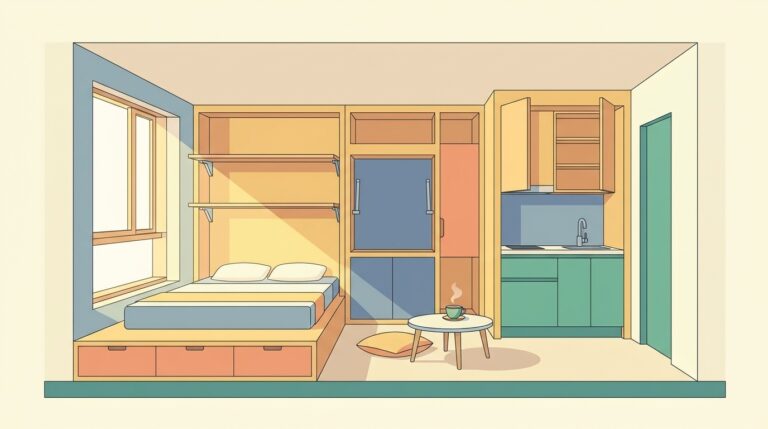
Picture this: You are watching a classic K-Drama. The hardworking protagonist lives in a romantic Oktapbang (rooftop apartment) overlooking the glittering skyline of Seoul. They sit outside on a wooden bench, drinking beer. It looks incredibly aesthetic, right? But what the camera rarely shows is the inside of that tiny studio. How on earth do they store their winter coats, three different sets of bedding, and a mountain of skincare products in a room the size of a parking space?
Welcome to the reality of Seoul living. If you are planning to live, study, or even just stay in a long-term Airbnb in Korea, you will encounter the infamous Oneroom (원룸, studio apartment). At the C2 level, you already know basic words like 방 (room) and 좁다 (narrow/small). Today, we are going to dive deep into the sophisticated vocabulary Koreans use to maximize space, organize clutter, and discuss interior design trends. Knowing these expressions won’t just make you sound fluent; it will earn you immense respect from your Korean friends as a true ‘local.’
This guide is inspired by countless foreign expats who stared at their 5-pyeong (approx. 16 sqm) apartments and asked me, “Teacher, where do I put my stuff?” Let’s unlock the secrets of Korean space-saving!
Phase 2: Core Expressions Deep Dive
1. 죽은 공간을 살리다
- Pronunciation: jugeun gonggan-eul sallida
- Meaning: (Literal) To revive dead space / (Real nuance) To utilize unused or awkward spaces for storage.
- K-Culture Moment: You will hear this phrase constantly in Korean home-makeover shows or YouTube “랜선 집들이” (Online Housewarming) vlogs. When a YouTuber reveals a hidden drawer under their bed or a custom shelf squeezed between the fridge and the wall, they proudly say this.
- Editor’s Insight: This phrase sounds extremely native. It shows a proactive, almost architectural approach to living. It turns a frustrating situation (a tiny room) into a creative challenge.
- Situation Spectrum:
- Casual with friends: ✅
- Professional (Interior Designers/Real Estate): ✅
- Formal/Elders: ✅
- 🤔 Think About It: Why does Korean interior terminology often use living/dying metaphors (like “dead space”)? Does your native language personify spaces in the same way, or is it more mechanical?
2. 동선을 최소화하다
- Pronunciation: dongseon-eul choesohwahada
- Meaning: (Literal) To minimize the line of movement / (Real nuance) To arrange furniture so you don’t have to walk around much.
- K-Culture Moment: This is the golden rule of Korean Oneroom interior design. Because space is limited, the bed, desk, and kitchen counter are often just one step away from each other.
- Editor’s Insight: Dongseon (동선) is a high-level vocabulary word used in daily life. Whether you are talking about cooking in a kitchen or organizing an event, optimizing your dongseon means you are smart and efficient.
- Situation Spectrum:
- Casual with friends: ✅
- Professional (Interior Designers/Real Estate): ✅
- Formal/Elders: ✅
- 🤔 Think About It: In hyper-dense cities like Seoul, efficiency is paramount. How does the obsession with minimizing movement reflect the “Palli-palli” (hurry up) culture of Korea?
3. 짐을 싹 비우다 (당근하다)
- Pronunciation: jim-eul ssak biuda (danggeun-hada)
- Meaning: (Literal) To completely empty out luggage / (Real nuance) To aggressively declutter, often by selling things on secondhand apps.
- K-Culture Moment: A friend moves into a smaller apartment. Instead of buying more storage boxes, they declare minimalism. They start taking photos of their K-Pop albums, clothes, and toaster to sell on Danggeun Market (Korea’s most popular secondhand app).
- Editor’s Insight: While “버리다” means to throw away, “비우다” (to empty) has a philosophical, minimalist nuance. But in reality, modern Koreans just verbify the app name: “당근해야겠다” (I should Danggeun it).
- Situation Spectrum:
- Casual with friends: ✅
- Professional (Interior Designers/Real Estate): ⚠️ (Use ‘비우다’ instead of ‘당근하다’)
- Formal/Elders: 🚫 (They might not understand the slang ‘당근하다’)
- 🤔 Think About It: “Danggeun Market” connects people within the same neighborhood. How does this localized secondhand economy change the way people view ownership and decluttering in tight urban spaces?
Phase 3: Textbook vs. Real Korean
- 📖 Textbook Korean: 방이 너무 작아서 가구를 효율적으로 배치해야 합니다. (The room is too small, so we must arrange the furniture efficiently.)
- 🗣️ Real Korean: 방이 좁아서 테트리스 잘해야 돼요. (The room is small, so you have to be good at Tetris.)
- 💡 Why the difference?: Koreans love using gaming metaphors. “Tetris-ing” perfectly captures the struggle of fitting square furniture into awkward corners of a tiny apartment.
-
📖 Textbook Korean: 더 이상 필요 없는 물건을 중고로 팔겠습니다. (I will sell items I no longer need secondhand.)
- 🗣️ Real Korean: 안 쓰는 거 싹 다 당근마켓에 올릴게요. (I’ll put everything I don’t use up on Danggeun Market.)
-
💡 Why the difference?: Brand names often become verbs in Korea, reflecting how deeply integrated tech platforms are in daily lifestyle choices.
-
📖 Textbook Korean: 벽과 침대 사이의 공간을 사용하세요. (Please use the space between the wall and the bed.)
- 🗣️ Real Korean: 틈새 수납장을 활용해서 죽은 공간을 살려보세요. (Try using a gap storage cabinet to revive the dead space.)
- 💡 Why the difference?: “틈새 수납장” (gap storage) is a highly specific but incredibly common search term on Korean shopping sites, reflecting the market demand for hyper-specific storage solutions.
Phase 4: Cultural Context — K-Culture Deep Dive
4-1. Non-verbal Nuances: The Art of “Nunchi” in Shared Spaces
If you live in a shared house (쉐어하우스) or an idol dorm, organizing your space isn’t just about aesthetics; it’s about Nunchi (눈치). Leaving your belongings in shared spaces (like the living room or bathroom) without proper storage is considered a major breach of etiquette. Koreans often use small, personal storage baskets (목욕 바구니) to carry their toiletries in and out of shared bathrooms to avoid taking up communal space.
4-2. The “Online Housewarming” (랜선 집들이) Phenomenon
If you search “랜선 집들이” on YouTube, you will see millions of views on videos of people showing off their tiny apartments. Since buying a house in Seoul is overwhelmingly expensive for younger generations, they focus heavily on their rented spaces. They create a “감성 숙소” (emotional/aesthetic accommodation) vibe using warm lighting, fabric posters to hide ugly wallpapers, and storage beds (수납형 침대) to hide clutter. It is a psychological coping mechanism: “I may not own this house, but I own this aesthetic.”
Phase 5: Interactive Roleplay
Setting: A rainy Saturday afternoon. You have just moved into a 5-pyeong (16 sqm) Oneroom near Hongdae. Your room is currently a disaster zone of cardboard boxes. Your Korean friend, Ji-eun (29, an interior design enthusiast who lives in a perfectly aesthetic studio), comes over with iced Americanos to help you unpack.
Characters:
– YOU: An expat who brought way too many winter coats and books.
– Ji-eun: Blunt but helpful, knows every storage trick in the book.
Dialogue:
Ji-eun: 와… 짐 진짜 많다. 너 이 좁은 원룸에 이거 다 어떻게 넣으려고? 📦
(Wa… jim jinjja manta. Neo i job-eun wollum-e igeo da eotteoke neoeullyeogo?)
[Wow… you have so much stuff. How are you planning to fit all this in this tiny studio?]
YOU: 그래서 멘붕이야. 일단 수납장 몇 개 더 살까?
(Geuraeseo menbung-iya. Ildan sunapjang myeot gae deo salkka?)
[That’s why I’m having a mental breakdown. Should I buy a few more storage cabinets first?]
Ji-eun: 안 돼! 좁은 집에 가구 막 들이면 동선 꼬이고 답답해져.
(An dwae! Job-eun jib-e gagu mak deurimyeon dongseon kkoigo dapdaphaejeo.)
[No! If you just blindly bring furniture into a small house, your movement paths get tangled and it feels suffocating.]
YOU: 그럼 내 겨울옷들은 어떡해? 옷장이 터질 것 같은데.
(Geureom nae gyeourot-deul-eun eotteokhae? Otjang-i teojil geot gateunde.)
[Then what about my winter clothes? The closet looks like it’s going to burst.]
Ji-eun: 침대 밑에 빈 공간 있지? 거기가 완전 죽은 공간이잖아.
(Chimdae mit-e bin gonggan itji? Geogiga wanjeon jugeun gonggan-ijana.)
[You know the empty space under your bed? That’s totally dead space.]
YOU: 아, 거기에 리빙박스를 넣으라고?
(Ah, geogie ribingbakseu-reul neoeurago?)
[Ah, you’re saying I should put living boxes (storage bins) in there?]
Ji-eun: 정답! 압축팩으로 부피 줄여서 싹 수납하면 완벽해.
(Jeongdap! Apchukpaek-euro bupi juryeoseo ssak sunaphamyeon wanbyeokhae.)
[Bingo! If you reduce the volume with vacuum bags and store them all away, it’s perfect.]
Ji-eun: 그리고 이 책들은… 솔직히 다 안 읽지?
(Geurigo i chaek-deul-eun… soljikhi da an ilji?)
[And these books… honestly, you don’t read them all, right?]
🔀 Your Turn! How will you respond?
– A) “그래도 책은 버릴 수 없어! 책장을 큰 걸로 살래.”
– B) “음, 1년 동안 안 본 책은 당근해야겠다. 비우기의 미학이랄까?”
– C) “다 버려주세요. 미니멀리즘 가자!”✅ Best Choice: B — It uses the advanced slang “당근하다” (to sell secondhand) and humorously applies the C2 concept of “비우기의 미학” (aesthetics of emptying). Ji-eun will definitely be impressed by your native-like wit.
⚠️ Choice A Analysis: Buying a bigger bookshelf is exactly what Ji-eun just told you not to do!
Ji-eun (If you chose B): 오~ 비우기의 미학? 한국어 진짜 많이 늘었는데? 당근해서 번 돈으로 오늘 마라탕 쏘기! 🍜
(Oh~ biugi-ui mihak? Hangugeo jinjja mani neureonneunde? Danggeun-haeseo beon don-euro oneul maratang ssogi!)
[Oh~ aesthetics of emptying? Your Korean has really improved! Treat me to Malatang today with the money you make from Danggeun!]
Phase 6: 10-Second Shadowing Drill
Let’s practice a phrase you can proudly say after organizing your room. Pay attention to the pauses (/) and the proud emotion.
😤 이 좁은 / 원룸에서도 / 죽은 공간만 잘 살리면 / 수납은 문제없어요!
(i job-eun / wollum-eseodo / jugeun gonggan-man jal sallimyeon / sunab-eun munjeeopseoyo!)
[Even in this tiny studio, as long as you utilize the dead spaces well, storage is no problem!]
Phase 7: K-Culture Mini Dictionary
1. 원룸 (Oneroom)
* Romanization: wollum
* English: Studio apartment
* Context: The standard living space for university students and young professionals in Korea. It means the bedroom, kitchen, and living area are all in one single room.
2. 풀옵션 (Full Option)
* Romanization: puropseon
* English: Fully furnished
* Context: A crucial real estate term. A “Full Option” apartment comes with a washing machine, fridge, AC, and sometimes a bed and microwave. Essential for expats who don’t want to buy large appliances.
3. 당근하다 (Danggeun-hada)
* Romanization: danggeun-hada
* English: To sell/buy on Danggeun Market
* Context: The ultimate tool for minimalist living. Because bulky trash disposal costs money in Korea, people prefer to “Danggeun” items away for cheap or for free (무료 나눔).
4. 감성 인테리어 (Gamseong Interior)
* Romanization: gamseong interieo
* English: Aesthetic / Emotional interior design
* Context: A huge trend among Korean youth. It usually involves warm lighting, white or wood-toned furniture, and hiding all ugly, practical items inside sleek storage units to make a small rental feel like a boutique cafe.
Phase 8: Traveler Survival Kit
Even if you aren’t moving to Korea, you will likely stay in an Airbnb or a boutique hotel that uses these exact space-saving concepts. Sometimes, the storage is so well hidden you can’t find it!
🆘 Survival Phrases for Airbnbs & Hotels
– 🇰🇷 “짐 보관할 수 있는 수납 공간이 따로 있나요?” (jim bogwanhal su inneun sunap gonggan-i ttaro innayo?)
– 🗣️ Pronunciation: [jim bo-gwan-hal soo in-neun soo-nap gong-gan-i tta-ro in-na-yo?]
– 📍 Where to use: Texting an Airbnb host or asking a front desk.
– 💡 Pro Tip: Many modern Korean Airbnbs use “수납형 침대” (storage beds). If you can’t find extra blankets or a place for your suitcase, try lifting the mattress frame or checking the drawers built into the base of the bed!📌 Editor’s Travel Note
– Useful Apps for Luggage: If your tiny Airbnb doesn’t have space for your massive suitcases before check-in, use the T-Locker app to find oversized lockers in subway stations, or use luggage delivery services like Safex.
Phase 9: Critical Thinking Corner — “One Step Deeper”
🧠 Think Deeper: Media vs Reality
K-Dramas often romanticize poverty and small spaces. Think of the beautiful Oktapbang (rooftop room) with fairy lights and a view of Namsan Tower. However, the reality of Korean real estate is much harsher. These spaces are often freezing in winter, boiling in summer, and severely lack storage. The recent obsession with “clever storage hacks” and “emotional interior” is actually a byproduct of a severe housing crisis. Because young people feel they can never afford to buy a multi-room apartment in Seoul, they channel all their resources into maximizing the aesthetic and utility of their rented 5-pyeong boxes. It is both a brilliant display of creativity and a somewhat melancholic reflection of the modern urban struggle.💬 Your Turn: Does your culture romanticize certain types of small or low-income housing in media (like tiny houses or studio lofts)? Share your thoughts in the comments!
Phase 10: FAQ & Common Mistakes
Q: Can I use “좁다” (narrow) to describe a small house?
Yes! In English, we say a house is “small,” but in Korean, we use “좁다” (narrow) for floor space. Saying “집이 작다” is understandable, but “집이 좁다” or “평수가 좁다” sounds much more native.
Q: Can I say “당근하다” to my landlord?
Probably not, unless your landlord is young. It’s a slang term. To older people or in formal situations, use “중고로 팔다” (to sell secondhand) or “짐을 처분하다” (to dispose of belongings).
❌ Common Mistake #1: Saying “여기에 물건을 숨길게요” (I will hide things here) when organizing.
✅ Do This Instead: Use “수납할게요” (I will store it). “숨기다” sounds like you are hiding something illegal or embarrassing. “수납하다” sounds clean and organized.
Phase 11: Summary & Action Items
- One-Liner Summary: Mastering advanced Korean space-saving vocabulary transforms you from a confused expat into a resourceful local who can thrive in any tiny Seoul studio.
-
Action Mission 3-Steps:
- 🥉 Bronze (Solo): Look around your room right now. Point to an empty corner and say out loud: “저 죽은 공간을 살려야겠다!” (I need to revive that dead space!)
- 🥈 Silver (Online): Go to YouTube, search “랜선 집들이 5평” (Online housewarming 5 pyeong), and leave a comment saying, “공간 활용도가 정말 높네요!” (The space utilization is really high!)
- 🥇 Gold (Real World): If you are in Korea, visit an IKEA (이케아) or Hanssem (한샘) store, look at the built-in cabinets, and confidently ask a staff member, “수납을 극대화할 수 있는 가구가 있을까요?” (Do you have furniture that can maximize storage?)
- K-Culture Mission: Go on Danggeun Market (or imagine doing so) and write a mock listing for an item in your room using the phrase “공간 차지해서 비웁니다” (Emptying it out because it takes up space).
Phase 12: Quiz — Interactive Challenge
1. Situational Judgment: You are talking to an interior designer about your new, very small studio. Which phrase shows you want to make the most of the limited space?
– A) 방을 넓게 부숴주세요. (Please destroy the room widely.)
– B) 짐을 다 숨겨주세요. (Please hide all my luggage.)
– C) 죽은 공간을 최대한 살려주세요. (Please revive the dead spaces as much as possible.)
2. Fill in the Blank:
좁은 집에서는 가구 배치를 잘해서 (________)을/를 최소화하는 것이 중요해요.
(In a small house, it’s important to arrange furniture well to minimize ________.)
– A) 동선 (Movement paths)
– B) 시선 (Gaze)
– C) 감성 (Emotion)
3. True or False — K-Culture Edition:
In Korea, it is common to leave your personal shampoo and body wash bottles taking up space in the shared bathroom of a multi-roommate house. (T/F)
Answers & Explanations (Click to reveal)
1. C. “죽은 공간을 살리다” is the perfect C2 expression for utilizing unused space.
2. A. 동선 (Dongseon). Minimizing the path you walk inside the house makes it feel less cluttered.
3. False. To show good Nunchi, Koreans often keep their toiletries in a personal basket in their room and bring it to the shower to keep communal spaces clear.
Frequently Asked Questions (FAQ)
Q: What does "죽은 공간을 살리다" mean in Korean and how do you pronounce it?
A: In Korean, "죽은 공간을 살리다" is pronounced [jugeun gonggan-eul sallida] and means: (Literal) To revive dead space / (Real nuance) To utilize unused or awkward spaces for storage.
Q: What does "동선을 최소화하다" mean in Korean and how do you pronounce it?
A: In Korean, "동선을 최소화하다" is pronounced [dongseon-eul choesohwahada] and means: (Literal) To minimize the line of movement / (Real nuance) To arrange furniture so you don't have to walk around much.
Q: What does "짐을 싹 비우다 (당근하다)" mean in Korean and how do you pronounce it?
A: In Korean, "짐을 싹 비우다 (당근하다)" is pronounced [jim-eul ssak biuda (danggeun-hada] and means: (Literal) To completely empty out luggage / (Real nuance) To aggressively declutter, often by selling things on secondhand apps.







