

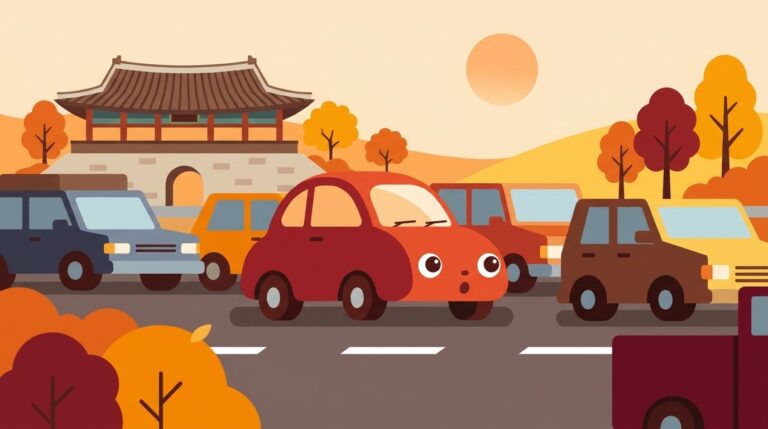
Surviving Chuseok Traffic: The True Test of Korean Patience
Phase 1: Welcome to the Great Migration
Hello! I’m your Daily Hangul Editor.
Picture this: You’re watching a classic K-Drama. It’s Chuseok (추석), the Korean Thanksgiving. The protagonist is driving back to their hometown. The camera pans out to show a highway that looks more like a giant parking lot. The red taillights stretch endlessly into the autumn night. The driver sighs, looks at the GPS app on their phone, and mutters something in frustration.
If you ever travel in Korea during major holidays—or honestly, just try to leave Seoul on a Friday evening—you will experience the legendary 고속도로 정체 (highway traffic jam).
In this module, we are going to learn the survival phrases you need when you are stuck in a car, plus the incredible silver lining of Korean road trips: the Hyugeso (휴게소, Rest Stop) culture!
This guide is based on real questions from my students who successfully (and barely) survived their first Korean road trips. Let’s dive in!
Phase 2: Core Phrases Deep Dive
Here are the absolute basic (A1 level) phrases you need when stuck in traffic.
1. 차 막혀요 (Cha makyeoyo)
- Pronunciation: Cha mak-hyuh-yo
(Tip: ‘Cha’ sounds like the cha in cha-cha. ‘Mak’ sounds like mock. ‘Hyuh’ is like exhaling deeply).- Meaning: Literal: Cars are blocked. vs Real nuance: Traffic is heavy.
- K-Culture Moment: You will text this exact phrase to your friends when your taxi is barely moving in Gangnam traffic.
- Editor’s Insight: We don’t usually say “there is a lot of traffic.” We focus on the cars (차) being blocked (막혀요). It conveys that feeling of being totally stuck!
- Situation Spectrum:
- 친구 사이 (Casual Friends): ✅ (Just say: 차 막혀 – Cha makyeo)
- 직장 동료 (Co-workers): ✅
- 직장 상사·어른 (Boss/Elders): ✅ (Polite and standard)
- 🤔 Think About It: Why do Koreans say “cars are blocked” instead of “the road is busy”? How do you express traffic jams in your native language?
2. 얼마나 걸려요? (Eolmana geollyeoyo?)
- Pronunciation: Eol-ma-na gull-yuh-yo?
(Tip: ‘Eol’ rhymes with dull. ‘Gull’ is like seagull).- Meaning: Literal: How much hangs? vs Real nuance: How long does it take?
- K-Culture Moment: The anxious question every passenger asks the driver while staring at the red lines on Naver Map.
- Editor’s Insight: This is a magic phrase! You can use it anywhere: asking a taxi driver, asking how long the food will take at a restaurant, or asking how long a flight is.
- Situation Spectrum:
- 친구 사이 (Casual Friends): ✅ (얼마나 걸려? – Eolmana geollyeo?)
- 직장 동료 (Co-workers): ✅
- 직장 상사·어른 (Boss/Elders): ✅
- 🤔 Think About It: Time is very important in Korea’s “Pali-Pali” (hurry up) culture. Knowing exactly how many minutes are left brings comfort!
3. 휴게소 가요 (Hyugeso gayo)
- Pronunciation: Hyu-ge-so ga-yo
- Meaning: Literal/Real nuance: Let’s go to a rest stop.
- K-Culture Moment: The moment of salvation! When the driver finally says this, everyone in the car cheers. It means bathroom breaks and delicious street food!
- Editor’s Insight: Simply add “가요” (let’s go / I am going) after a place. It’s incredibly versatile for A1 learners!
- Situation Spectrum:
- 친구 사이 (Casual Friends): ✅ (휴게소 가자! – Hyugeso gaja!)
- 직장 동료 (Co-workers): ✅
- 직장 상사·어른 (Boss/Elders): ⚠️ (Better to ask: 휴게소 갈까요? – Shall we go to a rest stop?)
Phase 3: Textbook vs. Real Korean
[Stating the Traffic is Bad]
* 📖 Textbook Korean: 길이 매우 복잡합니다. (The road is very complicated/crowded.)
* 🗣️ Real Korean: 아, 차 엄청 막혀요. (Ah, traffic is crazy blocked.)
* 💡 Why the difference?: “복잡합니다” sounds like a formal news broadcast. In real life, Koreans emphasize their frustration with words like 엄청 (crazy much).
[Asking for a Bathroom Break]
* 📖 Textbook Korean: 화장실에 다녀와도 되겠습니까? (May I go to the restroom and come back?)
* 🗣️ Real Korean: 저 화장실 급해요! (I’m urgent for the restroom!)
* 💡 Why the difference?: Survival over politeness! When you’re stuck on a highway, “급해요” (it’s urgent) communicates the emergency immediately.
Bottom Note: For A1 beginners, don’t worry about complex polite endings. Just sticking “요” at the end of your short sentences is polite enough to survive!
Phase 4: Cultural Context — K-Culture Deep Dive
4-1. Non-verbal Cues: The Art of the ‘Sigh’
When traffic stops completely, don’t complain loudly. The Korean way is a deep, communal sigh. Look at the navigation app, gently shake your head, and say “하아… (Haa…)”. It shows you share the driver’s pain. Use your Nunchi (눈치, situational awareness)—if the driver looks stressed, it’s not a good time to ask for a favor!
4-2. K-Food Connection: The Oasis of ‘Hyugeso’
If you watch K-Variety shows, you know that the Korean highway rest stop (휴게소, Hyugeso) is basically a culinary theme park. Surviving 5 hours of Chuseok traffic is only possible because of the food.
– Sotteok-Sotteok (소떡소떡): A skewer of alternating sausages and chewy rice cakes.
– Hodu-gwaja (호두과자): Warm walnut pastries filled with sweet red bean paste.
– Udon (우동): Eating a hot bowl of Udon at the food court is a national road trip tradition.
Phase 5: Real-life Roleplay Scenario
Setting:
Friday evening, the day before Chuseok. You are in a car on the Gyeongbu Expressway. It is raining slightly. The red taillights in front of you stretch to the horizon. You are traveling with your Korean friend, Minho, to visit his hometown. You have been in the car for 4 hours.
Characters:
– YOU: A beginner Korean learner, currently very hungry and needing a bathroom.
– Minho (30): Your Korean friend. He is driving and looks exhausted.
Minho: 하아… 차 진짜 안 가네.
(Haa… cha jinjja an gane.)
[English: Sigh… cars are really not moving.]
(🎭 Stage Direction: Minho taps his fingers on the steering wheel)
YOU: 민호 씨, 우리 얼마나 걸려요?
(Minho ssi, uri eolmana geollyeoyo?)
[English: Minho, how long will we take?]
Minho: 내비게이션 보니까… 아직 3시간 더 가야 해요.
(Naebigeisyeon bonikka… ajik se sigan deo gaya haeyo.)
[English: Looking at the navi… we still have to go for 3 more hours.]
(🎭 Stage Direction: Minho rubs his tired eyes)
YOU: 헉, 3시간요? 차가 너무 막혀요!
(Heok, se siganyo? Chaga neomu makyeoyo!)
[English: Gasp, 3 hours? Traffic is too blocked!]
Minho: 명절이라서 그래요. 미안해요, 지루하죠?
(Myeongjeoriraseo geuraeyo. Mianhaeyo, jiluhajyo?)
[English: It’s because it’s a holiday. Sorry, you’re bored, right?]
YOU: 아니에요 괜찮아요. 그런데…
(Anieyo gwaenchanayo. Geureonde…)
[English: No, it’s okay. But by the way…]
🔀 Your Turn! What is the most crucial thing to say next?
– A) “집에 가고 싶어요.” (I want to go home.)
– B) “저 화장실 급해요. 휴게소 가요!” (I urgently need the restroom. Let’s go to a rest stop!)
– C) “운전 똑바로 하세요.” (Drive properly.)✅ Best Choice: B — It perfectly communicates your needs using the A1 phrases we learned.
⚠️ Choice A & C Analysis: ‘A’ will make Minho feel very sorry and awkward. ‘C’ is incredibly rude and will ruin your friendship! Never say this to your driver!
Minho: 아! 알겠어요. 다음 휴게소로 갈게요.
(Ah! Algesseoyo. Daeum hyugesoro galgeyo.)
[English: Ah! Understood. I’ll go to the next rest stop.]
(🎭 Stage Direction: 15 minutes later, pulling into the bright rest stop)
Minho: 도착! 뭐 먹을래요?
(Dochak! Mwo meogeullaeyo?)
[English: Arrived! What do you want to eat?]
YOU: 소떡소떡 먹어요!
(Sotteok-sotteok meogeoyo!)
[English: Let’s eat Sotteok-sotteok!]
Phase 6: 10-Second Shadowing Drill
Practice reading this aloud to sound like a local!
(/ indicates a short pause, emphasize the bolded parts)
- 😤 단호하게 (Frustrated):
아, / 차 엄청 / 막혀요. (Ah, / cha eomcheong / makyeoyo.) - 🥺 애절하게 (Desperately):
저 / 화장실 / 너무 급해요! (Jeo / hwajangsil / neomu geupaeyo!) - 😊 밝게 (Brightly):
우리 / 휴게소 가요! (Uri / hyugeso gayo!)
Phase 7: K-Culture Mini Dictionary
Here are 4 keywords to fully grasp the Chuseok traffic culture:
1. 추석
* Romanization: Chuseok
* English: Korean Thanksgiving Day
* Context: One of Korea’s two biggest holidays. Millions travel simultaneously to their ancestral homes.
2. 귀성길
* Romanization: Gwiseong-gil
* English: The journey back to one’s hometown
* Context: You will hear news anchors use this word repeatedly when reporting on the massive traffic jams.
3. 휴게소
* Romanization: Hyugeso
* English: Highway Rest Stop
* Context: Not just gas stations! They are massive complexes with clothing stores, food courts, arcades, and parks.
4. 톨게이트
* Romanization: Tolgeiteu
* English: Tollgate
* Context: During Chuseok, the government often makes tollgates free (무료) to help ease the financial burden of the long trip.
Phase 8: Traveler Survival Kit
Even if you aren’t driving, you might take an intercity bus or a taxi during your travels!
🆘 Survival Phrases TOP 3
– 🇰🇷 “서울까지 얼마나 걸려요?” (Seoul-kkaji eolmana geollyeoyo?)
– 🗣️ English: How long does it take to Seoul?
– 📍 Where to use: Taxi, Bus terminal
– 💡 Pro Tip: Replace ‘Seoul’ with any destination! (e.g., 부산까지… Busan-kkaji)
- 🇰🇷 “여기 세워 주세요.” (Yeogi sewo juseyo.)
- 🗣️ English: Please pull over here.
- 📍 Where to use: In a taxi when you reach your destination.
🇰🇷 “영수증 주세요.” (Yeongsujeung juseyo.)
- 🗣️ English: Please give me the receipt.
- 📍 Where to use: Paying for your Hyugeso snacks or taxi ride.
📌 Editor’s Travel Note
– Useful Apps: Google Maps doesn’t work well for driving/walking in Korea. You MUST download Naver Map or Kakao T (for taxis).
– Bus vs. Train: During Chuseok, KTX (bullet train) tickets sell out months in advance. Buses have a dedicated “Bus Only Lane” (버스전용차로) on the highway, so they are faster than cars during traffic jams!
Phase 9: Critical Thinking — “One Step Deeper”
Food & Identity: Why Go Through the Torture of Traffic?
🧠 Think Deeper:
Have you ever wondered why millions of Koreans willingly sit in 10-hour traffic jams every Chuseok? At its core, it reflects the deep-rooted Korean value of 가족 (Family) and 정 (Jeong – deep emotional connection). Sharing a massive feast with family makes the grueling journey worth it. The highway rest stop culture (sharing snacks in the car) is an extension of this identity—in Korea, food isn’t just fuel; it’s the ultimate expression of love and togetherness.💬 Your Turn: Does your country have a holiday that involves massive national travel? How do people pass the time in traffic? Let us know in the comments!
Phase 10: FAQ & Avoiding Mistakes
Q: Can I use “차 막혀요” with my boss?
Yes! Just ensure you keep the “요 (yo)” at the end. If you want to be extra polite on the phone, say “차가 많이 막힙니다 (Chaga mani makimnida).”
Q: Can I take food into a taxi or intercity bus?
No! In Korea, taking hot/smelly food or unsealed drinks onto public buses is actually prohibited by law now. Finish your snacks at the bus terminal before boarding!
❌ Common Mistake #1: Saying “시간이 커요” (Time is big) to mean it takes a long time.
✅ Do this instead: Say “오래 걸려요” (Orae geollyeoyo – It takes a long time). Use the verb 걸리다 (to take time).
Phase 11: Summary & Action Items
- One-Liner Summary: Survive Korean traffic jams by mastering “차 막혀요” (Traffic is bad) and finding joy in the “휴게소” (Rest Stop)!
Action Mission 3-Steps:
– 🥉 Bronze (Solo): Look at a map app and say “차 엄청 막혀요” out loud 3 times.
– 🥈 Silver (Online): Find a YouTube video about “Korean Highway Rest Stop Food” and leave a comment: “휴게소 가요!”
– 🥇 Gold (Real World): Next time you are in a taxi in Korea and there is traffic, gently sigh and say to the driver: “오늘 차 많이 막혀요.” (Traffic is heavy today.) Watch them instantly bond with you!
K-Culture Mission:
Search for “소떡소떡 (Sotteok-Sotteok)” on YouTube or Instagram. Watch how Koreans eat the sausage and rice cake in one bite for the perfect flavor ratio!
Phase 12: Interactive Quiz
1. Situational Judgment:
You are in a taxi and the road is completely blocked. Which is the most natural A1 expression to use?
A) 길이 복잡합니다.
B) 차 막혀요.
C) 차 안 가요.
(Answer: B. It is the most standard, natural way to express a traffic jam).
2. True or False – K-Culture Edition:
“You can take your hot rest-stop Udon onto the Express Bus if you eat it quietly.”
(Answer: False! Hot foods and unsealed drinks are banned on Korean public buses. Eat it at the rest stop!)
3. Fill in the Blank:
Driver: “Where should we stop?”
You: “_____ 가요!” (Let’s go to the rest stop!)
(Answer: 휴게소 / Hyugeso)
Frequently Asked Questions (FAQ)
Q: What does "차 막혀요 (Cha makyeoyo)" mean in Korean and how do you pronounce it?
A: In Korean, "차 막혀요 (Cha makyeoyo)" is pronounced [Cha mak-hyuh-yo] and means: Literal: Cars are blocked. vs Real nuance: Traffic is heavy.
Q: What does "얼마나 걸려요? (Eolmana geollyeoyo?)" mean in Korean and how do you pronounce it?
A: In Korean, "얼마나 걸려요? (Eolmana geollyeoyo?)" is pronounced [Eol-ma-na gull-yuh-yo?] and means: Literal: How much hangs? vs Real nuance: How long does it take?
Q: What does "휴게소 가요 (Hyugeso gayo)" mean in Korean and how do you pronounce it?
A: In Korean, "휴게소 가요 (Hyugeso gayo)" is pronounced [Hyu-ge-so ga-yo] and means: Literal/Real nuance: Let's go to a rest stop.






