

Phase 1: Empathy & The K-Culture Connection
Hello! I’m your Daily Hangul Editor, your friendly neighborhood Korean tutor and cultural navigator! 😊
Picture this: You are watching a classic K-Drama. The sunlight streams through the tall windows of a university library. The main character reaches for a book on the top shelf, and suddenly, the charming lead actor’s hand accidentally brushes against theirs. Cue the romantic OST! 🎶
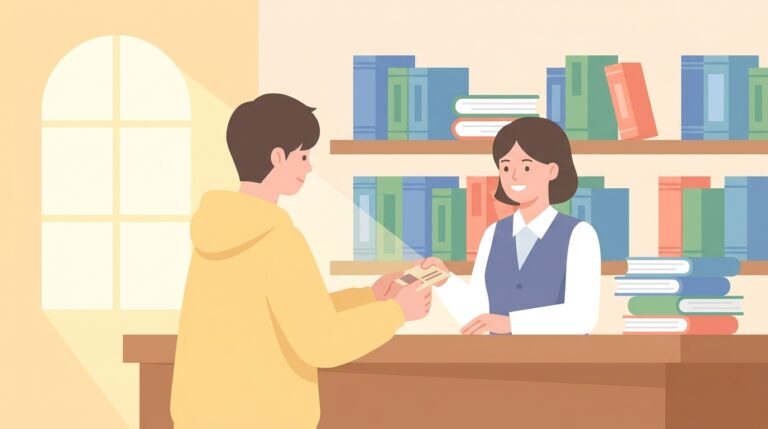
But let’s hit pause and come back to reality. You’re an exchange student or an expat in Korea, standing in front of the actual library desk. You just want to borrow a Korean textbook, but the librarian rapidly asks you something that sounds like “Daechuljeung isseuseyo?” Panic sets in. Wait, did they just ask for my ID? My credit card? What’s going on?
If you don’t know the exact library vocabulary, you might end up buying expensive books instead of borrowing them for free! But don’t worry. Today, we are going to learn how to confidently navigate a Korean library—and sound like a local while doing it. This guide is built from the real struggles of my A2-level students who were too shy to enter the campus library. Let’s unlock the doors to infinite Korean books!
Phase 2: Core Expressions Deep Dive
Let’s master the three golden phrases you absolutely need at the checkout desk.
1. 이 책 빌리고 싶어요. (I want to borrow this book.)
- Pronunciation: [i chaek bil-li-go si-peo-yo.]
Tip: ‘싶’ sounds like ‘sheep’ but shorter. Say it smoothly!- Meaning: I want to borrow this book. (Literal: This book borrow want-to.)
- K-Culture Moment: This is the most natural way to express your intention. In K-Dramas, when a student bravely asks their crush to lend them notes, they use this exact verb: “노트 좀 빌려줄래?” (Can you lend me your notes?)
- Editor’s Insight: The verb ‘빌리다’ (to borrow) is your best friend. You can use it for books, pens, umbrellas, or even borrowing money! Adding ‘~고 싶어요’ (I want to) makes it polite and clear.
- Situation Spectrum:
- Casual (Friends): ✅ (이거 빌릴게!)
- Semi-formal (Librarian/Staff): ✅ (이 책 빌리고 싶어요.)
- Highly Formal (Professor): ⚠️ (빌리고 싶습니다 is better)
- 🤔 Think About It: In English, we usually say “Can I check this out?” but in Korean, we directly state our desire: “I want to borrow.” How does your native language express requests in public spaces?
2. 대출증 있으세요? (Do you have a library card?)
- Pronunciation: [dae-chul-jeung i-sseu-se-yo?]
Tip: ‘으’ (eu) sounds like the noise you make when stepping in something sticky. Pull your lips back! ‘증’ (jeung) sounds like ‘j’ + ‘eu’ + ‘ng’.- Meaning: Do you have a library card? (Literal: Library-card exist?)
- K-Culture Moment: Whenever you sign up for something in Korea—a gym, a cafe membership, or a library—you will hear “~있으세요?” (Do you have~?).
- Editor’s Insight: ‘대출’ literally means ‘loan’. Yes, the same word is used for bank loans and library books! ‘증’ means a certificate or card.
- Situation Spectrum:
- Casual (Friends): 🚫 (Friends don’t ask for your library card!)
- Semi-formal (Staff to you): ✅
- 🤔 Think About It: Korean often drops the word “You” (당신). The librarian doesn’t say “Do you have a card?” They just say “Card exists?” Why do you think Korean omits the subject so often?
3. 언제까지 반납해야 돼요? (When is the due date?)
- Pronunciation: [eon-je-kka-ji ban-na-pae-ya dwae-yo?]
Tip: ‘반납’ is written as ‘ban-nap’, but when spoken fast, it flows into the next word like ‘ban-na-pae’.- Meaning: Until when do I have to return it?
- K-Culture Moment: Korea is a “Ppalli-Ppalli” (hurry hurry) culture, but it’s also a society of strict rules. Returning things on time is crucial for your Nunchi (social reputation)!
- Editor’s Insight: ‘언제까지’ (until when) is incredibly useful. You can use it to ask about store closing times, homework deadlines, or event endings.
- Situation Spectrum:
- Casual (Friends): ✅ (언제까지 주면 돼?)
- Semi-formal (Staff): ✅
- 🤔 Think About It: “~해야 돼요” means “must/have to.” Notice how Korean pairs the deadline (until when) directly with obligation (have to). Does this reflect a rule-oriented society?
Phase 3: Textbook vs. Real Korean
Don’t sound like a walking dictionary! Let’s tweak those textbook phrases.
[Telling them you want to check out books]
* 📖 Textbook Korean: 이 도서를 대출하겠습니다. (I will check out this material.)
* 🗣️ Real Korean: 이거 빌릴게요. (I’ll borrow this.)
* 💡 Why the difference?: ‘도서’ (material/book) and ‘대출’ (loan) are formal Sino-Korean words. In real life, native speakers prefer the simpler, native Korean words ‘책’ (book) or ‘이거’ (this) and ‘빌리다’ (borrow) for everyday efficiency.
[Asking if you can keep the book longer]
* 📖 Textbook Korean: 대출 기간을 연장하고 싶습니다. (I would like to extend the loan period.)
* 🗣️ Real Korean: 이거 연장할 수 있어요? (Can I extend this?)
* 💡 Why the difference?: Asking a question “~할 수 있어요?” (Can I?) feels softer and more conversational than stating a formal intention to extend.
Bottom Note for A2 Learners: Stick to ‘~게요’ (I will) or ‘~고 싶어요’ (I want to). They are perfectly polite and sound 100 times more natural than stiff dictionary forms!
Phase 4: Cultural Context — K-Culture Deep Dive
4-1. Non-Verbal Elements: Two Hands and Nunchi
When you hand your library card or book to the librarian, always use two hands (or support your right elbow with your left hand). In Korean culture, giving or receiving items with one hand to someone older or in a service position can be seen as rude.
Also, a library is the ultimate test of Nunchi (the art of reading the room). In Korean reading rooms (열람실), even the sound of an overly loud pen clicking or heavy breathing can earn you a cold glare. Silence is golden!
4-2. The K-Drama Illusion vs. “Study Cafe” Reality
In K-Dramas, libraries are places where magical romances happen between the dusty bookshelves. But in reality? Korean campus libraries are intense battlegrounds. During exam seasons (중간고사/기말고사), students line up at 6 AM just to secure a seat.
Because university libraries are so packed, a unique K-Culture space was born: the Study Cafe (스터디카페). It’s not a noisy Starbucks; it’s a paid, pin-drop-silent facility with individual cubicles, free coffee machines, and strict anti-noise rules. If you ever need to cram like a Korean student, search for a “스터디카페” on your map app!
Phase 5: Real-Life Roleplay Scenario
Setting: Tuesday afternoon, Yonsei University Central Library. The air smells like old paper and strong iced Americanos. You finally found the Korean grammar book you needed.
Characters:
– YOU: An A2-level Korean learner trying to read a native book.
– Librarian (사서선생님): A polite but busy staff member in her 40s.
Dialogue:
YOU: 안녕하세요! 이 책 빌리고 싶어요. 📚
(annyeonghaseyo! i chaek billigo sipeoyo.)
[Hello! I want to borrow this book.]
(🎭 Stage Direction: You hand the book over with two hands)
Librarian: 네, 대출증 있으세요?
(ne, daechuljeung isseuseyo?)
[Yes, do you have a library card?]
YOU: 아, 학생증도 괜찮아요? 🪪
(a, haksaengjeungdo gwaenchanayo?)
[Ah, is a student ID okay too?]
Librarian: 네, 학생증 주시면 됩니다.
(ne, haksaengjeung jusimyeon doemnida.)
[Yes, you can just give me your student ID.]
YOU: 여기 있습니다.
(yeogi isseumnida.)
[Here it is.]
Librarian: (Beep!) 처리되었습니다. 2주 뒤 화요일까지입니다.
(cheoridoeeotseumnida. i-ju dwi hwayoilkkaji-imnida.)
[It’s processed. It is due two weeks from now on Tuesday.]
YOU: 혹시… 언제까지 반납해야 돼요? 잘 못 들었어요.
(hoksi… eonjekkaji bannaphaeya dwaeyo? jal mot deureosseoyo.)
[By any chance… until when do I have to return it? I didn’t hear well.]
Librarian: 10월 15일까지 반납하시면 돼요.
(si-wol sibil-kkaji bannaphasimyeon dwaeyo.)
[You can return it by October 15th.]
🔀 Your Turn! Decision Point:
You realize you have a big trip that week and might need more time. How do you ask?
– A) “시간 더 주세요!” (Give me more time!)
– B) “연장할 수 있어요?” (Can I extend it?)
– C) “안 반납해요.” (I won’t return it.)✅ Best Choice: B — “연장할 수 있어요?” is polite and natural.
⚠️ Choice A Analysis: This sounds like a demand, like you’re yelling at someone in a video game! Always ask, never demand in a service setting.
YOU: 아, 연장할 수 있어요?
(a, yeonjanghal su isseoyo?)
[Ah, can I extend it?]
Librarian: 네, 홈페이지에서 1회 연장 가능합니다. 다음 분 오세요~
(ne, hompeijieseo il-hoe yeonjang ganeunghamnida. daeum bun oseyo~)
[Yes, you can extend it once on the website. Next person, please~]
🎭 Bonus Roleplay: Asking for Directions in the Library
(You are lost among the giant bookshelves)
– YOU: 저기요… 화장실이 어디에 있어요? (Excuse me… where is the restroom?)
– Student: 아, 이쪽으로 쭉 가면 엘리베이터 옆에 있어요. (Ah, if you go straight this way, it’s next to the elevator.)
– YOU: 감사합니다! (Thank you!)
Phase 6: 10-Second Shadowing Drill
Practice making your Korean sound natural by copying the rhythm!
🥺 살짝 걱정스럽게 (A bit worriedly):
언제까지 / 반납해야 / 돼요?
(eon-je-kka-ji / ban-na-pae-ya / dwae-yo?)😊 밝고 친절하게 (Bright and polite):
이거 / 연장할 수 / 있어요?
(i-geo / yeon-jang-hal su / i-sseo-yo?)
Phase 7: K-Culture Mini Dictionary
Learn these 4 keywords to survive Korean campus & study culture!
1. 눈치 (Nunchi)
* Romanization: nunchi
* English: Emotional intelligence / Reading the room
* Context: Knowing you shouldn’t eat crispy chips in the reading room requires good nunchi. It’s the core of Korean social harmony.
2. 열람실 (Yeollamsil)
* Romanization: yeol-lam-sil
* English: Reading room / Study room
* Context: Unlike the general library where you can check out books, the yeollamsil is purely for intense studying. Absolute silence is required.
3. 학생증 (Haksaengjeung)
* Romanization: hak-saeng-jeung
* English: Student ID card
* Context: In most university libraries, you must scan your haksaengjeung at the turnstile just to enter the building.
4. 벼락치기 (Byeorakchigi)
* Romanization: byeo-rak-chi-gi
* English: Cramming for an exam
* Context: Literally translates to “getting struck by lightning.” It’s what every Korean student does at the library the night before a test!
Phase 8: Traveler & Student Survival Kit
Even if you’re just a tourist visiting the famous Starfield Library in Seoul, these phrases are lifesavers.
🆘 Survival Phrases TOP 3
– 🇰🇷 “와이파이 비밀번호가 뭐예요?” (waipai bimilbeonhoga mwoyeyo?)
– 🗣️ Translation: What is the Wi-Fi password?
– 📍 Where to use: Cafes, libraries, airports.
- 🇰🇷 “화장실이 어디예요?” (hwajangsiri eodiyeyo?)
- 🗣️ Translation: Where is the restroom?
- 📍 Where to use: Literally everywhere.
- 🇰🇷 “여기 앉아도 돼요?” (yeogi anjado dwaeyo?)
- 🗣️ Translation: Can I sit here?
- 📍 Where to use: Crowded libraries or study cafes when asking to share a large table.
📌 Editor’s Travel Note
– Finding a library: Use Naver Map (네이버 지도) and search “도서관” (Doseogwan). Google Maps does not work well for walking directions in Korea!
– Public Libraries: You usually need an Alien Registration Card (ARC) to make a library card in local public libraries, but you can enter and read books inside for free without one!
Phase 9: Critical Thinking Corner — “One Step Deeper”
Language & Power in Public Spaces
🧠 Think Deeper:
Have you noticed that almost all public signs and staff interactions in Korea use “~요” (yo) or “~다/까” (da/kka) formal endings? The Korean politeness system isn’t just about age; it’s heavily based on the relationship between strangers. In a public space like a library, using informal language (반말, banmal) to a librarian, even if they are younger than you, is considered highly offensive. The language serves to maintain a respectful distance between strangers, ensuring social harmony and acknowledging the professional role of the staff.💬 Your Turn: How does customer service language differ in your country? Do you use a specific polite tense for librarians and shop clerks, or is it more casual? Let us know in the comments!
Phase 10: FAQ & Avoiding Common Mistakes
Q: “Can I bring my iced Americano into the library?”
A: Mostly, Yes! Korea runs on iced coffee. Most university libraries and study cafes allow drinks with secure lids. However, smelly food (like cup noodles) is strictly banned.
Q: “Can I use 반말 (informal language) if the librarian looks like a student worker?”
A: Absolutely NOT. Always use “~요” in public service settings, regardless of age.
⚠️ Top 3 Common Mistakes to Avoid:
❌ Mistake #1: Saying “이 책 주세요” (Give me this book) to borrow it.
✅ Do this instead: Say “이 책 빌려주세요” or “이 책 빌리고 싶어요”. ‘주세요’ implies you are taking it forever or buying it!❌ Mistake #2: Throwing your ID card on the desk.
✅ Do this instead: Hand it over respectfully, preferably with two hands or a slight nod of the head.❌ Mistake #3: Asking “얼마예요?” (How much is it?) at the public library.
✅ Do this instead: Borrowing is free! If you are asking about late fees, say “연체료가 얼마예요?” (How much is the late fee?).
Phase 11: Summary & Action Items
🔥 One-Liner Summary: Remember to politely say “이 책 빌리고 싶어요” (I want to borrow this book) and check the date with “언제까지 반납해야 돼요?” (When is the due date?).
🎯 Action Missions:
– 🥉 Bronze (Solo): Look at your favorite book at home, point to it, and say “이 책 빌리고 싶어요” aloud 3 times.
– 🥈 Silver (Online): Leave a comment below telling us what book genre you would check out from a Korean library! (e.g., 로맨스, 판타지)
– 🥇 Gold (Real World): Visit a Korean library or a Korean section in your local library, find a book, and quietly practice the roleplay from Phase 5 in your head!
🎬 K-Culture Mission:
Search for a “Study With Me” video by a Korean creator on YouTube (search: 스터디윗미). Leave it on while you study Korean today and absorb the intense Yeollamsil vibes!
Phase 12: Interactive Challenge — Quiz Time!
Test what you’ve learned today!
1. Situational Judgment: The librarian scans your book and hands it back. You want to know when to bring it back. What do you say?
– A) 언제까지 반납해야 돼요?
– B) 이 책 빌리고 싶어요.
– C) 대출증 있으세요?
(Answer: A)
2. Fill in the Blank:
You want to ask if you can keep the book for one more week.
“이거 (_______) 할 수 있어요?”
(Answer: 연장 – yeonjang – extend)
3. True or False – K-Culture Edition:
It is totally acceptable to eat a sandwich in the Korean library’s main reading room (열람실) as long as you chew quietly.
(Answer: FALSE. Food is heavily restricted. Only drinks with lids are usually allowed. Eat your sandwich in the designated lounge or cafeteria!)
4. Roleplay Application:
If the librarian asks you “대출증 있으세요?” and you don’t have a library card but you do have a student ID, what is the best thing to say based on Phase 5?
– A) 없어요! (I don’t have it!)
– B) 학생증도 괜찮아요? (Is a student ID okay too?)
– C) 와이파이 비밀번호가 뭐예요? (What’s the Wi-Fi password?)
(Answer: B)
Great job today! Next time you step into a Korean library, you won’t just be a confused foreigner—you’ll be the confident main character. Keep studying with Daily Hangul! 📚✨
Frequently Asked Questions (FAQ)
Q: What does "이 책 빌리고 싶어요. (I want to borrow this book.)" mean in Korean and how do you pronounce it?
A: In Korean, "이 책 빌리고 싶어요. (I want to borrow this book.)" is pronounced [i chaek bil-li-go si-peo-yo.] and means: I want to borrow this book. (Literal: This book borrow want-to.)
Q: What does "대출증 있으세요? (Do you have a library card?)" mean in Korean and how do you pronounce it?
A: In Korean, "대출증 있으세요? (Do you have a library card?)" is pronounced [dae-chul-jeung i-sseu-se-yo?] and means: Do you have a library card? (Literal: Library-card exist?)
Q: What does "언제까지 반납해야 돼요? (When is the due date?)" mean in Korean and how do you pronounce it?
A: In Korean, "언제까지 반납해야 돼요? (When is the due date?)" is pronounced [eon-je-kka-ji ban-na-pae-ya dwae-yo?] and means: Until when do I have to return it?






