

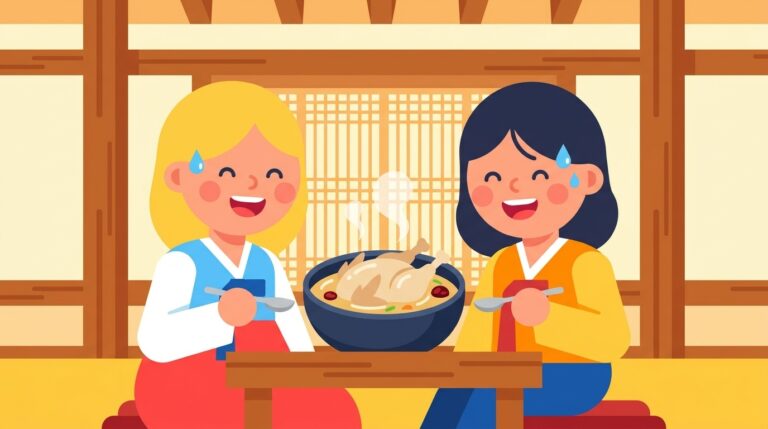
Phase 1: Empathy (The Sweaty K-Culture Cold Open)
Hello there! It’s your Daily Hangul Editor.
Imagine this: You walk out of a subway station in Seoul in mid-July. The humidity hits you like a warm, wet blanket. You’re sweating instantly. Your Korean friend grabs your arm, looking excited. “I know the perfect place for lunch today!” they say.
You expect cold noodles (냉면, naengmyeon) or an air-conditioned cafe. Instead, they drag you to a packed restaurant, wait in line for 30 minutes, and proudly present you with… a boiling, bubbling hot stone bowl of chicken soup. In 35°C (95°F) heat.
“Why are we doing this?!” your brain screams.
Welcome to Boknal (복날), the three hottest days of the Korean summer. This isn’t just about eating food; it’s a centuries-old survival tactic and a profound cultural experience. If you don’t understand the vocabulary around this, you might think your Korean friends are trying to torture you. But once you get it, you’ll earn massive ‘Insider’ (인싸, in-ssa) points. Let’s dive into the fascinating world of fighting the Korean summer heat!
Phase 2: Core Expression Deep Dive
1. 이열치열 (Fighting fire with fire)
- Pronunciation: [I-yeol-chi-yeol] (Sounds like: ee-yuhl-chee-yuhl)
- Meaning: Literal: Heat controls heat. / Real nuance: Fighting fire with fire; eating hot food to beat the summer heat.
- K-Culture Moment: You’ll hear this on the news, in K-Dramas, and from every Korean dad sitting in front of a boiling bowl of Samgyetang (삼계탕, ginseng chicken soup) in August. It’s the ultimate justification for sweating through your meal.
- Editor’s Insight: This is a four-character idiom (Saja-seongeo). Saying this makes you sound incredibly fluent and culturally tuned in. It’s not just a phrase; it’s a mindset.
- Situation Spectrum:
- Casual with friends: ✅
- Semi-formal with coworkers: ✅
- Formal with bosses/elders: ✅ (It’s a universally respected proverb!)
- 🤔 Think About It: Why does Korean culture value enduring discomfort (like sweating over hot soup) to achieve a sense of relief? Do you have a similar “endurance brings comfort” concept in your culture?
2. 아, 시원하다! (Ah, that hits the spot!)
- Pronunciation: [A, si-won-ha-da!] (Sounds like: ah, shee-won-ha-da)
- Meaning: Literal: Ah, it’s cool! / Real nuance: Ah, it’s refreshing! / That hits the spot! / My tension is melting away.
- K-Culture Moment: Picture a K-Drama scene: An older man steps into a scalding hot bath or drinks a spoonful of boiling soup, closes his eyes, and sighs deeply, “아, 시원하다!” A young kid next to him gets confused, touches the water/soup, and burns their finger.
- Editor’s Insight: This is the #1 most confusing word for foreigners. 시원하다 doesn’t just mean “cold temperature.” It means “the feeling of blockage or tension being cleared.” Sweating out the heat with hot soup clears your body’s sluggishness, hence… it’s siwonhada.
- Situation Spectrum:
- Casual with friends: ✅
- Semi-formal with coworkers: ✅
- Formal with bosses/elders: ⚠️ (Use ‘시원합니다’ [si-won-ham-ni-da] for formal situations.)
- 🤔 Think About It: Have you ever felt “refreshed” by something physically hot? A sauna? A hot tea when you have a cold? That is the essence of siwonhada.
3. 몸보신 좀 하자 (Let’s get some healthy food)
- Pronunciation: [Mom-bo-sin jom ha-ja] (Sounds like: mohm-bo-sheen johm ha-ja)
- Meaning: Literal: Let’s supplement our bodies. / Real nuance: Let’s eat something nutritious to restore our energy.
- K-Culture Moment: Summer heat drains your energy (기력, giryeok). When coworkers notice everyone looking tired in July, the manager will usually declare, “오늘 점심은 몸보신 좀 합시다!” (Let’s eat something healthy for lunch today!), and everyone knows they are going to eat Samgyetang or Eel.
- Editor’s Insight: Food is medicine in Korea. Taking someone out for mombosin is a deep expression of care.
- Situation Spectrum:
- Casual with friends: ✅
- Semi-formal with coworkers: ✅
- Formal with bosses/elders: 🚫 (Let the elder suggest it, or say “몸보신 하러 가시죠” [Mom-bo-sin ha-reo ga-si-jyo] respectfully.)
- 🤔 Think About It: Food is often linked to affection in Korea (e.g., “Have you eaten?”). How does sharing a “health-boosting” meal strengthen community bonds?
Phase 3: Textbook vs. Real Korean
[Situation 1: Expressing that the weather is unbearably hot]
* 📖 Textbook Korean: 날씨가 너무 덥습니다. (Nalssiga neomu deopseumnida. – The weather is very hot.)
* 🗣️ Real Korean: 아, 더워 죽겠다! (A, deowo jukgetda! – Ah, I’m going to die of heat!)
* 💡 Why the difference?: Koreans love dramatic exaggeration to express discomfort. Adding “~죽겠다” (going to die from ~) to verbs is a very common, expressive daily habit.
[Situation 2: Suggesting Samgyetang for lunch]
* 📖 Textbook Korean: 점심에 삼계탕을 먹을까요? (Jeomsime samgyetangeul meogeulkkayo? – Shall we eat Samgyetang for lunch?)
* 🗣️ Real Korean: 오늘 점심 삼계탕 각? (Oneul jeomsim samgyetang gak? – Today’s lunch is totally a Samgyetang vibe?)
* 💡 Why the difference?: The slang “각” (gak, meaning ‘angle’) is popular among younger generations to mean “the perfect timing/situation for something.”
Bottom Note: For B1 learners, using “더워 죽겠어요” (deowo jukgesseoyo – polite form of dying from heat) is a perfect, natural phrase to use with colleagues!
Phase 4: Cultural Context — K-Culture Deep Dive
4-1. Non-verbal Nuances & Nunchi (눈치)
When eating Samgyetang with Korean colleagues on Boknal, watch their body language. You’ll see people wiping sweat with a napkin while smiling. That shared suffering is part of the bonding! Also, exercise your Nunchi (눈치, social situational awareness): Each table usually has a small container of salt and pepper. Don’t just scoop it for yourself. Scoop a little onto the small plates and pass them to your coworkers first.
4-2. K-Food Connection: The Anatomy of a Samgyetang Meal
Samgyetang isn’t just chicken soup. It’s a whole young chicken stuffed with sticky rice, garlic, jujubes (대추), and a whole ginseng root.
* How to eat it: You don’t pick up the whole chicken. You use your chopsticks to gently tear the soft meat apart. Dip the meat slightly into the salt/pepper mix you prepared.
* The Insam-ju (인삼주): Many traditional restaurants give you a tiny shot glass of ginseng liquor. You can drink it before the meal to warm up your stomach, or pour it directly into your hot soup to remove any gamey smell.
* Critical Perspective: Why do Koreans obsess over eating this specifically on three dates (Chobok, Jungbok, Malbok)? It stems from an agricultural society where enduring the summer was literally a matter of life and death. The community had to share high-protein food to survive the farming season. Today, it’s a corporate bonding ritual.
Phase 5: Real-World Roleplay Scenario
Scenario A: The Friday Lunch Rush
- Setting: Friday, 11:30 AM. Mid-July. The humidity is 80%. You and your Korean team are standing outside a famous Samgyetang restaurant in Bukchon. The line is already 20 people deep.
- Characters:
- YOU: An expat working in Seoul, currently sweating through your shirt.
- Minsoo (32): Your friendly, slightly dramatic Korean coworker.
Minsoo: 와, 오늘 진짜 더워 죽겠다, 그쵸?
(Wa, oneul jinjja deowo jukgetda, geuchyo?)
[Wow, I’m seriously going to die of heat today, right?]
YOU: 네, 너무 덥네요. 근데 우리 왜 이 날씨에 뜨거운 걸 먹어요? 🥵
(Ne, neomu deomneyo. Geunde uri wae i nalssie tteugeoun geol meogeoyo?)
[Yes, it’s so hot. But why are we eating something hot in this weather?]
Minsoo: 에이, 한국의 여름을 아직 모르시네! 이열치열!
(Ei, hangugui yeoreumeul ajik moreusine! Iyeolchiyeol!)
[Hey, you don’t know the Korean summer yet! Fight fire with fire!]
(🎭 Stage Direction: 20 minutes later. You finally sit down. The waitress places a fiercely boiling stone bowl in front of you.)
Minsoo: 자, 국물부터 한 입 드셔보세요. 몸보신 제대로 될 겁니다.
(Ja, gungmulbuteo han ip deusyeoboseyo. Mombosin jedaero doel geomnida.)
[Here, try a sip of the broth first. It’ll properly nourish your body.]
(🎭 Stage Direction: You take a careful sip of the hot, rich ginseng broth. You start sweating, but strangely, your stomach feels warm and relaxed.)
Minsoo: 어때요? 맛있죠?
(Eottaeyo? Masitjyo?)
[How is it? Delicious, right?]
🔀 Your Turn! How should you respond to sound like a true local?
– A) “너무 뜨거워요!” (Neomu tteugeowoyo! – It’s too hot!)
– B) “진짜 시원하네요!” (Jinjja siwonhaneyo! – It’s really refreshing!)
– C) “진짜 차갑네요!” (Jinjja chagapneyo! – It’s really cold!)✅ Best Choice: B — While A is factually correct, choosing B will make Minsoo’s jaw drop. He will immediately announce to the whole office that you are basically Korean now.
⚠️ Choice C Analysis: “차갑다” strictly means “cold to the touch.” Since the soup is boiling, saying this will make people think you’ve lost your mind to the heat!
Scenario B: Bonus — Asking for Refills (The K-Food Hack)
Samgyetang is always served with Kkakdugi (깍두기, cubed radish kimchi). It’s the perfect pairing.
YOU: 이모님, 여기 깍두기 좀 더 주시겠어요?
(Imonim, yeogi kkakdugi jom deo jusigesseoyo?)
[Auntie, could you give us a little more radish kimchi here?]
Imo (Waitress): 네~ 많이 드세요!
(Ne~ mani deuseyo!)
[Yes~ eat a lot!]
(💡 Pro-tip: In busy authentic restaurants, calling the waitress “이모님” (Imonim – Auntie) or “사장님” (Sajangnim – Boss) is much more natural than just shouting “저기요” (Jeogiyo – Excuse me).)
Phase 6: 10-Second Shadowing Drill
Practice these sentences out loud to nail the natural intonation!
- 😤 단호하게 (Determinedly, as you wipe your sweat):
이열 / 치열! / 오늘 점심은 / 무조건 / 삼계탕입니다.
(I-yeol / chi-yeol! / o-neul jeom-si-meun / mu-jo-kkeon / sam-gye-tang-im-ni-da.) -
😊 감탄하며 (With admiration, after tasting the soup):
국물이 / 정~~~말 / 시원하네요!
(Gung-mu-ri / jeong~~~mal / si-won-ha-ne-yo!)
Phase 7: K-Culture Mini Dictionary
1. 복날
* Romanization: Boknal
* English: Dog Days of Summer
* Context: The three hottest days based on the lunar calendar (Chobok, Jungbok, Malbok). It’s the peak season for poultry farmers in Korea!
2. 웨이팅
* Romanization: We-i-ting
* English: Waiting in line
* Context: Konglish for waiting in a queue. On Boknal, “웨이팅 쩐다” (The wait is insane) is a phrase you’ll hear outside every famous chicken restaurant.
3. 이모님
* Romanization: I-mo-nim
* English: Auntie (respectful)
* Context: The affectionate term used to call middle-aged female staff in traditional Korean restaurants. It builds instant rapport.
4. 앞접시
* Romanization: Ap-jeop-si
* English: Personal front plate
* Context: Because Korean food often comes in large communal boiling pots, you must ask for an ap-jeop-si to cool down your portion before eating.
Phase 8: Traveler’s Survival Kit
Planning to visit Korea in July or August? You absolutely need this survival kit for dining out.
🆘 Survival Phrases for the Samgyetang Restaurant
– 🇰🇷 “앞접시 하나만 주세요.” (Apjeopsi hanaman juseyo.)
– 🗣️ Pronunciation: ap-jeop-shee ha-na-man joo-se-yo.
– 📍 Usage: When your soup is too hot and you need a small plate to cool down the meat.
- 🇰🇷 “뼈 버리는 통 어디 있어요?” (Ppyeo beorineun tong eodi isseoyo?)
- 🗣️ Pronunciation: ppyuh buh-ri-neun tong uh-di ee-ssuh-yo?
- 📍 Usage: Asking for the bucket to throw away the chicken bones.
📌 Editor’s Travel Note
– Navigating the Line: Popular spots like Tosokchon or Korea Samgyetang don’t always use queue apps (like CatchTable). Sometimes you literally just have to stand in the sun. Bring a portable mini fan (손선풍기)!
– No Tipping: Did the waitress bring you four free refills of Kimchi? Do not leave a tip! Just say “잘 먹었습니다” (I ate well) loudly as you leave. Tipping will cause confusion.
– Paying: You take the small bill holder (계산서) from your table to the front door to pay when you leave.
Phase 9: Critical Thinking Corner — “One Step Deeper”
🧠 Think Deeper: Food & Identity (음식과 정체성)
Why do Koreans insist on eating the same food on the exact same day? The culture of Boknal reveals a deep aspect of the Korean psyche: Communal Endurance. Korea modernized rapidly from an agrarian society. Enduring the harsh summer wasn’t an individual task; it was a village effort. By eating Boyangsik (health food) together, coworkers and families are silently saying, “We are suffering through this heat together, and we will overcome it together.” It transforms the physical act of eating into a shared emotional bond.
💬 Your Turn: Does your culture have a specific food that everyone eats on a certain day to build community spirit? Share it in the comments below!
Phase 10: FAQ & Avoiding Common Mistakes
Q: Can I use “시원하다” for cold drinks like Iced Americano too?
Yes! That’s the beauty of the word. An Iced Americano is cold (차가운), so drinking it makes you feel refreshed (시원하다). A hot bath is hot (뜨거운), but releasing muscle tension makes you feel refreshed (시원하다).
Q: I’m vegetarian. What can I eat on Boknal?
Don’t worry! You don’t have to eat chicken. Many Koreans eat Kong-guksu (콩국수, cold soy milk noodle soup) or fresh watermelon (수박) as a vegetarian way to beat the heat.
❌ Common Mistake #1: Confusing 덥다 (Deopda) and 뜨겁다 (Tteugeopda)
– Foreigners often say: “이 국물 너무 더워요!” (This soup is too hot!)
– Why it’s wrong: ‘덥다’ is ONLY for the weather or the room temperature.
– ✅ Do this: Use 뜨겁다 (Tteugeopda) for things you touch or eat. “이 국물 너무 뜨거워요!” (This soup is too hot to touch/eat!)
Phase 11: Summary & Action Items
- One-Liner Summary: On the hottest days of Korean summer (Boknal), survive the heat like a local by eating boiling Samgyetang and proudly declaring, “Iyeolchiyeol!”
Action Mission 3 Steps:
– 🥉 Bronze (Solo): Look at your hot coffee or tea today, take a sip, and sigh, “아, 시원하다~”
– 🥈 Silver (Online): Comment on a K-Drama YouTube clip featuring food with: “이열치열!”
– 🥇 Gold (Real World): Visit a local Korean restaurant, order a hot soup, ask the “Imonim” for some Kkakdugi, and use your new survival phrases!
🇰🇷 Special K-Culture Mission:
Search for “Samgyetang Mukbang” on YouTube. Watch how the creator pulls the chicken apart and dips it in salt. Count how many times they say “시원하다” or “맛있다” (Delicious)!
Phase 12: Quiz — Interactive Challenge
1. Situational Judgment: Your Korean boss takes the team out for lunch in mid-August. He orders boiling hot stew for everyone. Sweating, he looks at you and says, “It’s Iyeolchiyeol!” What is the best response?
– A) “사장님, 저는 에어컨이 좋아요.” (Boss, I like the AC.)
– B) “맞습니다. 아, 국물이 정말 시원하네요!” (That’s right. Ah, the broth is so refreshing!)
– C) “날씨가 뜨거워요!” (The weather is hot!)
2. Fill in the Blank:
“The weather outside is 35 degrees! 너무 더워 _______!” (It’s so hot I could die!)
3. True or False — K-Culture Edition:
In a traditional Korean restaurant, you should leave a 15% tip if the “Imonim” gives you extra side dishes. (T/F)
🚨 Click here for the Answers!
1. B. A is too blunt/rude for a boss. C uses the wrong word for weather (should be 덥다, not 뜨겁다). B shows you understand both the culture and the vocabulary!
2. 죽겠다 (jukgetda). A very natural Korean exaggeration.
3. False. Korea is a non-tipping culture. Tipping might cause the staff to chase you down the street thinking you left your change behind!
Frequently Asked Questions (FAQ)
Q: What does "이열치열 (Fighting fire with fire)" mean in Korean and how do you pronounce it?
A: In Korean, "이열치열 (Fighting fire with fire)" is pronounced [I-yeol-chi-yeol] and means: Literal: Heat controls heat. / Real nuance: Fighting fire with fire; eating hot food to beat the summer heat.
Q: What does "아, 시원하다! (Ah, that hits the spot!)" mean in Korean and how do you pronounce it?
A: In Korean, "아, 시원하다! (Ah, that hits the spot!)" is pronounced [A, si-won-ha-da!] and means: Literal: Ah, it's cool! / Real nuance: Ah, it's refreshing! / That hits the spot! / My tension is melting away.
Q: What does "몸보신 좀 하자 (Let's get some healthy food)" mean in Korean and how do you pronounce it?
A: In Korean, "몸보신 좀 하자 (Let's get some healthy food)" is pronounced [Mom-bo-sin jom ha-ja] and means: Literal: Let's supplement our bodies. / Real nuance: Let's eat something nutritious to restore our energy.







