

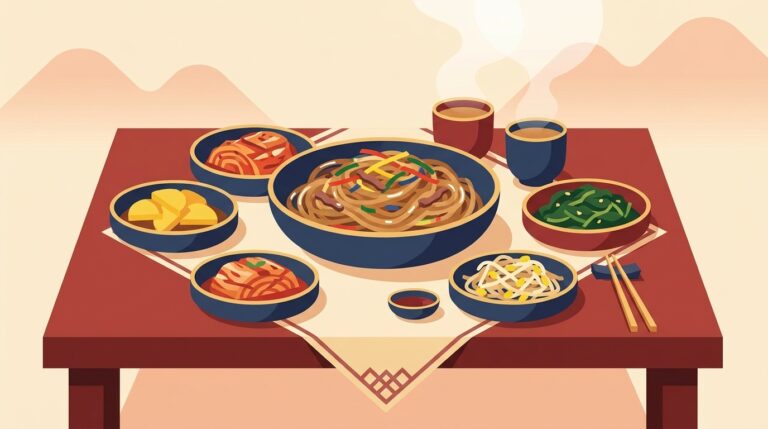
Phase 1: Empathy & K-Culture Cold Open
Hello! I’m your Daily Hangul Editor, your personal guide to the vibrant, delicious, and sometimes confusing world of Korean culture and language.
Imagine this: You’re watching a classic K-Drama. It’s the mother-in-law’s birthday, and the daughter-in-law is sweating over a hot stove at 5 AM. The kitchen looks like a war zone. What is she making that requires five different frying pans? It’s 잡채 (Japchae)—the glistening, savory glass noodle dish that makes every Korean mouth water. But when the family finally sits down to eat, she bows her head and says, “I haven’t prepared much, but please eat.”
Wait, what? She hasn’t prepared much? The table is practically breaking under the weight of 15 different dishes!
If you’ve ever felt utterly confused by Korean food culture, humble-bragging, or why some noodles are treated like side dishes, you are not alone. Understanding the language surrounding 잔치 음식 (Janchi Eumsik – Banquet Food) is your golden ticket to unlocking the heart of Korean hospitality.
This guide is crafted from real questions asked by my students who found themselves paralyzed at a Korean dinner party. By the end of this post, you won’t just know how to eat Japchae—you’ll know how to talk about it like a true local.
Phase 2: Core Expressions Deep Dive
Let’s break down the three essential expressions you’ll hear (and need to use) whenever there’s a Korean feast.
1. 손이 참 많이 가요.
- Pronunciation: [soni cham mani gayo] (The ‘o’ in son sounds like the ‘o’ in bone. Make it smooth!)
- Meaning:
- Literal: Hands go to it a lot.
- Real Nuance: It requires a tremendous amount of effort, time, and meticulous work.
- K-Culture Moment: This is the ultimate compliment-slash-complaint when making Japchae. Because every single ingredient (spinach, carrots, mushrooms, onions, beef) must be stir-fried separately before being mixed with the noodles, Koreans always use this phrase to describe it.
- Editor’s Insight: You use this phrase to validate someone’s hard work. If a Korean friend makes you Japchae or any complex Korean dish, saying this will make them feel instantly appreciated. It acknowledges their literal “blood, sweat, and tears.”
- Situation Spectrum:
- Friends (Casual): ✅ (손 진짜 많이 가잖아!)
- Colleagues (Semi-formal): ✅ (손이 많이 가는 요리네요.)
- Elders/Bosses (Formal): ✅ (어머, 손이 참 많이 갔겠어요.)
- 🤔 Think About It: Why do Koreans value foods that “take a lot of hands”? In an era of instant food, what does the sacrifice of time signify in Korean relationships?
2. 면이 붇기 전에 드세요.
- Pronunciation: [myeoni butgi jeone deuseyo] (The ‘eu’ in deuseyo sounds like the disgusted sound you make when stepping in gum—pull your lips back!)
- Meaning:
- Literal: Eat it before the noodles swell.
- Real Nuance: Eat it quickly before the noodles get soggy/mushy!
- K-Culture Moment: Whether you’re eating Japchae, Jajangmyeon, or Ramyeon, this is the Korean equivalent of a ticking time bomb. The texture of noodles (쫄깃쫄깃 – chewy) is sacred in Korea. If the noodles absorb too much moisture and get soft, the dish is considered ruined.
- Editor’s Insight: Grammatically, the base verb is 붇다 (to swell), but colloquially, 99% of Koreans just say “불기 전에” (bulgi jeone). If a restaurant auntie says this to you, she cares about you. Drop whatever you’re doing and eat the noodles first!
- Situation Spectrum:
- Friends (Casual): ✅ (야, 불기 전에 빨리 먹어!)
- Colleagues (Semi-formal): ✅ (불기 전에 드세요.)
- Elders/Bosses (Formal): ✅ (면 붇기 전에 어서 드세요.)
- 🤔 Think About It: Koreans are famous for their “빨리빨리” (Ppal-i Ppal-i / Hurry Hurry) culture. Do you think the obsession with eating noodles before they get soggy is related to this fast-paced lifestyle?
3. 차린 건 없지만 많이 드세요.
- Pronunciation: [charin geon eopjiman mani deuseyo]
- Meaning:
- Literal: I haven’t prepared much, but please eat a lot.
- Real Nuance: I have prepared a massive feast for you, but out of humility, I will pretend it’s nothing special. Please enjoy it!
- K-Culture Moment: You are invited to a Korean family’s house for Chuseok (Thanksgiving). The table has Japchae, Galbijjim (braised short ribs), Jeon (pancakes), and 10 side dishes. The host will 100% say this phrase.
- Editor’s Insight: Never, ever agree with them! If they say “I didn’t prepare much,” do not say, “Yeah, it’s a bit small.” You must gasp and say, “What do you mean? The table’s legs are about to break!” (상다리가 부러지겠어요).
- Situation Spectrum:
- Friends (Casual): ✅ (차린 건 없지만 많이 먹어.)
- Colleagues (Semi-formal): ✅ (차린 건 없지만 많이 드세요.)
- Elders/Bosses (Formal): ⚠️ (As a guest, you don’t say this. Only the host says it!)
- 🤔 Think About It: Humility is deeply ingrained in Confucian cultures. Does your culture have a similar way of downplaying one’s own efforts to elevate the guest?
Phase 3: Textbook vs. Real Korean
Let’s see how these situations play out in the real world versus what your textbook teaches you.
[Situation 1: Asking for more Japchae at a restaurant]
* 📖 Textbook Korean: 잡채를 더 주시겠습니까? (Could you please give me more Japchae?)
* 🗣️ Real Korean: 이모님~ 여기 잡채 리필 좀 해주세요! (Auntie~ Please give us a Japchae refill here!)
* 💡 Why the difference?: In Korean restaurants, “리필” (refill – Konglish) is the magic word for side dishes. Also, calling the waitress “이모님” (Auntie) establishes a warm, informal connection rather than a stiff customer-server dynamic.
[Situation 2: Complimenting the host’s cooking]
* 📖 Textbook Korean: 음식이 매우 맛있습니다. 요리하시느라 수고하셨습니다. (The food is very delicious. Thank you for your trouble in cooking.)
* 🗣️ Real Korean: 와, 이거 직접 만드신 거예요? 진짜 대박! 손맛이 장난 아니에요. (Wow, did you make this yourself? Totally amazing! Your ‘hand-taste’ is no joke.)
* 💡 Why the difference?: Mentioning “손맛” (Sonmat – the unique flavor of someone’s personal cooking style) is the ultimate compliment in Korea, far more authentic than a textbook sentence.
Bottom Note for B2 Learners: You don’t need to use intense slang, but dropping words like “리필” (refill) and “손맛” (sonmat) will immediately signal to Koreans that you truly understand their culture, not just their vocabulary.
Phase 4: Cultural Context — K-Culture Deep Dive
4-1. Non-Verbal Cues (The Art of Nunchi)
When you are eating banquet food like Japchae at a Korean gathering, 눈치 (Nunchi – social sense) is crucial.
* Chopstick Etiquette: Japchae noodles are long and slippery. Do not lift the bowl to your mouth! Pick up a manageable portion with your chopsticks, place it on your spoon or rice bowl, and eat.
* The Power of the First Bite: If the host spent hours making Japchae, take a bite of that specific dish first, widen your eyes, and visibly nod in approval before saying how delicious it is.
4-2. K-Food Connection: The “Jeong” of Mixed Noodles
Why is Japchae the quintessential 잔치 음식 (Banquet Food)? In Korean, the prefix “잡” (Jap) means “mixed” or “various,” and “채” (Chae) means “vegetables.”
Historically, colorful vegetables were expensive and hard to gather. Bringing together five colors (representing the traditional Korean color spectrum, Obangsaek) into one harmonious dish symbolizes unity and prosperity. When you watch K-Dramas like Reply 1988, you’ll notice mothers making Japchae in giant metal mixing bowls. They mix it with their bare hands (wearing plastic gloves) to physically infuse their love—this is the very definition of 정 (Jeong – affection/bonding).
Critical View: Korean food culture places immense pressure on women (especially mothers and daughters-in-law) during holidays to produce these labor-intensive dishes. While beautiful, there is an ongoing modern debate in Korea about simplifying holiday meals to reduce this stress!
Phase 5: Real-Life Roleplay Scenario
Scenario A: The Housewarming Feast
- Setting: Friday night, 7:30 PM. You’ve been invited to your Korean friend’s new apartment for a 집들이 (housewarming party). The living room table is completely covered with food. Right in the center is a massive plate of steaming Japchae.
- Characters:
- YOU: An expat living in Korea, eager to impress your friends.
- Minji (30): Your Korean friend and host. She has been cooking since the morning.
Dialogue:
Minji: 다들 배고프지? 차린 건 없지만 많이들 먹어! 🍲
(dadeul baegopeuji? charin geon eopjiman manideul meogeo!)
[Are you all hungry? I haven’t prepared much, but please eat a lot!]
(🎭 Stage Direction: Minji hands out chopsticks with an exhausted but proud smile.)
YOU: 와… 상다리가 부러지겠어요! 이거 다 직접 하신 거예요?
(wa… sangdariga bureojigesseoyo! igeo da jikjeop hasin geoeyo?)
[Wow… the table’s legs are going to break! Did you make all this yourself?]
Minji: 응, 잡채는 내가 새벽부터 준비했어. 면 불기 전에 잡채부터 먹어봐.
(eung, japchaeneun naega saebyeokbuteo junbihaesseo. myeon bulgi jeone japchaebuteo meogeobwa.)
[Yeah, I prepared the Japchae since dawn. Try the Japchae first before the noodles get soggy.]
YOU: (Takes a bite) 음~! 진짜 맛있어요. 식당에서 파는 것보다 훨씬 나아요.
(eum~! jinjja masisseoyo. sikdangeseo paneun geotboda hwolssin naayo.)
[Mmm~! It’s really delicious. It’s way better than what they sell at restaurants.]
Minji: 다행이다! 잡채가 은근히 손이 참 많이 가거든. 입에 맞아?
(dahaengida! japchaega eungeunhi soni cham mani gageodeun. ibe maja?)
[Thank goodness! Japchae secretly takes a whole lot of effort. Does it suit your taste?]
YOU: 네, 완전 제 스타일이에요. 채소도 듬뿍 들어가서 좋아요.
(ne, wanjeon je seutairieyo. chaesodo deumppuk deureogaseo joayo.)
[Yes, it’s totally my style. I love that there are plenty of vegetables in it too.]
Minji: 그럼 더 먹어! 여기 내가 덜어줄게.
(geureom deo meogeo! yeogi naega deoreojulge.)
[Then eat more! Here, let me scoop some onto your plate.]
(🎭 Stage Direction: Minji moves to put a massive second mountain of Japchae on your plate.)
🔀 YOUR TURN! How do you respond?
* A) “아니요, 괜찮습니다. 배가 부릅니다.” (Strict and textbook.)
* B) “아, 너무 배부른데… 워낙 맛있어서 조금만 더 먹을게요!” (Flattering and accepting.)
* C) “안 돼! 그만!” (Too blunt/aggressive.)✅ Best Choice: B — Reason: In Korea, refusing food abruptly can hurt the host’s feelings, especially if they put “a lot of effort” (손이 많이 가는) into it. Acknowledging you are full but accepting a little bit because “it’s so delicious” is the ultimate Korean social skill!
Scenario B: Bonus Roleplay (The Market Survival)
- Setting: Gwangjang Market, bustling with tourists and locals. You see a mountain of glossy Japchae at a side-dish stall.
- Stall Auntie: 학생~ 잡채 좀 보고 가. 금방 무쳐서 맛있어!
(Student~ Take a look at the Japchae. I just mixed it, it’s delicious!) - YOU: 우와, 냄새 진짜 좋네요. 이거 한 팩에 얼마예요?
(Wow, it smells really good. How much is it for one pack?) - Stall Auntie: 오천 원! 당면 안 불게 국물도 조금 넣어줄게. 포장해 줘?
(5,000 won! I’ll add a little broth so the noodles don’t get soggy. Should I pack it for you?) - YOU: 네, 한 팩 포장해 주세요!
(Yes, please pack one for me!)
Phase 6: 10-Second Shadowing Drill
Let’s practice your tone! Repeat this out loud, focusing on the pauses (/) and the emotion.
🥺 (Full of gratitude) 와~ / 차린 게 너무 많아서 / 상다리가 부러지겠어요! / 정말 잘 먹겠습니다!
(wa~ / charin ge neomu manaseo / sangdariga bureojigesseoyo! / jeongmal jal meokgetseumnida!)
😤 (Urgently to a friend) 야! / 당면 다 붇는다! / 불기 전에 / 빨리 먹어!
(ya! / dangmyeon da bunneunda! / bulgi jeone / ppalli meogeo!)
Phase 7: K-Culture Mini Dictionary
Here are 4 keywords to level up your Korean food vocabulary:
1. 잔치 (Janchi)
* Pronunciation: jan-chi
* English: Feast / Banquet / Party
* Context: Used for massive celebrations like 1st birthdays (돌잔치), 60th birthdays (환갑잔치), or weddings. “잔치국수” (Janchi Guksu) is a warm noodle dish literally meaning “banquet noodles.”
2. 당면 (Dangmyeon)
* Pronunciation: dang-myeon
* English: Glass noodles / Cellophane noodles
* Context: The main ingredient of Japchae. Made from sweet potato starch, they are translucent, highly chewy, and prone to absorbing liquids quickly!
3. 손맛 (Sonmat)
* Pronunciation: son-mat
* English: Hand-taste (Mother’s touch)
* Context: The intangible, unique flavor that comes from an experienced cook’s intuition, rather than a strict recipe. A massive compliment in Korea.
4. 상다리가 부러지다 (Sangdariga bureojida)
* Pronunciation: sang-da-ri-ga bu-reo-ji-da
* English: The legs of the table will break
* Context: An idiomatic expression used to praise a host for preparing an overwhelmingly large amount of food.
Phase 8: Traveler Survival Kit
Visiting Korea? You will definitely encounter Japchae in traditional markets (시장) or as a side dish in restaurants. Here is your survival kit!
🆘 Survival Phrases for the Market & Restaurant
* 🇰🇷 “반찬 리필 되나요?” (banchan ripil doenayo?)
* 🗣️ Can I get a refill on the side dishes?
* 📍 Where to use: Any traditional Korean restaurant (like BBQ joints). Most side dishes, including Japchae, are free to refill!
- 🇰🇷 “이거 한 팩에 얼마예요?” (igeo han paege eolmayeyo?)
- 🗣️ How much is this per pack?
- 📍 Where to use: Traditional markets when buying banchan to-go.
🇰🇷 “안 맵게 해주실 수 있나요?” (an maepge haejusil su innayo?)
- 🗣️ Can you make it not spicy?
- 📍 Where to use: Japchae isn’t spicy, but if you’re ordering other mixed noodles like Jjolmyeon (쫄면), use this to save your stomach!
📌 Editor’s Travel Note
* To Tip or Not to Tip? There is absolutely ZERO tipping culture in Korea. If you try to give the restaurant Auntie extra money for refilling your Japchae, she might run down the street to return your “forgotten” change!
* Market Payment: While Korea is a “card paradise,” some small traditional market stalls still prefer cash (현금) or account transfers for small purchases under 5,000 KRW.
Phase 9: Critical Thinking Corner — “한 발 더 깊이”
🧠 Food & Identity: The Labor of Love
In many Western cultures, a “great meal” might be defined by expensive ingredients or complex culinary techniques presented elegantly on an individual plate. In Korea, however, a meal’s value is deeply tied to commensality (the act of eating together) and the visible labor of the host.
When someone says “손이 참 많이 가는 음식이에요” (It’s a dish that takes a lot of effort) about Japchae, they are not complaining about the recipe; they are affirming the love and sacrifice of the person who cooked it. Korean food culture is essentially a culture of “Jeong” (정)—an invisible bond forged through shared hardship and shared meals. This is why hosts humble themselves (“I haven’t prepared much”) and guests exaggerate their praise (“The table will break!”). The food is merely a vehicle for mutual respect and affection.
💬 Your Turn: How does your culture show love through food? Is it about the cost, the presentation, the family recipe, or something else? Share with us in the comments!
Phase 10: FAQ & Common Mistakes
Q: Is it rude to ask for a refill of Japchae since it’s an expensive/hard-to-make side dish?
* Maybe! In standard, affordable eateries (백반집), Japchae is considered a premium side dish. It’s okay to ask for one refill (“이모님, 잡채 조금만 더 주시겠어요?”), but asking 3 or 4 times might earn you a side-eye. In high-end Hanjeongsik (한정식), they will happily refill it.
Q: Should Japchae be eaten hot or cold?
* Both! Freshly made Japchae is warm and soft. However, left-over Japchae in the fridge becomes hard. Koreans usually stir-fry leftover Japchae in a pan with a little water or oil, or mix it with rice and red pepper paste (잡채밥)!
❌ Common Mistake #1: Taking the whole plate of shared Japchae to your side of the table.
✅ Do this instead: In Korea, side dishes are strictly communal. Use your chopsticks to take a bite directly from the center plate, or scoop a small portion onto your personal rice bowl. Do not “hoard” the dish!❌ Common Mistake #2: Agreeing when the host says, “차린 건 없지만…” (I haven’t prepared much…)
✅ Do this instead: Always politely disagree and compliment the sheer volume of food. “아니에요, 정말 푸짐해요!” (No, it’s really plentiful!)
Phase 11: Summary & Action Items
One-Liner Summary: Korean banquet food is all about shared effort (손이 많이 가다), eating with perfect timing (불기 전에), and mastering the art of humble hospitality.
Your Action Missions:
* 🥉 Bronze (Solo): Stand in front of your mirror and practice the humble brag: “차린 건 없지만 많이 드세요!” with a warm smile.
* 🥈 Silver (Online): Find a Korean recipe video on YouTube for Japchae and leave a comment: “우와, 진짜 손이 많이 가는 요리네요!” (Wow, it really is a dish that takes a lot of effort!)
* 🥇 Gold (Real World): Next time you are at a Korean restaurant, ask the server nicely: “잡채 리필 되나요?” (Can I get a refill on the Japchae?)
🎬 K-Culture Special Mission:
Watch an episode of a family K-Drama (like Reply 1988 or Hospital Playlist). Pay close attention to the dining scenes. Can you spot anyone telling someone else to eat quickly “before the noodles get soggy” (면 불기 전에)?
Phase 12: Quiz — Interactive Challenge
Test your new K-Culture instincts!
1. Situational Judgment: Your Korean mother-in-law has spent 4 hours making you a massive birthday feast with Japchae, Galbi, and soup. She smiles and says, “차린 건 없지만 많이 먹어라.” What is your BEST response?
* A) “네, 조금 부족하지만 잘 먹겠습니다.” (Yes, it’s a bit lacking, but I’ll eat well.)
* B) “무슨 말씀이세요! 상다리가 부러지겠어요!” (What do you mean! The table legs are going to break!)
* C) “왜 많이 안 차리셨어요?” (Why didn’t you prepare much?)
2. Fill in the Blank:
“당면이 ( ________ ) 전에 빨리 드세요!” (Eat quickly before the glass noodles get soggy!)
* Hint: It starts with a ‘ㅂ’.
3. True or False – K-Culture Edition:
* You should tip the restaurant owner 10% if they refill your Japchae for free. (T/F)
(Answers: 1. B, 2. 불기 / bulgi, 3. False – Tipping is not practiced in Korea and will cause confusion!)
Frequently Asked Questions (FAQ)
Q: What does "손이 참 많이 가요." mean in Korean and how do you pronounce it?
A: In Korean, "손이 참 많이 가요." is pronounced [soni cham mani gayo] and means: Literal: Hands go to it a lot.
Q: What does "면이 붇기 전에 드세요." mean in Korean and how do you pronounce it?
A: In Korean, "면이 붇기 전에 드세요." is pronounced [myeoni butgi jeone deuseyo] and means: Literal: Eat it before the noodles swell.
Q: What does "차린 건 없지만 많이 드세요." mean in Korean and how do you pronounce it?
A: In Korean, "차린 건 없지만 많이 드세요." is pronounced [charin geon eopjiman mani deuseyo] and means: Literal: I haven't prepared much, but please eat a lot.







