

Phase 1: Empathy
Hello! I’m the lead editor at Daily Hangul, your local culture navigator.
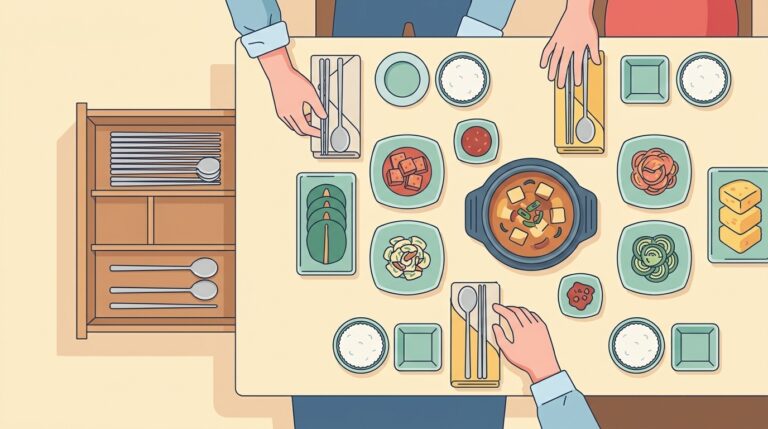
Picture this: You just walked into a bustling Korean BBQ restaurant in Hongdae. The savory smell of pork belly fills the air, K-Pop is blasting in the background, and everyone is chatting loudly. You sit down with your Korean friends, and before you can even take off your coat or look at the menu, a flurry of activity begins. A drawer under the table suddenly slides open. Hands are moving at lightning speed, pulling out napkins, spoons, and chopsticks, dealing them out to everyone at the table like a seasoned Vegas poker dealer.
You sit there thinking, “Wait, did we even order yet? What is going on?”
Welcome to the intersection of Korea’s Pali-Pali (빨리빨리, Hurry-Hurry) culture and Nunchi (눈치, Social Sense)! In Korea, setting the table before the food arrives isn’t just a polite gesture; it’s an unspoken social reflex. Knowing how to navigate this lightning-fast cutlery ritual won’t just save you from sitting awkwardly empty-handed—it will instantly upgrade you from “clueless tourist” to “cultural insider.”
This guide is built on real questions from our B2-level students who were completely caught off guard by this restaurant ritual. Let’s dive into the words and actions you need to survive and thrive at the Korean dining table!
Phase 2: Core Expressions Deep Dive
To jump into the action, here are the most important expressions you’ll need.
1. 수저 세팅할게요 (I’ll set the cutlery)
- Pronunciation: sujeo setinghalgeyo [soo-juh seh-ting-hal-ggeh-yo]
- Meaning: I will set up the spoons and chopsticks. (Literal: I will do the spoon-chopstick setting).
- K-Culture Moment: You’re at a company dinner (Hoesik). The youngest employee (or the one with the most Nunchi) immediately pulls open the table drawer and announces this softly to let the seniors know, “Don’t worry, I’ve got this handled.”
- Editor’s Insight: Notice how Koreans use the English word “setting” (세팅) here! It feels much more natural and active than saying “I will place the items.” It shows you are proactive.
- Situation Spectrum:
- Friends (Casual): ✅ (Say: 내가 수저 세팅할게! – naega sujeo setinghalge!)
- Coworkers (Semi-formal): ✅
- Boss/Elders (Formal): ✅ (It shows great manners!)
- 🤔 Think About It: Why do Koreans announce that they are doing a favor, rather than just doing it silently? Does your culture vocalize small acts of service in the same way?
2. 여기 서랍에 수저통 있어요 (The cutlery box is in the drawer here)
- Pronunciation: yeogi seorabe sujeotong isseoyo [yuh-gee suh-rap-eh soo-juh-tong ee-ssuh-yo]
- Meaning: The spoon-and-chopstick container is in this drawer.
- K-Culture Moment: You’re looking around wildly for a waiter to ask for a fork. Your Korean friend simply points to the edge of the table, slides open a hidden compartment, and reveals a treasure trove of utensils.
- Editor’s Insight: The sound ‘으’ in ‘수저통’ (sujeotong) is tricky. It sounds exactly like the disgusted “ugh” sound you make when you step in wet chewing gum. Try it!
- Situation Spectrum:
- Friends (Casual): ✅ (Say: 여기 서랍에 있어 – yeogi seorabe isseo)
- Coworkers (Semi-formal): ✅
- Boss/Elders (Formal): ✅
- 🤔 Think About It: Most Korean tables have hidden drawers for utensils to save space and time for both the servers and customers. How does this reflect the Pali-Pali mindset?
3. 휴지 한 장만 깔아줄래? (Can you lay down a napkin for me?)
- Pronunciation: hyuji han jangman kkarajullae? [hyoo-jee han jang-man gga-ra-jool-leh?]
- Meaning: Could you place a sheet of tissue/napkin down?
- K-Culture Moment: You’re dining out. Your friend pulls out a tissue, places it flat on the table, and then rests the spoon and chopsticks on top of it. It’s a hygiene habit many Koreans have when dining at older or busier restaurants!
- Editor’s Insight: The verb 깔다 (kkalda) means “to lay something flat.” You’ll hear this a lot in Korea, whether it’s laying down a napkin, a picnic mat, or even a foundation of makeup.
- Situation Spectrum:
- Friends (Casual): ✅
- Coworkers (Semi-formal): ⚠️ (Use ‘깔아주시겠어요?’ instead)
- Boss/Elders (Formal): 🚫 (Just quietly lay the napkin down for them instead of asking!)
- 🤔 Think About It: Even if the table is wiped clean by the staff, Koreans still create a “barrier” with a napkin for their utensils. What does this tell you about Korean perceptions of shared public spaces versus personal hygiene?
Phase 3: Textbook vs. Real Korean
Let’s see how the stiff textbook phrases evolve in the real, fast-paced streets of Seoul.
[Situation 1: Offering to prepare the table]
* 📖 Textbook Korean: 제가 숟가락과 젓가락을 식탁 위에 놓겠습니다. (I will place the spoon and chopsticks on the dining table.)
* 🗣️ Real Korean: (Pulling open the drawer) 수저 세팅할게요. (I’ll set the cutlery.)
* 💡 Why the difference?: Efficiency! “숟가락과 젓가락” is too long. We combine them into the portmanteau 수저 (sujeo). Plus, borrowing the English word “setting” sounds much more modern and casual.
[Situation 2: Pointing out the napkin location]
* 📖 Textbook Korean: 식탁 옆에 휴지가 있습니다. (There are tissues next to the table.)
* 🗣️ Real Korean: 서랍 열면 휴지 있어요. (If you open the drawer, there are tissues.)
* 💡 Why the difference?: Real conversations emphasize action. Instead of just stating where it is, Koreans tell you what to do (open the drawer) to get it.
Bottom Note: At a B2 level, start using “수저” instead of “숟가락, 젓가락” separately. It instantly elevates your conversational flow!
Phase 4: Cultural Context — K-Culture Deep Dive
4-1. Non-Verbal Cues: The Ultimate Nunchi Test
Language isn’t just about speaking. In Korea, setting the table is the ultimate test of Nunchi (눈치). If you are the youngest person at the table (Mangnae), or the host, it is silently expected that you will locate the drawer and distribute the utensils.
Pro Tip: When handing over the spoon and chopsticks to someone older or higher in rank, use two hands (or place one hand lightly under your serving arm) to show respect.
4-2. The K-Food Connection: Pali-Pali (빨리빨리) Meets Communal Dining
Why does this happen before you even order? Korean dining is inherently communal and hyper-efficient. Unlike Western dining where courses come out sequentially with fresh silverware, Korean food—whether it’s a bubbling Kimchi stew or sizzling K-BBQ—arrives all at once with a dozen side dishes (banchan).
The servers are incredibly busy, so making customers self-sufficient with table drawers is a stroke of Pali-Pali genius. It reduces wait times and empowers the diners. When you set the table immediately, you are essentially signaling to the universe (and your hungry friends): “We are ready. Bring on the feast!”
Phase 5: Real-Life Roleplay Scenario
Setting: Friday evening, 7:00 PM. A lively Samgyeopsal (pork belly) restaurant near Gangnam Station. The air is thick with the savory smoke of grilling meat. The tables are sticky, the chatter is loud. You are sitting with three Korean colleagues.
Characters:
– YOU: A foreign employee on your 3rd day of a business trip in Seoul. You want to make a good impression.
– Min-su (32): Your friendly, humorous Korean coworker.
– Manager Park (45): Your department boss. Stern but generous.
Dialogue:
Manager Park: 자, 여기 삼겹살 3인분 주세요! 🥩
(Romanization) Ja, yeogi samgyeopsal sam-inbun juseyo!
(English) [Translation] Alright, three servings of pork belly here, please!
(🎭 Stage Direction: Manager Park turns to the group, satisfied with his order.)
Min-su: 아, 배고프다. 빨리 먹고 싶네요.
(Romanization) Ah, baegopeuda. Ppalli meokgo simneyo.
(English) [Translation] Ah, I’m starving. I want to eat quickly.
YOU: 저도요! 그런데 숟가락은 달라고 해야 하나요?
(Romanization) Jeodoyo! Geureonde sutgarageun dallago haeya hanayo?
(English) [Translation] Me too! But should we ask them to give us spoons?
Min-su: 에이, 여긴 한국이잖아요! 테이블 옆을 한 번 보세요.
(Romanization) Ei, yeogin hangugijanayo! Teibeul yeopeul han beon boseyo.
(English) [Translation] Hey, this is Korea! Take a look at the side of the table.
(🎭 Stage Direction: Min-su taps the wooden edge of your side of the table.)
YOU: 앗, 서랍이 있네요? 와, 신기해요.
(Romanization) At, seorabi inneyo? Wa, singihaeyo.
(English) [Translation] Oh, there’s a drawer? Wow, that’s fascinating.
🔀 YOUR TURN! The drawer is open, revealing spoons, chopsticks, and napkins. What do you do?
– A) “오, 다행이네요.” (Oh, that’s a relief.) Leaves the drawer open and waits for Min-su to do it.
– B) “제가 수저 세팅할게요!” (I’ll set the cutlery!) Takes out the utensils and starts passing them around.
– C) “부장님, 이거 쓰세요!” (Manager, use this!) Tosses a pair of chopsticks across the table.✅ Best Choice: B — Reason: By taking initiative to set the table, you demonstrate excellent Nunchi. You’ll instantly win the hearts of your coworkers!
⚠️ Choice A Analysis: You won’t get scolded, but you missed a golden opportunity to show your cultural fluency.
🚫 Choice C Analysis: Tossing items is rude, and telling a boss “이거 쓰세요” (Use this) can sound too commanding.
YOU: (Choosing B) 제가 수저 세팅할게요!
(Romanization) Jega sujeo setinghalgeyo!
(English) [Translation] I’ll set the cutlery!
(🎭 Stage Direction: You carefully place napkins down and rest the utensils on them for everyone.)
Manager Park: 오~ 한국 문화 벌써 다 배웠네! 센스 있어요.
(Romanization) Oh~ hanguk munhwa beolsseo da baewonne! Senseu isseoyo.
(English) [Translation] Oh~ You’ve already learned all about Korean culture! You have great sense.
Min-su: 맞아요. 눈치가 백 단이네요!
(Romanization) Majayo. Nunchiga baek danineyo!
(English) [Translation] Right. Your Nunchi is at level 100!
YOU: 하하, 과찬이십니다. 맛있게 드세요!
(Romanization) Haha, gwachanisimnida. Masitge deuseyo!
(English) [Translation] Haha, you flatter me. Enjoy the meal!
Phase 6: 10-Second Shadowing Drill
Speak out loud to get the rhythm of a true Seoulite. Follow the slashes for pauses!
😊 제가 / 수저 / 세팅할게요!
(je-ga / su-jeo / se-ting-hal-ge-yo!)
Emotion Tag: Bright and proactive! Show them you are eager to help.
😲 와, / 테이블 밑에 / 수저통이 / 있네요!
(wa, / te-i-beul mi-te / su-jeo-tong-i / in-ne-yo!)
Emotion Tag: Pleasantly surprised. Let your voice rise at the end.
Phase 7: K-Culture Mini Dictionary
Here are 5 essential keywords surrounding this dining ritual:
1. 눈치
* Romanization: nunchi
* English: Social sense / Emotional intelligence
* Context: The unspoken ability to read a room. Setting the table without being told is considered having “fast nunchi” (눈치가 빠르다).
2. 수저
* Romanization: sujeo
* English: Spoon and chopsticks
* Context: A combination of 숟가락 (spoon) and 젓가락 (chopsticks).
3. 막내
* Romanization: mangnae
* English: The youngest person (in a group/company)
* Context: In Korean hierarchical culture, the mangnae usually takes on small chores like setting the cutlery or grilling the meat.
4. 빨리빨리
* Romanization: ppalli-ppalli
* English: Hurry-hurry culture
* Context: Korea’s obsession with speed and efficiency, beautifully demonstrated by the hidden table drawers designed to skip the waiter-fetching step.
5. 앞접시
* Romanization: apjeopsi
* English: Small individual sharing plate
* Context: Since Korean dishes are often served in one large communal pot, you’ll need to ask for apjeopsi to scoop your portion out.
Phase 8: Traveler’s Survival Kit
If you’re visiting Korea, navigating the restaurant tables can be intimidating. Here is your cheat sheet!
🆘 Survival Expression #1
– 🇰🇷 “수저통이 어디 있어요?” (sujeotongi eodi isseoyo?)
– 🗣️ Pronunciation: [soo-juh-tong-ee uh-dee ee-ssuh-yo?]
– 📍 Where to use: Any local restaurant when you can’t find the drawer.
– 💡 Pro Tip: Before you ask, run your hand along the bottom edge of the table. 90% of the time, the drawer is there!🆘 Survival Expression #2
– 🇰🇷 “앞접시 좀 주세요.” (apjeopsi jom juseyo.)
– 🗣️ Pronunciation: [ahp-juhp-shi jom joo-seh-yo.]
– 📍 Where to use: When sharing a big stew or a platter of fried chicken.
– 💡 Pro Tip: You can often find a stack of these plates near a “Self-Bar” (셀프바) in modern restaurants.📌 Editor’s Travel Note
– The Magic Button: Look for the little call button (벨, bel) on the table. Don’t yell for the waiter across the room; just press it!
– Wet Wipes: Your hands might get messy with K-BBQ. Ask for “물티슈” (mul-ti-syu – wet tissue) to wipe your hands before eating.
Phase 9: Critical Thinking Corner — “A Step Deeper”
🧠 Think Deeper: Food & Identity (음식과 정체성)
In Korea, dining is rarely a solitary experience. The act of sharing a large, bubbling pot of stew or grilling meat on a single pan in the center of the table reflects Korea’s deep-rooted Jeong (정 – communal affection and bonding). However, this communal eating also creates a micro-society at the table. Setting the cutlery, pouring the water, and grilling the meat are acts of service that quietly reinforce social harmony and hierarchy. It’s a delicate dance of showing respect to your elders while ensuring the group eats efficiently. The hidden table drawer isn’t just furniture; it’s a tool that facilitates this unique blend of care and speed.
💬 Your Turn:
“In your culture, are there unspoken rules about who sets the table or serves the food at a restaurant? Share your thoughts in the comments!”
Phase 10: FAQ & Avoiding Misunderstandings
Q: Do I always have to put a napkin under the spoon?
A: No! In fact, some Koreans argue that the chemicals in the napkin are worse than the table surface. It is a personal preference. But doing it for others shows you are trying to be extra considerate.
Q: What if I am the oldest person at the table? Should I still set the cutlery?
A: If you are with close friends, anyone can do it! But in a formal business setting, if you are the boss and you start setting the table, the younger staff will panic and feel incredibly apologetic. Let them do it!
❌ Common Mistake #1: Waiting patiently for the waiter to bring your fork and knife.
✅ Do This Instead: Koreans rarely use forks unless eating Western food. Check the table drawer for chopsticks, and embrace the self-serve culture!❌ Common Mistake #2: Placing your chopsticks sticking straight vertically into a bowl of rice.
✅ Do This Instead: Never do this! It resembles incense sticks at a traditional Korean funeral. Always lay your chopsticks flat on the table, napkin, or over the edge of a bowl.
Phase 11: Summary & Action Items
💡 One-Liner Summary: Be the hero of the Korean dining table by finding the hidden drawer and confidently saying, “제가 수저 세팅할게요!” (I’ll set the cutlery!).
Your Action Missions:
– 🥉 Bronze (Solo): Stand in your kitchen, open a drawer, and say “수저 세팅할게요!” with a confident smile 3 times.
– 🥈 Silver (Online): Comment on a Korean food video on YouTube or Instagram with: “진짜 맛있겠네요! 앞접시 좀 주세요~” (Looks so delicious! Small plates, please~)
– 🥇 Gold (Real World): Next time you visit a Korean restaurant, find the table drawer and distribute the spoons to your friends before they even notice!
🎬 K-Culture Mission:
Watch an episode of any slice-of-life K-Drama (like Hospital Playlist or Reply 1988). Pay close attention to the restaurant scenes. Spot the exact moment the youngest character distributes the utensils. It happens faster than you think!
Phase 12: Quiz — Interactive Challenge
Test your Nunchi!
1. Situational Judgment: You sit down at a local Tteokbokki spot with your Korean senior (Sunbae). The food is about to arrive. What is your best move?
– A) Yell “수저 주세요!” to the kitchen staff.
– B) Wait for your Sunbae to hand you a spoon.
– C) Silently open the table drawer, place a napkin down, and hand the spoon to your Sunbae with two hands.
2. Fill in the Blank:
“아, 테이블 옆 ___ 열어보세요. 거기에 수저 있어요!”
(Ah, open the ___ next to the table. The cutlery is in there!)
– A) 의자 (Chair)
– B) 서랍 (Drawer)
– C) 창문 (Window)
3. True or False (K-Culture Edition):
“In Korea, leaving a tip on the table after a great meal is the best way to show appreciation to the server.”
(Answers below!)
Click to reveal answers
1. C – This is peak Nunchi! A is too loud/unnecessary, B lacks initiative.
2. B (서랍 – Drawer) – Tables have hidden drawers for utensils.
3. False – Korea has a strict NO-TIP culture. Leaving money on the table will result in a confused server chasing you down the street to return your “forgotten” change!
Frequently Asked Questions (FAQ)
Q: What does "수저 세팅할게요 (I'll set the cutlery)" mean in Korean and how do you pronounce it?
A: In Korean, "수저 세팅할게요 (I'll set the cutlery)" is pronounced [sujeo setinghalgeyo [soo-juh seh-ting-hal-ggeh-yo] and means: I will set up the spoons and chopsticks. (Literal: I will do the spoon-chopstick setting).
Q: What does "여기 서랍에 수저통 있어요 (The cutlery box is in the drawer here)" mean in Korean and how do you pronounce it?
A: In Korean, "여기 서랍에 수저통 있어요 (The cutlery box is in the drawer here)" is pronounced [yeogi seorabe sujeotong isseoyo [yuh-gee suh-rap-eh soo-juh-tong ee-ssuh-yo] and means: The spoon-and-chopstick container is in this drawer.
Q: What does "휴지 한 장만 깔아줄래? (Can you lay down a napkin for me?)" mean in Korean and how do you pronounce it?
A: In Korean, "휴지 한 장만 깔아줄래? (Can you lay down a napkin for me?)" is pronounced [hyuji han jangman kkarajullae? [hyoo-jee han jang-man gga-ra-jool-leh?] and means: Could you place a sheet of tissue/napkin down?







