

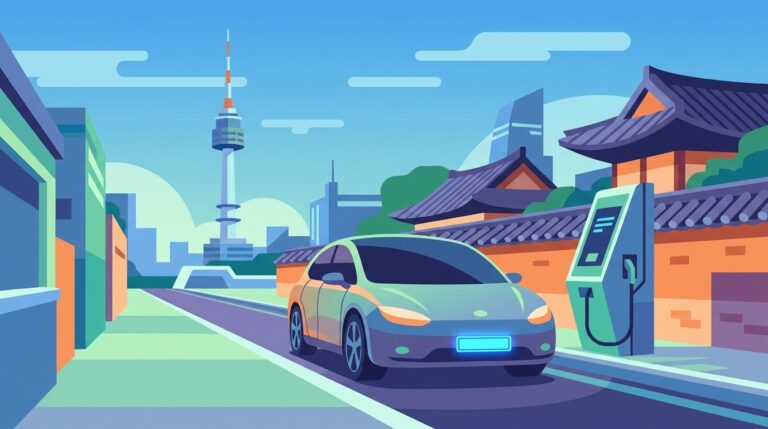
Driving the Future: How to Discuss Hydrogen Cars & Mobility in High-Level Korean
Hello, learners! I am the Lead Editor of Daily Hangul.
Imagine this: You’ve just landed at Incheon International Airport. You grab a taxi, but as you settle in, you notice something different. It is unbelievably quiet, and the license plate is a bright, sky blue. The driver looks at you through the rearview mirror and asks proudly, “수소차 처음 타보시죠?” (Is this your first time riding a hydrogen car?)
In recent K-Dramas featuring chaebol executives, or in real-life Seoul, the conversation around eco-friendly mobility—especially Electric Vehicles (EVs) and Fuel Cell Electric Vehicles (FCEVs/Hydrogen cars)—is everywhere. Hyundai’s Nexo is a frequent sight on Korean roads, yet behind the sleek design lies a fierce debate about the potential and limitations of this technology.
If you want to move beyond “I like cars” to casually debating infrastructure and commercialization at a tech company’s team dinner (회식), you need C1-level vocabulary. Let’s dive into the words that will make your Korean colleagues drop their soju glasses in awe. This guide is crafted from the real pain points of advanced learners who want to sound less like a textbook and more like an industry insider.
Phase 2: Core Expressions Deep Dive
Let’s break down three crucial expressions used when discussing tech limitations and potentials.
1. 상용화되기엔 시기상조예요.
- Pronunciation: [sang-yong-hwa-doe-gi-en si-gi-sang-jo-ye-yo] + [sang-yong-hwa-dwe-gi-en shee-gee-sang-jo-ye-yo]
- Meaning: (Literal) It is premature for commercialization. / (Real nuance) It’s way too early for this to become mainstream.
- K-Culture Moment: Picture a tense boardroom scene in a K-Drama like Start-Up or Itaewon Class. A junior developer pitches a radical hydrogen drone network. The cynical senior executive adjusts his glasses and delivers this exact line to shut down the idea.
- Editor’s Insight: This phrase screams “educated professional.” 상용화 (commercialization) and 시기상조 (a four-character Hanja idiom meaning ‘too early to tell/act’) are the bread and butter of Korean business meetings. It shows you aren’t just speaking Korean; you are speaking corporate Korean.
- Situation Spectrum:
- Casual with close friends: ⚠️ (A bit too stiff, they might call you “Professor”)
- Co-workers (Semi-formal): ✅
- Boss/Elders (Formal): ✅
- 🤔 Think About It: Why do Koreans rely so heavily on four-character Hanja idioms (사자성어) in professional settings? Does your native language have a specific “professional register” that differs completely from street slang?
2. 충전소 찾기가 하늘의 별 따기예요.
- Pronunciation: [chung-jeon-so chat-gi-ga ha-neul-ui byeol tta-gi-ye-yo] + [choong-jeon-so chat-gee-ga ha-neul-eh byul tta-gee-ye-yo]
- Meaning: (Literal) Finding a charging station is like plucking a star from the sky. / (Real nuance) Finding a charging station is virtually impossible.
- K-Culture Moment: You are on a road trip to Busan with your Korean friends in a hydrogen car. The fuel gauge is low, and the GPS shows no stations nearby. Your friend slams the steering wheel and sighs this phrase.
- Editor’s Insight: This is one of the most beloved Korean idioms. It perfectly captures the frustration of scarcity. While you could just say “어려워요” (It’s difficult), using “하늘의 별 따기” adds a poetic, dramatic flair that Koreans love.
- Situation Spectrum:
- Casual with close friends: ✅
- Co-workers (Semi-formal): ✅
- Boss/Elders (Formal): ✅ (Safe to use even politely!)
- 🤔 Think About It: Koreans love dramatic nature metaphors. How would you express “virtually impossible” in your language?
3. 인프라가 턱없이 부족해요.
- Pronunciation: [in-peu-ra-ga teok-eop-si bu-jok-hae-yo] + [een-peu-ra-ga tuk-up-she boo-jok-he-yo]
- Meaning: (Literal) The infrastructure is jaw-droppingly lacking. / (Real nuance) We are severely lacking the necessary infrastructure.
- K-Culture Moment: Watching a Korean news broadcast (뉴스데스크), the anchor stands in front of a long line of hydrogen taxis waiting hours just to refuel. This is the exact phrase the anchor will use.
- Editor’s Insight: 턱없이 comes from the idea of lacking a chin/limit, meaning “absurdly” or “ridiculously.” Combined with 부족하다 (to lack), it strongly emphasizes a critical shortage. Also note the Konglish word “인프라” (infrastructure)—Koreans use it heavily in politics, tech, and economy.
- Situation Spectrum:
- Casual with close friends: ✅
- Co-workers (Semi-formal): ✅
- Boss/Elders (Formal): ✅
- 🤔 Think About It: The word “인프라” is English, yet it’s fully integrated into Korean tech debates. What does the heavy use of English loanwords in Korean tech say about the global nature of modern industries?
Phase 3: Textbook vs. Real Korean
Let’s see how language shifts from the classroom to the streets of Gangnam.
[Discussing the limits of Hydrogen Cars]
* 📖 Textbook Korean: 수소 자동차는 아직 한계가 있습니다. (Hydrogen cars still have limitations.)
* 🗣️ Real Korean: 수소차요? 좋긴 한데 아직 충전하기 너무 빡세죠. (Hydrogen cars? They’re good, but charging is still way too intense/hard.)
* 💡 Why the difference?: 빡세다 is a highly common slang word meaning “exhausting” or “intense.” It perfectly conveys the physical and mental toll of waiting an hour at a charging station, something a textbook word like “한계” (limits) fails to capture emotionally.
[Predicting the future of the technology]
* 📖 Textbook Korean: 이 기술은 미래에 성공할 가능성이 높습니다. (This technology has a high probability of succeeding in the future.)
* 🗣️ Real Korean: 인프라만 깔리면 이거 완전 대박 날 템인데. (If only the infrastructure is laid out, this item will be a total mega-hit.)
* 💡 Why the difference?: Tech early-adopters often mix internet slang (대박 – huge success) with shortened words (템 from “item”) to express enthusiasm. Efficiency in speech is key in Korea’s “Pali-pali” culture.
Bottom Note for C1 Learners: You don’t need to use slang in a boardroom, but knowing “빡세다” or “대박 날 템” will instantly bridge the gap between you and your Korean peers during an after-work beer.
Phase 4: Cultural Context — K-Culture Deep Dive
4-1. The Non-Verbal Game of “Nunchi” at the Charging Station
When discussing the limitations of hydrogen cars, the biggest real-world K-Culture element is 눈치 (Nunchi). Hydrogen stations in Korea are still scarce, and refueling takes time. If you finally get a spot, you can’t just take your sweet time cleaning your car windows. You have to read the room—or rather, read the line of cars behind you. Moving quickly and acknowledging the waiting drivers with a quick nod is essential. The “hurry up” (빨리빨리) culture clashes directly with the slow refueling time of FCEVs, creating a unique social tension.
4-2. K-Drama & The Tech Chaebol Trope
If you watch K-Dramas like Reborn Rich or Start-Up, mobility and tech are central plot devices. The protagonist always bets on the “future” (like hydrogen or autonomous driving), while the conservative villain says, “It’s too early! It’s a money pit!” By using words like “상용화” (commercialization) and “시기상조” (premature), you are essentially roleplaying the visionary CEO in a drama.
Critical View: Notice how dramas make tech innovation look glamorous? In reality, owning a hydrogen car in Korea right now involves a lot of “눈치 게임” (Nunchi games) through WhatsApp groups just to find out which charging station is currently operating.
Phase 5: Real-Life Roleplay Scenario
Setting: Thursday evening, 8:00 PM. A trendy craft beer pub in Pangyo (the Silicon Valley of Korea). You are having drinks with your Korean tech colleagues. The topic shifts to buying a new car.
Characters:
* YOU: An expat working in Seoul, considering buying an eco-friendly car but worried about the hassle.
* Minsu (32): Your Korean colleague, an early adopter who proudly owns a Tesla.
* Ji-eun (35): Your team leader, who is surprisingly advocating for Hydrogen cars.
Dialogue:
Minsu: 팀장님, 요즘 전기차 대세인데 왜 자꾸 수소차를 고집하세요? ⚡
(tim-jang-nim, yo-jeum jeon-gi-cha dae-se-in-de wae ja-kku su-so-cha-reul go-jip-ha-se-yo?)
[Translation: Team Leader, EVs are the trend these days, why do you keep insisting on hydrogen cars?]
Ji-eun: 에이, 전기차는 충전 너무 오래 걸리잖아. 수소는 5분이면 끝인데.
(e-i, jeon-gi-cha-neun chung-jeon neo-mu o-rae geol-li-jan-a. su-so-neun o-bun-i-myeon kkeut-in-de.)
[Translation: Come on, EVs take too long to charge. Hydrogen is done in 5 minutes.]
Minsu: 그래도 수소차는 아직 충전소 찾기가 하늘의 별 따기잖아요.
(geu-rae-do su-so-cha-neun a-jik chung-jeon-so chat-gi-ga ha-neul-ui byeol tta-gi-jan-a-yo.)
[Translation: Still, finding a hydrogen charging station is like plucking a star from the sky.]
Ji-eun: (Looking at you) OO씨는 어떻게 생각해요? 외국인 시각에서는 어때요?
(OO-ssi-neun eo-tteo-ke saeng-gak-hae-yo? oe-guk-in si-gak-e-seo-neun eo-ttae-yo?)
[Translation: What do you think, OO? How does it look from a foreigner’s perspective?]
🔀 Your Turn! How do you reply?
* A) “저도 수소차가 좋아요. 최고예요!” (I like hydrogen cars too. They’re the best!)
* B) “친환경적이긴 한데, 아직 상용화되기엔 시기상조 같아요.” (It’s eco-friendly, but it seems premature for commercialization.)
* C) “충전 빡세서 절대 안 사요.” (Charging is too intense, I will never buy it.)✅ Best Choice: B — Reason: It uses high-level vocabulary perfectly fitted for a semi-formal debate with your team leader. It acknowledges her point (eco-friendly) but logically sides with reality.
⚠️ Choice A Analysis: Too basic for a C1 learner. You sound like a textbook.
⚠️ Choice C Analysis: Using “빡세다” (intense/hard) to your team leader might be a bit too casual, even at a pub.
Phase 6: 10-Second Shadowing Drill
Practice your flow, intonation, and emotional delivery!
😤 친환경적인 건 / 알지만, // 인프라가 / 턱없이 부족해요!
(chin-hwan-gyeong-jeok-in geon / al-ji-man, // in-peu-ra-ga / teok-eop-si bu-jok-hae-yo!)
- Intonation Guide: Pause slightly at the slashes (
/). Emphasize 턱없이 by raising your pitch and stretching the first syllable slightly to show your frustration: teok~eopsi!
Phase 7: K-Culture Mini Dictionary
Here are 4 must-know keywords related to Korean mobility and tech culture:
1. 파란 번호판 (Paran beonhopan)
* English: Blue License Plate
* Context: In Korea, EVs and Hydrogen cars are issued distinct light-blue license plates. It’s a status symbol for eco-friendly drivers and grants them 50% off public parking and highway tolls!
2. 인프라 (Inpeura)
* English: Infrastructure
* Context: A Konglish word used constantly in business and news. Koreans rarely use pure Korean words for this concept, showcasing how intertwined English is with Korean tech development.
3. 눈치 게임 (Nunchi geim)
* English: Nunchi Game (Mind game of timing)
* Context: Trying to figure out the best time to visit a hydrogen charging station to avoid a 2-hour queue. “Are others going now? Should I go?”
4. 대세 (Daese)
* English: The main trend / The big thing
* Context: Used to describe whatever is dominating the market. Right now, “전기차가 대세” (EVs are the trend).
Phase 8: Traveler’s Survival Kit
Even if you aren’t buying a car, you will likely ride an eco-friendly taxi in Seoul. Here is what you need to know.
🆘 Survival Expressions for Eco-Taxis
* 🇰🇷 “기사님, 이거 수소차예요? 엄청 조용하네요!”
(gi-sa-nim, i-geo su-so-cha-ye-yo? eom-cheong jo-yong-ha-ne-yo!)
* 🗣️ English: “Driver, is this a hydrogen car? It’s incredibly quiet!”
* 📍 Where to use: Inside a blue-plated Kakao Taxi.
* 💡 Pro Tip: Korean taxi drivers love it when you compliment their cars. A hydrogen car is very expensive, so praising its quietness will instantly earn you a friendly conversation (and a very smooth ride!).📌 Editor’s Travel Note
* Map Apps: Google Maps does not work well for driving in Korea. Always use KakaoMap or Naver Map. They even have real-time filters to show available EV/Hydrogen charging stations!
* Tolls: Eco-friendly cars get a “Hi-Pass” toll discount. If you rent one, make sure the rental company explains how the automatic toll deduction works.
Phase 9: Critical Thinking Corner — “One Step Deeper”
🧠 Think Deeper: Global Era & Konglish in Tech (글로벌 시대의 한국어)
When we discuss mobility in Korean, pure Korean vocabulary almost vanishes. Words like 인프라 (infrastructure), 모빌리티 (mobility), 플랫폼 (platform), and 충전소 (charging station – Hanja) dominate the conversation. As Korea aggressively pushes into global tech markets, English loanwords have become the standard language of innovation, often displacing native Korean words. This sparks a massive debate: Is the language losing its purity, or is this simply the “efficient” reality of a highly globalized tech economy? Using English loanwords correctly in Korean actually elevates your perceived professionalism in tech circles, proving that language is always tied to economic power.
💬 Your Turn: How does your native language handle new tech vocabulary? Do you invent new words, or do you just adopt the English terms? Let’s discuss in the comments!
Phase 10: FAQ & Avoiding Common Mistakes
“Can I use ‘시기상조’ to my boss when I disagree with them?”
* Maybe. While it is a highly professional term, telling your boss their idea is “시기상조” directly can sound condescending. Soften it by saying: “좋은 아이디어지만, 아직은 시기상조가 아닐까 싶습니다.” (It’s a great idea, but I wonder if it might be a bit premature.)
K-Culture Mobility FAQ:
* “I rented an EV in Jeju. Can I ask a random cafe if I can plug my car in?”
* NO. Electricity theft (도전 – do-jeon) is a serious issue. Always use official charging stations found via Naver Map.
❌ Common Mistake #1: Confusing 수소 (Hydrogen) with 산소 (Oxygen).
* Foreigners sometimes accidentally say “산소차” (Oxygen car). A driver might laugh and say, “Are you driving an ambulance?”
✅ How to fix: Remember the “Soo” in Su-so sounds like “Soup.” Hydrogen car = 수소차 (Su-so-cha).
Phase 11: Summary & Action Items
One-Liner Summary: To master high-level Korean tech discussions, blend professional Hanja idioms like “시기상조” with vivid descriptive metaphors like “하늘의 별 따기.”
Action Mission:
* 🥉 Bronze (Solo): Read the 10-Second Shadowing phrase out loud three times, focusing on sounding frustrated yet professional.
* 🥈 Silver (Online): Go to a Korean YouTube video reviewing the “현대 넥쏘” (Hyundai Nexo) and leave a comment using “인프라가 부족해요.”
* 🥇 Gold (Real Life): The next time you catch a Kakao Taxi with a blue license plate, ask the driver: “기사님, 혹시 이거 수소차예요?”
K-Culture Mission: Open Naver Map, type “수소 충전소” (Hydrogen charging station) and see how few pop up in central Seoul compared to gas stations. You’ll instantly understand why it’s “하늘의 별 따기”!
Phase 12: Interactive Quiz
1. Situational Judgment:
You are at a tech seminar in Seoul. A presenter asks about the current state of hydrogen mobility. What is the most sophisticated C1-level response?
* A) 아직 한계가 너무 많고 어려워요. (Still too many limits and difficult.)
* B) 수소차 완전 대박 날 템인데 빡세네요. (Hydrogen car is a mega hit item but it’s intense.)
* C) 친환경적이지만, 상용화되기엔 인프라가 턱없이 부족합니다. (It’s eco-friendly, but infrastructure is heavily lacking for commercialization.)
2. Fill in the Blank:
요즘 서울에서 수소 충전소 찾기는 정말 ( ______ ) 따기예요!
3. True or False – K-Culture Edition:
In Korea, eco-friendly cars (EVs and Hydrogen) are easily recognizable because they have bright yellow license plates. (T/F)
(Answers: 1. C – A is too basic, B is too slangy for a seminar. / 2. 하늘의 별 / 3. False. Yellow plates are for commercial vehicles like taxis and buses. Eco-friendly cars have Blue plates!)
Frequently Asked Questions (FAQ)
Q: What does "상용화되기엔 시기상조예요." mean in Korean and how do you pronounce it?
A: In Korean, "상용화되기엔 시기상조예요." is pronounced [sang-yong-hwa-doe-gi-en si-gi-sang-jo-ye-yo] and means: (Literal) It is premature for commercialization. / (Real nuance) It's way too early for this to become mainstream.
Q: What does "충전소 찾기가 하늘의 별 따기예요." mean in Korean and how do you pronounce it?
A: In Korean, "충전소 찾기가 하늘의 별 따기예요." is pronounced [chung-jeon-so chat-gi-ga ha-neul-ui byeol tta-gi-ye-yo] and means: (Literal) Finding a charging station is like plucking a star from the sky. / (Real nuance) Finding a charging station is virtually impossible.
Q: What does "인프라가 턱없이 부족해요." mean in Korean and how do you pronounce it?
A: In Korean, "인프라가 턱없이 부족해요." is pronounced [in-peu-ra-ga teok-eop-si bu-jok-hae-yo] and means: (Literal) The infrastructure is jaw-droppingly lacking. / (Real nuance) We are severely lacking the necessary infrastructure.







