

Hello! I’m your Lead Editor from Daily Hangul.
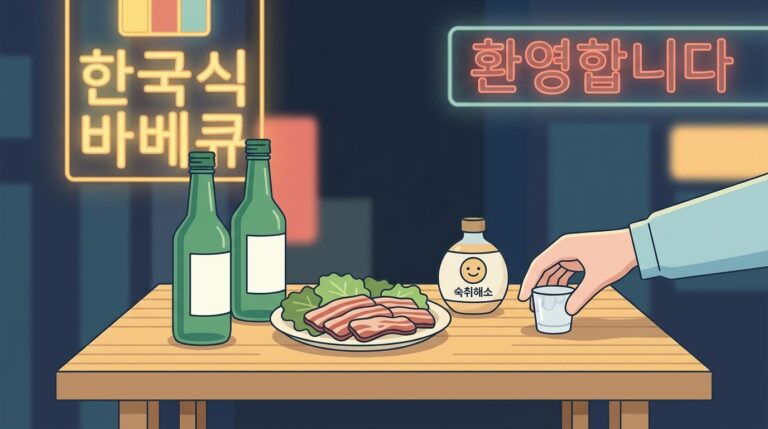
Imagine this classic K-Drama scene: The main characters are sitting in a green or orange outdoor tent (Pojangmacha). There are green Soju bottles piling up on the table. Someone starts speaking a little too loudly, their head drops, and eventually, the other person has to give them a piggyback ride all the way home. It’s romantic on screen, but in reality? It’s a heavy workout!
Korean drinking culture is vibrant, fun, and deeply connected to building relationships. But just as important as knowing how to cheer (Geonbae!) is knowing how to handle 술버릇 (sulbeoreut – drinking habits). Whether you need to politely refuse another shot, check if your friend is okay, or admit that you’ve had enough, knowing the right phrases will save you from an embarrassing night.
This guide is built from the real, slightly embarrassing, and funny experiences of my past students. Let’s dive into the real Korean language you need to survive a Soju night!
Phase 2: Deep Dive into Core Expressions
Here are the top 3 expressions you need when things start getting blurry.
1. 취했어요 (I’m drunk)
- Pronunciation: chwihaesseoyo [Sounds like you’re about to sneeze ‘achoo’, but you say chwee-hae-sseo-yo]
- Meaning: Literal & Real meaning: I am drunk.
- K-Culture Moment: You are at a company dinner (Hoesik), and someone offers you another shot of Soju. You smile weakly, cover your glass, and say this to let them know you’ve reached your limit.
- Editor’s Insight: This phrase is very straightforward. If you want to soften it, you can add 조금 (jogeum – a little) -> “저 조금 취했어요.” (I am a little drunk). It sounds much cuter and more polite!
- Situation Spectrum:
- Friends (Casual): ✅ (Say: 나 취했어 – na chwihaesseo)
- Coworkers (Semi-formal): ⚠️
- Boss/Elders (Formal): 🚫 (Better to say “I am a bit tired” instead)
- 🤔 Think About It: Why is it sometimes harder to admit you are drunk in certain cultures than in others? How do people decline alcohol in your home country?
2. 필름이 끊겼어요 (I blacked out)
- Pronunciation: pilleumi kkeungyeosseoyo [pil-leu-mi kkeun-gyeo-sseo-yo – the ‘keun’ sounds like a short grunt]
- Meaning: Literal: The film was cut. / Real: I blacked out / I don’t remember last night.
- K-Culture Moment: The morning after a crazy Friday night in Hongdae. You wake up in your own bed, but you have no idea how you got there. You text your friend: “Ah… pilleumi kkeungyeosseoyo.”
- Editor’s Insight: This is a fantastic native idiom! Koreans compare memory to a roll of movie film. When you drink too much, the camera stops recording, and the film is “cut.”
- Situation Spectrum:
- Friends (Casual): ✅
- Coworkers (Semi-formal): ⚠️ (Only if you are close!)
- Boss/Elders (Formal): 🚫 (Never admit this to your boss!)
- 🤔 Think About It: What metaphors does your language use to describe losing your memory from drinking?
3. 적당히 마셔요 (Take it easy / Drink in moderation)
- Pronunciation: jeokdanghi masyeoyo [jeok-dang-hi ma-syeo-yo]
- Meaning: Literal: Drink appropriately. / Real: Don’t drink too much / Take it easy.
- K-Culture Moment: Your friend is acting wild, singing loudly at a Korean BBQ restaurant and pouring themselves more Soju. You take the bottle away and say this with a worried face.
- Editor’s Insight: This expression shows Jeong (affection/care). You aren’t just telling them to stop; you are showing that you care about their well-being and don’t want them to make a fool of themselves.
- Situation Spectrum:
- Friends (Casual): ✅ (Say: 적당히 마셔 – jeokdanghi masyeo)
- Coworkers (Semi-formal): ⚠️
- Boss/Elders (Formal): 🚫 (It sounds like you are lecturing them!)
- 🤔 Think About It: Does telling someone to “stop drinking” sound bossy or caring in your culture?
Phase 3: Textbook vs. Real Korean
[Situation 1: Refusing a drink]
* 📖 Textbook Korean: 저는 술을 못 마십니다. (I cannot drink alcohol.)
* 🗣️ Real Korean: 저 오늘 차 가져왔어요. (jeo oneul cha gajyeowasseoyo. – I brought my car today.)
* 💡 Why is it different?: In Korean culture, a direct “no” can sometimes break the good mood. Providing an external, undeniable excuse (like driving or taking antibiotics) saves face for everyone.
[Situation 2: Warning a friend who is drinking too fast]
* 📖 Textbook Korean: 술을 너무 많이 마시지 마세요. (Do not drink too much alcohol.)
* 🗣️ Real Korean: 야, 천천히 좀 마셔! (ya, cheoncheonhi jom masyeo! – Hey, drink slowly!)
* 💡 Why is it different?: Between friends, keeping it short and adding “좀 (jom – a little/please)” makes it sound natural, caring, and urgent.
Bottom Note: For an A2 (Beginner) level, sticking to polite but natural excuses is the safest and most authentic way to navigate Korean drinking culture!
Phase 4: Cultural Context — K-Culture Deep Dive
4-1. Non-Verbal Cues: The Art of “Nunchi”
When it comes to drinking, 눈치 (Nunchi – reading the room) is everything.
– If you don’t want more Soju, leave your glass half full. In Korea, we only pour a new drink when the glass is completely empty!
– When an older person or a boss pours you a drink, you must hold your glass with two hands.
– When you drink it, turn your head and shoulders slightly away from the older person. It’s a sign of respect!
4-2. The “Hangover Cure” Culture (K-Food Connection)
If you watch K-Dramas, you’ve probably seen someone hand a small bottle or a jelly packet to their friend before or after a heavy drinking session. This is 숙취해소제 (sukchwi-haesoje – Hangover cure)! Korean convenience stores have entire sections dedicated to these potions. Sharing these with your coworkers before a Hoesik is considered the ultimate power move to show you are a thoughtful team player.
Phase 5: Real-Life Roleplay Scenario
Setting: 11 PM on a Friday night at a bustling pub in Hongdae. Empty green bottles are lined up on the table. The music is loud.
Characters:
– YOU: An exchange student who is feeling a bit dizzy but still aware.
– Minho (22): Your Korean buddy. He is usually quiet but gets very loud and overly friendly when he drinks.
Minho: 야, 우리 2차 가자! 내가 쏜다! 🍻
(ya, uri icha gaja! naega ssonda!)
[Hey, let’s go to the 2nd round! It’s on me!]
(🎭 Stage Direction: Minho grabs his coat and stumbles slightly)
YOU: 민호야, 너 너무 많이 마셨어.
(minhoya, neo neomu mani masyeosseo.)
[Minho, you drank too much.]
Minho: 아니야~ 나 하나도 안 취했어! 진짜야!
(aniya~ na hanado an chwihaesseo! jinjjaya!)
[No~ I’m not drunk at all! Really!]
🔀 Your Turn! How should you respond to stop him?
– A) “그럼 2차 가자!” (Then let’s go to the 2nd round!)
– B) “너 취했어. 오늘 적당히 마시고 집에 가자.” (You are drunk. Take it easy today and let’s go home.)
– C) “너 진짜 시끄러워. 나 갈게.” (You’re really loud. I’m leaving.)✅ Best Choice: B — You address his condition firmly but kindly, using “적당히 마셔” to show you care, and suggesting going home together.
⚠️ Choice C Analysis: Walking away abruptly might hurt his feelings. In Korean drinking culture, making sure your friend gets in a taxi safely is a huge part of friendship.
Phase 6: 10-Second Shadowing Drill
Practice this sentence so you can naturally admit defeat the morning after!
😢 아, / 저 오늘 / 필름이 / 끊겼어요...
(ah, / jeo oneul / pilleumi / kkeungyeosseoyo...)
Tip: Say the “Ah…” with a deep sigh of regret for maximum authenticity!
Phase 7: K-Culture Mini Dictionary
Here are 4 keywords you must know to survive the drinking scene.
1. 회식 (hoesik)
* Romanization: hoesik
* English: Company dinner / Team gathering
* Context: It’s not just a dinner; it’s considered an extension of work where teamwork and bonding happen.
2. 2차 (icha)
* Romanization: icha
* English: 2nd round
* Context: Koreans rarely stay at one venue. Dinner is 1차 (1st round), a pub is 2차, and karaoke might be 3차!
3. 흑역사 (heugyeoksa)
* Romanization: heugyeoksa
* English: Dark history
* Context: An embarrassing memory you want to erase forever—usually created after your “film is cut” from drinking.
4. 해장국 (haejangguk)
* Romanization: haejangguk
* English: Hangover soup
* Context: A spicy, hearty pork or beef bone soup eaten the next morning to cure a hangover. It’s soul food!
Phase 8: Traveler Survival Kit
If you are traveling in Korea and find yourself out late, keep these survival phrases handy!
🆘 Survival Phrases for the Night
– 🇰🇷 “여기 숙취해소제 있어요?” (yeogi sukchwihaesoje isseoyo?)
– 🗣️ Meaning: Do you have hangover medicine here?
– 📍 Where to use: Convenience stores (CU, GS25, 7-Eleven)
- 🇰🇷 “택시 좀 불러주실 수 있나요?” (taeksi jom bulleojusil su innayo?)
- 🗣️ Meaning: Could you please call a taxi for me?
- 📍 Where to use: To a restaurant owner or hotel staff.
📌 Editor’s Travel Note
– Navigating late at night: Use Kakao T app to catch a taxi safely without needing to speak much Korean.
– Late-night safety: Korea is incredibly safe at night. If you or a friend drink too much, you can rest at a 24-hour café or a Jjimjilbang (Korean sauna) until the trains start running again at 5:30 AM.
Phase 9: Critical Thinking — “One Step Deeper”
🧠 Think Deeper: Community and Care in Drinking
In many Western cultures, drinking is an individual choice, and your limits are strictly your own responsibility. However, in Korea, drinking is heavily tied to the community (공동체 의식). It’s about breaking down the strict hierarchical walls of the workplace or school. Because you are drinking together, taking care of someone who is drunk—making sure they get a taxi, handing them a hangover drink, or telling them “적당히 마셔요”—is seen as a profound sign of care and friendship.
💬 Your Turn: Does your culture view drinking as an individual activity or a group bonding experience? How do you take care of a friend who had too much? Share in the comments!
Phase 10: FAQ & Avoiding Misunderstandings
- Q: Can I say “적당히 마셔요” to my boss if they are drunk?
- A: NO! Telling an elder or boss to “drink appropriately” sounds like you are scolding them. Instead, say “부장님, 많이 피곤하신 것 같습니다” (Manager, you look very tired).
- Q: Do I have to drink alcohol if I attend a Hoesik?
- A: Maybe in the past, but not anymore! Modern Korean culture respects personal choices. You can easily ask for cider (Sprite) or Cola and still participate in the “Geonbae” (cheers) with your glass!
❌ Common Mistake #1: Saying “나는 취했다 (na-neun chwi-haet-da)” to an older Korean. This is a diary-form sentence and sounds rude in spoken dialogue.
✅ Do this instead: Use the polite form: “저 조금 취했어요 (jeo jogeum chwihaesseoyo).”
Phase 11: Summary & Action Items
One-Liner Summary: Acknowledging your limits with “취했어요” and caring for your friends with “적당히 마셔요” are the keys to a happy and safe Korean night out!
Action Mission:
– 🥉 Bronze (Solo): Stand in front of the mirror, sigh, and say “필름이 끊겼어요” dramatically.
– 🥈 Silver (Online): Write a comment below using today’s phrase: “I don’t drink well, so I always say [Your favorite phrase]!”
– 🥇 Gold (Real-world): Next time you watch a K-Drama drinking scene, shout “적당히 마셔!” at the screen when the character pours their 5th glass.
K-Culture Mission: Go to a local Korean market (or search on Google Images) and find a “Condition (컨디션)” or “Dawn 808 (여명808)” bottle. These are Korea’s legendary hangover cures!
Phase 12: Quiz — Interactive Challenge
1. Situational Judgment:
You are at a dinner with your strict manager. He offers you a 4th glass of Soju, but you feel dizzy. What is the BEST way to decline?
– A) 부장님, 저 필름이 끊겼어요! (Manager, my film is cut!)
– B) 부장님, 적당히 마시세요. (Manager, drink appropriately.)
– C) 부장님, 죄송하지만 저 오늘 약을 먹어서요. (Manager, I’m sorry but I took medicine today.)
2. True or False – K-Culture Edition:
– T/F: If you don’t want any more alcohol at a Korean dinner, you should immediately empty your glass so they know you are done.
Click to see answers!
1. C is correct! Using a polite, external excuse like taking medicine is the best way to save face. (A) makes no sense because if you blacked out, you wouldn’t be talking! (B) will definitely get you fired (just kidding, but it’s very rude!).
2. False! If you empty your glass, they will think you want MORE and refill it! Leave it half full to signal you are done.
Did you enjoy today’s lesson? Which expression are you most excited to use? Let me know in the comments!
Frequently Asked Questions (FAQ)
Q: What does "취했어요 (I'm drunk)" mean in Korean and how do you pronounce it?
A: In Korean, "취했어요 (I'm drunk)" is pronounced [chwihaesseoyo [Sounds like you're about to sneeze 'achoo', but you say chwee-hae-sseo-yo] and means: Literal & Real meaning: I am drunk.
Q: What does "필름이 끊겼어요 (I blacked out)" mean in Korean and how do you pronounce it?
A: In Korean, "필름이 끊겼어요 (I blacked out)" is pronounced [pilleumi kkeungyeosseoyo [pil-leu-mi kkeun-gyeo-sseo-yo - the 'keun' sounds like a short grunt] and means: Literal: The film was cut. / Real: I blacked out / I don't remember last night.
Q: What does "적당히 마셔요 (Take it easy / Drink in moderation)" mean in Korean and how do you pronounce it?
A: In Korean, "적당히 마셔요 (Take it easy / Drink in moderation)" is pronounced [jeokdanghi masyeoyo [jeok-dang-hi ma-syeo-yo] and means: Literal: Drink appropriately. / Real: Don't drink too much / Take it easy.






