

Phase 1: Empathy (The K-Culture Cold Open)
Hello there! I’m the Senior Editor of Daily Hangul.
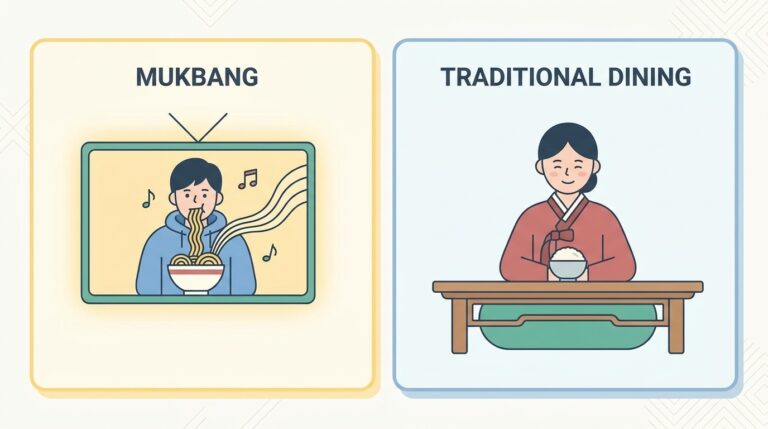
Imagine this: You’ve watched over 50 K-Mukbang (eating broadcasts) videos. The hosts are loudly slurping spicy Ramyeon, smacking their lips as they eat crispy fried chicken, and it sounds amazing. Fast forward to your first trip to Seoul. You’re sitting in a packed K-BBQ restaurant with your new Korean friends and their older relatives. You take a big bite of Samgyeopsal (pork belly), and to show how much you love it, you chew loudly, smacking your lips—just like your favorite YouTubers!
Suddenly… the table goes quiet. Your Korean friend awkwardly clears their throat.
Wait, didn’t TV teach us that loud eating means the food is delicious?
Welcome to one of the biggest culture clashes in Korean dining! While K-Media makes loud eating seem normal for entertainment, real-life Korean Etiquette (한국의 예절) strictly values eating without making noise, especially lip-smacking.
Today, as your veteran tutor and local guide, I’m going to teach you the truth about Korean table manners, how to avoid the “Mukbang trap,” and the survival phrases you need to dine like a true local.
Let’s dive in!
Phase 2: Core Expressions Deep Dive
Here are the top phrases related to eating quietly. Notice how Koreans use specific sounds (onomatopoeia) to describe this!
1. 쩝쩝 소리 (Smacking sounds)
- Pronunciation: [jjeop-jjeop so-ri] (Think of making two quick, light ‘jup’ sounds with your lips closed, followed by ‘so-ree’)
- Meaning: The sound of smacking one’s lips while chewing.
- K-Culture Moment: You’ll often hear this in K-Dramas when an older sibling scolds a younger one at the dining table: “Ya! Don’t make jjeop-jjeop sounds!”
- Editor’s Insight: In Korea, “쩝쩝” is the ultimate villain of dining etiquette. Chewing with your mouth open and making this sound is considered very rude. If you want to say the food is good, use your words, not your lips!
- Situation Spectrum:
- Casual (Friends): ✅ (Used to tease or scold a friend)
- Semi-formal (Co-workers): ⚠️ (Only if you’re very close)
- Formal (Elders/Boss): 🚫 (Never say this to an elder!)
- 🤔 Think About It: Korean language has hundreds of words that mimic sounds (onomatopoeia). Why do you think Korean culture focuses so much on the exact sound of actions rather than just describing them?
2. 입 다물고 먹어 (Chew with your mouth closed)
- Pronunciation: [ip da-mul-go meo-geo] (Ip sounds like ‘eep’)
- Meaning: Close your mouth and eat.
- K-Culture Moment: Picture a mother in a K-Drama lightly smacking her teenage son’s back at the breakfast table because he’s chewing loudly while playing mobile games.
- Editor’s Insight: This is a very direct, casual command. You can only use it with close friends, younger siblings, or if you are a parent. If you are the learner, you will hear this rather than say it!
- Situation Spectrum:
- Casual (Friends): ✅
- Semi-formal (Co-workers): 🚫
- Formal (Elders/Boss): 🚫
- 🤔 Think About It: Notice the casual ending “먹어” (meo-geo) instead of the formal “먹어요” (meo-geo-yo). In your language, how do you change your tone when talking to family versus strangers?
3. 맛있게 드세요 (Enjoy your meal)
- Pronunciation: [ma-sit-ge deu-se-yo] (ma-seet-geh deu-seh-yo)
- Meaning: Literal: Please eat deliciously. Real nuance: Bon appétit / Enjoy your meal!
- K-Culture Moment: Whenever food is served at a restaurant, the staff will say this. And before you start eating quietly, you should say this to show politeness!
- Editor’s Insight: Instead of making loud sounds to show you like the food, Koreans express their respect before eating by saying this, and after eating by saying “잘 먹었습니다” (I ate well).
- Situation Spectrum:
- Casual (Friends): ✅ (Use “맛있게 먹어” ma-sit-ge meo-geo)
- Semi-formal (Co-workers): ✅
- Formal (Elders/Boss): ✅
Phase 3: Textbook vs. Real Korean
Let’s see how textbook phrases compare to what you’ll actually hear in a Seoul restaurant.
[Situation 1: Telling a friend to stop chewing loudly]
* 📖 Textbook: 식사 예절을 지켜주세요. (Please follow dining etiquette.)
* 🗣️ Real Korean: 야, 쩝쩝거리지 마. (Hey, stop smacking your lips.)
* 💡 Why?: “예절” (etiquette) is a very formal, written word. Friends just point out the annoying sound directly!
[Situation 2: Showing you love the food]
* 📖 Textbook: (Eating loudly to show appreciation)
* 🗣️ Real Korean: 와, 진짜 대박 맛있어요! (Wow, this is seriously amazing!) + Chewing quietly
* 💡 Why?: Unlike some cultures where loud slurping is a compliment to the chef, modern Koreans prefer verbal compliments and a clean eating style.
Bottom Note: At the
A2(Beginner)level, you don’t need to correct other people’s manners. Focus on praising the food verbally with “진짜 맛있어요!” (It’s really delicious) while chewing quietly!
Phase 4: Cultural Context — K-Culture Deep Dive
4-1. Non-Verbal Etiquette (The Unspoken Rules)
When we talk about quiet eating, it’s not just about lip-smacking.
* The Rice Bowl Rule: In Korea, never lift your rice bowl off the table to eat. Keep the bowl on the table and use your spoon. Lifting it to your mouth is considered bad manners (unlike in Japan or China).
* Spoons vs. Chopsticks: Use your spoon for rice and soup, and chopsticks for side dishes. Don’t hold both in one hand at the same time!
* Nunchi (눈치): Pay attention to the oldest person at the table. Wait for them to pick up their spoon before you start eating. That’s good Nunchi!
4-2. K-Food & Media Link: The Mukbang Dilemma
Have you heard of 면치기 (Myeon-chi-gi)? It’s the act of slurping long noodles in one breath without biting them.
If you watch Korean TV shows, celebrities do this all the time. But beware! Media vs. Reality is very different here. Slurping noodles loudly is a modern TV trend created for ASMR and entertainment. In real-life family dinners or business lunches, loudly slurping noodles is still considered impolite by many Koreans. Play it safe: eat quietly!
Phase 5: Real-Life Roleplay Scenario
Setting: Friday night, 7 PM. A bustling K-BBQ restaurant in Gangnam. The smell of roasted garlic is in the air. You are having dinner with your Korean co-worker, Min-su, and his father, who is visiting.
Characters:
* YOU: A foreigner working in Korea, trying to make a good impression on Min-su’s dad.
* Min-su: (30s) Your friendly co-worker who wants to help you.
* Min-su’s Dad: A traditional but kind older gentleman.
Dialogue:
Min-su’s Dad: 한국 삼겹살 어때요? 입에 맞아요?
(hanguk samgyeopsal eottaeyo? ibe majayo?)
(English) How is Korean pork belly? Does it suit your taste?
(🎭 Stage Direction: You take a huge bite of pork belly wrapped in lettuce (Ssam). It’s so good that you forget yourself and start chewing with your mouth open, making “jjeop-jjeop” sounds to show you love it.)
YOU: (Chewing loudly) 와! 진짜 맛있어요!
(wa! jinjja masisseoyo!)
(English) Wow! It’s really delicious!
Min-su: (Leans in and whispers quickly)
야… 너 너무 쩝쩝 소리 내. 우리 아빠 앞이잖아.
(ya… neo neomu jjeop-jjeop sori nae. uri appa apijana.)
(English) Hey… you’re making too much smacking sound. We’re in front of my dad.
🔀 Your Turn! How do you react?
– A) “TV에서 이렇게 먹던데요!” (But they eat like this on TV!)
– B) “앗, 죄송해요. 너무 맛있어서…” (Oops, I’m sorry. It’s because it’s so good…)
– C) “아빠도 쩝쩝 드시는데요?” (But your dad is smacking his lips too?)✅ Best Choice: B — Why? Apologizing politely and complimenting the food again diffuses the tension perfectly.
⚠️ Choice A Analysis: Trying to argue using K-Media as an excuse to an elder is considered talking back.
🚫 Choice C Analysis: Absolute disaster! Never point out an elder’s mistakes in Korea.
YOU: 앗, 죄송해요. 고기가 너무 맛있어서요. 입 다물고 먹을게요!
(at, joesonghaeyo. gogiga neomu masisseoseoyo. ip damulgo meogeulgeyo!)
(English) Oops, I’m sorry. The meat is so delicious. I’ll eat with my mouth closed!
Min-su’s Dad: 하하하! 맛있게 먹으면 됐어요. 많이 드세요.
(hahaha! masitge meogeumyeon dwaesseoyo. mani deuseyo.)
(English) Hahaha! As long as you enjoy it, it’s fine. Eat a lot.
Phase 6: 10-Second Shadowing Drill
Practice explaining a polite mistake! Pay attention to the pauses (/) and the emotion tags.
😲 앗, / 죄송해요! / (at, / joesonghaeyo!)
Oops, I’m sorry!
😊 너무 / 맛있어서 / 그랬어요. (neomu / masisseoseo / geuraesseoyo.)
I did that because it was so delicious.
Phase 7: K-Culture Mini-Dictionary
1. 눈치
* Romanization: Nunchi
* English: Reading the room / Social sense
* Context: The Korean superpower of sensing what others are feeling or what the situation requires. Eating quietly when others are quiet is having “good nunchi.”
2. 쩝쩝충
* Romanization: Jjeop-jjeop-chung
* English: A slang word for someone who eats loudly
* Context: ‘Chung’ means insect/bug, used as an internet slang suffix to criticize someone’s annoying habits. Don’t be a jjeop-jjeop-chung!
3. 먹방
* Romanization: Mukbang
* English: Eating broadcast
* Context: A global phenomenon! But remember, the exaggerated sounds here are not the standard for real-life Korean dining etiquette.
4. 밥상머리 예절
* Romanization: Bapsang-meori yejeol
* English: Dining table manners
* Context: The strict etiquette taught by Korean parents, including not talking with food in your mouth, not picking at side dishes, and eating quietly.
Phase 8: Traveler’s Survival Kit
Since you are mastering dining etiquette, here are the top 3 phrases you must know when eating out in Korea!
🆘 Survival Expression #1: Before eating
– 🇰🇷 “잘 먹겠습니다!” (jal meokgetseumnida!)
– 🗣️ English Pronunciation: jal mukk-get-seum-ni-da
– 📍 Where to use: At restaurants, or when someone treats you to a meal.
– 💡 Pro Tip: Saying this loudly and cheerfully shows great respect to the cook or the host.🆘 Survival Expression #2: Asking for more
– 🇰🇷 “여기 반찬 좀 더 주세요.” (yeogi banchan jom deo juseyo.)
– 🗣️ English Pronunciation: yuh-gee ban-chan jom duh joo-seh-yo
– 📍 Where to use: Any traditional restaurant.
– 💡 Pro Tip: Side dishes (banchan) are usually free to refill in Korea! Don’t be shy, just press the call button.🆘 Survival Expression #3: After eating
– 🇰🇷 “잘 먹었습니다!” (jal meogeotseumnida!)
– 🗣️ English Pronunciation: jal mug-uht-seum-ni-da
– 📍 Where to use: When leaving the restaurant or to the person who paid.📌 Editor’s Travel Note
– Call Buttons (벨): Most Korean tables have a small bell button. Press it once to call the staff. Don’t yell loudly!
– Tipping: Korea has NO tipping culture. Leaving money on the table will confuse the staff, and they might run after you to give it back!
Phase 9: Critical Thinking — “A Step Deeper”
🧠 Think Deeper: Media vs. Reality
K-Media has successfully exported Korean food culture globally through Mukbangs and K-Dramas. In these videos, loud slurping and heavy chewing sounds are emphasized to make the food seem incredibly appetizing (ASMR). However, this creates a fascinating paradox: the very behavior that makes Korean food famous online is considered rude at a traditional Korean dining table. This shows how media can alter or exaggerate a culture’s image for entertainment purposes.💬 Your Turn: Are there any behaviors in your culture that are popular on TV or social media but would be considered rude in real life? Share it in the comments!
Phase 10: FAQ & Avoiding Misunderstandings
Q: Can I slurp my Ramyeon noodles like in K-Dramas?
Yes and No. If you are eating alone at a convenience store or with close friends, a little slurping is totally fine and shows you’re enjoying it. But at a business lunch or with elders? Keep it quiet.
Q: Can I lift my soup bowl to drink the last drop?
While it’s acceptable for a casual bowl of Ramyeon, for traditional Korean soups (like Kimchi Jjigae or rice bowls), you should leave the bowl on the table and use your spoon.
❌ Common Mistake #1: Making loud “Mmm!” or smacking sounds to compliment the chef.
✅ Do this instead: Chew quietly, swallow, and then say “진짜 맛있어요!” (It’s really delicious!)❌ Common Mistake #2: Sticking your chopsticks vertically into your rice bowl.
✅ Do this instead: Rest your chopsticks on the table or on the small chopstick rest. Sticking them upright looks like incense used in Korean funeral rituals!
Phase 11: Summary & Action Items
One-Liner Summary: In real-life Korea, showing you love the food is done with polite words (“맛있어요!”), not with loud smacking sounds (쩝쩝)!
Action Mission 3 Steps:
* 🥉 Bronze (Solo): Look in the mirror, pretend you are eating, and practice saying “앗, 죄송해요! 너무 맛있어서 그랬어요.”
* 🥈 Silver (Online): Go to your favorite Mukbang video on YouTube and write a comment: “I want to eat this quietly in Korea! (한국에서 조용히 먹고 싶어요!)”
* 🥇 Gold (Real Life): Next time you visit a Korean restaurant, leave your rice bowl on the table, eat without making noise, and say “잘 먹었습니다!” when you leave.
🎬 K-Culture Mission:
Watch one episode of any family K-Drama. Observe a dining scene. Do the characters lift their bowls? Do they smack their lips? Notice how the elders eat compared to the younger characters!
Phase 12: Quiz — Interactive Challenge
Let’s test your K-Etiquette survival skills!
1. True or False: In Korea, lifting your rice bowl to your mouth is the polite way to eat.
Click for Answer
False! Unlike Japan or China, Koreans keep their rice and soup bowls on the table and use a spoon.
2. Fill in the Blank: The Korean sound word for annoying lip-smacking is “[ _ _ ] 소리”.
Click for Answer
쩝쩝 (Jjeop-jjeop). It’s the sound you want to avoid making!
3. Situational Judgment: You are at a business dinner in Seoul. The Galbi (short ribs) is amazing. How do you show your appreciation?
* A) Chew loudly and make “Mmm!” sounds.
* B) Tell the boss, “쩝쩝 소리 낼게요!” (I will make smacking sounds!)
* C) Eat quietly, smile, and say “고기가 정말 맛있습니다!” (The meat is really delicious!)
Click for Answer
Correct Answer: C! A is a Mukbang myth, B is grammatically strange and rude, C is the perfect respectful Korean etiquette.
Did you enjoy learning the real culture behind the K-Dramas? Let us know in the comments if you have ever made a dining etiquette mistake in a foreign country!
Frequently Asked Questions (FAQ)
Q: What does "쩝쩝 소리 (Smacking sounds)" mean in Korean and how do you pronounce it?
A: In Korean, "쩝쩝 소리 (Smacking sounds)" is pronounced [jjeop-jjeop so-ri] and means: The sound of smacking one's lips while chewing.
Q: What does "입 다물고 먹어 (Chew with your mouth closed)" mean in Korean and how do you pronounce it?
A: In Korean, "입 다물고 먹어 (Chew with your mouth closed)" is pronounced [ip da-mul-go meo-geo] and means: Close your mouth and eat.
Q: What does "맛있게 드세요 (Enjoy your meal)" mean in Korean and how do you pronounce it?
A: In Korean, "맛있게 드세요 (Enjoy your meal)" is pronounced [ma-sit-ge deu-se-yo] and means: Literal: Please eat deliciously. Real nuance: Bon appétit / Enjoy your meal!







