

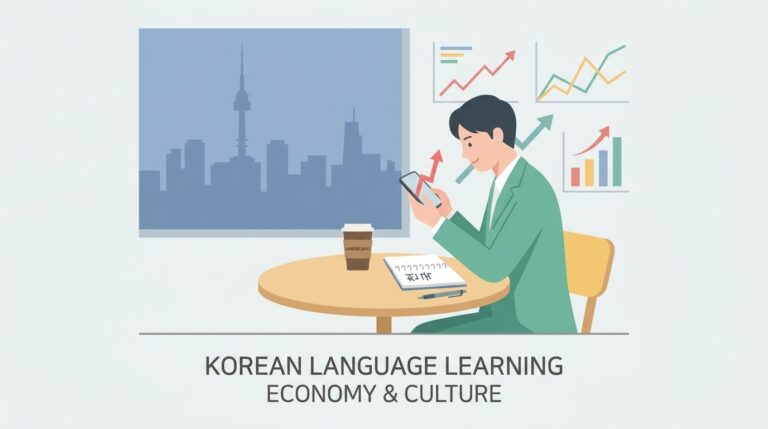
Phase 1: Empathy & The K-Culture Cold Open
Hello! I’m the lead editor of Daily Hangul.
Imagine this: It’s 11:30 AM in Yeouido, often called the Wall Street of Seoul. You’re having lunch with your Korean coworkers. Suddenly, everyone pulls out their phones, opens a trading app, and a collective sigh echoes across the table. In a K-Drama, this is the exact moment the protagonist discovers their company is facing a hostile takeover. But in reality? Your coworker just saw the U.S. Federal Reserve raised interest rates, and their portfolio is bleeding.
At a C1 (Upper-Intermediate to Advanced) level, you already know basic terms like 주식 (stock) or 투자 (investment). But if you want to truly understand the heartbeat of modern Korean society—especially the 20s-to-40s demographic—you need to understand how they talk about macroeconomics (거시 경제) and its real-time effect on their daily lives. In Korea, being an individual investor (a ‘개미’ or ant) isn’t just about finance; it’s a massive cultural phenomenon.
If you don’t know the expressions we are about to cover, you might wonder why everyone is so depressed when the screen is ‘blue’ (Wait, isn’t blue a calm, good color? Not in Korea!). Let’s dive into the real, sophisticated Korean used when talking about the economy and the market.
Phase 2: Core Expressions Deep Dive
1. 선반영되다 (To be priced in)
- Pronunciation: [seonbanyeongdoeda] (Sounds like: sun-bahn-young-dway-da)
- Meaning: (Literal) To be reflected in advance vs. (Real Nuance) The market already anticipated this macroeconomic news, so the stock price won’t move.
- K-Culture Moment: You’re at a company dinner (회식). The Bank of Korea just announced a freeze on interest rates. You excitedly say, ‘Hey, the market will go up tomorrow!’ Your senior takes a shot of soju and dryly responds, ‘에이, 그거 이미 다 선반영됐어’ (Nah, that’s already completely priced in).
- Editor’s Insight: This word is the ultimate ‘cool-headed investor’ flex. It shows you aren’t swaying with the daily news and understand how smart money operates. It combines 선 (first/advance) + 반영 (reflection) + 되다 (to become).
- Situation Spectrum:
- Friends (Casual): ✅
- Coworkers (Semi-formal): ✅
- Boss/Elders (Formal): ✅ (Very professional term)
- 🤔 Think About It: Why do Koreans love using passive voice (되다) in financial contexts? It reflects a mindset that the ‘market’ is an uncontrollable force acting upon the investors, rather than something they can actively control.
2. 박스권에 갇히다 (To be stuck in a range-bound market)
- Pronunciation: [bakseugwone gachida] (Sounds like: box-gwun-eh gah-chee-da)
- Meaning: (Literal) To be trapped in a box zone vs. (Real Nuance) The stock market is fluctuating within a tight range without a clear upward or downward macroeconomic trend.
- K-Culture Moment: For over a decade, the KOSPI (Korea Composite Stock Price Index) was notorious for bouncing between 1,900 and 2,200, earning the nickname ‘Box-pi’ (박스피). If inflation data is unclear, you’ll hear news anchors and YouTubers alike saying, ‘당분간 박스권 장세가 예상됩니다’ (A range-bound market is expected for a while).
- Editor’s Insight: The imagery of being ‘trapped’ (갇히다) perfectly captures the frustration of Korean retail investors waiting for a bull market.
- Situation Spectrum:
- Friends (Casual): ✅
- Coworkers (Semi-formal): ✅
- Boss/Elders (Formal): ✅
- 🤔 Think About It: Does your language have a physical metaphor for a stagnant market? How does the image of a ‘box’ make you feel about your investments?
3. 관망세 / 관망하다 (Wait-and-see attitude / To wait and see)
- Pronunciation: [gwanmangse / gwanmanghada] (Sounds like: gwan-mahng-seh / gwan-mahng-ha-da)
- Meaning: (Literal) To observe a view vs. (Real Nuance) To hold off on buying or selling because macroeconomic indicators (like CPI or employment rates) are too volatile.
- K-Culture Moment: A coworker asks if you bought the dip on a tech stock. You sip your iced Americano and confidently say, ‘아니요, 금리 인상 이슈가 있어서 일단 관망하려고요.’ (No, there’s an interest rate hike issue, so I’m going to wait and see for now.) Instant respect.
- Editor’s Insight: This is a C1-level elegant alternative to saying ‘아무것도 안 하고 있어요’ (I’m doing nothing). It sounds strategic and deliberate.
- Situation Spectrum:
- Friends (Casual): ⚠️ (A bit too formal for close friends, they might use ‘존버’ – hold on for dear life)
- Coworkers (Semi-formal): ✅
- Boss/Elders (Formal): ✅
Phase 3: Textbook vs. Real Korean
[Describing a Market Drop due to Macro Factors]
* 📖 Textbook Korean: 물가가 올라서 주가가 하락했습니다. (Prices rose, so stock prices fell.)
* 🗣️ Real Korean: 인플레 때문에 오늘 국장 파란불 켜졌네요. (Because of inflation, the domestic market turned on the blue lights today.)
* 💡 Why the difference?: In Korea, red means up (profit) and blue means down (loss). Referencing the UI color of trading apps is the most natural way to talk about market trends.
[Discussing Investment Strategy]
* 📖 Textbook Korean: 저는 시장이 좋아질 때까지 투자하지 않고 기다리겠습니다. (I will wait without investing until the market improves.)
* 🗣️ Real Korean: 지금 거시 경제가 너무 불안정해서 그냥 관망하는 게 답인 것 같아요. (The macroeconomy is too unstable right now, so I think just waiting and seeing is the answer.)
* 💡 Why the difference?: Using Sino-Korean vocabulary like ‘관망’ (wait-and-see) or ‘불안정’ (unstable) elevates your speech to a professional, educated C1 level.
Phase 4: Cultural Context — K-Culture Deep Dive
4-1. Non-Verbal Elements: The Nunchi of the Market
When discussing stock losses, Nunchi (눈치) is crucial. If the market plummeted due to a bad CPI report, do not loudly celebrate your short-selling profits in the office. A subtle sigh, a quick check of the phone under the desk, and avoiding direct questions about ‘How much did you lose?’ are basic manners. Empathy is expressed through shared suffering: ‘요즘 장이 너무 안 좋죠?’ (The market is so bad lately, right?).
4-2. K-Culture Connection: The ‘Donghak Ant’ Phenomenon
In K-Dramas like Reborn Rich (재벌집 막내아들), you see chaebols manipulating macroeconomic news. But in real modern Korea, the true stars of the stock market are the ‘Ants’ (개미 – retail investors). During the pandemic crash, millions of ordinary Koreans bought domestic stocks to ‘defend’ the market from foreign sell-offs, a movement dubbed the ‘Donghak Ant Movement’. Because of this, talking about macroeconomic indicators (like the US Fed’s FOMC meetings) isn’t just for Wall Street bankers anymore; it’s the default icebreaker at cafes, barbershops, and family gatherings.
Phase 5: Real-Life Roleplay Scenario
Setting: A Friday evening, 7:00 PM. A lively Samgyeopsal (pork belly) restaurant near Gangnam Station. The sound of sizzling meat and clinking soju glasses fills the air.
Characters:
– YOU: A foreign professional working in Seoul, navigating the intense Korean corporate culture.
– Minsu (32): Your Korean coworker. He invests heavily in the US market and loves talking about the economy.
Dialogue:
Minsu: 아, 오늘 미국 CPI 발표 나오는 날이네요. 떨린다. 📉
(A, oneul miguk CPI balpyo naoneun narineyo. tteollinda.)
[Ah, today is the day the US CPI is announced. I’m nervous.]
(🎭 Stage Direction: Minsu nervously checks his Apple Watch.)
YOU: 저도 아까 뉴스 봤어요. 물가 상승률이 생각보다 높던데요?
(Jeodo akka nyuseu bwasseoyo. Mulga sangseungnyuri saenggakboda nopdeondeyo?)
[I saw the news earlier too. The inflation rate was higher than expected, right?]
Minsu: 맞아요. 그래서 지금 미장 선물 다 파란불이에요. 금리 또 올릴까 봐 걱정이네요.
(Majayo. Geuraeseo jigeum mijang seonmul da paranburieyo. Geumri tto ollilkka bwa geokjeongineyo.)
[Exactly. That’s why US futures are all blue (down) right now. I’m worried they’ll raise interest rates again.]
YOU: 진짜요? 그럼 한국 주식 시장(국장)에도 영향이 크겠네요.
(Jinjjayo? Geureom hanguk jusik sijang(gukjang)edo yeonghyangi keugenneyo.)
[Really? Then it will have a big impact on the Korean domestic market too.]
Minsu: 당연하죠. 외인들이 달러 비싸지니까 한국 주식 다 팔고 나가잖아요. 오늘 완전 떡락장이었어요.
(Dangyeonhajyo. Oeindeuri dalleo bissajinikka hanguk jusik da palgo nagajanhayo. Oneul wanjeon tteongnakjangieosseoyo.)
[Of course. Since the dollar is getting expensive, foreign investors are selling all their Korean stocks and leaving. Today was a total crash.]
🔀 Your Turn! How should you respond?
– A) “그럼 지금이 매수 타이밍이네요! 주식 더 사세요!” (Then now is the time to buy! Buy more stocks!)
– B) “네, 악재가 선반영된 것 같긴 한데, 당분간은 관망하는 게 낫겠어요.”
– C) “주식은 도박이에요. 하지 마세요.”✅ Best Choice: B — “Yeah, the bad news seems priced in, but it’s better to wait and see for a while.” This is the perfect C1 response. It shows sympathy, uses advanced financial vocabulary (선반영, 관망), and sounds incredibly professional.
⚠️ Choice A & C Analysis: Telling a Korean to buy a falling knife (A) when they are stressed is bad Nunchi. Preaching that stocks are gambling (C) will instantly kill the mood and end the conversation.
Minsu: (Impressed) 오~ 한국어 진짜 잘하시네요! 맞아요, 일단 이번 주는 관망세가 답입니다. 고기나 먹죠! 🥩
(O~ hangugeo jinjja jalhasineyo! Majayo, ildan ibeon juneun gwanmangsega dabimnida. Gogina meokjyo!)
[Oh~ Your Korean is really good! You’re right, for this week, waiting and seeing is the answer. Let’s just eat meat!]
Phase 6: 10-Second Shadowing Drill
Read this aloud, focusing on the pauses (/) and the confident, analytical tone.
😤 거시 경제 지표가 / 너무 불안정해서, / 악재가 / 선반영될 때까지 / 관망하려고요.
(geosi gyeongje jipyoga / neomu buranjeonghaeseo, / akjaega / seonbanyeongdoel ttaekkaji / gwanmangharyeogoyo.)
[The macroeconomic indicators are too unstable, so I’m going to wait and see until the bad news is priced in.]
Phase 7: K-Culture Mini Dictionary
1. 개미 (gaemi)
* English: Ant (Retail / Individual Investor)
* Context: Institutions are ‘foreigners’ (외인) or ‘agencies’ (기관), while everyday individual investors are affectionately and slightly pitifully called ‘ants’.
2. 국장 / 미장 (gukjang / mijang)
* English: Domestic Market (Korea) / US Market
* Context: Abbreviations for 국내 주식 시장 and 미국 주식 시장. Currently, many young Koreans are leaving the underperforming ‘gukjang’ for the highly profitable ‘mijang’.
3. 파란불 / 빨간불 (paranbul / ppalganbul)
* English: Blue light (Loss/Drop) / Red light (Profit/Rise)
* Context: In Western markets, green/black is up, and red is down. In Korea, RED is UP, and BLUE is DOWN. This is a critical cultural difference!
4. 떡락 / 떡상 (tteongnak / tteoksang)
* English: Plummet / Mooning (Skyrocketing)
* Context: Internet slang widely used even in the office. ‘떡’ (rice cake) here acts as an intensifier meaning ‘drastically’.
Phase 8: Traveler Survival Kit (Macroeconomics Edition)
As a traveler, the macroeconomic indicator that affects you most is the Exchange Rate (환율 – hwanyul). When the Fed raises rates, the USD gets stronger against the KRW, meaning your trip to Seoul just got cheaper!
🆘 Survival Phrases for Currency Exchange
– 🇰🇷 “오늘 달러 환율이 어떻게 되나요?” (oneul dalleo hwanyuri eotteoke doenayo?)
– 🗣️ English Guide: [Oh-neul dahl-lo hwan-yool-ee uh-ttoh-keh dweh-na-yo?]
– 📍 Where to use: Myeongdong exchange booths, banks, airport.
– 💡 Pro Tip: Never exchange large amounts at the airport! Myeongdong’s private exchange booths (환전소) offer significantly better rates. Just walk in and look at the electronic board.📌 Editor’s Travel Note
– Useful Apps: Check the ‘Naver’ app for real-time exchange rates. Just search ‘환율’ (hwanyul).
– Cash vs. Card: Korea is a cashless society, but if you are loading a ‘NAMANE’ or ‘WOWPASS’ card (prepaid cards for tourists), monitoring the exchange rate before loading bulk cash is a smart move.
Phase 9: Critical Thinking — “One Step Deeper”
Korean in the Global Era & Economic Identity
Why do office workers in Seoul care so much about what a man in Washington D.C. (the Fed Chairman) says? South Korea’s economy is heavily export-driven and highly dependent on foreign capital. Therefore, global macroeconomic indicators are not just distant numbers; they directly dictate the cost of living, real estate loans, and the KOSPI index. The Korean language has rapidly absorbed global financial terms (like ‘빅스텝’ – Big Step for a 0.5% rate hike, or ‘매파적’ – hawkish), creating a unique hybrid jargon. It reflects a society that is hyper-connected to the global financial grid and intensely driven by financial literacy.
🧠 Think Deeper:
The obsession with ‘미장’ (US Stocks) among young Koreans has even led to a phrase: ‘주식 이민’ (Stock Immigration – moving one’s assets entirely to the US market). What does this tell us about the younger generation’s faith in their own domestic economy?💬 Your Turn: How closely do people in your country follow global macroeconomic indicators in their daily conversations? Let us know in the comments!
Phase 10: FAQ & Avoiding Mistakes
Q: Can I ask a Korean coworker how much money they made in stocks?
No! It is considered very rude to ask about exact profit/loss amounts (수익률). Keep the conversation on general trends, macroeconomic indicators, and market sentiment, rather than personal bank accounts.
Q: Why did my coworker say ‘I’m bleeding blue’ when looking at their phone?
Remember Phase 7! In Korea, blue indicates a drop in stock price. Do not congratulate someone if their portfolio is ‘all blue’!
❌ Common Mistake #1: Saying “장이 빨갛네요, 안타까워요.” (The market is red, that’s a pity.)
✅ Do This Instead: Red means the market is SURGING in Korea. You should say, “장이 빨갛네요, 축하해요!” (The market is red, congratulations!)
Phase 11: Summary & Action Items
- One-Liner Summary: To talk about investments in Korea like a native, master the art of observing the market (‘관망하다’) and understanding when the macro news is already priced in (‘선반영되다’).
-
Action Mission 3 Steps:
- 🥉 Bronze (Solo): Read a Korean financial news headline today and spot the words 금리 (interest rate) or 환율 (exchange rate).
- 🥈 Silver (Online): Go to a Korean stock YouTube video and leave a comment: “거시 경제가 불안해서 관망 중입니다.” (I’m waiting and seeing because the macroeconomy is unstable.)
- 🥇 Gold (Real Life): Next time the stock market comes up with your Korean friends, casually drop the phrase: “그건 이미 선반영된 거 아니에요?” (Isn’t that already priced in?)
- K-Culture Mission: Open the Naver Finance page (네이버 금융). See how red is used for positive numbers and blue for negative numbers. Try to find the KOSPI index and see if it’s currently in a ‘박스권’ (box-pattern)!
Did you ever have a ‘blue screen’ panic moment in Korea? Share your story below!
Phase 12: Interactive Quiz
1. Situational Judgment: The Fed just announced a massive interest rate hike. The Korean KOSPI index is dropping. Your coworker is sighing. What is the BEST thing to say?
– A) “빨간불이 켜졌네요!”
– B) “지금은 관망세가 답이네요.”
– C) “얼마 잃으셨어요?”
(Answer: B. It shows empathy and strategic thinking. A is wrong because the market would be blue, not red. C is rude.)
2. True or False — K-Culture Edition:
– In Korean stock apps, an upward arrow ↑ is colored Blue. (True / False)
(Answer: False. Upward trends are colored Red (빨간색) in Korea.)
3. Fill in the Blank:
“The bad news is already _________, so the stock didn’t drop today.”
– 한국어: 악재가 이미 [ _________ ]되어서, 오늘 주가가 안 떨어졌어요.
(Answer: 선반영)
Frequently Asked Questions (FAQ)
Q: What does "선반영되다 (To be priced in)" mean in Korean and how do you pronounce it?
A: In Korean, "선반영되다 (To be priced in)" is pronounced [seonbanyeongdoeda] and means: (Literal) To be reflected in advance vs. (Real Nuance) The market already anticipated this macroeconomic news, so the stock price won't move.
Q: What does "박스권에 갇히다 (To be stuck in a range-bound market)" mean in Korean and how do you pronounce it?
A: In Korean, "박스권에 갇히다 (To be stuck in a range-bound market)" is pronounced [bakseugwone gachida] and means: (Literal) To be trapped in a box zone vs. (Real Nuance) The stock market is fluctuating within a tight range without a clear upward or downward macroeconomic trend.
Q: What does "관망세 / 관망하다 (Wait-and-see attitude / To wait and see)" mean in Korean and how do you pronounce it?
A: In Korean, "관망세 / 관망하다 (Wait-and-see attitude / To wait and see)" is pronounced [gwanmangse / gwanmanghada] and means: (Literal) To observe a view vs. (Real Nuance) To hold off on buying or selling because macroeconomic indicators (like CPI or employment rates) are too volatile.






