

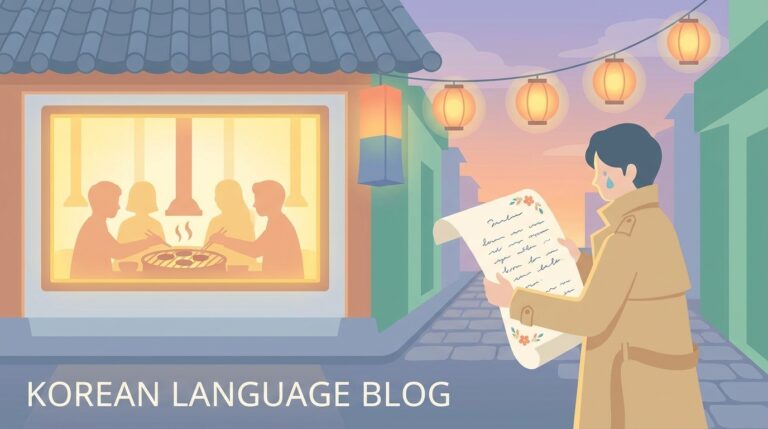
Phase 1: Empathy (The K-Culture Cold Open)
Hello there! It’s your Daily Hangul editor.
Picture this: You are standing in the middle of a massive stadium. The lights dim, a sea of glowing lightsticks waves in unison, and your favorite K-Pop group sings their final acoustic ballad. Or maybe you’re watching episode 16 of that K-Drama, and the two leads finally reunite under the falling snow while the ultimate dramatic OST swells in the background.
In these moments, saying “기뻐요” (I’m happy) or “좋아요” (It’s good) feels like a massive understatement, doesn’t it?
As B2 learners, you already know how to express basic happiness and sadness. But when you truly connect with Korean culture—whether you’re touched by a fan project, moved by a coworker’s farewell gift, or overwhelmed by the kindness of a local restaurant owner—you need words that carry the true weight of your heart. Today, we are moving beyond textbook vocabulary to explore how Koreans actually describe those goosebump-inducing, tear-jerking, overwhelmingly touching moments.
Phase 2: Core Expressions Deep Dive
Let’s upgrade your emotional vocabulary with these 3 native-level expressions.
1. 가슴이 벅차오르다 (My heart is overflowing)
- Pronunciation: gaseumi beokchaoreuda [gah-seum-ee buk-cha-o-reu-da]
(Tip: ‘벅’ sounds like ‘buck’ in ‘bucket’, spoken with a sudden burst of air)- Meaning: Literal: The chest fills up to the brim. / Real Nuance: To be overwhelmed with positive emotion, pride, or deep awe.
- K-Culture Moment: You will hear this exact phrase from K-Pop idols during their ending ‘ments’ (speeches) at a concert when they look out at the fans. It’s the ultimate expression of being moved by a grand, beautiful moment.
- Editor’s Insight: This isn’t just about being happy. It’s that feeling when your chest feels physically tight because you are so moved or proud.
- Situation Spectrum:
- Casual with friends: ✅
- Semi-formal (Co-workers): ✅
- Formal (Boss/Elders): ✅ (Great for expressing gratitude at a formal farewell)
- 🤔 Think About It: Why does Korean use the chest (가슴) so often to describe emotions? How does your native language physicalize overwhelming joy?
2. 울컥하다 (To suddenly choke up)
- Pronunciation: ulkeokhada [ool-kuck-ha-da]
(Tip: ‘울’ sounds like ‘pool’ without the p, and ‘컥’ sounds like the ‘cuck’ in ‘cuckoo’—it literally mimics the sound of a lump forming in your throat!)- Meaning: Literal: To retch/surge. / Real Nuance: To suddenly choke up with tears because you are unexpectedly moved or saddened.
- K-Culture Moment: Think of K-Survival shows (like Produce 101 or Boys Planet). When a trainee unexpectedly hears their name called for the debut group, they cover their mouths and say, “아, 진짜 울컥했어요” (Ah, I really choked up).
- Editor’s Insight: This is a sudden emotional spike. It’s perfect for surprise parties, unexpected heartfelt letters, or seeing a beautiful ending to a movie.
- Situation Spectrum:
- Casual with friends: ✅
- Semi-formal (Co-workers): ✅
- Formal (Boss/Elders): ⚠️ (A bit too raw for very formal business settings)
- 🤔 Think About It: In many cultures, crying is hidden. In Korean media, “울컥하다” is often shared openly to show genuine appreciation. Do you prefer hiding or showing your sudden tears?
3. 눈물이 핑 돌다 (Tears well up)
- Pronunciation: nunmuri ping dolda [noon-moo-ree ping dol-da]
(Tip: ‘핑’ sounds like ‘ping’ but higher pitched, mimicking the sudden, dizzying sensation of tears pooling in your eyes)- Meaning: Literal: Tears spin ‘ping’. / Real Nuance: Tears suddenly welling up in your eyes before they fall.
- K-Culture Moment: The classic K-Drama trope! The female lead hears a harsh truth or a beautiful confession. The camera zooms in on her eyes, and you can literally see the tears glistening but not yet falling. That is the exact moment of ‘눈물이 핑 돌다’.
- Editor’s Insight: Use this when you are deeply touched but trying to hold it together. It shows vulnerability but also restraint.
- Situation Spectrum:
- Casual with friends: ✅
- Semi-formal (Co-workers): ✅
- Formal (Boss/Elders): 🚫 (Too personal for a strict boss)
- 🤔 Think About It: ‘핑’ is an ideophone (a word that evokes an idea in sound). Korean has hundreds of these. Does your language have sound words for visual emotions?
Phase 3: Textbook vs. Real Korean
Let’s look at how to sound less like a textbook and more like someone who’s lived in Seoul for years.
[Situation 1: Receiving an unexpected, touching gift from a friend]
* 📖 Textbook Korean: 정말 감동적입니다. 감사합니다. (This is very touching. Thank you.)
* 🗣️ Real Korean: 와, 미쳤다… 나 진짜 울컥했어. (Wow, crazy… I seriously choked up.)
* 💡 Why the difference?: “감동적이다” (touching) sounds very objective, like you are reviewing a movie. “울컥하다” describes your physical reaction, which feels much more genuine and intimate among friends.
[Situation 2: Coming out of a highly emotional movie theater]
* 📖 Textbook Korean: 이 영화는 아주 슬프고 아름답습니다. (This movie is very sad and beautiful.)
* 🗣️ Real Korean: 마지막 장면에서 가슴이 너무 먹먹하더라. (My heart felt so heavy/overwhelmed at the last scene.)
* 💡 Why the difference?: “먹먹하다” means a feeling of deafness or a heavy heart. Koreans love using sensory adjectives rather than simple “sad/happy” labels to express complex emotional resonance.
Bottom Note: For B2 level, start replacing “너무 감동받았어요” with “눈물 날 뻔했어요” (I almost cried) or “가슴이 벅차네요” (My heart is full). It instantly elevates your fluency!
Phase 4: Cultural Context — K-Culture Deep Dive
4-1. Non-Verbal Cues: The Art of Holding It In
When Koreans use words like 울컥하다 or 눈물이 핑 돌다, pay attention to their body language. You will rarely see someone just let the tears fall freely right away. Instead, they will rapidly fan their face with their hands, look up at the ceiling, and laugh awkwardly while saying, “아, 왜 이러지?” (Ah, what’s wrong with me?). Culturally, showing emotion is appreciated, but making a loud, messy scene is not.
4-2. The K-Drama “Over-Immersion” (과몰입)
In Korean internet culture, there is a word called 과몰입 (Gwamolip), which means “over-immersion.” Koreans don’t just watch dramas or survival shows; they completely emotionally invest in them. If you want to bond with Korean friends over a show, don’t just say it was good. Say, “나 그 드라마에 완전 과몰입했잖아. 주인공 우는데 나도 같이 눈물이 핑 돌았어.” (I was completely over-immersed in that drama. When the main character cried, tears welled up in my eyes too.) Sharing this deep, empathetic connection is a core part of Korean social bonding.
Phase 5: Real-Life Roleplay Scenario
Let’s put you in the spotlight.
- Setting: Friday night, 9 PM. A noisy, lively K-BBQ restaurant in Gangnam. Steam from the grill fills the air. You are having a farewell dinner with your Korean language exchange group before you move back to your home country.
- Characters:
- YOU: A B2 Korean learner who has grown very close to this group over the past year.
- Jiwon: (28, your closest Korean friend in the group, usually playful but surprisingly sentimental today).
Jiwon: 오늘 고기는 내가 쏠게! 그동안 너무 고마웠어.
(oneul gogineun naega ssolge! geudongan neomu gomawosseo.)
[I’m treating us to the meat today! Thank you so much for everything.]
YOU: 에이, 무슨 소리야. 오늘은 내가 사야지!
(ei, museun soriya. oneureun naega sayaji!)
[Hey, what are you talking about. I should buy today!]
Jiwon: 씁, 조용히 해. (Reaches into her bag) 자, 이거 받아.
(sseup, joyonghi hae. ja, igeo bada.)
[Shh, be quiet. Here, take this.]
(🎭 Stage Direction: Jiwon hands you a thick, beautifully decorated scrapbook. Inside are photos and handwritten letters from everyone in the group over the past year.)
Jiwon: 너 몰래 애들이랑 같이 롤링페이퍼 썼어. 가서 읽어봐.
(neo mollae aedeurirang gachi rollingpeipeo sseosseo. gaseo ilgeobwa.)
[We wrote a rolling paper together without you knowing. Read it later.]
YOU: 헐… 진짜 생각도 못했는데…
(heol… jinjja saenggakdo motaenneunde…)
[Oh my god… I really didn’t expect this at all…]
Jiwon: 야, 너 우는 거 아니지? 눈 빨개졌는데?
(ya, neo uneun geo aniji? nun ppalgaejyeonneunde?)
[Hey, are you crying? Your eyes are red?]
🔀 Your Turn! How should you respond?
– A) “네, 저는 매우 슬픕니다. 눈물이 납니다.” (Yes, I am very sad. Tears are coming out.)
– B) “아니야! 그냥… 진짜 너무 감동이라서 울컥해서 그래.”
(No! It’s just… I’m so touched that I’m choking up.)
– C) “대박! 이거 비싸?”
(Daebak! Is this expensive?)✅ Best Choice: B — Reason: It perfectly captures the mixed emotion of gratitude and sudden tearfulness. It uses “울컥하다” naturally in a casual setting.
⚠️ Choice A Analysis: Extremely robotic and unnatural. “슬프다” (sad) is the wrong emotion here; you are touched, not mourning.
⚠️ Choice C Analysis: Too materialistic for a sentimental moment!
K-Culture Bonus Roleplay: The Airport Departure
(You are at Incheon Airport, dragging your suitcase. Jiwon sent you a long KakaoTalk message right as you are about to pass through security.)
Kakao Message (Jiwon): 조심히 가! 네가 있어서 진짜 행복했어. 꼭 다시 와야 해! ㅠㅠ
[Have a safe flight! I was so happy because you were here. You have to come back! T_T]
YOU (Typing back): 아 진짜… 공항 한가운데서 눈물이 핑 돌잖아 ㅠㅠ 나도 너무 벅차다. 꼭 다시 올게!
[Ah seriously… my tears are welling up right in the middle of the airport T_T My heart is so full too. I will definitely come back!]
Phase 6: 10-Second Shadowing Drill
Read these out loud with feeling! Follow the / for natural pausing and intonation.
- 🥺 Holding back tears: 아, 진짜 / 생각도 못했는데… / 너무 울컥하네요.
(ah, jinjja / saenggakdo motaenneunde… / neomu ulkeokane-yo) - 😭 Deeply moved: 팬분들 덕분에 / 정말 가슴이 / 벅차오릅니다.
(paen-bun-deul deokbune / jeongmal gaseumi / beokchaoreumnida) - 🥹 Nostalgic: 마지막 장면 보는데 / 갑자기 / 눈물이 핑 돌더라고요.
(majimak jangmyeon boneunde / gapjagi / nunmuri ping doldeoragoyo)
Phase 7: K-Culture Mini Dictionary
Here are some keywords related to being deeply moved in Korea:
1. 정 (Jeong)
* Romanization: jeong
* English: Deep emotional bond / affection
* Context: The foundational Korean emotion. It’s the invisible string of attachment that forms between people, places, and even things. When you are “touched” in Korea, it usually means your Jeong has been triggered.
2. 과몰입 (Gwamolip)
* Romanization: gwamolip
* English: Over-immersion
* Context: A trendy slang term used when you are way too emotionally invested in a drama character, a K-pop idol, or a reality show.
3. 떼창 (Ttechang)
* Romanization: ttechang
* English: Sing-along / Crowd singing
* Context: When the entire concert audience sings a song together. This is the #1 moment when artists say “가슴이 벅차오르다.”
4. 롤링페이퍼 (Rolling Paper)
* Romanization: rolling-peipeo
* English: Group message board/card
* Context: A large piece of paper or a notebook passed around a group so everyone can write a short farewell message. Guaranteed to make you “울컥하다.”
Phase 8: Traveler Survival Kit
Even as a traveler, you’ll experience touching moments—like when an elderly woman at a market gives you extra food just because it’s raining, or when a stranger helps you navigate the complex Seoul subway.
🆘 Survival Expressions for Touching Hospitality
– 🇰🇷 “이렇게까지 도와주셔서 정말 감사합니다.” (ireokekkaji dowajusyeoseo jeongmal gamsahamnida)
– 🗣️ English Guide: Thank you so much for going out of your way to help me.
– 📍 Where to use: When a local physically walks you to your destination instead of just pointing.
– 💡 Pro Tip: In Korea, saying “Thank you” multiple times while bowing slightly shows that you are truly moved, not just being polite.📌 Editor’s Travel Note
– The “Service” Culture (서비스): If a restaurant owner gives you a free drink or extra side dish, they will say “서비스예요” (It’s service). Don’t try to tip them! Tipping does not exist in Korea and can cause confusion. Just express your deep gratitude: “우와, 진짜 감동이에요! 잘 먹겠습니다!” (Wow, I’m so touched! I will eat it well!).
Phase 9: Critical Thinking — “One Step Deeper”
🧠 Think Deeper: Language & Emotion — Why do Koreans cry together?
If you watch Korean media, you’ll notice that emotions are highly contagious. If one person chokes up (울컥하다), the MC, the panel, and the audience will also have tears welling up (눈물이 핑 돌다). This stems from the deeply rooted collective culture of Korea. Emotions aren’t just private, individual experiences; they are communal events. Empathizing visibly with someone’s pain or joy is a sign of good character and “Jeong” (정). It shows that you are connected to the group’s emotional heartbeat.💬 Your Turn: In your culture, is it normal to openly cry with strangers when watching a touching moment, or is it considered private? Share in the comments!
Phase 10: FAQ & Avoiding Mistakes
Q: Can I say “울컥했어요” to my boss at a company dinner?
A: Maybe. If it’s a farewell dinner and they gave a beautiful speech, saying “부장님 말씀 듣고 정말 울컥했습니다” is highly flattering. But don’t use it for minor things in the office, or it might seem overly dramatic.
Q: I want to write a fan letter to my favorite idol. Can I use these phrases?
A: ABSOLUTELY! “오빠들 무대 보고 가슴이 벅차올랐어요” (My heart was overflowing watching your stage) is top-tier fan letter material.
❌ Common Mistake #1: Translating “I was touched” literally as “저는 터치되었습니다.” (Please don’t! That means someone physically touched you!)
✅ Do This: Use “감동받았어요” (I received emotion) or “울컥했어요” (I choked up).❌ Common Mistake #2: Overusing “슬프다” (Sad).
✅ Do This: Remember, crying from gratitude or overwhelming joy isn’t “슬프다”. Use “가슴이 벅차다” or “눈물 날 것 같다” (I feel like crying).
Phase 11: Summary & Action Items
One-Liner Summary: To describe profound, touching moments like a native, move past simple adjectives and use physical descriptions like 가슴이 벅차다 (overflowing chest) and 울컥하다 (choking up).
Your Action Missions:
* 🥉 Bronze (Solo): Stand in front of a mirror, pretend you just won a Grammy, and say “정말 가슴이 벅차오릅니다” with maximum emotion.
* 🥈 Silver (Online): Go to a YouTube video of a touching K-Pop encore stage or K-Drama clip, and leave a comment: “이 장면 볼 때마다 눈물이 핑 돌아요 ㅠㅠ”
* 🥇 Gold (Real World): Next time a Korean friend or teacher does something incredibly nice for you, tell them, “진짜 감동… 나 방금 약간 울컥했어.”
🎬 K-Culture Mission:
Watch the final 10 minutes of any K-Drama this week. Count how many times the characters look like “눈물이 핑 도는” state before they actually cry!
Phase 12: Interactive Challenge Quiz
1. Situational Judgment: Your Korean host family throws you a surprise birthday party. What is the most natural, native-like response?
* A) 생일 파티는 아주 좋습니다. (The birthday party is very good.)
* B) 와… 진짜 예상 못했는데, 너무 울컥하네요. 감사합니다.
* C) 저는 지금 슬퍼요.
(Answer: B! It perfectly captures the unexpected emotion. A is robotic, and C means you are unhappy!)
2. Fill in the Blank:
콘서트 장에서 팬들이 다 같이 내 노래를 부를 때, 정말 (_______) 올랐습니다.
(Answer: 가슴이 벅차 – When fans sang my song together at the concert, my heart truly overflowed.)
3. T/F – K-Culture Edition:
If a Korean restaurant owner gives you a free “service” (서비스) dish because you tried speaking Korean, you should leave a generous tip on the table.
(Answer: FALSE. Korea has no tipping culture. Leaving money might confuse them! Just show genuine gratitude.)
How did you do? Start practicing these expressions, and soon you’ll be speaking with the true heart of a Seoul local! See you in the next Daily Hangul post!
Frequently Asked Questions (FAQ)
Q: What does "가슴이 벅차오르다 (My heart is overflowing)" mean in Korean and how do you pronounce it?
A: In Korean, "가슴이 벅차오르다 (My heart is overflowing)" is pronounced [gaseumi beokchaoreuda [gah-seum-ee buk-cha-o-reu-da] and means: Literal: The chest fills up to the brim. / Real Nuance: To be overwhelmed with positive emotion, pride, or deep awe.
Q: What does "울컥하다 (To suddenly choke up)" mean in Korean and how do you pronounce it?
A: In Korean, "울컥하다 (To suddenly choke up)" is pronounced [ulkeokhada [ool-kuck-ha-da] and means: Literal: To retch/surge. / Real Nuance: To suddenly choke up with tears because you are unexpectedly moved or saddened.
Q: What does "눈물이 핑 돌다 (Tears well up)" mean in Korean and how do you pronounce it?
A: In Korean, "눈물이 핑 돌다 (Tears well up)" is pronounced [nunmuri ping dolda [noon-moo-ree ping dol-da] and means: Literal: Tears spin 'ping'. / Real Nuance: Tears suddenly welling up in your eyes before they fall.







