

Phase 1: Empathy (Welcome to the K-Mountain!)
Hello! I’m the Lead Editor of Daily Hangul. Have you ever watched a K-Drama where the main characters casually hike a mountain on the weekend, wearing fully-equipped, neon-colored outdoor gear as if they were climbing Mount Everest? Or maybe you’ve visited Seoul and noticed the subways on a Saturday morning filled with energetic older folks holding trekking poles and carrying backpacks that smell faintly of cucumbers and sesame oil.
Hiking (등산 – deungsan) isn’t just a sport in Korea; it’s a massive social phenomenon, a networking hub, and honestly, a fantastic excuse to eat and drink together. Joining a hiking club (동호회 – donghohoe) is arguably the fastest way to break out of the “expat bubble” and make genuine local friends. But wait—how do you actually join one? What do you say when the club leader hands you a mysterious cup of rice wine at the peak?
Today, we are diving deep into the real-world Korean you need to survive and thrive in a Korean hiking club. This guide is built on the hilarious and sometimes embarrassing real-life experiences of my past B2-level students. Let’s get you ready for the mountain!
Phase 2: Core Expressions Deep Dive
1. 가입하고 싶은데, 어떻게 신청하면 되나요? (I’d like to join, how should I apply?)
- Pronunciation: ga-ip-hago sipeunde, eotteoke sincheonghamyeon doenayo?
(Sound tip: The ‘eu’ in ‘eotteoke’ sounds like the disgusted “Ugh!” you make when you step in gum on the street. Keep it short and tight!)- Meaning: Literal: “I want to join, how do I apply?” / Real Nuance: “I’m interested in this group, please tell me the official process to get in.”
- K-Culture Moment: You’ll use this mostly online. Young Koreans (20s-30s) use apps like ‘소모임’ (Somoim) or KakaoTalk Open Chat to find clubs. Older generations might use Naver Cafes or Daum Cafes. You send this message to the ‘방장’ (Room/Club Leader) to show your interest.
- Editor’s Insight: The ending “~하면 되나요?” (Is it okay if I do…/How should I…) is a magic phrase for B2 learners. It sounds much softer and more polite than directly asking “How do I do this?”
- Situation Spectrum:
- Casual with friends: ⚠️ (Too formal)
- Club leader/Admin (Semi-formal): ✅
- Formal/Corporate: ✅
- 🤔 Think About It: Why do Koreans often ask “How should I do it?” instead of just “Tell me how”? It reflects the cultural value of letting the person in charge set the rules and showing respect for their established system.
2. 오늘 뒷풀이 참석하실 거죠?
- Pronunciation: oneul dwitpuri chamseokhasil geojyo?
- Meaning: Literal: “You will attend the after-party today, right?” / Real Nuance: “You’re coming to drink Makgeolli with us later, right? Don’t even think about running away!”
- K-Culture Moment: Half the people on the mountain are only there for the ‘뒷풀이’ (dwitpuri – after-party). This usually involves Pajeon (scallion pancakes) and Makgeolli (rice wine) at a restaurant at the base of the mountain. If someone asks you this while descending, it means they like your vibe.
- Editor’s Insight: Notice the “~하실 거죠?” (You will do it, right?). It’s an assumptive question. It politely but firmly nudges you to say “Yes!”
- Situation Spectrum:
- Casual with friends: ✅ (Though friends might just say “뒷풀이 갈 거지?”)
- Club members (Semi-formal): ✅
- Formal/Elders: ⚠️ (Use “참석하시나요?” instead)
- 🤔 Think About It: “뒷풀이” literally means “untying the back” or “releasing tension afterwards.” Does your culture have a specific word for the meal/drinks after a main physical activity?
3. (거의 다 왔어요) 정상이 코앞이에요!
- Pronunciation: (geoui da wasseoyo) jeongsangi koapieyo!
- Meaning: Literal: “(We are almost there) The summit is right in front of your nose!” / Real Nuance: “You still have 30 minutes of grueling stairs left, but I need you to not give up.”
- K-Culture Moment: This is the greatest lie told on Korean mountains. As you are panting, sweating, and questioning your life choices, older hikers descending will enthusiastically yell, “다 왔어요!” (You’re all here!). Don’t trust them. Just smile and keep climbing.
- Editor’s Insight: “코앞이다” (in front of the nose) is a fantastic B2 idiom meaning “very close in distance or time.”
- Situation Spectrum:
- Strangers on the trail: ✅
- Friends complaining: ✅
- Formal meetings: 🚫
- 🤔 Think About It: Why do strangers encourage each other on the mountain, even if it means telling a white lie? It highlights the collective “cheering” culture in Korea, where enduring hardship together builds a spontaneous bond.
Phase 3: Textbook vs. Real Korean
Let’s upgrade your textbook Korean to real-world trail Korean!
[Situation 1: Asking about the membership fee]
* 📖 Textbook Korean: 동호회 회비는 얼마입니까? (How much is the club membership fee?)
* 🗣️ Real Korean: 모임 회비는 한 달에 얼마예요? 가입비 따로 있나요? (How much are the dues per month? Is there a separate joining fee?)
* 💡 Why it’s different: Koreans rarely use “입니까” in casual hobby groups. Also, clarifying “가입비” (initiation fee) vs. “회비” (monthly dues) is practical real-world sense.
[Situation 2: Dividing the restaurant bill after the hike]
* 📖 Textbook Korean: 계산은 각자 내도록 합시다. (Let us pay individually.)
* 🗣️ Real Korean: 오늘 뒷풀이 비용은 N빵 할게요! 단톡방에 계좌 올려주세요. (We’ll split today’s after-party cost! Please post the bank account in the group chat.)
* 💡 Why it’s different: “N빵” (N-bbang) is essential slang meaning to divide the bill equally by N people. No one pays individually at the counter; one person pays, and everyone wire-transfers them the money.
[Situation 3: Handing someone a snack during a break]
* 📖 Textbook Korean: 저의 오이를 드시겠습니까? (Would you like to eat my cucumber?)
* 🗣️ Real Korean: 이거 (방울토마토) 좀 드셔보세요. 집에서 가져왔어요. (Try some of these cherry tomatoes. I brought them from home.)
* 💡 Why it’s different: Offering food is an action of “정” (Jeong – affection). Keeping it casual with “좀 드셔보세요” (Please try a little) makes the offer less burdensome.
Phase 4: Cultural Context — K-Culture Deep Dive
4-1. Non-Verbal Cues: The Art of the Mountain Bow
When you pass people on narrow trails, you don’t need to do a full 90-degree bow. A simple, polite nod (목례 – mongnye) while making brief eye contact and murmuring “안녕하세요” is perfect. Also, if an older hiker offers you a piece of fruit, always receive it with two hands, or at least support your right arm with your left hand. It shows respect and understanding of the subtle Nunchi dynamics.
4-2. K-Food Link: The Peak Picnic Ritual
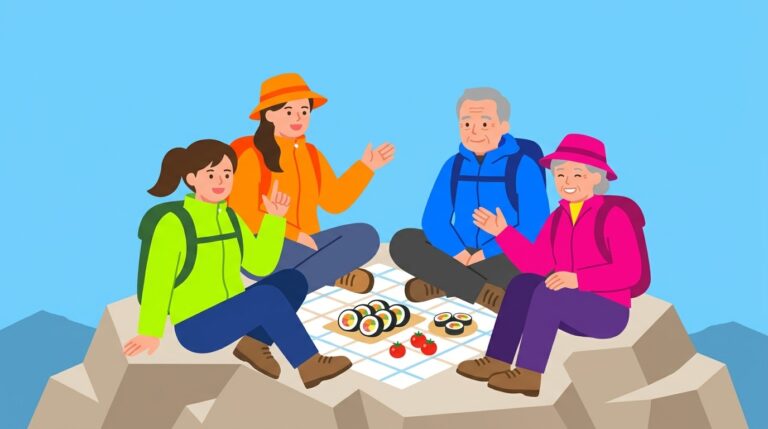
In Korea, climbing a mountain without eating is considered a tragedy. You will notice hikers pulling out elaborate meals at the summit: Kimbap, cup noodles (bringing hot water in thermoses), sliced cucumbers, and cherry tomatoes.
Why cucumbers? They are hydrating and crisp. Why share? It’s deeply rooted in the communal eating culture. If you join a club, always pack a little extra of whatever snack you bring so you can share it. It’s the ultimate icebreaker. Just remember to pack out your trash (쓰레기는 되가져가기)!
Phase 5: Real-Life Roleplay Scenario
Setting: Saturday, 11:30 AM. Halfway up Bukhansan Mountain. You finally decided to join a hiking club through an app. The group is taking a 10-minute break on a large, flat rock. You are sweating profusely.
Characters:
– YOU: An expat eager to make friends but exhausted.
– Ji-hoon (30): The enthusiastic club leader who seems to have infinite stamina.
– Min-a (28): A friendly member who brought an entire buffet in her backpack.
Dialogue:
Ji-hoon: 다들 고생하셨습니다! 여기서 10분만 쉬고 바로 출발할게요!
(Dadeul gosaenghasyeotseumnida! Yeogiseo sipbumman swigo baro chulbalhalgeyo!)
[Everyone, great effort! We’ll rest here for 10 minutes and head out immediately!]
(🎭 Stage Direction: Ji-hoon aggressively stretches his calves)
Min-a: 에휴, 방장님은 지치지도 않나 봐요. OO(You)씨, 괜찮아요? 많이 힘들죠?
(Ehyu, bangjangnimeun jichijido anna bwayo. OO-ssi, gwaenchanayo? Mani himdeuljyo?)
[Sigh, the leader never seems to get tired. Are you okay, OO? It’s pretty hard, right?]
YOU: 네, 조금 힘들지만 경치가 진짜 좋네요.
(Ne, jogeum himdeuljiman gyeongchiga jinjja jonneyo.)
[Yes, it’s a bit hard, but the view is really nice.]
Min-a: 이거 제가 아침에 싼 김밥인데, 한 입 드셔보세요!
(Igeo jega achime ssan gimbabinde, han ip deusyeoboseyo!)
[This is Kimbap I made this morning, have a bite!]
(🎭 Stage Direction: Min-a holds out a perfectly rolled piece of Kimbap towards you)
🔀 Your Turn! How do you respond?
– A) “아니요, 저는 괜찮습니다. 제 간식이 있습니다.” (No, I am fine. I have my own snacks.)
– B) “와, 진짜요? 감사합니다! 잘 먹겠습니다!” (Wow, really? Thank you! I will eat it well!)
– C) “저 지금 다이어트 중이라서 탄수화물 안 먹어요.” (I am on a diet right now so I don’t eat carbs.)✅ Best Choice: B — Reason: Never reject food offered with good intentions in a Korean social setting, especially homemade food on a mountain! Accepting it enthusiastically with “잘 먹겠습니다” instantly raises your likability.
⚠️ Choice A & C Analysis: Rejecting food can come off as cold or creating a wall between you and the group. Even if you are full, accept one piece out of politeness.
Ji-hoon: 자, 이제 진짜 다 왔어요! 20분만 더 올라가면 정상이에요!
(Ja, ije jinjja da wasseoyo! Isippumman deo ollagamyeon jeongsangieyo!)
[Alright, we are really almost there now! Just 20 more minutes up and it’s the summit!]
YOU: 방금 전에도 다 왔다고 하시지 않았나요…? 😂
(Banggeum jeonedo da watdago hasiji anannayo…?)
[Didn’t you say we were almost there a moment ago too…?]
Min-a: ㅋㅋㅋ 한국 등산객들 거짓말 1위잖아요! 절대 믿지 마세요.
(Kkk hanguk deungsangaekdeul geojitmal irwijanayo! Jeoldae mitji maseyo.)
[Hahaha, it’s the #1 lie told by Korean hikers! Never believe it.]
Phase 6: 10-Second Shadowing Drill
Practice this sentence. It’s the perfect icebreaker at the after-party!
😊 저 오늘 / 뒷풀이 비용은 / 제가 계좌이체 / 할게요!
(jeo oneul / dwitpuri biyongeun / jega gyejwaiche / halgeyo!)
[For today’s after-party cost, I will wire-transfer the money!]
Coach’s Tip: Put a slight emphasis on “제가” (I will) to show your willingness to participate in the group’s payment system.
Phase 7: K-Culture Mini Dictionary
1. 눈치 (nunchi)
* Meaning: Social sense, the ability to read the room.
* Context in Hiking: Knowing when the group wants to rest, noticing if someone is falling behind, or knowing when to jump in and help pour Makgeolli at the after-party.
2. 소모임 (somoim)
* Meaning: Small gathering/hobby group (also the name of a wildly popular app).
* Context in Hiking: The primary way Korean millennials and Gen Z find groups based on their interests, from running to hiking and book clubs.
3. 뒷풀이 (dwitpuri)
* Meaning: After-party or wrap-up gathering.
* Context in Hiking: The meal and drinks following the hike. Often the main reason people join the club in the first place.
4. 등산복 (deungsanbok)
* Meaning: Hiking clothes/outdoor gear.
* Context in Hiking: Older Koreans treat hiking gear as a status symbol. You’ll see high-end brands in blinding neon colors. Younger Koreans lean towards stylish, minimalist “gorpcore” fashion like leggings and neutral windbreakers.
Phase 8: Traveler Survival Kit
Whether you joined a club or you’re navigating a mountain trail by yourself, you need these phrases.
🆘 Survival Expression #1: Asking for Directions
– 🇰🇷 “실례지만, 백운대 가는 길이 이쪽 맞나요?” (sillyejiman, baegundae ganeun giri ijjok mannayo?)
– 🗣️ Meaning: Excuse me, is this the right way to Baegundae peak?
– 📍 Where to use: At forks in the trail when you are confused.🆘 Survival Expression #2: Checking the Distance
– 🇰🇷 “정상까지 얼마나 걸려요?” (jeongsangkkaji eolmana geollyeoyo?)
– 🗣️ Meaning: How long does it take to the summit?
– 📍 Where to use: When you want to cry and need to know how much suffering is left.🆘 Survival Expression #3: The After-Party Payment
– 🇰🇷 “제 몫은 얼마 보내면 될까요?” (je mokseun eolma bonaemyeon doelkkayo?)
– 🗣️ Meaning: How much should I send for my share?
– 📍 Where to use: In the KakaoTalk group chat after the hike.📌 Editor’s Travel Note for Hikers
– Best Apps: Google Maps is terrible for Korean hiking trails. You must download KakaoMap or Naver Map to see accurate topographical lines and trail routes.
– Etiquette: Don’t play loud music on your Bluetooth speaker. It’s a major pet peeve, even if some older hikers still do it.
Phase 9: Critical Thinking — “One Step Further”
Food & Identity: The Communal Summit
Why do Koreans insist on sharing food on the mountain? In Korean culture, eating alone (혼밥) used to be considered lonely or sad, though it is changing now. Food is the ultimate medium of “정” (Jeong—a deep, collective feeling of affection and attachment). By sharing a piece of fruit or pouring a cup of Makgeolli for a stranger, Koreans break down social barriers. It’s a silent acknowledgment of shared effort and community.
🧠 Think Deeper:
Have you ever noticed that Korean language uses “우리” (Our) instead of “내” (My) for things like “우리 엄마” (Our mom) or “우리 나라” (Our country)? The act of sharing food physically manifests this “Uri” (We) mindset.💬 Your Turn: Does your culture have a tradition of sharing food with strangers during outdoor activities? Let us know in the comments!
Phase 10: FAQ & Avoiding Common Mistakes
Q: “Can I use 반말 (informal language) if I find out a club member is the exact same age as me?”
A: MAYBE, BUT NOT IMMEDIATELY. Even if you are the same age (동갑), you should use polite form (존댓말) until one of you explicitly suggests, “우리 말 놓을까요?” (Shall we drop the formalities?).
Q: “Can I wear jeans and sneakers to a club hike?”
A: NO. Korean hiking clubs take safety (and fashion) very seriously. If you show up in jeans, you will likely be lectured by the club leader or older hikers about safety. Wear proper activewear and hiking shoes.
❌ Common Mistake #1: Leaving immediately after the hike without a word.
✅ Do this instead: If you can’t attend the 뒷풀이 (after-party), make sure to say goodbye properly: “오늘 너무 즐거웠습니다! 저는 선약이 있어서 먼저 가보겠습니다.” (I had a great time today! I have a prior engagement so I will head out first.)
Phase 11: Summary & Action Items
One-Liner Summary: Surviving a Korean hiking club requires knowing how to ask to join, surviving the “almost there” lies, and mastering the art of the Makgeolli after-party!
Your Action Missions:
– 🥉 Bronze: Stand in front of your mirror and practice saying: “오늘 뒷풀이 비용은 N빵 할게요!”
– 🥈 Silver: Download the ‘소모임’ (Somoim) app or Kakao Open Chat, search “등산” (Deungsan), and read the descriptions of 3 different clubs.
– 🥇 Gold: Next time you go hiking in Korea, pack some cherry tomatoes and offer them to a fellow hiker taking a break!
K-Culture Mission: Go to YouTube and search “북한산 등산 브이로그” (Bukhansan Hiking Vlog). Listen closely to how hikers greet each other on the trail. Can you hear anyone saying “다 왔어요”?
Phase 12: Quiz — Interactive Challenge
1. Situational Judgment: You are resting on the trail. An older hiker hands you a cup of coffee from their thermos. What is the most culturally appropriate B2-level response?
– A) 안 먹어요. (I don’t eat it.)
– B) 얼마예요? (How much is it?)
– C) 와, 감사합니다! 잘 마실게요. (Wow, thank you! I will drink it well.)
– D) 내일 만나요. (See you tomorrow.)
(Answer: C. Always accept with gratitude and “잘 먹겠습니다/마실겠습니다”.)
2. Fill in the Blank:
“오늘 식당 계산은 영수증 보고 ______ 할게요! 단톡방 확인해주세요!”
(We will ______ the restaurant bill looking at the receipt! Please check the group chat!)
(Answer: N빵 – N-bbang. Splitting the bill evenly.)
3. True or False – K-Culture Edition:
“If a Korean hiker tells you ‘정상이 코앞이에요’ (The summit is right in front of your nose), you will reach the top in exactly 2 minutes.”
(Answer: False! It is a motivational lie. Prepare for at least 20 more minutes of pain.)
Great job! You are now officially ready to conquer the Korean mountains and the after-parties. Let me know in the comments which Korean mountain you want to hike first!
Frequently Asked Questions (FAQ)
Q: What does "가입하고 싶은데, 어떻게 신청하면 되나요? (I'd like to join, how should I apply?)" mean in Korean and how do you pronounce it?
A: In Korean, "가입하고 싶은데, 어떻게 신청하면 되나요? (I'd like to join, how should I apply?)" is pronounced [ga-ip-hago sipeunde, eotteoke sincheonghamyeon doenayo?] and means: Literal: "I want to join, how do I apply?" / Real Nuance: "I'm interested in this group, please tell me the official process to get in."
Q: What does "오늘 뒷풀이 참석하실 거죠?" mean in Korean and how do you pronounce it?
A: In Korean, "오늘 뒷풀이 참석하실 거죠?" is pronounced [oneul dwitpuri chamseokhasil geojyo?] and means: Literal: "You will attend the after-party today, right?" / Real Nuance: "You're coming to drink Makgeolli with us later, right? Don't even think about running away!"
Q: What does "(거의 다 왔어요) 정상이 코앞이에요!" mean in Korean and how do you pronounce it?
A: In Korean, "(거의 다 왔어요) 정상이 코앞이에요!" is pronounced [geoui da wasseoyo] and means: Literal: "(We are almost there) The summit is right in front of your nose!" / Real Nuance: "You still have 30 minutes of grueling stairs left, but I need you to not give up."







