

Hello! I’m the Lead Editor of Daily Hangul.
Have you ever watched K-Dramas like Hospital Playlist or reality shows like BTS’s In the Soop? Picture this: the stars are sitting around a campfire, roasting massive slabs of pork belly (samgyeopsal) and boiling spicy Ramyeon. It’s an absolute feast. But the very next morning, the campsite is completely spotless. Not a single wrapper or food scrap is in sight.
Was it just TV magic? Actually, no.
South Korea is 70% mountainous and has a booming outdoor culture. Because so many people share these small, beautiful spaces, the LNT (Leave No Trace) movement isn’t just a trendy hashtag—it’s a strict social rule. If you don’t know the specific phrases and unspoken rules of the Korean outdoors, you might accidentally become the ‘rude tourist’ who gets glaring looks from the campsite manager.
This guide is crafted from the real-life blunders and triumphs of advanced (C1) Korean learners. Let’s dive into the high-level vocabulary and cultural nunchi you need to navigate Korean campsites and hiking trails like a true local.
Phase 2: Core Expressions Deep Dive
Here are three advanced expressions you’ll see and hear when engaging in the Korean LNT movement.
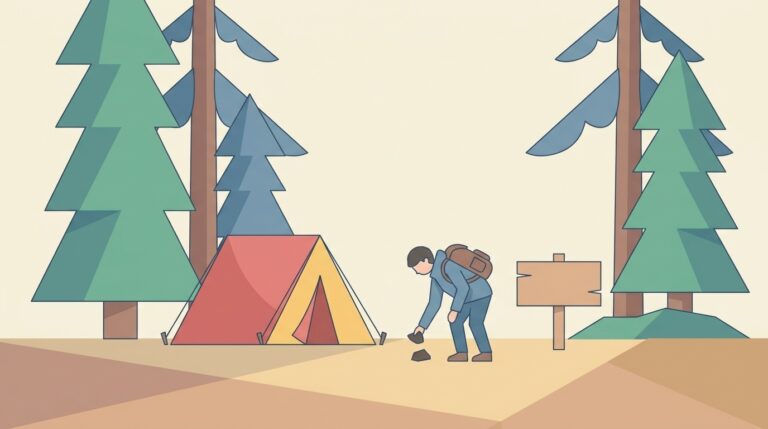
1. 아니 온 듯 다녀가소서
- Pronunciation: [ani on deut danyeogasoseo] -> Sounds like: ah-nee ohn doot dahn-yeo-gah-so-seo
- Meaning: (Literal) Please go having been here as if you had not come. / (Real nuance) Leave the place exactly as you found it; Leave no trace.
- K-Culture Moment: You will see this poetic, almost historical-sounding phrase carved into wooden signs at the entrances of national parks or pristine hiking trails. It has a respectful, zen-like vibe that makes you instinctively check your pockets for stray wrappers.
- Editor’s Insight: This isn’t a phrase you speak; it’s a phrase you read and feel. The ending “~소서” is an archaic, highly respectful imperative form (think of historical K-Dramas where subjects speak to the King). It elevates the act of picking up trash from a simple rule to a spiritual duty to nature.
- Situation Spectrum:
- Reading signs / Written language: ✅
- Speaking to a friend: 🚫 (Unless you are jokingly acting like a wise sage)
- 🤔 Think About It: Why do Koreans use such poetic, historical grammar to enforce a modern environmental rule? Does elevating the language make people more likely to obey it?
2. 머문 자리는 아름답게
- Pronunciation: [meomun jarineun areumdapge] -> Sounds like: muh-moon jah-ree-neun ah-reum-dahp-geh
- Meaning: (Literal) Make the place you stayed beautiful. / (Real nuance) Clean up after yourself.
- K-Culture Moment: If you visit a public restroom at a Korean campsite or rest stop, this phrase is almost always plastered on the mirror. It’s the softer, more encouraging sister to “Don’t litter.”
- Editor’s Insight: The full phrase is usually “아름다운 사람은 머문 자리도 아름답습니다” (A beautiful person leaves a beautiful space behind). It appeals to one’s sense of pride and social face (체면, chaemyeon).
- Situation Spectrum:
- Public signage: ✅
- Casual reminder to friends (Shortened: “우리 머문 자리는 아름답게 하고 가자!”): ✅
- Speaking to a boss: ⚠️ (Might sound a bit condescending if you are directing it at them)
- 🤔 Think About It: Notice how this phrase focuses on the person’s character (“a beautiful person”) rather than the action itself. How does this reflect the Korean concept of social reputation?
3. 국물은 화장실에 버리지 마세요
- Pronunciation: [gungmureun hwajangsire beoriji maseyo] -> Sounds like: goong-moo-reun hwa-jang-shee-reh buh-ree-jee mah-seh-yo
- Meaning: (Literal) Do not throw broth in the restroom. / (Real nuance) Properly dispose of leftover Ramyeon/soup broth; don’t clog the sinks!
- K-Culture Moment: Ramyeon is the soul food of Korean camping. But what do you do with the leftover spicy broth (국물, gukmul)? Many beginners try to dump it in the campsite’s public sink or toilet, causing a massive mess. This sign is a strict warning.
- Editor’s Insight: This phrase highlights a unique clash between Korean food culture (which is heavily liquid-based) and LNT. To be a true pro, buy “국물 응고제” (broth solidifier powder) before your trip. It turns the liquid into a solid block you can easily throw in the trash!
- Situation Spectrum:
- Campsite rules: ✅
- Friendly reminder: ✅
Phase 3: Textbook vs. Real Korean
Let’s look at how LNT principles translate from stiff textbook sentences to natural, everyday campsite chatter.
[Situation 1: Telling friends it’s time to clean up the trash]
* 📖 Textbook Korean: 쓰레기를 버리지 마십시오. (Do not throw away trash.)
* 🗣️ Real Korean: 쓰레기는 다 종량제에 넣고, 분리수거 확실히 하자! (Let’s put all the trash in the volume-based bag and make sure we recycle properly!)
* 💡 Why the difference?: In Korea, you can’t just throw trash in any bag. You must use a “종량제 봉투” (jongnyangje bongtu – official volume-based waste bag) purchased from a local convenience store. It’s an essential C1 cultural vocabulary word!
[Situation 2: Pointing out that fires/cooking aren’t allowed]
* 📖 Textbook Korean: 여기에서 요리하면 안 됩니다. (You cannot cook here.)
* 🗣️ Real Korean: 헐, 여기 취사 금지 구역이야. 불 피우면 클나. (Whoa, this is a no-cooking zone. We’ll be in big trouble if we light a fire.)
* 💡 Why the difference?: “클나” is a common spoken contraction of “큰일 나” (big trouble will happen). Also, official zones use Sino-Korean words like “취사” (cooking/preparing food) rather than the standard “요리” (cooking).
Bottom Note: For C1 learners, mastering Sino-Korean words like 취사 (cooking), 야영 (camping/pitching a tent), and 훼손 (damage) is crucial for reading maps and signs in national parks.
Phase 4: Cultural Context — K-Culture Deep Dive
4-1. Non-Verbal Elements: Nunchi and Manner Time
In the Korean outdoor scene, LNT isn’t just about physical trash; it’s also about noise pollution. This brings us to 매너타임 (Manner Time). Usually starting at 10 PM or 11 PM, campsites enforce strict quiet hours. You don’t need to speak to enforce this; Korean campers use nunchi (reading the room). If you are talking loudly after 10 PM, neighboring tents won’t usually yell at you. Instead, they will shine their flashlights briefly towards your tent, or the 캠지기 (Campsite manager) will quietly walk over and tap his watch. You must lower your voice to a whisper immediately.
4-2. K-Variety Connection: The “Clean Up” Montage
If you watch K-Variety shows like Tent Outside Europe or 2 Days & 1 Night, there is always a mandatory “morning after” time-lapse montage. The cast wakes up, complains about being tired, but immediately starts meticulously sorting their trash into plastics, cans, and general waste (분리수거). This media representation strongly reinforces the real-life culture. It shows that no matter how famous you are, failing to recycle properly is considered a major character flaw in Korean society.
Phase 5: Real-Life Roleplay Scenario
Setting: Saturday night, 9:45 PM. A private campsite in Gapyeong, surrounded by pine trees. The stars are out, and the campfire is dying down. You are camping with two Korean coworkers.
Characters:
* YOU: An expat who loves Korean nature and knows the rules of the outdoors.
* Min-su (32): Your friendly but slightly clueless Korean coworker who just finished eating his second bowl of Ramyeon.
Dialogue:
Min-su: 아, 진짜 배부르다. 캠핑 와서 먹는 라면이 최고지! 🍜
(A, jinjja baebureuda. Kaemping waseo meongneun ramyeoni choegoji!)
[Ah, I’m so full. Ramyeon while camping is the best!]
YOU: 맞아요, 밖에서 먹으니까 더 맛있네요.
(Majayo, bakkeseo meogeunikka deo masinneyo.)
[Right, it tastes even better eating outside.]
Min-su: (Looking at his half-full pot of broth) 근데 이 국물 어떡하지? 저기 풀숲에 그냥 버릴까?
(Geunde i gungmul eotteokhaji? Jeogi pulseupe geunyang beorilkka?)
[But what should I do with this broth? Should I just pour it into the bushes over there?]
YOU: 헉, 안 돼요! 자연 훼손이에요.
(Heok, andwaeyo! Jayeon hwesonieyo.)
[Gasp, no! That’s damaging nature.]
Min-su: 에이, 조금인데 뭐 어때서요. 거름이 되지 않을까요?
(Ei, jogeuminde mwo eottaeseoyo. Georeumi doeji aneulkkayo?)
[Hey, it’s just a little bit. Won’t it become fertilizer?]
🔀 Your Turn! How do you respond?
– A) “그래도 규정은 규정이잖아요. 개수대에 버리세요.” (Still, rules are rules. Throw it in the sink.)
– B) “절대 안 돼요! 제가 가져온 국물 응고제 드릴 테니까 여기 넣으세요.” (Absolutely not! I’ll give you the broth solidifier I brought, so put it in here.)
– C) “경찰 부를 거예요!” (I’m going to call the police!)✅ Best Choice: B — This is the ultimate C1 flex. Not only do you know the environmental rule, but you also offer the uniquely Korean solution (국물 응고제 – broth solidifier). It saves face for Min-su while solving the problem.
⚠️ Choice A Analysis: While technically okay, dumping spicy/oily broth in the communal sink (개수대) is often frowned upon by campsite managers because it clogs pipes and smells.
(Roleplay continues assuming Choice B)
Min-su: 우와, 국물 응고제요? 그런 것도 챙겨왔어요? 진짜 캠핑 고수네요!
(Uwa, gungmul eunggojeyo? Geureon geotdo chaenggyeowasseoyo? Jinjja kaemping gosuneyo!)
[Wow, broth solidifier? You even brought something like that? You’re a true camping pro!]
YOU: (Handing him the packet) 머문 자리는 아름답게! LNT의 기본이죠.
(Meomun jarineun areumdapge! LNT-ui gibonijyo.)
[Make the place you stayed beautiful! It’s the basics of LNT.]
Phase 6: 10-Second Shadowing Drill
Let’s practice a firm but polite way to suggest cleaning up.
😊 우리 / 머문 자리는 / 아름답게 / 정리하고 갈까요?
(uri / meomun jarineun / areumdapge / jeongrihago galkkayo?)
[Shall we clean up and leave the place we stayed beautiful?]
Focus on raising your intonation slightly at the end to make it sound like a warm suggestion rather than a strict command.
Phase 7: K-Culture Mini Dictionary
Master these 4 keywords, and you will be respected by every Korean camper.
1. 종량제 봉투 (Jongnyangje bongtu)
* Meaning: Volume-based waste bag.
* Context: You cannot use regular plastic bags for trash in Korea. You must buy these specific government-mandated bags from a local convenience store near your campsite.
2. 분리수거장 (Bunrisugeojang)
* Meaning: Recycling area.
* Context: Korean recycling is intense. You will need to separate vinyl, clear plastic, colored plastic, cans, and paper. Knowing where this area is located is step one of setting up camp.
3. 매너타임 (Maeneo-taim)
* Meaning: Manner Time (Quiet hours).
* Context: Usually 10 PM to 7 AM. No music, no loud laughing, and sometimes even no dishwashing. Breaking this rule is the fastest way to get kicked out.
4. 캠지기 / 산장지기 (Kaem-jigi / Sanjang-jigi)
* Meaning: Campsite manager / Mountain hut keeper.
* Context: The ultimate authority figure in the outdoor space. Being polite to them ensures you have a good trip.
Phase 8: Traveler’s Survival Kit
If you are navigating the Korean outdoors, memorize these essential C1-level survival phrases.
🆘 Survival Phrases for the Outdoors
– 🇰🇷 “혹시 이 근처 편의점에서 종량제 봉투 파나요?” (hoksi i geuncheo pyeonui-jeom-eseo jongnyangje bongtu panayo?)
Meaning: By any chance, do they sell volume-based trash bags at the convenience store near here?
– 🇰🇷 “여기 분리수거장은 어디에 있어요?” (yeogi bunrisugeojang-eun eodie isseoyo?)
Meaning: Where is the recycling area here?
– 🇰🇷 “화로대(불멍) 사용 가능한가요?” (hwarodae (bulmeong) sayong ganeunghangayo?)
Meaning: Are fire pits allowed here? (불멍 = ‘bulmeong’, slang for zoning out looking at a fire)📌 Editor’s Travel Note
– Apps: Download Tranggle (트랭글) or KakaoMap. Google Maps does not work well for Korean hiking trails.
– Wild Camping: ‘노지 캠핑’ (Noji camping / wild camping) is technically illegal in most non-designated areas, especially national parks. Always look for official sites.
– Trash taking: If you are hiking a national park, there are NO trash cans. The rule is strictly “쓰레기 되가져가기” (take your trash back with you). Bring a spare ziplock bag!
Phase 9: Critical Thinking — “One Step Deeper”
🧠 Think Deeper: Food & Identity vs. Environmentalism
Korean food culture is deeply tied to the concept of “정” (Jeong – affection/connection), which is usually expressed by sharing massive amounts of food, side dishes (banchan), and hot, communal stews (jjigae). However, this rich culinary identity directly clashes with the minimalist, zero-waste ethos of the LNT movement. How do Koreans balance this? Recently, the “BPL (Backpacking Light)” and “Clean Hiking” communities in Korea have started a cultural shift. Instead of cooking elaborate meals, young hikers bring “비화식” (Bi-hwasik – non-fire meals) like combat rations that heat up with water, or simple kimbap. It represents a fascinating evolution: Koreans are willingly sacrificing their beloved hot stews in the mountains to preserve the very nature they are enjoying.
💬 Your Turn: How does your culture balance traditional outdoor eating (like BBQs or picnics) with environmental protection? Share your thoughts in the comments!
Phase 10: FAQ & Avoiding Misunderstandings
Q: Can I leave leftover food in the mountains for stray cats or wild animals?
A: Absolutely NO. In Korea, leaving food for wildlife is considered “자연 훼손” (damaging nature). It disrupts the ecosystem and attracts wild boars (멧돼지, metdwaeji), which are highly dangerous. Pack it all out.
Q: I saw an older hiker playing loud trot music from a radio on the trail. I thought there was ‘Manner Time’?
A: Ah, the infamous ‘Trot Hikers.’ While campsites have strict “Manner Time,” day-hiking trails sometimes suffer from older generations playing loud music. However, younger Koreans strongly dislike this, and campaigns against noise pollution on trails are growing. Don’t copy them!
❌ Common Mistake: Throwing food waste into the regular trash bag.
✅ Do this instead: Korea strictly separates “음식물 쓰레기” (food waste) from general trash. Food waste must go into a designated food waste bin or a specific yellow food waste bag. If you mix them, the campsite manager will make you re-sort it with your bare hands!
Phase 11: Summary & Action Items
One-Liner Summary: To master the Korean outdoors, remember that preserving the environment (아니 온 듯 다녀가소서) and respecting communal peace (매너타임) are just as important as the views.
Action Mission 3 Steps:
– 🥉 Bronze (Solo): Write down “머문 자리는 아름답게” and place it near your desk or mirror to practice the pronunciation.
– 🥈 Silver (Online): Search the hashtag #클린산행 (Clean Hiking) on Instagram and leave a supportive comment in Korean (e.g., “자연을 아끼는 모습이 멋져요!”).
– 🥇 Gold (Real Life): On your next trip to a Korean park or campsite, successfully ask a local, “분리수거장 어딨어요?” and recycle properly!
🏕️ K-Culture Mission:
Watch an episode of the Korean variety show Tent Outside Europe or In the Soop. Pay close attention to the morning scenes—can you spot them strictly organizing their recycling and wiping down the area?
Did you know about Korea’s strict recycling rules before reading this? Let me know in the comments below!
Phase 12: Quiz — Interactive Challenge
1. Situational Judgment: It is 10:30 PM at the campsite. Your friends are laughing loudly and playing K-Pop. What is the most culturally appropriate thing to say?
A) “음악 소리 더 키워!” (Turn the music up!)
B) “얘들아, 지금 매너타임이야. 조금만 조용히 하자.” (Guys, it’s Manner Time right now. Let’s be a bit quiet.)
C) “경찰 부를게!” (I’ll call the police!)
2. Fill in the Blank: “Please come and go as if you were never here.”
( ______ ) 온 듯 다녀가소서.
3. True or False: It is perfectly fine to pour leftover Ramyeon broth into the bushes because it acts as fertilizer.
(Answers: 1. B, 2. 아니 (ani), 3. False – Use a solidifier or throw it in the designated food waste bin!)
Frequently Asked Questions (FAQ)
Q: What does "아니 온 듯 다녀가소서" mean in Korean and how do you pronounce it?
A: In Korean, "아니 온 듯 다녀가소서" is pronounced [ani on deut danyeogasoseo] and means: (Literal) Please go having been here as if you had not come. / (Real nuance) Leave the place exactly as you found it; Leave no trace.
Q: What does "머문 자리는 아름답게" mean in Korean and how do you pronounce it?
A: In Korean, "머문 자리는 아름답게" is pronounced [meomun jarineun areumdapge] and means: (Literal) Make the place you stayed beautiful. / (Real nuance) Clean up after yourself.
Q: What does "국물은 화장실에 버리지 마세요" mean in Korean and how do you pronounce it?
A: In Korean, "국물은 화장실에 버리지 마세요" is pronounced [gungmureun hwajangsire beoriji maseyo] and means: (Literal) Do not throw broth in the restroom. / (Real nuance) Properly dispose of leftover Ramyeon/soup broth; don't clog the sinks!







