

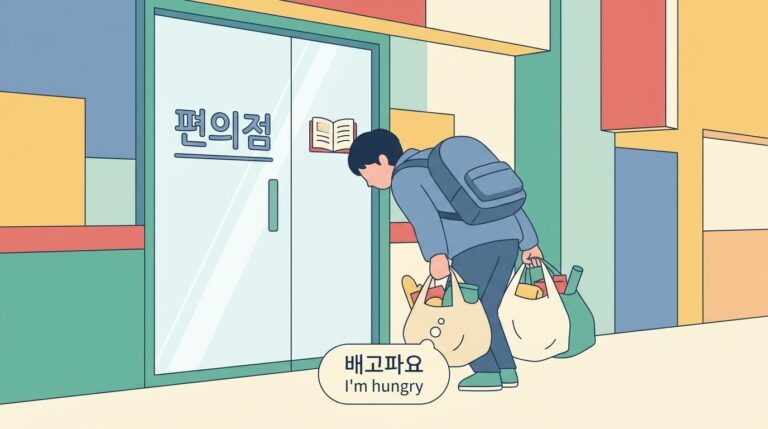
Phase 1: Empathy (The Coffee Tray Dilemma)
Hello! It’s your Daily Hangul editor.
Picture this: You are at a trendy cafe in Seongsu-dong. You’ve just picked up your order—two Iced Americanos and a giant slice of strawberry shortcake—balancing them carefully on a wooden tray. You walk toward the exit, but there’s a problem. It’s one of those massive, heavy glass doors. Your hands are full. A local is walking right toward you from the outside.
Do you stare at them and wait? Do you attempt a dangerous foot-kick to push the door? Or do you confidently ask for help?
If you translate “Open the door” literally, you might accidentally sound like a police officer on a raid! Today, we are going to learn how to politely and naturally ask someone to open the door for you in Korean. Knowing these expressions won’t just save your cake from hitting the floor; it will make you sound incredibly polite, unlocking that warm ‘Insider’ treatment from locals. Let’s dive in!
Phase 2: Core Expressions Deep Dive
1. 문 좀 열어 주시겠어요? (Could you please open the door?)
- Pronunciation: mun jom yeoreo jusigesseoyo? [Moon johm yuh-ruh joo-shee-geh-suh-yo?]
Tip: Think of ‘문(moon)’ like the moon in the sky. ‘좀(jom)’ sounds like ‘Rome’ but starting with a J.- Meaning: Literal: Would you give the action of opening the door a little? / Real nuance: Could you please open the door for me?
- K-Culture Moment: This is the classic K-Drama scene where the clumsy but lovable protagonist is carrying a huge stack of office files and bumps into the cold-but-handsome CEO. She struggles and politely squeaks out this exact phrase!
- Editor’s Insight: The magic word here is 좀 (jom). It literally means “a little,” but in Korean, inserting “좀” instantly softens your request, making it sound polite and non-demanding rather than a direct order.
- Situation Spectrum:
- Casual (Friends): 🚫 (Too formal)
- Semi-formal (Strangers/Coworkers): ✅ (Perfect!)
- Formal (Boss/Elders): ✅ (Very polite)
- 🤔 Think About It: Why do Koreans use words meaning “to give” (주다) when asking for favors? Does your culture treat favors as “gifts” in its language?
2. 문 좀 열어 줄래? (Can you open the door?)
- Pronunciation: mun jom yeoreo jullae? [Moon johm yuh-ruh jool-lae?]
- Meaning: Literal: Will you give the opening of the door? / Real nuance: Hey, can you get the door?
- K-Culture Moment: Imagine a K-Pop idol on a reality show carrying heavy camping gear. They look at their group member and casually toss this phrase out. It’s friendly, close, and very everyday.
- Editor’s Insight: This uses the casual form (반말 – banmal). Use this ONLY with close friends or people younger than you whom you’ve agreed to speak comfortably with.
- Situation Spectrum:
- Casual (Friends): ✅
- Semi-formal (Strangers/Coworkers): 🚫 (Rude!)
- Formal (Boss/Elders): 🚫 (Very rude!)
- 🤔 Think About It: Notice how just changing the end from “주시겠어요” to “줄래” completely shifts the power dynamic. Korean endings carry the weight of relationships!
3. 저기요, 죄송한데 문 좀… (Excuse me, sorry but the door…)
- Pronunciation: jeogiyo, joesonghande mun jom… [Juh-gee-yo, jway-song-han-day moon johm…]
- Meaning: Literal: Over there, I am sorry but door a little… / Real nuance: Excuse me, could you mind getting the door?
- K-Culture Moment: You are in a crowded convenience store, hands full of spicy ramyeon and banana milk. You catch eye contact with someone near the door. You trail off your sentence with an apologetic smile.
- Editor’s Insight: This is the most authentic local way to ask! Koreans love to leave sentences unfinished when asking for a favor. It shows you feel so bad for asking that you can’t even finish the sentence. The listener fills in the blank and helps you out of “Nunchi” (social tact).
- Situation Spectrum:
- Casual (Friends): ⚠️ (A bit too distant)
- Semi-formal (Strangers/Coworkers): ✅ (Perfectly natural)
- Formal (Boss/Elders): ⚠️ (Better to finish the sentence with 주시겠어요?)
- 🤔 Think About It: In English, trailing off might seem unconfident. In Korean, it’s an advanced politeness strategy. Have you noticed Koreans doing this?
Phase 3: Textbook vs. Real Korean
[Situation 1: Your hands are full at a cafe]
* 📖 Textbook Korean: 실례합니다. 문을 열어 주시겠습니까? (Excuse me. Would you open the door?)
* 🗣️ Real Korean: 저기요! 죄송한데 문 좀… (Excuse me! Sorry, but the door…)
* 💡 Why is it different?: “실례합니다” (Excuse me) is quite stiff. In real life, getting someone’s attention with “저기요” (Over there/Excuse me) and trailing off is much faster and sounds warmer.
[Situation 2: Asking your best friend to open the apartment door]
* 📖 Textbook Korean: 친구야, 문을 좀 열어 줄 수 있니? (Friend, can you open the door?)
* 🗣️ Real Korean: 야! 문 열어! (Hey! Open the door!) OR 문 좀! (Door please!)
* 💡 Why is it different?: Close friends value efficiency and intimacy over formal grammar. Dropping the verbs entirely (“문 좀!”) is the ultimate sign of closeness!
Bottom Note: For A2 learners, sticking to “문 좀 열어 주시겠어요?” is your safest, golden ticket. It works everywhere and offends nobody!
Phase 4: Cultural Context — K-Culture Deep Dive
4-1. Non-Verbal Elements (The Art of Nunchi)
When asking a stranger to open the door, body language speaks louder than words. If your hands are full, a slight head bow or a frantic but polite nod while making brief eye contact is essential. Staring them down intensely while saying the words will feel confrontational.
4-2. The K-Travel Reality: The Door Holding Culture
If you come from a Western culture, you might be used to people holding the door for the person behind them. In Korea, this wasn’t traditionally common. People used to just walk through, letting the door swing shut, which causes huge culture shock for travelers!
However, things are changing rapidly. Younger generations and people in big cities like Seoul will often hold the door for you. If they do, a quick “감사합니다 (gam-sa-ham-ni-da)” with a small bow of the head will make their day. And if you are the one holding the door, they will think you have incredible manners!
Phase 5: Real-Life Roleplay Scenario
Setting: A bustling GS25 convenience store in Hongdae. It’s Friday night, 11 PM. You just bought a massive haul of Korean snacks—honey butter chips, triangular kimbap, and four cans of beer. You are clutching the plastic bag with both hands, but the door is closed.
Characters:
* YOU: A traveler exploring Seoul, currently acting as the snack supplier for your friends.
* Min-su (22): The part-timer (알바생) arranging drinks near the door.
Dialogue:
YOU: (Struggling to balance the heavy bag)
앗, 무거워…
(at, mugeowo…)
[Ah, it’s heavy…]
Min-su: (Hears the rustling and looks over)
YOU: 저기요…
(jeogiyo…)
[Excuse me…]
Min-su: 네? 손님이 무슨 일 있으신가요?
(ne? sonnimi museun il isseusingayo?)
[Yes? Is everything okay, customer?]
YOU: 죄송한데, 문 좀 열어 주시겠어요? 손이 모자라서요.
(joesonghande, mun jom yeoreo jusigesseoyo? soni mojaraseoyo.)
[I’m sorry, but could you please open the door? I don’t have enough hands.]
Min-su: 아, 네! 잠시만요.
(a, ne! jamsimanyo.)
[Ah, yes! Just a moment.]
(Min-su quickly steps over and pushes the heavy glass door open)
🔀 YOUR TURN! How do you reply as you walk out?
– A) (Just nod and walk away silently)
– B) “감사합니다! 수고하세요~” (Thank you! Have a good shift~)
– C) “사랑해요!” (I love you!)✅ Best Choice: B — Saying “수고하세요” (Keep up the good work / Have a good shift) to service workers in Korea is the ultimate insider move. It shows immense respect.
⚠️ Choice C Analysis: Telling the part-timer you love them for opening a door might make them laugh, but it’s definitely going to make things awkward! Save that for the K-Pop concerts.
Phase 6: 10-Second Shadowing Drill
Let’s practice! Speak aloud, following the pauses (/) and the emotion tags.
- 🥺 (Apologetically) 저기요, / 죄송한데 / 문 좀…
(jeogiyo, / joesonghande / mun jom…) - 🙏 (Politely) 문 좀 / 열어 주시겠어요?
(mun jom / yeoreo jusigesseoyo?) - 😊 (Brightly, when thanking them) 아유, / 감사합니다!
(ayu, / gamsahamnida!)
Phase 7: K-Culture Mini Dictionary
1. 눈치 (Nunchi)
* Pronunciation: nunchi
* English: Social tact / Reading the room
* Context: The quintessential Korean social skill. When you trail off your sentence with “문 좀…”, you are relying on the other person’s nunchi to understand you need help.
2. 저기요 (Jeogiyo)
* Pronunciation: jeogiyo
* English: Excuse me / Over there
* Context: Used to get a stranger’s attention. Whether you’re calling a waiter for more kimchi or getting someone to open a door, this is your go-to opener.
3. 알바생 (Alba-saeng)
* Pronunciation: alba-saeng
* English: Part-time worker
* Context: Derived from the German word “Arbeit”. You’ll see friendly alba-saengs at cafes and convenience stores who might help you with the door.
4. 당기시오 / 미시오 (Danggisio / Misio)
* Pronunciation: danggisio / misio
* English: Pull / Push
* Context: The signs on almost every Korean door. Memorize these, or you’ll find yourself pushing a pull-door while everyone watches!
Phase 8: Traveler Survival Kit
Doors in Korea can be tricky! Here are the absolute must-know survival expressions for moving around.
🆘 Survival Phrases for Doors & Helping
– 🇰🇷 “당기세요” (danggiseyo) → Pull it!
– 🇰🇷 “미세요” (miseyo) → Push it!
– 🇰🇷 “잠시만요” (jamsimanyo) → Excuse me / Just a moment (Used when trying to squeeze through a crowded door, like on a subway).📌 Editor’s Travel Note: The Heavy Doors of Seoul
– Push vs. Pull: Many cafes in Korea have aesthetic, massive glass or wooden revolving doors. Look for the signs “당기시오(Pull)” or “미시오(Push)”.
– Subway Etiquette: If the subway doors are closing, do NOT stick your hand in. Stand back. But if you’re trying to get out of a crowded train, just say “잠시만요 (jamsimanyo)” loudly, and the Red Sea will part for you!
Phase 9: Critical Thinking Corner — “One Step Deeper”
🧠 Think Deeper: Language & Power (The Grammar of Giving)
In English, you ask “Can you open the door?” focusing on the person’s ability to do the action. But in Korean, we use the verb “주다” (to give), saying “Would you give me the opening of the door?” (열어 주시겠어요?). This reflects a deeply ingrained cultural mindset where asking for a favor is seen as asking for a precious gift of someone’s time and effort. By framing it as a “gift,” the speaker humbles themselves and elevates the helper. It’s a beautiful reflection of respect in the Korean language.
💬 Your Turn: Does your native language frame favors as abilities (“can you”), obligations (“will you”), or gifts (“give me”)? Share in the comments below!
Phase 10: FAQ & Avoiding Mistakes
Q: Can I just point at the door and say “열어 (yeoreo – open)”?
No! Unless you are talking to a smart home device or a dog, saying just the verb without polite endings sounds like a harsh command. You will shock the locals.
Q: If I’m holding the door for an older person, what should I say?
Just smile and say “먼저 가세요” (meonjeo gaseyo – Please go first). They will love you.
❌ Common Mistake #1: Saying “제발 (jebal)” for “Please.”
✅ Do this instead: Beginners often learn “제발” means “please.” But “제발” is begging desperately (like in a K-Drama when someone’s life is in danger!). For everyday requests, use “좀 (jom)” or politely conjugated verbs like “~주시겠어요?”.
Phase 11: Summary & Action Items
- One-Liner Summary: Soften your request with “좀” and politely ask for the “gift” of their help by saying “문 좀 열어 주시겠어요?”
🚀 Action Mission 3 Steps:
– 🥉 Bronze (Solo): Stand in front of your room door, pretend your hands are full, and say “문 좀 열어 주시겠어요?” 3 times out loud.
– 🥈 Silver (Online): Drop a comment below using the phrase! (Example: “에디터님, 마음의 문 좀 열어 주시겠어요?” – Editor, would you open the door to your heart? 😉)
– 🥇 Gold (Real Life): Next time you visit a Korean market or cafe, purposely carry too many things and ask a friend to open the door for you in Korean!
🎬 K-Culture Mission:
Next time you watch a K-Drama, pay attention to the cafe scenes. Watch how characters enter and exit. Do they hold the door for each other? Do they push or pull? You’ll start noticing the signs everywhere!
Phase 12: Quiz — Interactive Challenge
1. Situational Judgment: You are at a company dinner (회식) and your boss has their hands full carrying the grilled meat platter. You want to ask your peer (same age, close friend) to open the door. What do you say?
– A) 문 열어라.
– B) 문 좀 열어 주시겠어요?
– C) 야, 문 좀 열어 줄래?
2. True or False – K-Culture Edition:
In Korea, saying “제발 문 열어주세요” (Jebal mun yeoreojuseyo) is the most natural way to ask someone to open a convenience store door.
– True / False
3. Fill in the Blank:
Excuse me, I’m sorry, but could you open the door?
“_____, 죄송한데 문 좀 열어 주시겠어요?”
👉 Click here for the answers!
1. C (Since it’s a close friend, “줄래?” is perfect. A is too bossy, B is too formal for a close peer.)
2. False (Using ‘제발’ sounds like you are begging for your life! Use ‘좀’ instead.)
3. 저기요 (jeogiyo) (The essential attention-grabber!)
Frequently Asked Questions (FAQ)
Q: What does "문 좀 열어 주시겠어요? (Could you please open the door?)" mean in Korean and how do you pronounce it?
A: In Korean, "문 좀 열어 주시겠어요? (Could you please open the door?)" is pronounced [mun jom yeoreo jusigesseoyo? [Moon johm yuh-ruh joo-shee-geh-suh-yo?] and means: Literal: Would you give the action of opening the door a little? / Real nuance: Could you please open the door for me?
Q: What does "문 좀 열어 줄래? (Can you open the door?)" mean in Korean and how do you pronounce it?
A: In Korean, "문 좀 열어 줄래? (Can you open the door?)" is pronounced [mun jom yeoreo jullae? [Moon johm yuh-ruh jool-lae?] and means: Literal: Will you give the opening of the door? / Real nuance: Hey, can you get the door?
Q: What does "저기요, 죄송한데 문 좀... (Excuse me, sorry but the door...)" mean in Korean and how do you pronounce it?
A: In Korean, "저기요, 죄송한데 문 좀... (Excuse me, sorry but the door...)" is pronounced [jeogiyo, joesonghande mun jom... [Juh-gee-yo, jway-song-han-day moon johm...] and means: Literal: Over there, I am sorry but door a little... / Real nuance: Excuse me, could you mind getting the door?







