

Phase 1: Empathy & Immersion (Cold Open)
Hello! It’s your Daily Hangul Editor.
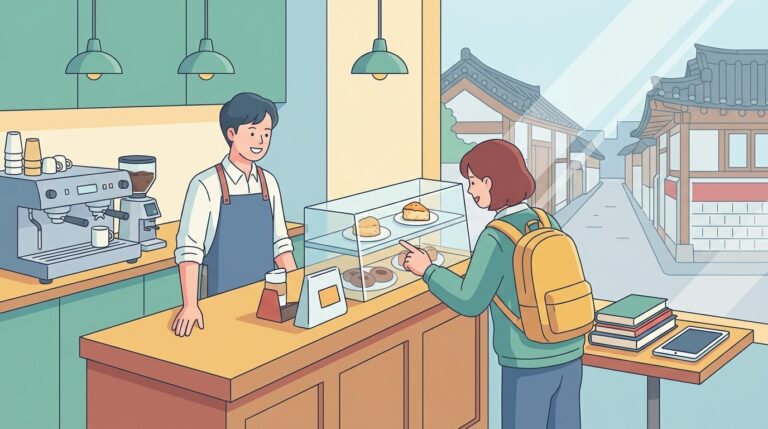
Imagine this: You are in Seongsu-dong, the Brooklyn of Seoul. You’ve just walked into one of those incredibly aesthetic Korean bakery cafes you’ve seen all over Instagram. The aroma of freshly brewed coffee and baked goods is heavenly. You point to a beautiful, golden-brown scone. You sit down, take a bite, and… it’s completely cold.
You look around. You see a Korean couple next to you enjoying a steaming, perfectly warmed pastry. You want to walk up to the barista and say, “Excuse me, can you warm this up?” But you freeze. How do you say “warm up” in Korean?
If you don’t know this phrase, you might end up eating cold pastries for your entire trip. But if you do? You’ll experience the warm, buttery magic of Korean cafe culture like a true insider!
Don’t worry, this guide is based on real questions from my beginner students who struggled at Korean bakeries. Let’s fix this together!
Phase 2: Core Expressions Deep Dive
Here are the magical phrases you need to get your scone perfectly warmed up. Since you are an A1 beginner, we won’t focus on complex grammar—just memorize these as super useful survival blocks!
1. 스콘 데워주세요 (Please warm up the scone)
- Pronunciation: seu-kon / de-wo-ju-se-yo
- seu-kon (Scone)
- de sounds like the ‘de’ in ‘desk’
- wo sounds like ‘woah’
- ju-se-yo means ‘please give me’ or ‘please do for me’
- Meaning: Please warm up the scone. (Literal: Scone warm-do-please)
- K-Culture Moment: You’ll see this situation in K-Dramas when the caring male lead brings a late-night snack to the heroine at her office. He won’t just hand her a cold sandwich; he’ll hand it to her and say, “내가 데워왔어 (I warmed it up).” Warmth equals care in Korea!
- Editor’s Insight: This is your golden phrase. You can replace “scone” with anything! Sandwich de-wo-ju-se-yo, Croissant de-wo-ju-se-yo. It’s polite, soft, and perfect for any cafe.
- Situation Spectrum:
- Casual with friends: ⚠️ (Use ‘데워줘’ de-wo-jwo instead)
- To a Barista/Staff (Formal): ✅ (Perfect!)
- 🤔 Think About It: In Korean, we often add “주세요 (ju-se-yo / please do for me)” to verbs. Why do you think Korean language emphasizes the act of doing a favor for someone else even in a simple transaction?
2. 이거 데워주세요 (Please warm THIS up)
- Pronunciation: i-geo / de-wo-ju-se-yo
- i-geo means ‘this’ (sounds like ‘ee-guh’)
- Meaning: Please warm this up.
- K-Culture Moment: This is the ultimate survival word! When you are in a bustling traditional market like Gwangjang Market, pointing at a pancake (Jeon) and saying “이거 (i-geo)” is an absolute lifesaver.
- Editor’s Insight: If you forgot the Korean word for the pastry, or if it’s a long English name you can’t pronounce with a Korean accent, just point at it and say “I-geo”!
- Situation Spectrum:
- Casual with friends: ⚠️
- To a Barista/Staff (Formal): ✅
Phase 3: Textbook vs. Real Korean
Let’s see how real Koreans speak in cafes compared to what a textbook might tell you!
[Situation: Asking to heat up your food]
* 📖 Textbook Korean: 이 스콘을 가열해 주시겠습니까? (Would you please apply heat to this scone?)
* 🗣️ Real Korean: 스콘 좀 데워주세요. (Please warm up the scone a little.)
* 💡 Why is it different?: “가열하다” is a scientific or industrial term. In real life, “데우다” is the natural word for heating up food. Adding “좀 (a little/please)” softens the request, making you sound much more polite and native!
[Situation: Saying you will eat inside the cafe]
* 📖 Textbook Korean: 저는 여기서 먹겠습니다. (I shall consume this right here.)
* 🗣️ Real Korean: 먹고 갈게요. (I’ll eat and go.)
* 💡 Why is it different?: Koreans value efficiency and movement. “먹고 갈게요 (Eat and go)” perfectly captures the fast-paced modern Korean lifestyle.
Bottom Note: For A1 beginners, don’t worry about adding “좀 (jom)” yet if it’s too much to remember. Just “데워주세요” is 100% polite and perfect!
Phase 4: Cultural Context — K-Culture Deep Dive
4-1. Non-Verbal Tips: The Art of “Nunchi” at the Register
In Korea, cafes are incredibly fast-paced during lunchtime (around 12 PM – 1 PM). This is where 눈치 (Nunchi – the ability to read the room) comes in.
– Hand Gestures: When handing your card to the barista, try to use two hands, or lightly support your right elbow with your left hand. It’s a subtle sign of respect!
– Timing: Decide what you want before you reach the register. If you hold up the line during the Korean office worker rush hour, you might feel the heavy nunchi from the line behind you!
4-2. K-Culture Connection: “Bbang-ji-sun-rye” (The Bread Pilgrimage)
Why is ordering pastries so important in Korea? Because Korea is currently obsessed with 빵지순례 (Bread Pilgrimage).
It refers to traveling around the country specifically to visit famous bakeries, much like a religious pilgrimage. In K-Dramas, you’ll often see characters sitting in massive, beautifully decorated cafes with a tray full of colorful desserts. These aren’t just snacks; they are social events. When you ask to warm up a scone, you aren’t just getting food—you are participating in Korea’s vibrant cafe lifestyle!
Phase 5: Real-Life Roleplay Scenario
Let’s put you in the scene! You are the main character.
- Setting: 2:00 PM on a Saturday. A gorgeous, sunlight-filled aesthetic cafe in Yeonnam-dong. You just picked up a delicious-looking Earl Grey scone from the display table using a wooden tray and tongs.
- Characters:
- YOU (The Traveler): Exploring Seoul, craving something sweet with your iced Americano.
- Barista (NPC): Friendly, wearing a neat apron, standing behind a sleek espresso machine.
Barista: 안녕하세요! 주문하시겠어요? ☕
(An-nyeong-ha-se-yo! Ju-mun-ha-si-ge-sseo-yo?)
[Hello! Would you like to order?]
YOU: 네, 아이스 아메리카노 한 잔 주세요.
(Ne, a-i-seu a-me-ri-ka-no han jan ju-se-yo.)
[Yes, one iced Americano, please.]
Barista: 네, 드시고 가시나요?
(Ne, deu-si-go ga-si-na-yo?)
[Yes, is it for here?]
YOU: 네, 먹고 갈게요. 아, 그리고…
(Ne, meok-go gal-ge-yo. Ah, geu-ri-go…)
[Yes, for here. Ah, and…]
(🎭 Stage Direction: You point to the scone on your tray, wanting it warm.)
🔀 Your Turn! How should you ask?
– A) “이거 따뜻해요?” (i-geo tta-tteu-tae-yo? – Is this warm?)
– B) “이거 데워주세요!” (i-geo de-wo-ju-se-yo! – Please warm this up!)
– C) “불 주세요!” (bul ju-se-yo! – Please give me fire!)✅ Best Choice: B — It’s the exact phrase we learned! Polite and direct.
⚠️ Choice A Analysis: This just asks if it is warm, so the barista might just say “No” and wait for your next move.
🚫 Choice C Analysis: Oh no! You are asking for fire (like a lighter). The barista will be very confused!
Barista: 네, 따뜻하게 데워드릴게요. 진동벨 울리면 픽업대로 와주세요!
(Ne, tta-tteu-ta-ge de-wo-deu-ril-ge-yo. Jin-dong-bel ul-ri-myeon pik-eop-dae-ro wa-ju-se-yo!)
[Yes, I’ll warm it up for you. Please come to the pickup counter when the pager rings!]
Phase 6: 10-Second Shadowing Drill
Let’s practice the rhythm! In Korean, the pause (/) and the intonation matter.
😊 Politely and brightly:
저기요, / 이거 / 데워주세요!
(jeo-gi-yo, / i-geo / de-wo-ju-se-yo!)
Excuse me, / this / please warm it up!
Pro tip: Raise the tone slightly at the very end of “yo” to sound friendly and approachable!
Phase 7: K-Culture Mini Dictionary
Here are some keywords related to this situation!
1. 눈치
* Romanization: nunchi
* English: The social sense of reading the room/atmosphere.
* Context: Knowing when to step aside at the cafe counter so the next person can order.
2. 얼죽아
* Romanization: eol-juk-a
* English: “Even if I freeze to death, Iced Americano.”
* Context: A popular slang for Koreans’ obsession with drinking iced coffee even in the middle of winter.
3. 진동벨
* Romanization: jin-dong-bel
* English: Vibrating pager.
* Context: The buzzer the cafe gives you. When it buzzes and flashes, your warmed scone is ready!
4. 디저트 배
* Romanization: di-jeo-teu bae
* English: Dessert stomach.
* Context: Koreans always say “The dessert stomach is separate!” Even after a massive K-BBQ dinner, there is always room for a scone.
Phase 8: Traveler’s Survival Kit
If you are cafe-hopping in Korea, these expressions will save your life.
🆘 Survival Expression #1: For here or to go?
– 🇰🇷 “먹고 갈게요” (meok-go gal-ge-yo) – I’ll eat it here.
– 🇰🇷 “포장해 주세요” (po-jang-hae ju-se-yo) – To-go / Takeout, please.
– 📍 Where to use: Every cafe, bakery, and fast-food restaurant.
– 💡 Pro Tip: In Korea, due to environmental laws, if you order “for here,” you will get a glass or ceramic mug. You cannot take that mug outside!📌 Editor’s Travel Note
– Kiosks: Many modern cafes in Korea use touch-screen kiosks. If you see one, you can usually change the language to English at the top right corner!
– No Tipping: Never leave a tip in a Korean cafe. They might chase you down the street thinking you left your money behind!
– Self-Return: In most Korean cafes, you must return your tray to the counter or a designated return area (Return / 반납) when you are finished.
Phase 9: Critical Thinking Corner — “A Step Deeper”
Food & Identity: The Culture of Sharing (Jeong)
🧠 Think Deeper:
When you order a dessert like a scone or a cake in a Korean cafe, the staff will almost always give you multiple forks, even if you ordered it for yourself. Why? Because Korean food culture is deeply rooted in communal eating and sharing, reflecting the concept of 정 (Jeong – affection/bonding). Desserts aren’t just individual treats; they are meant to be shared in the center of the table while chatting with friends. The language reflects this collective mindset too—we often say “our cafe” (우리 카페) instead of “my cafe.”💬 Your Turn: Do people in your culture share desserts, or does everyone order their own? Share in the comments!
Phase 10: FAQ & Mistake Prevention
Q: Can I use “데워주세요” to an older person?
Yes! The “~요(yo)” ending makes it polite. You can say this to an older cafe owner without any worry.
Q: What if I want my coffee warmed up, not the pastry?
Ah! For drinks, we don’t usually say “데워주세요”. Instead, just order a “따뜻한 (tta-tteu-tan – hot)” drink from the beginning, like “따뜻한 아메리카노 (Hot Americano).”
❌ Common Mistake #1: Saying “뜨겁게 해주세요 (Make it hot)”
✅ Do this instead: “데워주세요 (Warm it up)”
Why? “뜨겁다 (Tteu-geop-da)” implies something is dangerously hot, like boiling soup or a fire. You just want your scone gently warmed, not burned to a crisp!
Phase 11: Summary & Action Items
- One-Liner Summary: To enjoy a warm pastry in Korea, simply point and say, “이거 데워주세요 (i-geo de-wo-ju-se-yo)!”
-
Action Mission 3 Steps:
- 🥉 Bronze (Solo): Look at any object on your desk, point to it, and say “이거 데워주세요” 3 times out loud.
- 🥈 Silver (Online): Find a picture of your favorite Korean cafe pastry on Instagram and comment “데워주세요!” (in your head or for real!).
- 🥇 Gold (Real Life): Next time you visit a Korean cafe or bakery, actually use this phrase to get a perfectly warm treat!
- K-Culture Mission:
Watch a K-Drama set in an office or a cafe today. Try to catch the moment someone hands over food or coffee. Did you hear the word “따뜻해” (warm) or “데워” (warmed)?
Did you try saying it out loud? Let me know in the comments which pastry you want to order in Korea! 🥐
Phase 12: Quiz — Interactive Challenge
Test your A1 Korean cafe skills!
1. Situational Judgment:
You are at a busy cafe. You want the barista to warm up a croissant. What is the most natural thing to say?
– A) 이거 불(fire) 주세요.
– B) 크루아상 데워주세요.
– C) 나 크루아상 뜨거워.
2. True or False — K-Culture Edition:
– “It is customary to leave a $1 tip for the barista in Korea if they warm up your scone beautifully.” (T/F)
(Answers below)
Click to reveal answers!
- B – “크루아상 데워주세요 (Please warm up the croissant).” (A means ‘give me fire’, C means ‘I am a hot croissant’ – very weird!)
- False – There is strictly NO tipping culture in South Korea. The service is fully included!
Frequently Asked Questions (FAQ)
Q: What does "스콘 데워주세요 (Please warm up the scone)" mean in Korean and how do you pronounce it?
A: In Korean, "스콘 데워주세요 (Please warm up the scone)" is pronounced [seu-kon / de-wo-ju-se-yo] and means: a key conversational Korean expression covered in this lesson.
Q: What does "이거 데워주세요 (Please warm THIS up)" mean in Korean and how do you pronounce it?
A: In Korean, "이거 데워주세요 (Please warm THIS up)" is pronounced [i-geo / de-wo-ju-se-yo] and means: a key conversational Korean expression covered in this lesson.







