

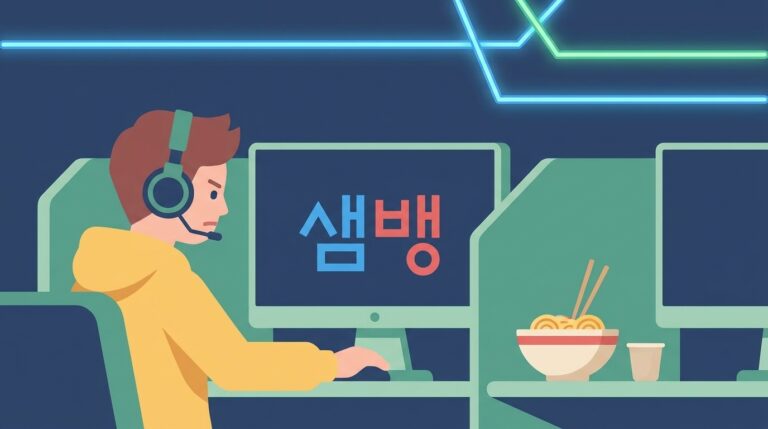
Phase 1: Empathy (The “Faker” Phenomenon)
Hello, learners! I’m the Senior Editor at Daily Hangul.
Picture this: You’re watching the League of Legends World Championship. The stadium is packed, the lights are blinding, and the Korean casters are screaming at the top of their lungs as Faker makes an impossible play. Or maybe, you’re just sitting in a PC Bang (internet cafe) in Seoul, and the high schoolers next to you are intensely communicating in what sounds like English, but… not quite.
You hear words like “mental,” “carry,” and “physical,” but they are used in completely different contexts. It’s frustrating, isn’t it? You’ve studied textbook Korean, but suddenly, the vocabulary of the fastest-growing industry in Korea—eSports—feels like a completely foreign dialect.
Welcome to C1-level Korean. At this stage, you’re not just learning grammar; you’re learning the sociolect of specific subcultures. The explosive growth of the Korean eSports industry hasn’t just shaped global gaming; it has birthed an entirely new vocabulary that has seeped into everyday corporate life, sports, and casual conversations. Today, we are decoding the language of champions.
Phase 2: Core Expressions Deep Dive
To understand the spirit of Korean eSports, you need to master these three quintessential expressions. They are Konglish (Korean-English), but they hold unique cultural weight.
1. 멘탈이 나가다 (Mental goes out)
- Pronunciation: mental-i nagada. [Sound guide: ‘Mental’ is pronounced with a softer ‘t’, and ‘na-ga-da’ sounds like ‘nah-gah-dah’]
- Meaning: (Literal) Mental goes out. (Real nuance) To lose one’s composure, to tilt, to have a mental breakdown due to stress or an unexpected shock.
- K-Culture Moment: You’re playing a ranked match, and your teammate makes a catastrophic error. You drop your mouse, sigh deeply, and say this. It’s the ultimate expression of your psychological state crumbling.
- Editor’s Insight: We don’t just say “I’m stressed.” By objectifying the mind as “mental” and saying it physically “left” the body, it creates a dramatic, almost comedic detachment from the stressful event.
- Situation Spectrum:
- Friends (Casual): ✅
- Colleagues (Semi-formal): ⚠️ (Only if you’re close and venting)
- Boss/Elders (Formal): 🚫
- 🤔 Think About It: Why do Koreans use the English word “mental” instead of native words like 마음 (mind) or 정신 (spirit) in competitive gaming? Does adopting a foreign word create a boundary between ‘game stress’ and ‘real-life emotion’?
2. 하드캐리하다 (To hard carry)
- Pronunciation: hadeukaerihada. [Sound guide: ha-deu-kae-ri-ha-da]
- Meaning: (Literal) Hard carry. (Real nuance) When one person overwhelmingly does the work of the entire team to secure a victory or success.
- K-Culture Moment: This started in gaming (e.g., “Faker hard-carried the game”), but now it’s used in the office. If Min-su finishes the group presentation single-handedly while everyone else slacked off, he “hard-carried” the project.
- Editor’s Insight: It’s the ultimate compliment for individual competence in a team-based society. It acknowledges that while teamwork is expected, individual brilliance saved the day.
- Situation Spectrum:
- Friends (Casual): ✅
- Colleagues (Semi-formal): ✅ (Great for praising a coworker informally)
- Boss/Elders (Formal): ⚠️ (Too slangy for a formal report)
- 🤔 Think About It: Korea is deeply rooted in collective teamwork (공동체 의식). How does the immense popularity of the concept of “hard carrying” reflect a shift toward valuing individual meritocracy?
3. 떡상하다 (To skyrocket / Surge)
- Pronunciation: tteoksanghada. [Sound guide: ‘tt’ is a tense sound like stopping your breath before saying ‘duck’, followed by ‘sang-ha-da’]
- Meaning: (Literal) Rice cake rises (slang origin). (Real nuance) A rapid, explosive increase in value, popularity, or status.
- K-Culture Moment: Used to describe the explosive growth of the eSports industry itself, a sudden spike in Bitcoin, or an obscure K-Pop idol group suddenly going viral on YouTube.
- Editor’s Insight: The opposite is 떡락하다 (tteongnakhada – to plummet). It perfectly captures the hyper-fast, volatile nature of modern trends in Korea.
- Situation Spectrum:
- Friends (Casual): ✅
- Colleagues (Semi-formal): ⚠️
- Boss/Elders (Formal): 🚫
- 🤔 Think About It: Does your language have a word specifically dedicated to things going viral or stocks exploding in value overnight?
Phase 3: Textbook vs. Real Korean
At the C1 level, you know the grammar. Now, you need the flavor.
[Describing an amazing performance]
* 📖 Textbook Korean: 오늘 정말 게임을 잘하시네요. (You play the game very well today.)
* 🗣️ Real Korean: 와, 오늘 완전 폼 미쳤다! (Wow, your form is absolutely crazy today!)
* 💡 Why the difference?: The slang “폼 미쳤다” (form is crazy) migrated from football/eSports to daily life to express utter disbelief at someone’s peak performance.
[Explaining Industry Growth]
* 📖 Textbook Korean: e스포츠 산업이 크게 성장했습니다. (The eSports industry has grown significantly.)
* 🗣️ Real Korean: 요즘 e스포츠 판이 엄청 커졌죠. (The eSports ‘scene/board’ has gotten huge lately.)
* 💡 Why the difference?: Koreans often use “판” (pan – meaning a board, scene, or arena) to describe an industry. It gives a more dynamic, insider feel than the sterile “산업” (industry).
[When you made a mistake and feel bad]
* 📖 Textbook Korean: 제 실수 때문에 져서 죄송합니다. (I apologize for losing because of my mistake.)
* 🗣️ Real Korean: 아, 이번 판 제가 제대로 트롤(troll)했네요. ㅈㅅㅈㅅ (Ah, I totally trolled this round. sry sry)
* 💡 Why the difference?: Admitting you “trolled” (ruined the game) with internet slang “ㅈㅅ” (short for 죄송 – sorry) diffuses tension faster in an online setting than a formal apology.
Phase 4: Cultural Context — K-Culture Deep Dive
4-1. Non-Verbal Communication: The Sound of APM
In Korean eSports, APM (Actions Per Minute) is a religion. The rapid-fire clicking of the mouse and keyboard isn’t just functional; it’s an auditory display of dominance. When you play with Koreans, a sudden silence followed by a heavy sigh (한숨) means “멘탈이 나갔다” (Mental breakdown). Also, remember Nunchi (눈치). In team games without voice chat, reading the movement of your teammates’ characters and knowing when to engage or retreat is pure virtual Nunchi.
4-2. The Sanctuary: PC Bang (PC방) Culture
The eSports industry didn’t grow in a vacuum; it grew in the PC Bang. A Korean PC Bang is not a dingy cybercafe. It’s a high-tech sanctuary with mechanical keyboards, curved monitors, and most importantly, an incredible food delivery system directly to your desk. From hot dogs to gourmet Ramyeon, it’s a culinary and social hub. When a Korean says, “Let’s go to the PC Bang,” they aren’t just inviting you to game; they are inviting you to a modern bonding ritual.
Phase 5: Real-Life Roleplay Scenario
- Setting: Friday night, 9 PM. A premium PC Bang in Sinchon. Neon lights, the smell of spicy Ramyeon in the air. You and your Korean coworkers are playing a 5v5 game to blow off steam.
- Characters:
- YOU: An expat working in Seoul, decent at the game but still learning the lingo.
- Min-su (32): Your coworker. Highly enthusiastic, terrible at the game.
- Ji-eun (28): The quiet designer who is secretly a gaming god.
[Dialogue]
Min-su: 아… 또 죽었네. 저 진짜 멘탈 나갈 것 같아요.
(A… tto jugeonne. Jeo jinjja mental nagal geot gatayo.)
[Ah… I died again. My mental is really going out (I’m tilting).]
(🎭 Stage Direction: Min-su aggressively runs his hands through his hair)
Ji-eun: 민수 대리님, 괜찮아요. 뒤로 좀 빠지세요. 제가 하드캐리 해볼게요.
(Minsu daerinim, gwaenchanayo. Dwiro jom ppajiseyo. Jaega hadeukaeri haebolgeyo.)
[Assistant Manager Min-su, it’s okay. Fall back a bit. I’ll try to hard-carry.]
YOU: 와, 지은 씨! 방금 컨트롤 완전 폼 미쳤어요!
(Wa, Jieun ssi! Banggeum keonteurol wanjeon pom micheosseoyo!)
[Wow, Ji-eun! Your control just now was absolutely crazy!]
Min-su: 그러니까요! 지은 씨 없었으면 우리 완전 졌어요.
(Geureonilkkayo! Jieun ssi eopseosseumyeon uri wanjeon jyeosseoyo.)
[Exactly! If we didn’t have Ji-eun, we would have totally lost.]
🔀 Your Turn! How should you respond to Min-su to keep the team spirit up?
* A) “네, 민수 씨는 게임을 너무 못해요.” (Yes, Min-su, you are very bad at the game.)
* B) “에이, 멘탈 부여잡으세요! 아직 안 끝났어요!” (Hey, hold onto your mental! It’s not over yet!)
* C) “제가 대신 할까요?” (Shall I do it instead?)✅ Best Choice: B. “멘탈(을) 부여잡다” (To grab hold of one’s mental/pull yourself together) is the perfect, native-sounding encouragement.
⚠️ Choice A Analysis: Too direct and rude, even if true. Korean humor relies on playful teasing (티키타카), not blunt insults.
Phase 6: 10-Second Shadowing Drill
Let’s practice the flow and emotion. Mimic the intonation markers!
😤 아… / 진짜 / 멘탈 나갈 것 같아. / (A… / jinjja / mental nagal geot gata.)
Emotion: Frustrated, sighing heavily.😎 걱정 마! / 이번 판은 / 내가 하드캐리 할게! / (Geokjeong ma! / ibeon paneun / naega hadeukaeri halge!)
Emotion: Confident, heroic.
Phase 7: K-Culture Mini Dictionary (eSports Edition)
1. PC방 (PC Bang)
* Romanization: pishibang
* English: PC Room / Internet Cafe
* Context: The incubator of Korean eSports. A cultural space for gaming, eating, and hanging out. Not just for “nerds,” but a mainstream social venue.
2. 버스 타다 (To ride the bus)
* Romanization: beoseu tada
* English: To be carried
* Context: Used when you contribute very little to the team but still win because someone else “drove the bus” (carried you). “오늘 완전 버스 탔네요” (I totally rode the bus today).
3. 현질 (Hyeonjil)
* Romanization: hyeonjil
* English: Pay-to-win / In-app purchases
* Context: Spending real money in a game to buy items or power. Derived from “현금(Cash) + 지르다(To splurge/throw money at)”.
4. 어그로 끌다 (To pull aggro)
* Romanization: eogeuro kkeulda
* English: To draw attention/hostility
* Context: Originally an MMO term for drawing a monster’s attack. Now widely used in media and daily life to describe someone acting provocatively to get attention (like a troll or clickbait).
Phase 8: Traveler’s Survival Kit (PC Bang Mission)
If you’re in Korea, visiting a premium PC Bang is a must-do cultural experience. Here is how you survive.
🆘 Survival Expressions TOP 3
* 🇰🇷 “비회원으로 할게요.” (Bihoewoneuro halgeyo.)
* 🗣️ English: I’ll play as a non-member.
* 💡 Why: To use a PC, you must buy time at the kiosk. If you don’t have a Korean ID/Phone number to register, always look for the ‘비회원’ (Non-member) button.
- 🇰🇷 “음식 주문은 어떻게 해요?” (Eumsik jumuneun eotteoke haeyo?)
- 🗣️ English: How do I order food?
- 💡 Why: You don’t go to the counter! You order directly from the software on your PC screen.
🇰🇷 “자리 좀 치워주세요.” (Jari jom chiwojuseyo.)
- 🗣️ English: Please clean this seat.
- 💡 Why: If you find a great seat but the previous user left their ramen bowl, politely ask the staff to wipe it down.
📌 Editor’s Travel Note
* Cash or Card?: PC Bang kiosks accept cards, but sometimes non-member logins require cash. Keep a 10,000 KRW bill handy.
* The Etiquette: It’s okay to make noise while playing, but screaming profanities will get you stared at. Keep your competitive spirit respectful!
Phase 9: Critical Thinking — “One Step Deeper”
Global Era Korean (Konglish in eSports): The Localization of Language
🧠 Think Deeper:
Let’s look at words like “Mental” and “Physical” (피지컬 – referring to mechanical skill and reflexes in gaming). Why didn’t Korea invent purely Korean words for these concepts? As the eSports industry exploded globally, English served as the baseline language for international servers. However, Koreans didn’t just borrow these words; they morphed them. “Physical” in English means bodily fitness. In Korean gaming, it means microscopic mouse precision. This phenomenon shows that Korean is incredibly adaptive, taking global terminology and reshaping it to fit the highly specific, hyper-competitive nature of Korean society. Language purists argue this ruins the Korean language, while others argue it proves the language’s dynamic evolution.💬 Your Turn: How does your native language handle internet and gaming slang? Do you borrow English words and change their meanings, or do you invent entirely new words? Tell me in the comments!
Phase 10: FAQ & Avoiding Misunderstandings
- Q: Can I tell my boss “과장님이 하드캐리하셨네요!” (Manager, you hard-carried!)?
- A: Maybe, but tread carefully. If you work in a young startup or an IT company, it’s a flattering compliment. If you work in a traditional, conservative conglomerate (like a bank), stick to “과장님 덕분에 잘 끝났습니다” (Thanks to you, it ended well).
- Q: If I’m losing my mind studying Korean, can I say “한국어 때문에 멘탈 나가요”?
- A: YES! This is a brilliantly natural way to express your frustration. Koreans will find it very relatable and cute.
❌ Common Mistake #1: Translating “You’re crazy” literally.
✅ Do this instead: In English, “You’re crazy!” can be a huge compliment in gaming. If you say “당신은 미쳤어요” (Dangshineun micheosseoyo) directly to a Korean, it sounds like a literal psychological diagnosis or an insult. Use the slang “폼 미쳤다” (Form is crazy) instead.
Phase 11: Summary & Action Items
- One-Liner Summary: To speak like a Korean native in competitive situations, master the art of Konglish slang like 멘탈, 캐리, and 떡상.
-
Action Mission:
- 🥉 Bronze (Solo): Stand in front of the mirror, sigh deeply, and practice saying “아, 멘탈 나가…”
- 🥈 Silver (Online): Go to a Korean YouTube video about gaming or sports and leave a comment saying “와, 이분 피지컬/폼 미쳤다!”
- 🥇 Gold (Real-world): Visit a PC Bang in your country (or Korea!), or play a game on a Korean server and type “제가 하드캐리 할게요!” in the chat.
- 🇰🇷 K-Culture Mission: Watch one highlight clip of the LCK (League of Legends Champions Korea). Listen closely to the casters—can you catch them screaming the words you learned today?
Phase 12: Quiz — Interactive Challenge
1. Situational Judgment: Your friend has been studying for the TOPIK exam for 10 hours straight. They look exhausted, drop their pen, and stare blankly at the wall. What is the most natural thing to say?
* A) 너 정신병원에 가야 해. (You need to go to a mental hospital.)
* B) 너 지금 멘탈 나갔구나. (Your mental just went out, huh.)
* C) 너 하드캐리 하는구나. (You are hard carrying.)
2. Fill in the Blank:
“Wow, the stock price for that company went up 300% overnight! 완전 ________ 했네!”
* A) 떡상 (tteoksang)
* B) 트롤 (troll)
* C) 현질 (hyeonjil)
3. True or False – Culture Edition:
In a Korean PC Bang, you must walk up to the cashier counter to order food and bring it to your desk yourself.
* (True / False)
👉 Click to reveal answers!
1. B – Perfect use of “mental going out” for stress and exhaustion.
2. A – 떡상 (Skyrocket/Surge).
3. False – You order directly from your PC software, and the staff brings the food right to your seat. It’s magical.
Frequently Asked Questions (FAQ)
Q: What does "멘탈이 나가다 (Mental goes out)" mean in Korean and how do you pronounce it?
A: In Korean, "멘탈이 나가다 (Mental goes out)" is pronounced [mental-i nagada. [Sound guide: 'Mental' is pronounced with a softer 't', and 'na-ga-da' sounds like 'nah-gah-dah'] and means: (Literal) Mental goes out. (Real nuance) To lose one's composure, to tilt, to have a mental breakdown due to stress or an unexpected shock.
Q: What does "하드캐리하다 (To hard carry)" mean in Korean and how do you pronounce it?
A: In Korean, "하드캐리하다 (To hard carry)" is pronounced [hadeukaerihada. [Sound guide: ha-deu-kae-ri-ha-da] and means: (Literal) Hard carry. (Real nuance) When one person overwhelmingly does the work of the entire team to secure a victory or success.
Q: What does "떡상하다 (To skyrocket / Surge)" mean in Korean and how do you pronounce it?
A: In Korean, "떡상하다 (To skyrocket / Surge)" is pronounced [tteoksanghada. [Sound guide: 'tt' is a tense sound like stopping your breath before saying 'duck', followed by 'sang-ha-da'] and means: (Literal) Rice cake rises (slang origin). (Real nuance) A rapid, explosive increase in value, popularity, or status.







