

Phase 1: Empathy (Immersive Open)
Hello! I’m your Daily Hangul Editor.
Picture this: You’re watching a slice-of-life K-Drama. The young protagonist has just moved to Seoul. They are sitting in a tiny rooftop room (옥탑방) or a cramped goshiwon (고시원), eating instant ramen and looking at their bank balance with a deep sigh. But fast forward a few episodes, and somehow, they move into a clean, modern, and affordable apartment. Drama magic? Not quite!
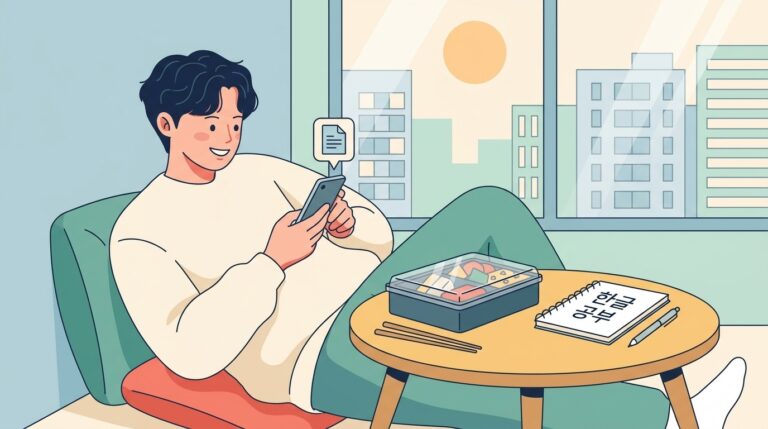
Behind these scenes lies a massive social shift in Korea: the rapid rise of 1인 가구 (Single Households). Today, nearly 40% of households in Korea consist of people living alone. Because of this, the Korean government and local districts have rolled out extensive 1인 가구 지원 정책 (Single Household Support Policies).
If you’re studying Korean at an intermediate (B2) level, knowing how to talk about these socio-economic realities will instantly elevate your Korean from ‘textbook foreigner’ to ‘local insider.’ It’s not just about politics; it’s about understanding the daily struggles and triumphs of your Korean friends. This guide is built on real conversations I’ve had with expats and international students trying to navigate adulting in Seoul. Let’s dive in!
Phase 2: Core Expressions Deep Dive
1. 1인 가구 (Single Household)
- Pronunciation: il-in gagu [ill-in gah-goo]
- Meaning: Single-person household (Literal: 1-person family)
- K-Culture Moment: You’ll see this word everywhere in Korean news, convenience store marketing (targeting 1인 가구 with smaller portions), and social programs. When a K-Pop idol on a variety show shows off their solo apartment lifestyle (like in the show I Live Alone / 나 혼자 산다), they are representing the 1인 가구.
- Editor’s Insight: This isn’t just a demographic term; it’s a cultural identity. It reflects a shift away from the traditional multi-generational family structure.
- Situation Spectrum:
- Casual (Friends): ✅
- Semi-formal (Co-workers): ✅
- Formal (Boss/News): ✅
- 🤔 Think About It: Why do Koreans use the word 가구 (household/family unit) even for a single person? It shows how the definition of ‘family’ is fundamentally evolving in modern Korea.
2. 청년 주택 (Youth Housing)
- Pronunciation: cheongnyeon jutaek [chung-nyun joo-teck]
- Meaning: Government-subsidized housing for young adults.
- K-Culture Moment: In dramas like Because This Is My First Life, housing insecurity is a huge theme. When young Koreans meet up for coffee, discussions about applying for 청년 주택 lotteries are incredibly common.
- Editor’s Insight: ‘청년’ (Youth) in Korean policy usually refers to people in their 20s to late 30s. Saying “청년 주택 당첨됐어요!” (I won the youth housing lottery!) is a reason to buy your friends a round of barbecue.
- Situation Spectrum:
- Casual: ✅
- Semi-formal: ✅
- Formal: ✅
- 🤔 Think About It: In your home country, does the government have specific housing policies exclusively targeting single, young adults?
3. 소셜 다이닝 (Social Dining)
- Pronunciation: sosyeol daining [so-shull die-ning]
- Meaning: Community dining events (often district-sponsored for single households).
- K-Culture Moment: Koreans are obsessed with sharing food. When people live alone, they miss out on 찌개 (stew) shared from a communal pot. Local governments now host ‘Social Dining’ events so single folks can cook and eat together, preventing social isolation.
- Editor’s Insight: It’s an English loanword, but it carries a very Korean emotional weight—the desire for 정 (jeong, connection) over a shared meal.
- Situation Spectrum:
- Casual: ✅
- Semi-formal: ✅
- Formal: ⚠️ (A bit too trendy for very traditional formal settings)
- 🤔 Think About It: Why use the English phrase “Social Dining” instead of a native Korean term? English loanwords are often used to make government programs sound modern and appealing to younger generations.
Phase 3: Textbook vs. Real Korean
[Talking about living alone]
* 📖 Textbook: 저는 혼자 삽니다. (I live alone.)
* 🗣️ Real Korean: 저 자취해요. (I live independently. / jeo jachwihaeyo.)
* 💡 Why the difference?: ‘자취’ specifically implies moving out of your parents’ house, usually for university or work. It highlights the action of fending for yourself.
[Struggling with rent]
* 📖 Textbook: 집세가 너무 비쌉니다. (The house rent is too expensive.)
* 🗣️ Real Korean: 이번에 월세 지원금 신청하려고요. (I’m planning to apply for the monthly rent subsidy this time. / ibeone wolse jiwongeum sincheongharyeogoyo.)
* 💡 Why the difference?: Young Koreans are proactive. Instead of just complaining, discussing practical government subsidies (지원금) is an everyday conversation topic.
Bottom Note: At the B2 level, knowing administrative terms like 지원금 (subsidy) and 신청하다 (to apply) makes you sound highly integrated into Korean society.
Phase 4: Cultural Context — K-Culture Deep Dive
4-1. Non-Verbal Cues: The ‘Housing Sigh’
When Koreans talk about real estate, rent, or moving, it’s often accompanied by a deep, half-laughing sigh. The housing market in Seoul is notoriously tough. If your Korean friend mentions applying for a housing policy, offer an empathetic nod and say, “집 구하기 진짜 힘들죠?” (Finding a house is really hard, isn’t it?). This shows high-level Nunchi (눈치).
4-2. K-Drama Connection: The Reality Behind the Romance
You’ve definitely seen it: the romantic ‘Rooftop Room’ (옥탑방) where the K-Drama leads drink beer while looking at the Seoul skyline. Critical Perspective: While dramas romanticize this, in reality, these rooms are freezing in winter and boiling in summer. The goal of 1인 가구 지원 정책 is to move young people out of these vulnerable living spaces and into secure environments. If you mention this reality to a Korean, they will be deeply impressed by your cultural understanding.
Phase 5: Real-Life Roleplay Scenario
Scenario A: The Office Break Room
- Setting: Wednesday afternoon, 2 PM. The office pantry room. You are pouring a cup of coffee.
- Characters:
- YOU: An expat working in Seoul, getting the hang of corporate life.
- Min-su (28): Your Korean junior colleague. He looks exhausted today.
Min-su: 하아… 이사하는 거 진짜 스트레스네요.
(Haa… isahaneun geo jinjja seuteureseuneyo.)
[Sigh… moving is really stressful.]
(🎭 Stage Direction: Min-su rubs his temples while holding his coffee mug)
YOU: 민수 씨, 또 이사 가요? 지금 집 계약 끝났어요?
(Minsu ssi, tto isa gayo? Jigeum jip gyeyak kkeunnasseoyo?)
[Min-su, are you moving again? Is your current house contract up?]
Min-su: 네, 주인이 월세를 너무 올려달라고 해서요. 저 같은 1인 가구는 서울에서 살아남기 너무 힘드네요.
(Ne, juini wolsereul neomu ollyeodallago haeseoyo. Jeo gateun irin gaguneun seoureseo saranamgi neomu himdeuneyo.)
[Yeah, the landlord asked to raise the monthly rent too much. It’s so hard for a single-person household like me to survive in Seoul.]
🔀 Your Turn! How should you respond?
– A) “월세가 비싸면 부모님 집으로 돌아가세요.” (If rent is expensive, go back to your parents’ house.)
– B) “혹시 청년 주택이나 월세 지원 정책 알아봤어요?”
– C) “저도 그래요! 돈이 없어요!”✅ Best Choice: B (Have you checked out youth housing or rent subsidy policies?) — Reason: It shows empathy while offering a culturally relevant, practical suggestion. It’s exactly how Korean peers support each other.
⚠️ Choice A Analysis: This can be seen as intrusive and insensitive to someone’s independence.
YOU: (Choosing B) 혹시 청년 주택이나 월세 지원 정책 알아봤어요?
(Hoksi cheongnyeon jutaegina wolse jiwon jeongchaek arabwasseoyo?)
[Have you by any chance looked into youth housing or rent subsidy policies?]
Min-su: 오! 외국인인데 그런 것도 알아요? 대박! 안 그래도 오늘 밤에 신청해보려고요.
(O! Oegugininde geureon geotdo arayo? Daebak! An geuraedo oneul bame sincheonghaeboryeogoyo.)
[Oh! You’re a foreigner but you know about that? Awesome! Actually, I’m planning to apply tonight.]
Scenario B: Convenience Store Bonus
- Setting: Your local convenience store (GS25 or CU).
- Cashier: 손님, 이거 2+1 행사 상품인데 하나 더 가져오시겠어요?
(Sonnim, igeo tu-peulleoseu-won haengsa sangpuminde hana deo gajyeoosigesseoyo?)
[Customer, this is a 2+1 promo item. Would you like to bring one more?] - YOU: 아, 저는 1인 가구라서 다 못 먹을 것 같아요. 그냥 두 개만 계산해 주세요.
(A, jeoneun irin gaguraseo da mot meogeul geot gatayo. Geunyang du gaeman gyesanhae juseyo.)
[Ah, I’m a single household so I don’t think I can eat it all. Please just ring up two.]
Phase 6: 10-Second Shadowing Drill
Practice this sentence focusing on the rhythm. In Korean, we group words by meaning!
😢 저는 / 1인 가구라서 / 청년 주택을 / 알아보고 있어요.
(jeo-neun / ir-in ga-gu-ra-seo / cheong-nyeon ju-taeg-eul / ar-a-bo-go is-seo-yo.)
[Because I am a single-person household, I am looking into youth housing.]
Tip: Don’t stress the particles (는, 를). Keep your tone smooth and slightly empathetic.
Phase 7: K-Culture Mini Dictionary
1. 자취 (Jachwi)
* Romanization: jachwi
* English: Living away from home / Independent living
* Context: Used heavily by college students and young professionals. “자취생” (jachwisaeng) means someone who lives alone.
2. 원룸 (Wonrum)
* Romanization: wonrum
* English: Studio apartment (One-room)
* Context: Konglish for a studio apartment. The most standard housing type for single people in Korea.
3. 고시원 (Goshiwon)
* Romanization: gosiwon
* English: Micro-housing / Study room
* Context: Originally cheap rooms for students studying for exams (goshi). Now often used as affordable, temporary housing with shared kitchens.
4. 혼밥 (Honbap)
* Romanization: honbap
* English: Eating alone
* Context: A portmanteau of 혼자 (alone) and 밥 (rice/meal). Once a taboo in communal Korea, it is now a massive social trend with specialized restaurants.
Phase 8: Traveler Survival Kit
Even if you are just visiting Korea for a week, you are participating in the single-person economy! Here is how to navigate it as a solo traveler.
🆘 Survival Expressions for Solo Travelers
– 🇰🇷 “여기 혼밥 되나요?” (yeogi honbap doenayo?)
– 🗣️ English Guide: [yuh-gee hohn-bap dwe-nah-yo?]
– 📍 Where to use: At restaurants when you walk in alone.
– 💡 Pro Tip: Korean BBQ places usually require a minimum of 2 portions. Ask: “혼자인데, 2인분 시켜도 되나요?” (I am alone, but can I order 2 portions?)📌 Editor’s Travel Note
– Useful Apps: ‘KakaoMap’ is better than Google Maps in Korea. Search for “1인 식당” (1-person restaurants) to find solo-friendly spots.
– Convenience Stores: GS25, CU, and 7-Eleven are heavens for solo travelers. Look for labels like “1인분” (1 portion) on fresh food.
– Tipping: Remember, NO tipping in Korea! Just pay at the counter near the exit.
Phase 9: Critical Thinking Corner — “A Step Deeper”
Food & Identity (음식과 정체성)
In traditional Korean culture, eating is profoundly communal. We share large pots of stew, eat side dishes (banchan) from the same plates, and use the word 식구 (Sikgu – family), which literally translates to ‘mouths that eat together.’ So, the rise of the 1인 가구 (single household) and the trend of 혼밥 (eating alone) caused a massive cultural shock a decade ago. It challenged the very core of Korean community identity. Government policies like ‘Social Dining’ aren’t just about feeding people; they are an attempt to recreate the lost ‘정 (Jeong)’ and community warmth in a fast-paced, individualized modern society.
💬 Your Turn: How does your culture view eating alone? Is it seen as a time for peaceful reflection, or does it carry a stigma? Let us know in the comments!
Phase 10: FAQ & Mistake Prevention
- Q: Can I ask a Korean co-worker if they live alone?
- A: Maybe, but tread lightly. While “자취하세요?” (Do you live alone?) is a common small-talk question among young people, some people prefer to keep it private for safety reasons. It’s safer to ask “통근 시간이 얼마나 걸려요?” (How long is your commute?).
- Q: I’m not Korean. Can I apply for 1인 가구 지원 정책?
- A: Generally, no. Most national housing and financial subsidies require Korean citizenship, though some local district programs (like cultural classes or social dining) might welcome registered alien residents. Always check with your local Gu-office (구청).
❌ Common Mistake #1: Confusing 월세 (Monthly Rent) and 전세 (Jeonse – Huge Lump Sum Deposit).
✅ How to fix it: If you are paying monthly, it is 월세 (wolse). Jeonse is a uniquely Korean system where you give the landlord a massive deposit (often 50-80% of the house value) and pay zero monthly rent. Don’t mix them up in conversation!
Phase 11: Summary & Action Items
- One-Liner Summary: Understanding terms like 1인 가구 and 청년 주택 unlocks the reality of modern Korean adulting, moving you past textbook phrases into deep, empathetic conversations.
-
Action Mission:
- 🥉 Bronze (Solo): Stand in front of a mirror and practice saying: “저는 1인 가구라서, 혼밥을 자주 해요.” (Because I am a single household, I eat alone often.)
- 🥈 Silver (Online): Go to a Korean language forum or app (like HelloTalk) and ask: “여러분 나라에도 청년 주택 정책이 있나요?” (Does your country have youth housing policies?)
- 🥇 Gold (Real World): Next time you talk to a Korean friend in their 20s or 30s, ask them: “요즘 서울에서 집 구하기 진짜 힘들죠?” (Finding a house in Seoul these days is really hard, right?)
- K-Culture Mission: Watch an episode of a modern K-Drama (like Record of Youth or Because This Is My First Life). Pay close attention to the characters’ living situations. Are they in a wonrum? An oktapbang? Spotting these spaces will give you a whole new appreciation for the story!
What’s the hardest part about living alone or finding a house in your country? Drop a comment below and let’s compare notes!
Phase 12: Quiz — Interactive Challenge
1. Situational Judgment: Your Korean friend says they are stressed because they have to move, but the rent is too high. What is the most culturally empathetic response?
– A) “그럼 집을 사세요!” (Then buy a house!)
– B) “청년 주택 정책 한번 찾아보는 거 어때요?” (How about looking into youth housing policies?)
– C) “저는 호텔에 살아요.” (I live in a hotel.)
(Answer: B. It offers a practical, realistic suggestion showing you understand the Korean system.)
2. Fill in the Blank: A micro-apartment originally meant for students studying for exams, now often used by low-income single households, is called a [ ______ ].
(Answer: 고시원 / Goshiwon)
3. True or False – K-Culture Edition: “It is historically a Korean tradition to eat meals completely alone.”
(Answer: False. Traditional Korean dining is highly communal. The ‘Honbap’ trend is a very modern phenomenon driven by the rise of 1인 가구.)
Frequently Asked Questions (FAQ)
Q: What does "1인 가구 (Single Household)" mean in Korean and how do you pronounce it?
A: In Korean, "1인 가구 (Single Household)" is pronounced [il-in gagu [ill-in gah-goo] and means: Single-person household (Literal: 1-person family)
Q: What does "청년 주택 (Youth Housing)" mean in Korean and how do you pronounce it?
A: In Korean, "청년 주택 (Youth Housing)" is pronounced [cheongnyeon jutaek [chung-nyun joo-teck] and means: Government-subsidized housing for young adults.
Q: What does "소셜 다이닝 (Social Dining)" mean in Korean and how do you pronounce it?
A: In Korean, "소셜 다이닝 (Social Dining)" is pronounced [sosyeol daining [so-shull die-ning] and means: Community dining events (often district-sponsored for single households).







