

Phase 1: Empathy & The “Emergency Beep”
Hello! I’m the Lead Editor of Daily Hangul.
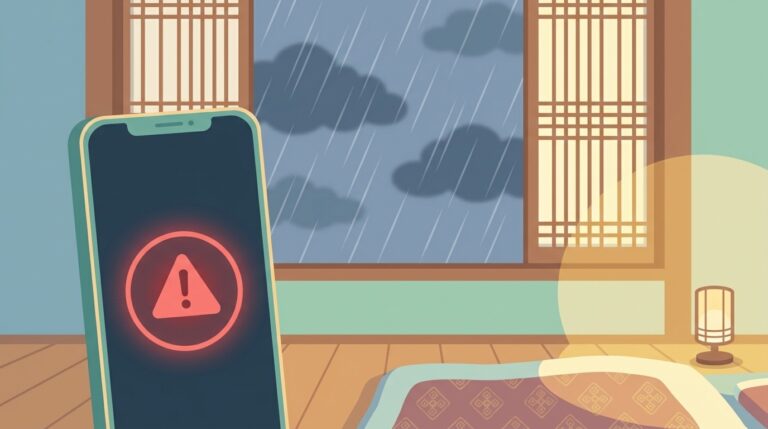
Imagine this: You’re relaxing in your beautiful Seoul Airbnb. You’ve got a full itinerary planned—visiting Gyeongbokgung Palace, eating street food at Myeongdong, and maybe hitting a K-Pop pop-up store. Suddenly, your phone erupts with an ear-piercing siren: BEEEEEP! BEEEEEP! BEEEEEP!
You jump out of your skin. You check your phone, but it’s entirely in Korean. Are we under attack? Is it an earthquake? You look out the window, and you see dark clouds and heavy rain. It’s just a
In K-Dramas, rainy days are often romantic. The main characters share a bright yellow umbrella or run through the rain laughing. But in real life, late summer in Korea brings typhoons (태풍), and the government takes safety very seriously.
As an A1 beginner, you don’t need to read the entire emergency text perfectly. But you do need to know how to communicate about the weather and stay safe! Let’s learn the essential survival phrases so you can navigate a Korean typhoon like a local.
Phase 2: Deep Dive into Core Expressions
Here are the top 3 phrases you need to know when the wind starts howling.
1. 태풍이 와요 (A typhoon is coming)
- Pronunciation: taepung-i wayo [Tae-poong-ee wa-yo]
- Meaning: Literal: Typhoon is coming. / Real nuance: A typhoon is hitting us right now.
- K-Culture Moment: You turn on the TV in your hotel room. Every news channel shows reporters standing on windy beaches in Jeju Island, struggling to hold their umbrellas. The news anchor looks serious and says this phrase.
- Editor’s Insight: The verb ‘오다’ (to come) is magical in Korean. We use it for rain (비가 와요), snow (눈이 와요), and even typhoons (태풍이 와요). Think of the weather physically traveling to visit you!
- Situation Spectrum:
- Friends (Casual): ✅ (Say: 태풍 와!)
- Coworkers (Semi-formal): ✅
- Strangers/Elders (Formal): ✅ (Perfectly polite!)
- 🤔 Think About It: Why do Koreans say the weather is “coming” instead of “it is raining” or “there is a typhoon”? Does treating the weather like an active visitor change how we react to nature?
2. 비가 많이 와요 (It’s raining a lot)
- Pronunciation: biga mani wayo [Bee-ga ma-nee wa-yo]
- Meaning: Literal: Rain a lot comes. / Real nuance: It’s pouring outside!
- K-Culture Moment: You’re inside a cozy Korean cafe. The music is soft, but outside, the sky is pouring buckets. You text your Korean friend to tell them you might be late. This is the exact phrase you type.
- Editor’s Insight: ‘비’ (bi) means rain. ‘많이’ (mani) means a lot. The ‘h’ in ‘많’ is silent! Just pronounce it smoothly like “ma-nee”.
- Situation Spectrum:
- Friends (Casual): ✅ (Say: 비 많이 와!)
- Coworkers (Semi-formal): ✅
- Strangers/Elders (Formal): ✅
- 🤔 Think About It: Koreans love talking about the weather to break the ice. Is talking about heavy rain a common small-talk topic in your country too?
3. 조심하세요 (Please be careful)
- Pronunciation: josimhaseyo [Jo-shim-ha-se-yo]
- Meaning: Literal: Please do care. / Real nuance: Stay safe! Be careful out there.
- K-Culture Moment: You’re leaving a restaurant during a storm. The kind restaurant owner (이모님 – auntie) hands you your umbrella and says this with a warm, worried look on her face.
- Editor’s Insight: This isn’t just about physical safety. It’s an expression of care and affection. When a Korean tells you “조심하세요”, they are wrapping you in a warm verbal blanket.
- Situation Spectrum:
- Friends (Casual): ✅ (Say: 조심해!)
- Coworkers (Semi-formal): ✅
- Strangers/Elders (Formal): ✅
- 🤔 Think About It: In some cultures, telling an adult to “be careful” might sound bossy. But in Korea, it’s a standard polite farewell. Why is collective safety such a strong social value here?
Phase 3: Textbook vs. Real Korean
Let’s see how textbook Korean compares to what you’ll actually hear on the streets of Seoul during a typhoon.
[Situation 1: Warning someone about the storm]
* 📖 Textbook: 매우 위험합니다. (It is very dangerous.)
* 🗣️ Real Korean: 위험해요! 조심하세요! (It’s dangerous! Be careful!)
* 💡 Why the difference?: Textbooks teach the highly formal ‘-ㅂ니다’ ending, which is great for news anchors. But in daily life, ‘-아요/어요’ is much softer and more natural for showing care.
[Situation 2: Canceling plans because of the rain]
* 📖 Textbook: 비가 많이 와서 갈 수 없습니다. (Because it rains a lot, I cannot go.)
* 🗣️ Real Korean: 비 너무 많이 와요. 다음에 봐요! (It’s raining too much. Let’s meet next time!)
* 💡 Why the difference?: Breaking sentences into shorter, emotional chunks (“It’s raining too much.”) feels much more genuine and less robotic than a long, logical explanation.
Phase 4: Cultural Context — K-Culture Deep Dive
4-1. Non-verbal Cue: The “Worried Frown”
When saying “조심하세요” (Be careful), don’t smile too brightly. Give a slight, empathetic frown and nod your head a little. This shows genuine concern. In Korean Nunchi (social awareness), matching your facial expression to the gravity of the weather is crucial.
4-2. K-Food Connection: Rain, Pancakes, and Delivery
Here’s a secret Korean cultural rule: When it rains, you must eat 파전 (Pajeon – Green onion pancakes) and drink 막걸리 (Makgeolli – Rice wine).
Why? The sound of the sizzling oil in the frying pan sounds exactly like raindrops hitting the roof!
However, during a Typhoon Advisory (태풍 주의보), things change. Koreans rely heavily on delivery apps like Baedal Minjok (배달의민족). But when the wind is too strong, delivery apps will completely shut down to protect the motorcycle delivery riders.
Critical Viewpoint: While Korea is known as the “Delivery Heaven,” the recent shift towards protecting workers’ safety during extreme weather reflects a growing social awareness. So, if there’s a typhoon, don’t try to order fried chicken—head to the nearest convenience store for some cup ramen instead!
Phase 5: Real-Life Roleplay Scenario
Setting: A Friday evening. You are sitting in the lobby of your hotel in Myeongdong. Outside, the wind is howling and the rain is aggressively hitting the glass doors. Your phone just beeped with a loud emergency alert.
Characters:
– YOU: A traveler exploring Seoul, feeling a bit confused by the alarm.
– Min-su (30s): The friendly hotel receptionist who speaks a little English but appreciates your Korean.
Dialogue:
YOU: 저기요… 이 소리 뭐예요?
(jeogiyo… i sori mwoyeyo?)
[Excuse me… what is this sound?]
(You show Min-su your phone screen)
Min-su: 아! 재난문자예요. 태풍이 와요.
(A! jaenanmunjayeyo. taepung-i wayo.)
[Ah! It’s an emergency text. A typhoon is coming.]
YOU: 진짜요? 헉…
(Jinjjayo? Heok…)
[Really? Gasp…]
Min-su: 네, 밖에 비가 많이 와요. 위험해요.
(Ne, bakke biga mani wayo. wiheomhaeyo.)
[Yes, it’s raining a lot outside. It’s dangerous.]
YOU: 오늘 식당에 가고 싶어요. 갈 수 있어요?
(Oneul sikdang-e gago sipeoyo. gal su isseoyo?)
[I want to go to a restaurant today. Can I go?]
Min-su: 안 돼요. 바람이 너무 강해요. 배달도 안 돼요.
(An dwaeyo. barami neomu ganghaeyo. baedaldo an dwaeyo.)
[No. The wind is too strong. Delivery is not available either.]
YOU: 아… 그럼 저녁은 어떡하죠?
(A… geureom jeonyeogeun eotteokhajo?)
[Ah… then what should I do for dinner?]
Min-su: 편의점이 호텔 1층에 있어요. 거기 가세요.
(Pyeonijeomi hotel 1cheung-e isseoyo. geogi gaseyo.)
[There is a convenience store on the 1st floor of the hotel. Go there.]
🔀 YOUR TURN! How do you reply?
– A) “싫어요. 저는 불고기 먹을 거예요!” (I hate it. I will eat Bulgogi!)
– B) “감사합니다. 편의점 라면 먹을게요. 조심하세요!” (Thank you. I will eat convenience store ramen. Please be careful!)
– C) “태풍 안 무서워요!” (I’m not scared of typhoons!)✅ Best Choice: B — Reason: It accepts the safety advice politely, uses the cultural staple (Ramen), and ends with the caring phrase you just learned!
⚠️ Choice A & C Analysis: They sound a bit childish and ignore the serious safety warnings. Korean Nunchi dictates we respect weather warnings.
Min-su: 네, 라면 맛있게 드세요. 방에 계세요!
(Ne, ramyeon masitge deuseyo. bang-e gyeseyo!)
[Yes, enjoy your ramen. Stay in your room!]
YOU: 네, 수고하세요!
(Ne, sugohaseyo!)
[Yes, keep up the good work!]
Phase 6: 10-Second Shadowing Drill
Let’s practice speaking with the right emotion and rhythm.
Guide: / means a short pause. Read the Korean aloud, matching the emotion tag!
😯 헉! / 비가 / 진~짜 / 많이 와요!
(Heok! / bi-ga / jin~jja / ma-nee wa-yo!)
[Gasp! / It is raining / real~ly / a lot!]
🥺 태풍이 와요. / 밖에 나가지 마세요.
(Tae-pung-ee wa-yo. / bak-ke na-ga-ji ma-se-yo.)
[A typhoon is coming. / Do not go outside.]
🙏 위험해요. / 조심하세요!
(Wi-heom-hae-yo. / jo-shim-ha-se-yo!)
[It is dangerous. / Please be careful!]
Phase 7: K-Culture Mini Dictionary
Here are 4 keywords to help you survive the stormy weather!
1. 태풍
* Romanization: tae-pung
* English: Typhoon
* Context: Similar to hurricanes. Usually hits Korea late summer to early autumn.
2. 재난문자
* Romanization: jae-nan mun-ja
* English: Emergency Alert Text
* Context: The loud, screeching text messages sent to all cell phones in a specific radius. Used for COVID, missing persons, typhoons, and heatwaves.
3. 파전
* Romanization: pa-jeon
* English: Green onion pancake
* Context: The ultimate Korean rainy-day soul food. Best paired with Makgeolli!
4. 방콕
* Romanization: bang-kok
* English: Staying stuck in one’s room
* Context: A fun slang term. ‘방’ means room, ‘콕’ means sticking to something. During a typhoon, “방콕합시다” means “Let’s stay holed up in our room!”
Phase 8: Traveler Survival Kit
Don’t let the rain ruin your trip. Here are essential survival phrases for navigating the wet streets!
🆘 Survival Phrase #1: Buying an Umbrella
– 🇰🇷 “우산 있어요?” (usan isseoyo?)
– 🗣️ Pronunciation: [oo-san iss-eo-yo?]
– 📍 Where to use: Convenience stores (CU, GS25, 7-Eleven).
– 💡 Pro Tip: Ask for an “우산” and they will usually point you to the clear vinyl umbrellas (비닐우산). They are cheap (around 5,000 KRW) and sturdy enough for a sudden downpour!🆘 Survival Phrase #2: Asking about operations
– 🇰🇷 “오늘 문 열어요?” (oneul mun yeoreoyo?)
– 🗣️ Pronunciation: [o-neul moon yeol-eo-yo?]
– 📍 Where to use: Calling a cafe or museum to see if they are open despite the typhoon.📌 Editor’s Travel Note
– Useful Apps: Download Emergency Ready App (by the Korean government) if you want alerts translated into English.
– Transportation: Subways usually run during heavy rain, but outdoor bus lines or flights (especially to Jeju) will likely be canceled. Always check your Kakao T or Naver Map apps!
Phase 9: Critical Thinking Corner — “A Step Deeper”
Language & Power: The Collective Safety Net
Why are Koreans so quick to text you “비 많이 와요. 조심하세요” (It’s raining a lot. Be careful)?
In Korea, society operates heavily on a collective mindset (공동체 의식). Safety is not just a personal responsibility; it’s a shared community concern. The extremely loud “Jaenan Munja” (Emergency Alerts) that make everyone’s phone scream simultaneously on the subway is a perfect example of this. You might find it intrusive, but it reflects a culture that believes “we must all be warned together to survive together.”
💬 Your Turn: Does your country have a similar emergency text system? How do people in your culture react when a major storm is announced? Tell me in the comments!
Phase 10: FAQ & Common Mistakes
Q: Can I use “조심하세요” to older people or my boss?
Yes! It is extremely polite and shows you care about their well-being. It is highly recommended to use it as a closing greeting on a rainy day.
Q: Should I order delivery during a typhoon?
It is highly discouraged. Delivery riders drive scooters, which are extremely dangerous in typhoon winds. Most apps will block orders anyway, but it’s good Nunchi to walk to a nearby convenience store instead.
❌ Common Mistake #1: Ignoring the “재난문자” (Emergency Alert).
✅ Do this instead: Even if you can’t read Korean perfectly, translate it with Papago! Look for keywords like 태풍 (Typhoon) or 대피 (Evacuate).❌ Common Mistake #2: Taking a taxi everywhere in the heavy rain.
✅ Do this instead: Take the subway! Seoul traffic becomes a nightmare during heavy rain, and getting a taxi on Kakao T is nearly impossible. The underground subway is your safest, driest bet.
Phase 11: Summary & Action Items
✨ One-Liner Summary:
When the alarm sounds, stay calm, grab some cup ramen, and tell your friends “태풍이 와요. 조심하세요!” (A typhoon is coming. Please be careful!).
🚀 Action Mission 3 Steps:
– 🥉 Bronze (Solo): Stand in front of your mirror and practice saying “비가 많이 와요!” with a surprised expression 3 times.
– 🥈 Silver (Online): Go to YouTube, find a Korean news clip about a typhoon (search 태풍 뉴스), and listen for the word “조심하세요”.
– 🥇 Gold (Real Life): Next time it rains (wherever you are), text your Korean friend or language partner: “오늘 비 많이 와요. 조심하세요!”
🇰🇷 K-Culture Mission:
Go to a Korean convenience store (or an Asian market in your country) and buy a cup ramen and a cheap plastic umbrella. Experience the true “Korean Rainy Day” survival kit!
Phase 12: Quiz — Interactive Challenge
Let’s test what you learned!
1. Situational Judgment:
Your phone blares a loud siren in your hotel room. You look out the window and see trees bending in the wind. What is the most appropriate text to send your Korean friend?
A) 날씨가 참 좋네요! (The weather is quite nice!)
B) 태풍이 와요. 조심하세요! (A typhoon is coming. Be careful!)
C) 빨리 배달시켜요! (Let’s order delivery quickly!)
2. True or False — K-Culture Edition:
“Koreans love to eat fried chicken when it rains, because the frying sound matches the rain.”
(True / False)
3. Fill in the Blank:
You want to ask the convenience store clerk if they sell umbrellas.
“_________ 있어요?”
👉 Click here for Answers!
- B – A typhoon is coming. A is for nice weather, and C is dangerous for riders!
- False – It’s 파전 (Pajeon – Green onion pancake) and Makgeolli!
- 우산 (usan – umbrella)
Did you enjoy this lesson? Let me know what other K-Survival situations you want me to cover next! Stay safe out there!
Frequently Asked Questions (FAQ)
Q: What does "태풍이 와요 (A typhoon is coming)" mean in Korean and how do you pronounce it?
A: In Korean, "태풍이 와요 (A typhoon is coming)" is pronounced [taepung-i wayo [Tae-poong-ee wa-yo] and means: Literal: Typhoon is coming. / Real nuance: A typhoon is hitting us right now.
Q: What does "비가 많이 와요 (It's raining a lot)" mean in Korean and how do you pronounce it?
A: In Korean, "비가 많이 와요 (It's raining a lot)" is pronounced [biga mani wayo [Bee-ga ma-nee wa-yo] and means: Literal: Rain a lot comes. / Real nuance: It's pouring outside!
Q: What does "조심하세요 (Please be careful)" mean in Korean and how do you pronounce it?
A: In Korean, "조심하세요 (Please be careful)" is pronounced [josimhaseyo [Jo-shim-ha-se-yo] and means: Literal: Please do care. / Real nuance: Stay safe! Be careful out there.







