

Phase 1: Empathy
Hello! I am the lead editor of Daily Hangul.
Imagine this: You are watching a tense Korean political drama like Designated Survivor: 60 Days. The President’s cabinet is gathered in a dimly lit, high-tech war room at the Blue House. A global crisis has just hit. The lead official slams a file on the table and says a long, intense sentence ending with “…gongjo chegye-reul mandeureoya hamnida!” The English subtitles simply read, “We need to cooperate.”
Wait, just “cooperate”? If it just meant a simple collaboration, why did it sound so heavy, so urgent?
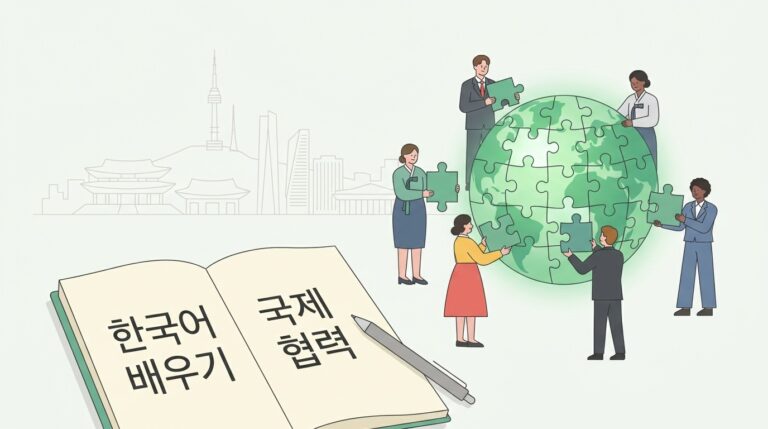
If you are an advanced (C2) Korean learner working in International Development Cooperation (ODA) or dealing with global issues like climate refugees, you know that “textbook Korean” won’t cut it in the boardroom. You are no longer just ordering an Americano; you are negotiating sustainable futures. At this level, mastering high-level Sino-Korean (Hanja) vocabulary isn’t just about showing off—it’s about earning your seat at the table as a respected global partner.
This guide is based on real experiences of foreign diplomats and NGO workers in Seoul who realized that the real negotiations don’t happen in the conference room—they happen over a boiling pot of Kimchi Jjigae. Let’s dive in.
Phase 2: In-Depth Analysis of Core Expressions
1. 국제적 공조 체계 마련이 시급합니다.
- Pronunciation: gukjejeok gongjo chegye maryeoni sigeupham니다. (gong-jo sounds like the deep hum of a ‘gong’ followed by ‘joe’)
- Meaning:
- Literal: The preparation of an international mutual-assistance system is urgent.
- Real Nuance: We desperately need a unified, global framework to tackle this crisis together.
- K-Culture Moment: This is the ultimate “Main Character NGO Worker” line. In dramas, this is said by the passionate protagonist facing a stubborn committee. It carries a sense of undeniable gravity.
- Editor’s Insight: Forget the basic word ‘협력’ (collaboration). ‘공조’ (共助) specifically means ‘mutual assistance’—often used by police forces or nations tackling cross-border crises. It implies that if we don’t work together, we both fall.
- Situation Spectrum:
- Friends (Casual): 🚫 (Unless you’re sarcastically planning a surprise party)
- Co-workers (Semi-formal): ⚠️ (A bit too formal for casual office chat)
- Official Meetings/Superiors (Formal): ✅ (Perfect for conferences)
- 🤔 Think About It: Why does Korean have so many distinct words for “helping” (도움, 협력, 지원, 공조)? What does this say about a culture that historically relied on collective farming (품앗이) to survive?
2. 일회성 원조가 아닌 자립 기반을 조성해야 합니다.
- Pronunciation: ilhoeseong wonjoga anin jarip gibaneul joseonghaeya hamnida.
- Meaning:
- Literal: We must create a foundation for independence, not one-time aid.
- Real Nuance: We need to focus on sustainable empowerment, not just throwing money at the problem.
- K-Culture Moment: If you watch Korean news (뉴스) in the back of a Seoul taxi, you will hear politicians use the phrase ‘자립 기반’ (foundation for self-reliance) constantly when discussing welfare or foreign aid.
- Editor’s Insight: This sentence captures the very soul of South Korea’s ODA philosophy. Korea is extremely proud of being the only country to transition from a major aid recipient (post-Korean War) to a major donor. They don’t just want to give; they want to teach others how to thrive independently.
- Situation Spectrum:
- Friends (Casual): 🚫
- Co-workers (Semi-formal): ✅
- Official Meetings/Superiors (Formal): ✅
- 🤔 Think About It: How does your country’s history shape the vocabulary you use when discussing international aid?
3. 기후 난민을 위한 인도적 지원 방안
- Pronunciation: gihu nanmineul wihan indojeok jiwon bangan.
- Meaning:
- Literal: Humanitarian support measures for climate refugees.
- Real Nuance: Actionable humanitarian aid strategies for people displaced by climate change.
- K-Culture Moment: You’ll see these exact words plastered across huge banners at international conventions hosted at COEX or KINTEX.
- Editor’s Insight: Pay attention to ‘방안’ (measures/plans). In Korean professional settings, you can’t just talk about a problem; you are always expected to present a ‘방안’.
- Situation Spectrum:
- Friends (Casual): 🚫
- Co-workers (Semi-formal): ✅
- Official Meetings/Superiors (Formal): ✅
Phase 3: Textbook vs. Real Korean
[Situation 1: Discussing the urgency of the climate crisis]
* 📖 Textbook Korean: 이 문제는 지금 매우 중요합니다. (This problem is very important right now.)
* 🗣️ Real Korean: 이거 골든타임(Golden Time) 놓치면 절대 안 됩니다. (We absolutely cannot miss the golden time for this.)
* 💡 Why is it different?: “Golden Time” (Konglish for the critical window of opportunity) is a massive buzzword in Korea, used in medical dramas, politics, and business to emphasize absolute urgency.
[Situation 2: Calling for a large-scale global effort]
* 📖 Textbook Korean: 우리가 다 같이 해결해야 합니다. (We must all solve this together.)
* 🗣️ Real Korean: 이건 범국가적(Pan-national) 차원에서 대응해야 할 사안입니다. (This is an issue that requires a pan-national response.)
* 💡 Why is it different?: Korean professionals love adding the prefix “범-” (pan- / all-encompassing) to stress the massive scale and seriousness of a project.
Bottom Note for C2 Learners: At your level, naturally dropping “골든타임” or “범국가적” in a meeting will make Korean delegates look at you with deep respect. It shows you don’t just know the dictionary; you know the boardroom pulse.
Phase 4: Cultural Context — K-Culture Deep Dive
4-1. Non-Verbal Cues: The Diplomatic ‘Nunchi’ (눈치)
In Korean professional settings, language is only 30% of the communication. When discussing heavy topics like climate refugees, maintaining a solemn expression (진지함) is crucial. Do not smile too brightly when discussing aid; it can be seen as taking the crisis lightly. Furthermore, use your Nunchi to read the hierarchy in the room—always direct your concluding remarks toward the highest-ranking official (usually the oldest person at the center of the table).
4-2. The “Hoesik” (회식) Diplomacy
You’ve finished the official climate summit. What now? You go to a Korean BBQ restaurant for Hoesik (staff dinner). In Korean business culture, the conference room is for stating official positions; the BBQ table is where actual compromises are made.
– Critical View: While Hoesik builds incredible solidarity (정), it can also blur the lines of professional boundaries. However, as an international worker, participating in this ritual—pouring a drink with two hands for a KOICA director—will break the ice faster than a 50-page ODA proposal.
Phase 5: Real-Life Roleplay Scenario
Setting: Friday, 7:30 PM. A high-end Samgyeopsal (pork belly) restaurant in Gangnam. The air is thick with savory smoke, and the clinking of Soju glasses provides a constant background beat. You have just wrapped up a 10-hour forum on “Asia-Pacific Climate Refugee Support.”
Characters:
– YOU: An international NGO director. You want South Korea to increase its technical support for climate displaced persons in Southeast Asia.
– Director Park (55): A veteran director at KOICA. Stern in the office, but currently relaxed, holding a pair of tongs to grill the meat.
Dialogue:
Director Park: 오늘 발표 아주 인상 깊었어요. 특히 기후 난민 자립 문제… 우리가 많이 고민해야 할 부분입니다. 🥩
(oneul balpyo aju insang gipeosseoyo. teukhi gihu nanmin jarip munje… uriga mani gominhaeya hal bubunimnida.)
[Translation: Your presentation today was very impressive. Especially the issue of climate refugees’ self-reliance… it’s an area we need to think deeply about.]
YOU: 좋게 봐주셔서 감사합니다. 한국의 발전 경험이 그들에게 큰 희망이 될 겁니다.
(joke bwajusyeoseo gamsahamnida. hangugui baljeon gyeongheomi geudeurege keun huimangi doel geomnida.)
[Translation: Thank you for the kind words. Korea’s experience with development will be a great hope for them.]
Director Park: 허허, 그렇긴 한데… 사실 예산 늘리는 게 쉽지가 않아요. 위원회 설득하는 게 참…
(heoheo, geureokin hande… sasil yesan neullineun ge swipjiga anayo. wiwonhoe seoldeukaneun ge cham…)
[Translation: Haha, that’s true, but… honestly, increasing the budget isn’t easy. Persuading the committee is quite…]
(🎭 Stage Direction: Director Park sighs and pours himself a shot of Soju. He is testing the waters to see how much you understand the internal politics.)
🔀 Your Turn! How do you respond?
– A) “포기하지 마세요! 할 수 있습니다!” (Don’t give up! You can do it!)
– B) “맞습니다. 하지만 지금이 공조 체계를 굳힐 골든타임 아닐까요? 저희가 명분을 만들어 드리겠습니다.”
– C) “아, 예산이 없군요. 헐, 대박 아쉽네요.”✅ Best Choice: B — “You’re right. But isn’t now the golden time to solidify our cooperation system? We will help create the justification (명분) for you.” This shows immense cultural intelligence. You acknowledge his difficulty, use a high-level buzzword (골든타임), and offer to save his face (명분) with his superiors.
⚠️ Choice A Analysis: Sounds like a naive cheerleader. Not suitable for C2 level diplomacy.
⚠️ Choice C Analysis: “헐, 대박” (Whoa, crazy) is slang for teenagers and close friends. Using this with a 55-year-old director will immediately destroy your professional credibility.
Phase 6: 10-Second Shadowing Drill
Let’s practice delivering that heavy, professional sentence with the right pacing and intonation.
😤 일회성 / 원조가 아닌, / 지속 가능한 / 자립 기반 조성이 / 시급합니다.
(ilhoeseong / wonjoga anin, / jisok ganeunghan / jarip giban joseongi / sigeuphamnida.)
[Translation: We urgently need a sustainable foundation for self-reliance, not one-time aid.]
Tip: Pause slightly at the slashes. Emphasize “자립” (self-reliance) and “시급” (urgent) to sound like a native Korean news anchor or policy maker!
Phase 7: K-Culture Mini Dictionary
1. 명분 (Myeongbun)
* Romanization: myeongbun
* English: Justification / Cause / Face-saving rationale
* Context: In Korean politics and business, you cannot just do something because it’s logical; you need a strong moral or social “myeongbun” to persuade the public and superiors.
2. 공조 (Gongjo)
* Romanization: gongjo
* English: Mutual assistance / Cooperation
* Context: Used heavily in news regarding international relations (e.g., 한미 공조 – Korea-US cooperation), emphasizing acting as one unified body.
3. 회식 (Hoesik)
* Romanization: hoesik
* English: Company dinner / Networking dinner
* Context: The unofficial continuation of the workday. For ODA workers, this is where you build the personal trust (정 – Jeong) required to get projects approved.
4. 개도국 / 선진국 (Gaedoguk / Seonjinguk)
* Romanization: gaedoguk / seonjinguk
* English: Developing country / Developed country
* Context: Shortened from 개발도상국 and 선진국. South Korea’s identity shift from Gaedoguk to Seonjinguk heavily influences its empathy-driven ODA policies.
Phase 8: Traveler’s (and Expat’s) Survival Kit
Even global policy-makers get lost in Seoul’s massive convention centers like COEX (where climate summits are often held).
🆘 Survival Phrases for the Conference Goer
– 🇰🇷 “국제 개발 협력 포럼 행사장이 어디예요?” (gukje gaebal hyeomnyeok poreom haengsajangi eodiyeyo?)
– 🗣️ English Guide: Where is the venue for the International Development Cooperation Forum?
– 📍 Where to use: Info desks at COEX or KINTEX.
– 💡 Pro Tip: Convention centers in Seoul are basically labyrinths attached to massive underground malls. If you get lost, follow the people wearing lanyards!📌 Editor’s Travel Note
– Useful Apps: KakaoMap or Naver Map. Google Maps does not provide walking directions in Korea due to national security laws!
– Transportation: Buy a T-Money card at any convenience store. It works for subways, buses, and even taxis.
– Tipping: Korea is strictly a NO-TIP culture. Do not try to tip the taxi driver or the server at the BBQ restaurant—they will chase you down the street to return your money!
Phase 9: Critical Thinking Corner — “A Step Deeper”
🧠 Think Deeper: Language & Power in Korea’s ODA Identity
South Korea’s approach to ODA is deeply tied to its historical trauma and rapid economic miracle. When Korean officials insist on “자립” (self-reliance) rather than just “원조” (aid), it reflects their own painful memory of relying on foreign food rations after 1953. The Korean language reflects this power dynamic sensitively. As a foreigner working in this space, recognizing that Korea views developing nations not just as “recipients” but as “younger versions of itself” is crucial. The language used in Korean ODA documents often sounds highly empathetic yet aggressively development-focused (like a strict but caring older sibling).💬 Your Turn: Does your home country approach international aid with a sense of shared history, or is it purely viewed as a diplomatic tool? How does your language reflect this? Share in the comments!
Phase 10: FAQ & Avoiding Mistakes
Q: Can I use “공조” (gongjo) when asking a coworker to help me with an Excel sheet?
* No! That would sound hilarious, like asking the UN to help you format your spreadsheet. Stick to “도와주세요” (dowajuseyo) or “협조 부탁드립니다” (hyeopjo butakdeurimnida) for office tasks.
Q: In a formal meeting with climate refugees, should I use the highest form of honorifics?
* Yes. Even if you are the donor, Korean culture dictates showing utmost respect in formal settings, using ~ㅂ니다/습니다 forms. Treating aid recipients with linguistic dignity is considered the baseline of humanitarian work.
❌ Common Mistake #1: Calling your Korean counterpart “[First Name]-ssi” in a formal business setting.
✅ Do this instead: Always use their title. If they are a Director, call them “국장님” (Gukjang-nim). If you don’t know, “대표님” (Daepyo-nim) or “선생님” (Seonsaeng-nim) is a safe bet.
Phase 11: Summary & Action Items
One-Liner Summary: To navigate Korea’s International Development sphere, ditch the textbook “help” and master high-level terms like ‘공조’ (mutual assistance) and ‘자립’ (self-reliance) while mastering the unspoken art of the Hoesik.
Your Action Missions:
– 🥉 Bronze (Solo): Stand in front of a mirror and deliver the shadowing drill sentence with your best “serious K-Drama official” face.
– 🥈 Silver (Online): Find a Korean news article on YouTube about “기후 난민” (Climate Refugees) and leave a supportive comment in Korean.
– 🥇 Gold (Real World): At your next meeting with Korean counterparts, use the phrase “골든타임을 놓치면 안 됩니다” to emphasize a deadline. Watch their eyes light up with respect!
🌍 K-Culture Mission for ODA Workers:
Next time you watch a Korean political/medical drama, listen carefully for the word “명분” (justification) or “골든타임” (Golden time). Notice how the characters’ body language changes when they say it!
Phase 12: Interactive Quiz
1. Situational Judgment: You are writing an official email to KOICA regarding a joint project for climate refugees. Which closing is most appropriate?
– A) 우리 같이 잘해봐요! 화이팅!
– B) 훌륭한 공조 체계 구축을 기대합니다.
– C) 빨리 골든타임 잡아봅시다. 대박 기원!
Answer: B. A is too casual, and C mixes a serious buzzword with inappropriate slang (“대박”).
2. True or False – K-Culture Edition:
“During a dinner negotiation (Hoesik) regarding an ODA budget, you should leave a generous tip on the table to show gratitude.”
Answer: False! Korea has no tipping culture. It will cause confusion, not gratitude.
Frequently Asked Questions (FAQ)
Q: What does "국제적 공조 체계 마련이 시급합니다." mean in Korean and how do you pronounce it?
A: In Korean, "국제적 공조 체계 마련이 시급합니다." is pronounced [gukjejeok gongjo chegye maryeoni sigeupham니다. (gong-jo sounds like the deep hum of a 'gong' followed by 'joe'] and means: Literal: The preparation of an international mutual-assistance system is urgent.
Q: What does "일회성 원조가 아닌 자립 기반을 조성해야 합니다." mean in Korean and how do you pronounce it?
A: In Korean, "일회성 원조가 아닌 자립 기반을 조성해야 합니다." is pronounced [ilhoeseong wonjoga anin jarip gibaneul joseonghaeya hamnida.] and means: Literal: We must create a foundation for independence, not one-time aid.
Q: What does "기후 난민을 위한 인도적 지원 방안" mean in Korean and how do you pronounce it?
A: In Korean, "기후 난민을 위한 인도적 지원 방안" is pronounced [gihu nanmineul wihan indojeok jiwon bangan.] and means: Literal: Humanitarian support measures for climate refugees.







