

Phase 1: Empathy (The K-Culture Cold Open)
Hello! I’m your Daily Hangul Editor.
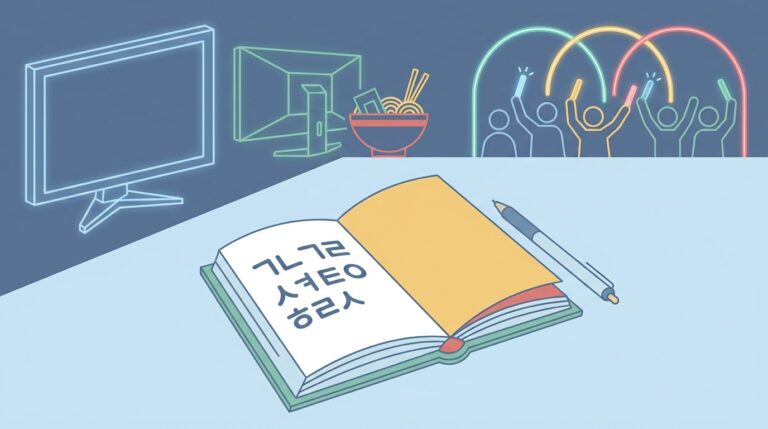
Picture this: It’s a Friday night in Seoul. You’re sitting in a dimly lit, neon-glowing PC Bang (PC방). To your right, there’s a steaming bowl of Shin Ramyeon and a crispy hotdog you ordered straight from your computer screen. On your monitor, the League of Legends World Championship finals are playing. Suddenly, the Korean player pulls off an impossible move. The entire PC Bang erupts. People are slamming their desks and shouting something that sounds like “Kaeri!!” and “Micheotda!!”
If you just learned textbook Korean, you might be wondering, “Wait, did someone just say ‘carry’ and ‘crazy’? What’s going on?”
Understanding e-sports and PC Bang terminology isn’t just about gaming; it’s your VIP pass to understanding the young, dynamic, and fast-paced heartbeat of modern Korean culture. E-sports in Korea isn’t just a hobby—it’s a massive cultural phenomenon, complete with idol-level fandoms, fanchants, and national pride.
Today, we are going to dive into the real, raw Korean expressions you need to survive (and thrive) in a Korean PC Bang or e-sports arena. Everything here is based on what actual Korean gamers shout at their screens!
Phase 2: Core Expressions Deep Dive
1. 폼 미쳤다 (Form is crazy)
- Pronunciation: [pom micheotda] / Sounds like pom mee-chut-dah (Make the ‘ch’ sound sharp and abrupt!)
- Meaning: Literal: Form is crazy. / Real Nuance: Someone is playing at their absolute peak; they are on fire.
- K-Culture Moment: You’ll hear this not just in e-sports stadiums like LoL Park, but also when watching K-Pop idols perform a flawless dance routine, or even when your friend aces an exam.
- Editor’s Insight: This expression perfectly captures the dramatic flair of Korean slang. By calling someone’s skill “crazy” (미쳤다), you are giving them the ultimate compliment. It’s an exclamation of pure awe.
- Situation Spectrum:
- Friends & Gamers (Casual): ✅
- Close Coworkers (Semi-formal): ⚠️ (Use with caution, maybe add ‘요’ -> 미쳤어요)
- Boss/Elders (Formal): 🚫
- 🤔 Think About It: Why do Koreans use extreme words like “crazy” or “die” (죽겠다) to express positive emotions? Does your language have a similar way of exaggerating for a compliment?
2. 하드캐리하다 (To hard carry)
- Pronunciation: [hadeu-kaerihada] / Sounds like ha-deu kae-ree-ha-dah
- Meaning: Literal: To hard carry. / Real Nuance: To single-handedly lead a team to victory, despite the team’s poor performance.
- K-Culture Moment: In K-Dramas, when the genius intern saves the entire marketing team from a disastrous presentation, the colleagues will say, “Wow, the intern hard-carried today!”
- Editor’s Insight: This is a classic example of ‘Konglish’ (Korean + English) born from gaming that has completely infiltrated daily life. You can use it in group projects, sports, or business.
- Situation Spectrum:
- Friends (Casual): ✅
- Coworkers (Semi-formal): ✅ (Very common in young offices! “과장님이 하드캐리하셨어요!”)
- Formal/Traditional: 🚫
- 🤔 Think About It: “Carry” implies taking a burden. It reflects the Korean collective mindset—if the group is failing, one person steps up to carry the weight for the team.
3. 졌잘싸 (Lost but fought well)
- Pronunciation: [jeot-jjal-ssa] / Sounds like jut-jjal-ssah (Emphasize the double ‘jj’ and ‘ss’ for an authentic feel!)
- Meaning: Literal: An abbreviation of 졌지만 잘 싸웠다 (Lost, but fought well). / Real Nuance: “Good effort,” “Valiant defeat,” or “GG.”
- K-Culture Moment: When the Korean national team loses a heartbreaking match at the World Cup or an e-sports team loses in the finals after a 5-hour marathon, the internet comments will be flooded with “졌잘싸 ㅠㅠ”.
- Editor’s Insight: It’s the ultimate comfort phrase. It acknowledges the bitter reality of losing but honors the sweat and tears poured into the game.
- Situation Spectrum:
- Friends/Online (Casual): ✅
- Coworkers/Semi-formal: ⚠️ (Usually used online or casually)
- Boss/Elders (Formal): 🚫
- 🤔 Think About It: Notice how Koreans love to abbreviate long phrases (졌지만 잘 싸웠다 -> 졌잘싸). Why do you think modern Korean slang relies so heavily on abbreviations?
Phase 3: Textbook vs. Real Korean
[Reacting to an amazing play on screen]
* 📖 Textbook Korean: 아주 잘했어요! (You did very well!)
* 🗣️ Real Korean: 와, 폼 미쳤다! / 대박! (Wow, form is crazy! / Epic!)
* 💡 Why the difference?: “잘했어요” sounds like a teacher praising a kindergarten student. In the heat of an e-sports match, you need explosive, emotional slang to match the adrenaline.
[Telling your teammate they are dragging the team down]
* 📖 Textbook Korean: 당신 때문에 지고 있어요. (We are losing because of you.)
* 🗣️ Real Korean: 아, 제발 버스 좀 타세요! (Ah, please just ride the bus!)
* 💡 Why the difference?: “Riding the bus” (버스를 타다) is gamers’ slang for “just sit still and let me carry you.” It’s metaphorical, witty, and slightly passive-aggressive—a staple of gaming culture.
Bottom Note: As a B2 learner, using terms like 폼 미쳤다 or 캐리하다 will instantly make Korean friends see you as “one of them.” Just remember to keep it among friends!
Phase 4: Cultural Context — K-Culture Deep Dive
4-1. Non-verbal Cues: The Art of PC Bang “Nunchi”
In Korea, Nunchi (눈치 – the ability to read the room) applies even in a noisy PC Bang. While cheering during an e-sports viewing party is great, sudden, aggressive shouting when people are quietly grinding their own games is a breach of Nunchi. You’ll notice Koreans express intense emotion through rapid keyboard clicking or synchronized, breathy gasps (“헐…” – Heol) rather than just screaming.
4-2. K-Culture Connection: E-Sports is the new K-Pop & K-Food Paradise
If you watch a live e-sports match in Seoul, you’ll immediately notice something familiar: it looks exactly like a K-Pop concert. Fans bring custom lightsticks, hold up beautifully decorated fan signs, and even have coordinated fan chants (응원법) for players like Faker (T1). E-sports athletes are treated as A-list celebrities, shooting commercials and featuring on variety shows.
Furthermore, the PC Bang is a marvel of K-Food. It’s an unwritten rule: you cannot watch a gaming tournament in a PC Bang without ordering food from your seat. From Sotteok-Sotteok (sausage and rice cake skewers) to gourmet Ramyeon topped with egg and cheese, the “PC Bang Mukbang” is an essential cultural experience.
Phase 5: Real-Life Roleplay Scenario
Setting: Saturday afternoon, 4 PM. You are inside a premium PC Bang in Hongdae. The air smells like spicy ramen and fried chicken. You and your Korean friend, Min-ho, are watching the grand finals of an e-sports tournament on your monitors.
Characters:
– YOU: A B2 Korean learner, passionate about e-sports, eager to use local slang.
– Min-ho (28): Your Korean friend, a hardcore gamer who takes matches very seriously.
Dialogue:
Min-ho: 아… 우리 팀 지금 너무 불리한데. 지겠다.
(A… uri tim jigeum neomu bullihande. Jigetta.)
[Ah… our team is at such a disadvantage right now. We’re going to lose.]
YOU: 아직 몰라요! 역전할 수 있어요!
(Ajik mollayo! Yeokjeonhal su isseoyo!)
[We don’t know yet! We can make a comeback!]
Min-ho: 에이, 상대편 정글러 폼이 미쳤잖아. 완전 하드캐리 중이야.
(Ei, sangdaepyeon jeonggeulleo pomi micheotjana. Wanjeon hadeukaeri jung-iya.)
[No way, the opponent jungler’s form is crazy. He’s totally hard-carrying.]
(🎭 Stage Direction: Suddenly, on the screen, the Korean team steals the main objective in a miraculous 1-vs-3 play! The PC Bang crowd gasps.)
Min-ho: 와!!!! 대박!!!! 방금 봤어?!!!
(Wa!!!! Daebak!!!! Banggeum bwasseo?!!!)
[Wow!!!! Epic!!!! Did you just see that?!!!]
🔀 Your Turn! How do you reply?
– A) 네, 아주 훌륭한 플레이였어요! (Yes, it was a very excellent play!)
– B) 와 미쳤다!! 진짜 하드캐리네!! (Wow, that’s crazy!! Total hard-carry!!)
– C) 조용히 좀 하세요! (Please be quiet!)✅ Best Choice: B — Perfect execution of gamer slang and matching Min-ho’s hype level.
⚠️ Choice A Analysis: Too textbook. It sounds like a sports commentator from the 1980s.
⚠️ Choice C Analysis: You just ruined the hype! While Nunchi is important, this is a globally shared moment of excitement.
Min-ho: 와, 텐션 올라간다! 우리 뭐 좀 먹으면서 볼까? 출출하지 않아?
(Wa, tensyeon ollaganda! Uri mwo jom meogeumyeonseo bolkka? Chulchulhaji ana?)
[Wow, the tension is rising! Should we eat something while watching? Aren’t you hungry?]
YOU: 좋아요! 피시방 오면 라면은 필수죠. 제가 쏠게요!
(Joayo! Pisibang omyeon ramyeoneun pilsujyo. Jaega ssolgeyo!)
[Sounds good! Ramen is a must when you come to a PC Bang. It’s my treat!]
Phase 6: 10-Second Shadowing Drill
Speak out loud! Focus on the pauses (/) and the emotion tags.
😲 와, / 방금 플레이 / 진짜 / 폼 미쳤다!
(Wa, / banggeum peullei / jinjja / pom micheotda!)
😢 아쉽지만, / 그래도 / 졌잘싸!
(Aswipjiman, / geuraedo / jeot-jjal-ssa!)
Phase 7: K-Culture Mini Dictionary
Here are 4 essential words to level up your gaming/viewing vocabulary:
1. 피방 (Pibang)
* Romanization: pibang
* English: PC Bang (Internet Cafe)
* Context: The shortened, widely used slang for PC Bang (PC방). Friends will text each other “피방 ㄱㄱ?” (Pibang gogo?).
2. 직관 (Jikgwan)
* Romanization: jikgwan
* English: Watching live in person
* Context: Short for 직접 관람 (direct viewing). Used when you actually go to the stadium (like LoL Park) to watch the game instead of watching the stream at home.
3. 입롤 (Ib-rol)
* Romanization: ib-rol
* English: Backseat gaming (Playing LoL with your mouth)
* Context: Refers to a viewer who constantly criticizes pro players and acts like they know better. “입” means mouth, and “롤” means LoL (League of Legends).
4. 빡겜 (Ppak-ggem)
* Romanization: ppak-ggem
* English: Try-hard gaming / Sweaty gaming
* Context: When you stop playing casually and lean forward in your chair to play extremely seriously. “빡치다” (angry/intense) + “게임” (game).
Phase 8: Traveler’s Survival Kit
Heading to an e-sports arena or a PC Bang in Seoul? Here are the survival phrases you need!
🆘 Survival Expression #1: PC Bang Registration
– 🇰🇷 “비회원으로 할게요.” (Bi-hoewoneuro halgeyo.)
– 🗣️ Pronunciation: [bee-hoe-won-eu-ro hal-ge-yo]
– 📍 Where to use: At the PC Bang payment kiosk.
– 💡 Pro Tip: Creating a member account at a PC Bang requires a Korean ID or phone number. As a traveler, just select “Non-member” (비회원) on the kiosk and buy a pre-paid ticket!🆘 Survival Expression #2: Asking for directions
– 🇰🇷 “롤파크 어떻게 가요?” (Rol-pakeu eotteoke gayo?)
– 🗣️ Pronunciation: [rol-pa-keu uh-tuh-keh ga-yo]
– 📍 Where to use: Jonggak Station (종각역) near LoL Park.🆘 Survival Expression #3: Food Ordering
– 🇰🇷 “음식 주문은 어디서 해요?” (Eumsik jumuneun eodiseo haeyo?)
– 🗣️ Pronunciation: [eum-sik joo-moon-eun uh-dee-suh hae-yo]
– 📍 Where to use: PC Bang counter.
– 💡 Pro Tip: You don’t actually need to ask this! 99% of Korean PC Bangs require you to order food directly through the software on your PC monitor. The staff will bring it to your desk.
📌 Editor’s Travel Note:
– App to use: Naver Map (Google Maps doesn’t work well for walking directions in Korea).
– Payment: PC Bang kiosks mostly accept physical credit cards or cash. Apple Pay is rarely accepted yet.
– Etiquette: It’s okay to chat, but don’t shout into your mic so loudly that the whole room hears you.
Phase 9: Critical Thinking — “One Step Deeper”
Global Era: Konglish in the Gaming World
Have you noticed how many Korean gaming terms are based on English? Words like 캐리하다 (Carry), 파밍하다 (Farming/Grinding), and 갱 가다 (Ganking).
However, Koreans don’t just borrow English words; they completely integrate them into Korean grammar by attaching the verb 하다 (to do). This reflects how the Korean language dynamically evolves in the global era. Instead of creating entirely new, traditional Korean words for foreign tech concepts, the younger generation prioritizes speed, efficiency, and global connectivity. But this also sparks a debate in Korea about the loss of “pure” Korean language.
💬 Your Turn: Does your native language borrow English words for gaming or internet slang and change their grammar? Share your examples in the comments!
Phase 10: FAQ & Avoiding Misunderstandings
Q: Can I write “폼 미쳤다” on my favorite idol’s live stream chat?
Yes! Absolutely. Idols love seeing fans use trendy slang. It shows you really understand the culture.
Q: Can I use “캐리하다” in a business meeting?
Maybe. If your office has a very young, startup-style culture, it’s fine to say “지훈 씨가 이번 프로젝트 하드캐리했어요” (Jihoon hard-carried this project). But avoid it in front of senior management or traditional companies.
Q: If I want to eat outside food in a PC Bang, is that okay?
No! PC Bangs actually make most of their profit from food sales, not PC usage fees. Bringing outside food is generally strictly prohibited.
❌ Common Mistake #1: Saying “너 폼 미쳤다” (Your form is crazy) to someone older than you. The slang itself is very informal, and using “너” (you) to an elder is extremely rude.
✅ Do this instead: Stick to “선배님 정말 대단하세요!” (Senior, you are truly amazing!) in formal situations.
Phase 11: Summary & Action Items
One-Liner Summary: From praising an epic play with “폼 미쳤다” to cheering a valiant loss with “졌잘싸,” Korean e-sports slang is your key to experiencing the country’s passionate gaming culture.
Action Mission 3 Steps:
– 🥉 Bronze: Say “와, 폼 미쳤다!” out loud three times while watching your favorite K-Pop music video or K-Drama scene.
– 🥈 Silver: Go to a Korean YouTube video about e-sports (or anything impressive) and leave a comment: “[Player name] 폼 미쳤다!”
– 🥇 Gold: Find a local PC Bang (if you’re in Korea) or log into a Korean server, and type “버스 좀 태워주세요” (Please carry me / let me ride the bus) in the chat!
🎮 K-Culture Mission:
Search “LoL Worlds Korean Casters Reaction” on YouTube. Listen closely and try to catch the moment they scream “캐리!” or “미쳤다!”
Did you enjoy today’s guide? What’s your favorite game to play or watch? Let me know in the comments below!
Phase 12: Quiz — Interactive Challenge
Q1. Situational Judgment:
Your Korean friend just barely lost an incredibly difficult Starcraft match after playing brilliantly for an hour. What is the most culturally appropriate thing to text them?
1) 폼 미쳤다!
2) 당신 때문에 졌어요.
3) 졌잘싸 ㅠㅠ
4) 하드캐리!
Q2. Fill in the Blank:
To ask someone to “carry” you in a game, Koreans metaphorically ask to ride a ________.
“[ ] 좀 타자!”
1) 비행기 (Airplane)
2) 택시 (Taxi)
3) 버스 (Bus)
4) 자전거 (Bicycle)
Q3. True or False – K-Culture Edition:
If you want to order Ramyeon in a Korean PC Bang, you must walk to the front counter, order, and bring it to your desk yourself. (T/F)
(Answers: Q1: 3, Q2: 3, Q3: False – You order from your PC monitor and the staff brings it to you!)
Frequently Asked Questions (FAQ)
Q: What does "폼 미쳤다 (Form is crazy)" mean in Korean and how do you pronounce it?
A: In Korean, "폼 미쳤다 (Form is crazy)" is pronounced [pom micheotda] and means: Literal: Form is crazy. / Real Nuance: Someone is playing at their absolute peak; they are on fire.
Q: What does "하드캐리하다 (To hard carry)" mean in Korean and how do you pronounce it?
A: In Korean, "하드캐리하다 (To hard carry)" is pronounced [hadeu-kaerihada] and means: Literal: To hard carry. / Real Nuance: To single-handedly lead a team to victory, despite the team's poor performance.
Q: What does "졌잘싸 (Lost but fought well)" mean in Korean and how do you pronounce it?
A: In Korean, "졌잘싸 (Lost but fought well)" is pronounced [jeot-jjal-ssa] and means: Literal: An abbreviation of 졌지만 잘 싸웠다 (Lost, but fought well). / Real Nuance: "Good effort," "Valiant defeat," or "GG."







