

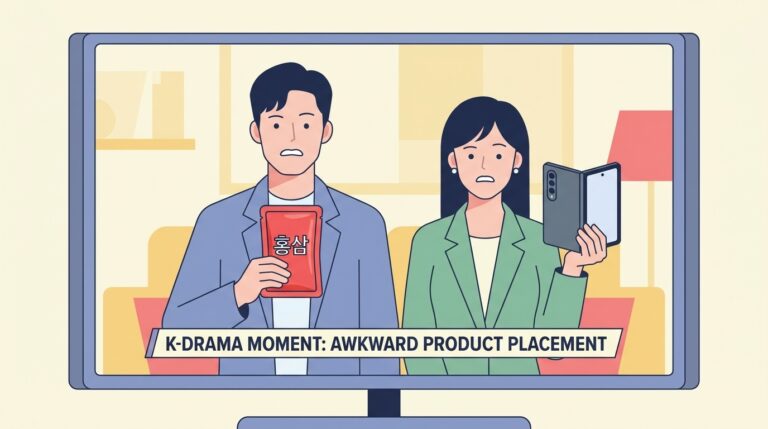
Phase 1: Empathy (The K-Culture Cold Open)
Hello! I’m the lead editor of Daily Hangul.
Picture this: You are deeply engrossed in a thrilling K-Drama. The male lead is frantically chasing a suspect down a dark alley. The tension is palpable. The music swells. Suddenly, he stops, pulls out a bright pink multi-balm stick, heavily rubs it on his cheeks and lips, and then dramatically downs a pouch of red ginseng extract.
Wait… what just happened?
If you’ve watched more than five K-Dramas, you know exactly what I’m talking about. The infamous K-Drama PPL (Product Placement). While subtitles might just translate the dialogue as “I need some energy,” the Korean internet is already ablaze with comments furiously typing about how their ‘immersion was shattered.’
At a C2 Advanced level, learning Korean is no longer just about ordering food or asking for directions. It’s about participating in the cultural discourse. In Korea, media consumers are highly active critics. Understanding the vocabulary surrounding PPL (간접 광고) and Viewers’ Rights (시청권) is your golden ticket to truly sounding like a local insider when discussing pop culture. Let’s dive in!
Phase 2: Deep Dive into Core Expressions
When Korean viewers encounter aggressive PPL that ruins the storyline, they don’t use textbook phrases. Here are the advanced expressions they actually use.
1. 뜬금없다
- Pronunciation: [tteun-geum-eop-da] (The ‘eu’ in ‘tteun’ sounds like the disgusted grunt you make when stepping in gum).
- Meaning: Literal: To be without a foundation. Real nuance: Completely out of the blue, random, or lacking logical context (개연성).
- K-Culture Moment: You are discussing last night’s drama episode with your coworkers. Someone says, “Did you see the sudden coffee machine close-up? 아, 진짜 너무 뜬금없지 않아요? (Ah, seriously, wasn’t that so random?)”
- Editor’s Insight: This word captures the sheer absurdity of the moment. It’s not just “unexpected”—it’s forcefully inserted without any respect for the narrative flow.
- Situation Spectrum:
- Casual with friends: ✅
- Semi-formal (Coworkers): ✅ (If discussing media casually)
- Formal/Elders: ⚠️ (Can sound a bit too colloquial for official reports)
- 🤔 Think About It: Why do Koreans value “개연성” (plausibility) so much in dramas that they coined specific slang to critique its absence? Does your home country’s media face similar backlash for breaking the fourth wall for money?
2. 몰입이 확 깨지다
- Pronunciation: [mo-ri-bi hwak kkae-ji-da]
- Meaning: Literal: Immersion is suddenly broken. Real nuance: It totally ruined the vibe/snapped me out of the story.
- K-Culture Moment: The romantic leads are about to have their first kiss, but they suddenly suggest eating a specific brand of fried chicken. You throw your hands up and yell, “아, 몰입 깨져!”
- Editor’s Insight: ‘몰입’ (immersion) is a sacred word for Korean media consumers. The adverb ‘확’ (suddenly/drastically) adds that visceral feeling of being forcefully ripped out of the fantasy.
- Situation Spectrum:
- Casual with friends: ✅
- Semi-formal: ✅
- Formal: ⚠️
- 🤔 Think About It: Notice how this is a passive construction (‘is broken’). It shifts the blame to the external factor (the drama production) rather than the viewer losing focus.
3. 자본주의가 낳은 괴물 (자낳괴)
- Pronunciation: [ja-bon-ju-ui-ga na-eun goe-mul] -> Usually abbreviated as [ja-nat-goe]
- Meaning: Literal: A monster born of capitalism. Real nuance: Someone (or a production) doing something completely out of character or shameless just for money.
- K-Culture Moment: An actor known for serious, brooding roles suddenly flashes a hyper-enthusiastic, unnatural smile while holding up a sponsor’s vacuum cleaner. Fans lovingly (and mockingly) call it a “자본주의 미소” (Capitalism smile).
- Editor’s Insight: This is top-tier internet slang. It shows a sophisticated, sarcastic understanding of how the media industry works. We hate the PPL, but we pity the actor who has to pay the bills.
- Situation Spectrum:
- Casual with friends: ✅
- Semi-formal: ⚠️ (Use only with close colleagues who know internet culture)
- Formal: 🚫
- 🤔 Think About It: This humorous exaggeration reflects a society highly aware of—and somewhat cynical about—hyper-capitalism. How do you express “selling out” in your language?
Phase 3: Textbook vs. Real Korean
Let’s see how the language evolves from the classroom to the internet forums.
[Situation 1: Pointing out an obvious advertisement]
* 📖 Textbook Korean: 이 드라마는 간접 광고가 너무 많습니다. (This drama has too many indirect advertisements.)
* 🗣️ Real Korean: 와, 이번 화 대놓고 앞광고 하네. (Wow, they’re blatantly doing upfront advertising this episode.)
* 💡 Why the difference?: With the rise of YouTube controversies over hidden ads (‘뒷광고’), the term ‘앞광고’ (blatant, upfront ad) became a trend. If they’re going to advertise, viewers prefer them to do it shamelessly and openly (‘대놓고’).
[Situation 2: Expressing frustration over a ruined scene]
* 📖 Textbook Korean: 광고 때문에 이야기에 집중할 수 없습니다. (I cannot concentrate on the story because of the ads.)
* 🗣️ Real Korean: PPL 때문에 개연성 다 말아먹었네. (PPL completely ruined the plausibility of the plot.)
* 💡 Why the difference?: ‘말아먹다’ (to ruin/mess up, literally ‘to roll up and eat’) is a highly expressive idiom showing utter disappointment in the production team’s artistic choices.
Phase 4: Cultural Context — K-Culture Deep Dive
4-1. The Unspoken “Nunchi” of Viewing
In Korea, there’s a delicate game of Nunchi (눈치) between broadcasters and viewers. Viewers aren’t naive; they know that blockbuster dramas need astronomical budgets, which global streaming platforms alone can’t cover. Therefore, viewers accept PPL as a necessary evil.
However, the production team must read the viewers’ nunchi. If the PPL is wittily integrated or self-aware (like characters jokingly acknowledging it’s an ad), viewers will actually praise it, saying, “제작비 벌려고 고생하네” (They’re working hard to earn production costs). But if it insults the viewers’ intelligence (e.g., stopping a historical sword fight to discuss the benefits of a modern dietary supplement), viewers will weaponize the term 시청권 침해 (Infringement of Viewers’ Rights), filing complaints to broadcasting regulators.
4-2. The “Subway” Trope
If you watch K-Dramas, you know the ultimate PPL nexus: Subway. Whether they are wealthy chaebol heirs or struggling students, everyone meets at Subway. Understanding this trope allows you to use it humorously in real life. If a friend suddenly suggests Subway for lunch, you can joke: “우리 지금 PPL 찍어?” (Are we filming a PPL right now?)
Phase 5: Real-Life Roleplay Scenario
Setting: A lazy Sunday afternoon. You and your close Korean friend, Min-su, are binge-watching a highly-rated medical thriller K-Drama on the couch. The tension is at its peak. The genius surgeon is about to perform an impossible surgery.
Characters:
– YOU: A C2-level Korean learner, fully immersed in the show.
– Min-su (29): Your Korean friend, cynical but loves a good drama.
Dialogue:
Min-su: 와, 드디어 수술 들어간다. 완전 긴장돼.
(wa, deudieo susul deureoganda. wanjeon ginjangdwae.)
[Wow, he’s finally going into surgery. I’m so tense.]
(🎭 Stage Direction: Min-su leans closer to the TV, holding his breath.)
YOU: 내 말이. 이거 실패하면 병원 쫓겨나는 거잖아.
(nae mari. igeo silpaehamyeon byeong-won jjotgyeonaneun geojana.)
[Tell me about it. If he fails this, he gets kicked out of the hospital.]
(🎭 On TV: The surgeon suddenly pauses in the locker room, takes out a branded coffee machine, slowly extracts a shot, and stares into the camera while taking a sip.)
Min-su: 아… 저게 뭐야. 미치겠다 진짜.
(a… jeoge mwoya. michigetda jinjja.)
[Ah… what is that. This is driving me crazy.]
🔀 Your Turn! How do you respond?
– A) “저건 간접 광고입니다. 상업적 목적이죠.”
– B) “와, 진짜 뜬금없네. 몰입 확 깨진다.”
– C) “저 커피 맛있겠다! 우리도 사 먹을까?”
✅ Best Choice: B — This is the perfect time to use your advanced slang! You are sharing the exact frustration native viewers feel.
⚠️ Choice A Analysis: Too robotic. You sound like a broadcasting textbook.
⚠️ Choice C Analysis: Min-su will look at you in disbelief. You just fell for the ‘자본주의가 낳은 괴물’!
(Continuing with B)
YOU: 와, 진짜 뜬금없네. 몰입 확 깨진다. 저 긴박한 상황에 커피가 넘어가?
(wa, jinjja tteun-geum-eomne. morip hwak kkaejinda. jeo ginbakan sanghwang-e keopiga neomeoga?)
[Wow, that’s so random. Completely breaks the immersion. In that urgent situation, he can swallow coffee?]
Min-su: 그러니까! 개연성 다 어디 갔냐고. 제작비가 많이 모자랐나 봐.
(geureonikka! gaeyeonseong da eodi gannyago. jejakbiga mani mojaratna bwa.)
[Exactly! Where did all the plot plausibility go? Guess they were really short on production budget.]
Phase 6: 10-Second Shadowing Drill
Master the intonation of an annoyed but amused K-Drama fan!
😤 아 진짜 / 뜬금없이 / 저게 뭐야. / 몰입 / 확 깨지게!
(a jinjja / tteun-geum-eopsi / jeoge mwoya. / morip / hwak kkaejige!)
[Ah seriously / out of nowhere / what is that. / Completely breaking / the immersion!]
(Tip: Put a strong emphasis on ‘확’ to express the suddenness of your ruined viewing experience!)
Phase 7: K-Culture Mini Dictionary
1. PPL (피피엘)
* Romanization: pi-pi-el
* English: Product Placement
* Context: Used far more commonly in Korea than the actual term ‘간접 광고’ (indirect ad).
2. 시청권
* Romanization: si-cheong-gwon
* English: Viewers’ Rights
* Context: A formal term used when viewers feel their right to enjoy quality broadcasting without excessive commercial interference has been violated.
3. 앞광고 / 뒷광고
* Romanization: ap-gwang-go / dwit-gwang-go
* English: Upfront Ad / Hidden Ad
* Context: ‘뒷광고’ became a massive scandal among Korean YouTubers who pretended sponsored items were bought with their own money (내돈내산). Now, creators aggressively announce ‘앞광고’ to avoid backlash.
4. 개연성
* Romanization: gae-yeon-seong
* English: Plausibility / Probability in narrative
* Context: The golden standard for Korean critics. If a story lacks ‘개연성’, it is mercilessly mocked online.
Phase 8: Traveler’s Survival Kit
Even as a traveler, PPL affects you! Many of the trendy cafes or restaurants you visit in Korea became famous strictly because they sponsored a K-Drama.
🆘 Survival Expression #1: Finding the K-Drama Spot
– 🇰🇷 “여기 그 드라마에 나온 데 맞아요?”
– 🗣️ Pronunciation: (yeogi geu deurama-e na-on de majayo?)
– 📍 Where to use: Cafes, franchise chicken restaurants, filming locations.
– 💡 Pro Tip: If you want to sit exactly where the actors sat, ask: “혹시 배우들이 앉았던 자리가 어디예요?” (Where is the seat the actors sat in?)📌 Editor’s Travel Note
– When visiting PPL locations (like BBQ Olive Chicken or a specific Subway branch featured in a drama), be aware that they can be packed with international tourists.
– Don’t be surprised if the actual food looks slightly less glamorous than the brightly lit, perfectly styled version you saw on TV. That’s the magic of ‘자본주의’ at work!
Phase 9: Critical Thinking — “A Step Deeper”
🧠 Think Deeper: Media vs Reality & The Power of the Audience
The discourse around PPL in Korea highlights a unique aspect of Korean society: the highly participatory and demanding nature of the audience. In the past, broadcasting stations held absolute power. Today, viewers recognize their collective power to influence media. By citing “시청권 침해” (Infringement of Viewers’ Rights), Korean audiences elevate their complaints from mere annoyance to a democratic right. They demand artistic integrity over capitalist intrusion, yet paradoxically, they meticulously track down and buy the PPL products, leading to massive sell-outs. This love-hate relationship shows a media-savvy public that balances artistic critique with hyper-consumerism.
💬 Your Turn: Does your country have a culture where viewers actively petition or heavily critique broadcasting networks for too many ads? Or is it simply accepted as the norm? Share your culture’s approach in the comments!
Phase 10: FAQ & Avoiding Misunderstandings
Q: Can I use “자본주의가 낳은 괴물” in a business meeting about marketing?
A: No! Despite its academic-sounding vocabulary, it is an internet meme. In a formal business setting, use “과도한 상업주의” (excessive commercialism) or simply “무리한 PPL” (forced PPL).
Q: If I’m writing a fan letter to an idol, can I mention PPL?
A: Yes, but keep it light! If they did a funny commercial, you can say, “오빠 자본주의 미소 너무 귀여웠어요 ㅋㅋㅋ” (Your capitalism smile was so cute lol). It shows you really understand the fandom humor.
❌ Common Mistake #1: Saying “집중할 수 없어요” (I can’t concentrate) when watching a drama.
✅ Do This Instead: Use “몰입이 안 돼요” or “몰입이 깨져요”. In Korean, you “concentrate” (집중) on studying or work, but you “immerse” (몰입) yourself in movies, dramas, and games.
Phase 11: Summary & Action Items
One-Liner Summary: To master advanced Korean media discourse, you must know how to critique “뜬금없는 PPL” (random PPL) that ruins “몰입” (immersion) and threatens “시청권” (viewers’ rights)!
🎬 Action Mission 3 Steps:
– 🥉 Bronze (Solo): Practice the 10-second shadowing drill in Phase 6 until you sound like a true frustrated netizen.
– 🥈 Silver (Online): Go to a YouTube clip of a famous K-Drama PPL scene and leave a comment: “아 몰입 확 깨진다 ㅋㅋ”
– 🥇 Gold (Real Life): The next time you watch a drama with a Korean friend and an ad pops up, confidently say, “이거 완전 대놓고 앞광고 하네!”
🍿 K-Culture Mission:
Pick a K-Drama you are currently watching. Spot the PPL (usually happens around episode 8 when the budget runs tight) and analyze if it had “개연성” (plausibility) or if it was “뜬금없다” (random)!
Phase 12: Quiz — Interactive Challenge
1. Situational Judgment:
You are writing a formal essay for your advanced Korean class about the negative effects of modern broadcasting. Which term should you use?
A) 자본주의가 낳은 괴물
B) 몰입 깨지는 피피엘
C) 과도한 간접 광고로 인한 시청권 침해
2. Fill in the Blank:
“저 사극 주인공이 갑자기 영어로 된 화장품을 꺼내 쓰다니, 정말 ( _______ ) 없네!”
(That historical drama lead suddenly taking out an English-branded cosmetic, it’s so _______!)
3. True or False — K-Culture Edition:
“Koreans absolutely hate all forms of PPL and will boycott a drama if it contains any product placement.”
(Answers: 1: C – A and B are internet slang. / 2: 뜬금 / 3: False – Koreans accept PPL as necessary for production costs, but hate it when it lacks plausibility [개연성] and breaks immersion.)
Frequently Asked Questions (FAQ)
Q: What does "뜬금없다" mean in Korean and how do you pronounce it?
A: In Korean, "뜬금없다" is pronounced [tteun-geum-eop-da] and means: Literal: To be without a foundation. Real nuance: Completely out of the blue, random, or lacking logical context (개연성).
Q: What does "몰입이 확 깨지다" mean in Korean and how do you pronounce it?
A: In Korean, "몰입이 확 깨지다" is pronounced [mo-ri-bi hwak kkae-ji-da] and means: Literal: Immersion is suddenly broken. Real nuance: It totally ruined the vibe/snapped me out of the story.
Q: What does "자본주의가 낳은 괴물 (자낳괴)" mean in Korean and how do you pronounce it?
A: In Korean, "자본주의가 낳은 괴물 (자낳괴)" is pronounced [ja-bon-ju-ui-ga na-eun goe-mul] and means: Literal: A monster born of capitalism. Real nuance: Someone (or a production) doing something completely out of character or shameless just for money.







