

Phase 1: Empathy (Welcome to the Real Korean Experience)
Hello! I’m your Daily Hangul editor.
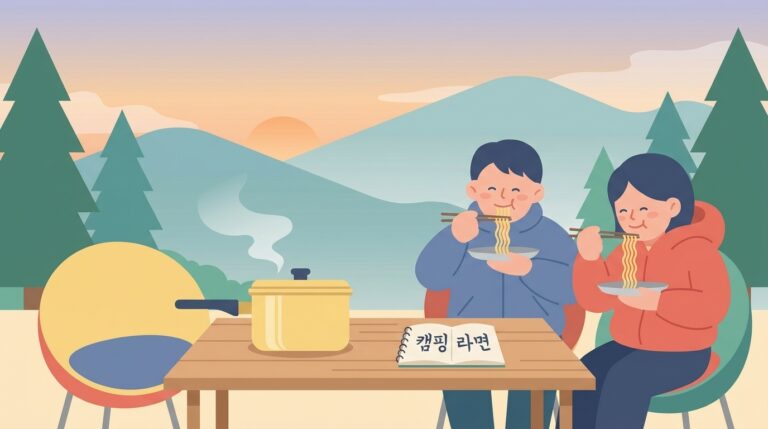
Picture this: You are watching a Korean reality show like In the Soop or 2 Days & 1 Night. The cast wakes up at a beautiful campsite. Their faces are a little puffy from sleeping in tents, their hair is messy, and what is the very first thing they do? They don’t make avocado toast or pour cereal. They bring out a small gas stove and boil a huge pot of spicy, steaming Ramyeon (라면).
In Korea, eating ramyeon the morning after camping is not just breakfast; it is a sacred ritual. The crisp morning air mixed with the smell of spicy MSG broth is pure magic. It cures hangovers, warms your body, and creates a sense of bonding.
If you don’t know the specific phrases and etiquette for ‘Morning Ramyeon’, you might end up starving while your Korean friends devour the pot! Don’t worry—this guide is based on real camping trips I’ve taken with foreign students who learned the hard way that when someone asks, “Are you going to eat?” you must always say “YES.”
Phase 2: Core Expressions Deep Dive
Here are the top three expressions you absolutely need when you wake up at a Korean campsite.
1. 라면 끓일까요?
- Pronunciation: Ramyeon kkeurilkkayo? [‘으’ (eu) sounds like the disgusted sound you make when stepping in gum. ‘kk’ is a sharp, tense K sound.]
- Meaning: Literal: Shall we boil ramyeon? / Real nuance: I’m going to cook ramyeon now, who is in?
- K-Culture Moment: You crawl out of your sleeping bag. Your Korean friend is already sitting by the portable stove with three packets of Shin Ramyun. They look at you and say this. It’s the starting gun for breakfast.
- Editor’s Insight: Notice we use the verb ‘끓이다’ (to boil) instead of ‘요리하다’ (to cook) or ‘만들다’ (to make) when talking about ramyeon or stews.
- Situation Spectrum:
- Friends (Casual – 라면 끓일까?): ✅
- Coworkers (Semi-formal – 라면 끓일까요?): ✅
- Boss/Elders (Formal – 라면 끓여 드릴까요?): ⚠️
- 🤔 Think About It: Why does Korean culture emphasize eating a hot, spicy soup first thing in the morning, especially after drinking? Does your culture have a specific ‘hangover breakfast’?
2. 국물이 진짜 시원해요!
- Pronunciation: Gungmuri jinjja siwonhaeyo! [gung-moo-ri jin-jja she-won-hae-yo]
- Meaning: Literal: The broth is really cool! / Real nuance: The broth is so hot and refreshing/relieving!
- K-Culture Moment: An older Korean man takes a sip of boiling hot soup, lets out a deep “Ahhhh~” and says it is “cool” (시원하다). Foreigners are always confused! In Korea, “siwonhada” for hot soup means it is hitting the spot, clearing your stomach, and relieving your hangover.
- Editor’s Insight: If you say this after taking a sip of ramyeon broth, Koreans will look at you with deep respect. You will instantly be treated as a local.
- Situation Spectrum:
- Friends (Casual): ✅
- Coworkers (Semi-formal): ✅
- Boss/Elders (Formal): ✅
- 🤔 Think About It: We use the same word for a cool autumn breeze and boiling hot soup. What does this tell you about how Koreans perceive ‘relief’ and ‘comfort’ physically?
3. 한 입만 주세요.
- Pronunciation: Han imman juseyo. [‘입’ is pronounced more like ‘im’ when followed by ‘만’. Han im-man!]
- Meaning: Literal: Please give me just one mouth. / Real nuance: Let me have just one bite/taste.
- K-Culture Moment: The greatest betrayal in Korean camping culture. When asked “Who wants ramyeon?” someone always says, “Not me, I’m too full.” But the moment it’s cooked and smells amazing, they approach with chopsticks and say, “한 입만!” (Just one bite!)
- Editor’s Insight: Say it with a slightly pathetic, cute face. But be warned: taking too big of a bite might start a friendly fight!
- Situation Spectrum:
- Friends (Casual – 한 입만!): ✅
- Coworkers (Semi-formal – 한 입만 먹어도 될까요?): ⚠️
- Boss/Elders (Formal): 🚫
- 🤔 Think About It: Why is it so hard to resist Korean ramyeon even when you are full? It’s the MSG magic!
Phase 3: Textbook vs. Real Korean
[Situation 1: Asking if it tastes good]
* 📖 Textbook Korean: 아주 맛있습니까? (Is it very delicious?)
* 🗣️ Real Korean: 와, 제대로 해장된다! (Wow, this is a proper hangover cure!) / 미쳤다! (It’s crazy!)
* 💡 Why is it different?: In real life, especially with comfort food, Koreans use emotional and physical reactions (“It cures me”, “It’s crazy”) rather than just describing the taste logically.
[Situation 2: Warning someone it’s hot]
* 📖 Textbook Korean: 온도가 높으니 조심하세요. (The temperature is high, so be careful.)
* 🗣️ Real Korean: 앗 뜨거워! 후후 불어 먹어. (Ah, hot! Blow on it before you eat.)
* 💡 Why is it different?: Daily language mimics the sound of the action. “후후” (hoo-hoo) is the onomatopoeia for blowing on hot food.
Phase 4: K-Culture Deep Dive
4-1. Non-verbal Cue: The Pot Lid (냄비 뚜껑)
If you are eating ramyeon at a campsite, do not ask for a nice ceramic bowl. Real campers use the pot lid! You flip the lid upside down, hold the handle from underneath, and use it as a mini-plate to cool the noodles down. It prevents you from dropping noodles on your lap and makes the food taste 100% better.
4-2. The K-Food Connection: The Golden Aluminum Pot
Have you seen the yellow, slightly dented pot in K-Dramas? It’s called 양은냄비 (Yangeun naembi). It heats up incredibly fast, boiling the water in minutes, which keeps the noodles perfectly chewy (쫄깃쫄깃). At a campsite, this pot is a must-have item. Also, remember: in Korea, slurping your noodles isn’t rude. In fact, a loud slurping sound is the best compliment to the chef!
Phase 5: Interactive Roleplay Scenario
Setting: Saturday, 8:30 AM at a campsite in Gapyeong. The air is chilly, pine needles are everywhere. You drank a bit too much Somaek (Soju + Beer) last night. Your Korean friend, Minsu, is kneeling in front of a camping stove, stirring a bubbling pot of Shin Ramyun.
Characters:
– YOU: The hungover foreign friend who said they wouldn’t eat breakfast.
– Minsu (30s): Your friend, the self-proclaimed ‘Camp Chef’.
Dialogue:
Minsu: 으아~ 냄새 미쳤다. 너 진짜 안 먹어? 🍜
(Eu-a~ naemsae micheotda. Neo jinjja an meogeo?)
(English) Ah~ The smell is crazy. Are you really not eating?
(🎭 Stage Direction: Minsu wafts the spicy steam toward your face.)
YOU: (Stomach growling) 와… 냄새가 너무 좋은데?
(Wa… naemsaega neomu joeunde?)
(English) Wow… the smell is too good though?
Minsu: 그치? 한 입 줄까?
(Geuchi? Han ip julkka?)
(English) Right? Shall I give you a bite?
YOU: 아까는 안 먹는다고 했는데…
(Akkaneun an meongneundago haenneunde…)
(English) I said I wouldn’t eat earlier, but…
Minsu: 괜찮아, 캠핑 오면 다 그래. 자, 아~ 해봐.
(Gwaenchana, kaemping omyeon da geurae. Ja, a~ haebwa.)
(English) It’s fine, everyone is like that when camping. Here, say ‘Ah~’.
🔀 YOUR TURN! How do you reply?
– A) “고마워! 한 입만 먹을게.” (Gomawo! Han imman meogeulge. – Thanks! I’ll just have one bite.)
– B) “내 것도 새로 하나 끓여줘!” (Nae geotdo saero hana kkeuryeojwo! – Boil a new one for me too!)
– C) “아니야, 나는 샐러드 먹을게.” (Aniya, naneun saelleodeu meogeulge. – No, I’ll eat a salad.)✅ Best Choice: A. It is the classic “One-bite” (한 입만) culture! It shows you surrender to the smell of the ramyeon.
⚠️ Choice B Analysis: This is funny, but making the chef boil water all over again is a bit of a hassle. It’s better to share the pot!
🚫 Choice C Analysis: Salad? At a Korean campsite? Minsu will look at you with utter disappointment.
Minsu: 자, 국물도 마셔봐. 어때?
(Ja, gungmuldo masyeobwa. Eottae?)
(English) Here, drink the broth too. How is it?
YOU: 와… 국물이 진짜 시원해! 해장되는 기분이야.
(Wa… gungmuri jinjja siwonhae! Haejangdoeneun gibuniya.)
(English) Wow… the broth is so refreshing! I feel like my hangover is cured.
Minsu: 거봐, 내 라면 솜씨가 최고라니까!
(Geobwa, nae ramyeon somssiga choegoranikka!)
(English) See, I told you my ramyeon cooking skills are the best!
[Bonus K-Culture Scenario: At the campsite convenience store]
You need more ramyeon. You run to the small camp store.
* You: 사장님, 신라면 두 개랑… 뜨거운 물 어디 있어요?
(Sajangnim, sinnamyeon du gaerang… tteugeoun mul eodi isseoyo? / Boss, two Shin Ramyuns and… where is the hot water?)
* Owner: 저기 정수기 쓰세요. 젓가락 챙겨 가시고요!
(Jeogi jeongsugi sseuseyo. Jeotgarak chaenggyeo gasigoyo! / Use the water dispenser over there. Make sure to take chopsticks!)
Phase 6: 10-Second Shadowing Drill
Let’s practice the ultimate reaction to a hot bowl of morning ramyeon. Speak loudly and with feeling!
🥺 아… / 😊 국물이 / 😤 진~짜 시원해요!
(Ah… / gungmuri / jin~jja siwonhaeyo!)
Tip: Pause slightly after ‘아…’, drop your shoulders to show relief, and stretch out the ‘진’ (jin) for emphasis!
Phase 7: K-Culture Mini-Dictionary
Here are 4 words you will definitely hear on a Korean camping trip:
1. 해장
* Romanization: haejang
* English: Hangover cure
* Context: The main purpose of morning ramyeon. Koreans ‘cure’ their hangovers with hot, spicy, or hearty soups.
2. 한입충
* Romanization: hanipchung
* English: One-bite pest
* Context: A funny slang word for that one friend who never orders their own food but always steals “just one bite” from everyone else.
3. 불멍
* Romanization: bulmeong
* English: Zoning out at the fire
* Context: ‘불’ (Fire) + ‘멍때리다’ (Zoning out). The favorite nighttime camping activity before the morning ramyeon ritual.
4. 꼬들꼬들하다
* Romanization: kkodeulkkodeulhada
* English: Chewy / Al dente
* Context: The perfect state of ramyeon noodles. If you cook it too long, it becomes ‘퍼지다’ (soggy), which is a tragedy.
Phase 8: Traveler Survival Kit
Are you traveling to a Korean campsite or just grabbing a late-night bite at a convenience store (편의점)? Here are your survival phrases!
🆘 Survival Phrases TOP 3
– 🇰🇷 “전자레인지 어디 있어요?” (jeonjareinji eodi isseoyo?)
– 🗣️ English: Where is the microwave?
– 🇰🇷 “나무젓가락 하나만 주세요.” (namujeotgarak hanaman juseyo.)
– 🗣️ English: Please give me one wooden chopstick.
– 🇰🇷 “덜 맵게 해 주실 수 있나요?” (deol maepge hae jusil su innayo?)
– 🗣️ English: Can you make it less spicy? (Useful at ramyeon snack shops!)📌 Editor’s Travel Note
– The Ramyeon Machine: If you visit a convenience store near the Han River, they have automatic ramyeon boiling machines! You buy the packet, put it in a foil bowl, press a button, and it boils it perfectly for you.
– Trash Sorting: Campsites and convenience stores are very strict about recycling. You must pour leftover soup into a specific food waste bucket (음식물 쓰레기) before throwing the cup away!
Phase 9: Critical Thinking — “One Step Deeper”
🧠 Think Deeper: Food & Identity (The Communal Pot)
Have you noticed that when Koreans eat ramyeon at a campsite, they often don’t scoop it into individual bowls? Instead, everyone dips their chopsticks into the single large pot. To some Western cultures, this might seem unhygienic. However, in Korea, sharing food from the same pot is deeply rooted in the concept of ‘정’ (Jeong – affection/bonding). It breaks down walls between people. “We share the same food from the same source, therefore we are family (식구 – meaning ‘mouths that eat together’).” Of course, post-pandemic, people are more careful, but the cultural sentiment remains strong.💬 Your Turn: How does your culture feel about sharing food directly from the same pot? Let me know in the comments!
Phase 10: FAQ & Avoiding Mistakes
Q: Wait, I heard “Do you want to eat ramyeon?” (라면 먹고 갈래?) means something else… Is it safe to say?
Yes and no! The phrase “라면 먹고 갈래?” (Do you want to come over for ramyeon?) became a famous euphemism (like ‘Netflix and chill’ in English) after a movie in 2001.
HOWEVER, at a campsite in the morning, or during lunch at work, it 100% literally means “Let’s eat noodles.” Just be careful not to say it to a date late at night in front of your house!
Q: Is it rude to lift the bowl and drink the soup directly?
Absolutely not. In fact, lifting the pot or bowl with both hands and drinking the soup directly is the ultimate sign that you are enjoying the meal.
❌ Common Mistake #1: Leaving your chopsticks stuck vertically in the ramyeon.
✅ Do this instead: Always lay your chopsticks flat across the top of the bowl or on the table. Chopsticks sticking up look like incense sticks offered to the dead in traditional Korean funerals!
Phase 11: Summary & Action Items
One-Liner Summary: Eating morning ramyeon is a bonding ritual; master “라면 끓일까요?” and “국물이 시원해요” to become a true Korean camping insider!
Your Action Missions:
– 🥉 Bronze (Solo): Stand in your kitchen, pretend to take a sip of soup, and practice saying “아~ 국물이 진짜 시원해요!”
– 🥈 Silver (Online): Post a picture of your next noodle meal on Instagram or Reddit and caption it with “한 입만 주세요!”
– 🥇 Gold (Real Life): Visit a Korean supermarket, buy Shin Ramyun or Jin Ramen, and cook it for a friend asking “라면 먹을래요?”
– 🏕️ K-Culture Mission: Watch an episode of a Korean variety show (like BTS In the Soop or Jinny’s Kitchen) and spot the moment they cook ramyeon. Notice what pot they use!
Phase 12: Interactive Quiz
Test your morning ramyeon survival skills!
1. Fill in the Blank:
Your friend takes a sip of boiling hot soup and says, “아~ 국물이 너무 ( ____ )!”
(Hint: It means refreshing/relieving, even though it’s hot!)
2. Situational Judgment:
You are full, but your friend’s ramyeon smells too good. What is the most culturally appropriate thing to say?
A) “I will take it all.”
B) “한 입만 주세요.” (Just one bite, please.)
C) “Are you eating again?”
3. True or False – K-Culture Edition:
“It is considered rude to slurp your noodles loudly at a Korean campsite.”
(Answers: 1. 시원해(요), 2. B, 3. False! Slurping means it’s delicious!)
Did you enjoy this Daily Hangul lesson? What is your favorite type of Korean ramyeon? Drop a comment below and let’s discuss! 🍜
Frequently Asked Questions (FAQ)
Q: What does "라면 끓일까요?" mean in Korean and how do you pronounce it?
A: In Korean, "라면 끓일까요?" is pronounced [Ramyeon kkeurilkkayo? ['으' (eu] and means: Literal: Shall we boil ramyeon? / Real nuance: I'm going to cook ramyeon now, who is in?
Q: What does "국물이 진짜 시원해요!" mean in Korean and how do you pronounce it?
A: In Korean, "국물이 진짜 시원해요!" is pronounced [Gungmuri jinjja siwonhaeyo! [gung-moo-ri jin-jja she-won-hae-yo] and means: Literal: The broth is really cool! / Real nuance: The broth is so hot and refreshing/relieving!
Q: What does "한 입만 주세요." mean in Korean and how do you pronounce it?
A: In Korean, "한 입만 주세요." is pronounced [Han imman juseyo. ['입' is pronounced more like 'im' when followed by '만'. Han im-man!] and means: Literal: Please give me just one mouth. / Real nuance: Let me have just one bite/taste.







