

Hello! I’m the lead editor at Daily Hangul.
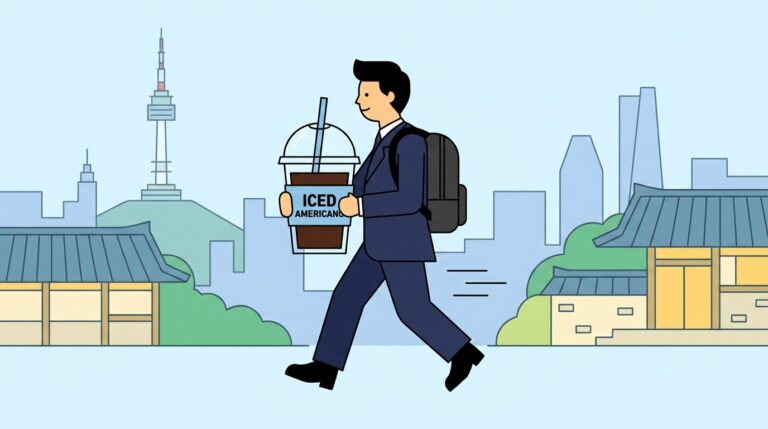
If you’ve watched a few K-Dramas, you might have noticed a recurring scene: The main character is running late for work, rushing into an elevator, but wait—what’s in their hand? A massive plastic cup of iced coffee. Or picture a bustling street in Gangnam at 1 PM. It seems like a coordinated flash mob because literally everyone is holding an Iced Americano.
Have you ever wondered why Koreans seem to drink three cups of coffee a day?
It’s not just a beverage; it’s a lifestyle, a survival tool, and a social currency. The first cup wakes you up, the second cup is an after-lunch social ritual, and the third cup is for powering through overtime or late-night studying. If you don’t know the language and culture surrounding this extreme coffee love, you might miss out on one of the most vibrant aspects of modern Korean life.
Today, we’re diving deep into the expressions and cultural secrets behind Korea’s ‘3 cups a day’ coffee culture. This isn’t textbook fluff—these are the real, caffeinated phrases you’ll hear on the streets of Seoul! ☕
Phase 2: Deep Dive into Core Expressions
Let’s look at three essential phrases that capture the Korean coffee mindset.
1. 커피 수혈 (Coffee Blood Transfusion)
- Pronunciation: [keo-pi su-hyeol] + Sounds like “kuh-pee soo-hyul”
- Meaning: (Literal) Coffee blood transfusion / (Real nuance) I desperately need coffee to survive right now.
- K-Culture Moment: Imagine a K-Drama where an exhausted office worker collapses onto their desk at 3 PM. Their colleague slides a cup of iced coffee over to them. The tired worker sighs, “Ah, I needed this coffee blood transfusion.”
- Editor’s Insight: This phrase isn’t meant to be medical; it’s wonderfully dramatic! Koreans love exaggerating their need for caffeine to show how hard they are working or studying. It has a vibe of, “I’m running on empty, and this coffee is my life support.”
- Situation Spectrum:
- Casual (Friends): ✅
- Semi-formal (Close Coworkers): ✅
- Formal (Boss/Elders): 🚫 (Too dramatic and slangy for formal settings)
- 🤔 Think About It: Why do you think modern Koreans use medical terms like “transfusion” for coffee? Does the fast-paced “Ppalli-Ppalli” (hurry-hurry) culture leave them feeling drained? How do you express extreme tiredness in your native language?
2. 얼죽아 (Eol-juk-a)
- Pronunciation: [eol-ju-ga] + Sounds like “ull-joo-gah”
- Meaning: (Literal) Even if I freeze to death, Iced Americano. (An abbreviation of 얼어 죽어도 아이스 아메리카노)
- K-Culture Moment: It’s minus 10 degrees Celsius (14°F) in Seoul. The snow is falling. Yet, in front of a cafe, you see Korean teenagers shivering in their long padding coats, happily sipping iced drinks. This is the pride of an “Eol-juk-a”!
- Editor’s Insight: This is arguably the most famous coffee slang in Korea. It’s almost a badge of honor. It shows a stubborn loyalty to cold drinks regardless of the season.
- Situation Spectrum:
- Casual (Friends): ✅
- Semi-formal (Close Coworkers): ✅
- Formal (Boss/Elders): ⚠️ (They might understand it, but it’s internet slang. Better to use the full word “아이스 아메리카노” when ordering from older staff).
- 🤔 Think About It: Is there a food or drink in your culture that people consume regardless of the extreme weather?
3. 쏠게요 / 내가 쏠게 (I’ll treat you / It’s on me)
- Pronunciation: [ssol-ge-yo / nae-ga ssol-ge] + Sounds like “ssohl-geh-yo” (The ‘ss’ is sharp, like a snake hissing)
- Meaning: (Literal) I will shoot. / (Real nuance) I’m buying (treating) this time.
- K-Culture Moment: After a spicy lunch of Kimchi Jjigae, a senior colleague points to the cafe next door and confidently says, “Let’s go. 내가 쏠게!” (I’ll buy!). Suddenly, they are everyone’s favorite person.
- Editor’s Insight: Because Koreans drink so much coffee, buying a round of coffee is the easiest way to build relationships at work or school. It’s cheaper than buying dinner, but it still shows “Jeong” (affection/bonding).
- Situation Spectrum:
- Casual (Friends): ✅ (내가 쏠게!)
- Semi-formal (Close Coworkers): ✅ (제가 쏠게요!)
- Formal (Boss/Elders): ⚠️ (Seniors usually treat juniors. If you want to treat your boss, it’s more polite to say “제가 대접하겠습니다” or simply “제가 사겠습니다”).
Phase 3: Textbook vs. Real Korean
Let’s compare what you learn in textbooks with what you actually hear in a bustling Korean cafe.
[Situation 1: Ordering an Iced Americano]
* 📖 Textbook Korean: 아이스 아메리카노 한 잔 주시겠습니까? (Could I please have one glass of Iced Americano?)
* 🗣️ Real Korean: 아아 하나요. (One “Ah-Ah”, please.) / 먹고 갈게요. (I’ll drink it here.)
* 💡 Why the difference?: Efficiency! Cafes in Korea are incredibly busy. “아아” (Ah-Ah) is the universally accepted abbreviation for Iced Americano, allowing for a 3-second transaction.
[Situation 2: Expressing Tiredness at Work]
* 📖 Textbook Korean: 저는 오늘 일이 많아서 아주 피곤합니다. (I have a lot of work today, so I am very tired.)
* 🗣️ Real Korean: 아, 당 떨어져… 카페인 충전 좀 하고 올게. (Ah, my sugar is dropping… I’m gonna go recharge my caffeine.)
* 💡 Why the difference?: Using physical states like “sugar dropping” or “recharging” sounds much more vivid and relatable than simply stating “I am tired.”
Bottom Note: For B1 (Intermediate) learners, using phrases like “아아 하나요” or “당 떨어져요” is perfectly sensible. It makes you sound naturally fluent without crossing the line into overly aggressive slang!
Phase 4: K-Culture Deep Dive
4-1. Non-Verbal Culture: Card Etiquette and “Nunchi”
When ordering your coffee, language isn’t everything. In Korea, handing over your credit card to the barista with two hands (or one hand supporting your other arm) is a basic sign of respect.
Also, let’s talk about Nunchi (눈치). If you are drinking coffee with your team and the manager says, “I’ll buy! Let’s all get Americanos to make it quick,” Nunchi tells you this is not the time to order a complex “Decaf Venti Iced Caramel Macchiato with Oat Milk and Extra Whip.” For the sake of group speed, you smile and say, “Me too!”
4-2. The Cafe as a “Third Space” (K-Drama & Real Life)
In K-Dramas, whenever characters need to break up, confess their love, or plan corporate espionage, they go to a cafe. This mirrors reality perfectly. Korean apartments can be small, and the culture emphasizes separating living spaces from social spaces. Cafes are the ultimate “Third Space.”
This is also why Korea has the “Kagong-jok” (카공족 – Cafe study tribe). It is completely normal for students to buy one cup of coffee and study in a mega-cafe for 4 hours. (Though recently, some cafes are putting time limits to combat this!)
Phase 5: Interactive Roleplay Scenario
Let’s put you in the scene!
- Setting: Wednesday, 12:45 PM. A busy cafe in Yeouido (the Wall Street of Seoul). You just finished a heavy lunch with your team.
- Characters:
- YOU: A foreign employee who just started working in Korea a month ago. You are exhausted.
- Min-su (32): Your friendly Korean coworker who loves taking care of you.
Min-su: 아휴, 배부르다. 날씨도 더운데 시원한 거 마실래요? ☀️
(Ah-hyu, bae-bu-reu-da. Nal-ssi-do deo-un-de si-won-han geo ma-sil-lae-yo?)
[Ah, I’m full. It’s hot outside, do you want to drink something cold?]
YOU: 좋아요! 저 진짜 지금 쓰러질 것 같아요.
(Jo-a-yo! Jeo jin-jja ji-geum sseu-reo-jil geot ga-ta-yo.)
[Sounds good! I feel like I’m going to pass out right now.]
Min-su: ㅋㅋㅋ 그쵸? 우리 빨리 커피 수혈하러 가요. 제가 쏠게요!
(Kkk geu-chyo? U-ri ppal-li keo-pi su-hyeol-ha-reo ga-yo. Jae-ga ssol-ge-yo!)
[Hahaha right? Let’s go get a coffee blood transfusion quickly. I’ll treat you!]
🔀 Your Turn! How should you respond to Min-su treating you?
– A) “아, 감사합니다! 잘 마실게요!” (Ah, thank you! I’ll enjoy it!)
– B) “에이~ 아니에요. 오늘은 제가 살게요!” (Ey~ No way. I’ll buy it today!)
– C) “오케이! 땡큐!” (Okay! Thank you!)✅ Best Choice: B — Reason: The Korean “Push-Pull” (밀당) of paying. It is extremely polite to refuse at least once and offer to pay yourself. If Min-su insists again (“아니에요, 제가 살게요”), then you gracefully accept with Choice A.
⚠️ Choice C Analysis: “Okay! Thank you!” in English style feels a bit too casual and abrupt here, lacking the traditional polite hesitation.
(🎭 Stage Direction: You offer to pay, but Min-su quickly taps his corporate card on the machine before you can even open your wallet.)
Min-su: 영수증은 버려주세요. 아아 두 잔이요!
(Yeong-su-jeung-eun beo-ryeo-ju-se-yo. A-a du jan-i-yo!)
[Please throw away the receipt. Two Ah-Ahs please!]
Phase 6: 10-Second Shadowing Drill
Practice reading this aloud to sound exactly like a tired Korean office worker after lunch!
😩 아, / 당 떨어져. / 우리 얼른 / 커피 수혈하러 가자!
(Ah, / dang tteol-eo-jeo. / u-ri eol-leun / keo-pi su-hyeol-ha-reo ga-ja!)
[Ah, my sugar is dropping. Let’s hurry and get a coffee blood transfusion!]
Vocal Tip: Let out a deep sigh at the “아” (Ah), as if the weight of the world is on your shoulders. Raise your pitch slightly at “가자!” (Let’s go!) to show renewed hope.
Phase 7: K-Culture Mini Dictionary
Here are some essential cafe-related keywords you need to survive in Korea.
1. 아아 (Ah-Ah)
* Romanization: a-a
* English: Iced Americano
* Context: The lifeblood of modern Korea. 70% of cafe orders in Korea are Iced Americanos.
2. 카공족 (Kagong-jok)
* Romanization: ka-gong-jok
* English: Cafe Study Tribe
* Context: People who sit in cafes for hours with laptops or books. If you see people with Apple gadgets and textbooks, you’ve found the tribe.
3. 디카페인 (Di-ka-pe-in)
* Romanization: di-ka-pe-in
* English: Decaf
* Context: Because Koreans drink so much coffee late into the evening, the demand for decaf has skyrocketed recently.
4. 샷 추가 (Syat chu-ga)
* Romanization: syat chu-ga
* English: Adding an extra espresso shot
* Context: When the standard “coffee transfusion” isn’t enough, you ask for a “shot chuga” to survive a late-night project.
Phase 8: Traveler Survival Kit
If you’re visiting Korea, ordering coffee is going to be your most frequent daily interaction. Keep these survival phrases handy!
🆘 Survival Phrases for the Cafe
– 🇰🇷 “드시고 가시나요?” (Deu-si-go ga-si-na-yo?)
– 🗣️ English: Are you drinking it here? (For here or to go?)
– 📍 Your Answer: “먹고 갈게요” (Here) OR “테이크아웃이요 / 포장이요” (To-go)
– 💡 Pro Tip: In Korea, “To go” is rarely understood by older staff. Use the Konglish word “Take-out” (테이크아웃) instead!📌 Editor’s Travel Note
– The Kiosk Fear: Many cafes now use touch-screen Kiosks. Don’t panic! 99% of them have an “English” button at the top right corner.
– Cash vs Card: Korea is a cashless society. Even a $2 coffee can (and should) be paid with a card. Paying with a 50,000 won bill for a cheap coffee might fluster the barista.
– Tipping: ZERO. Giving a tip at a cafe will just lead to a confused barista chasing you down the street to give you your money back!
Phase 9: Critical Thinking Corner — “One Step Deeper”
The Modern Korean Lifestyle & “Ppalli-Ppalli”
Why does Korea prefer the Americano, specifically Iced? Unlike European coffee cultures where people sip tiny espressos slowly on an outdoor terrace, coffee in Korea is directly tied to the fast-paced, hyper-competitive nature of society.
An Iced Americano can be made in 30 seconds. It can be gulped down quickly while walking to the subway. It cools down the “Hwabyung” (화병 – cultural stress/anger) of the modern worker. The “three cups a day” culture is a testament to Korea’s incredible economic engine, but it also reflects a society that is chronically exhausted and running on adrenaline.
💬 Your Turn: How is coffee viewed in your culture? Is it a tool for survival and efficiency, or is it strictly for leisure and relaxation? Share in the comments!
Phase 10: FAQ & Avoiding Misunderstandings
❌ Common Mistake #1: Saying “To go” at a local bakery or cafe.
✅ Do this instead: Say “테이크아웃 할게요” (Take-out hal-ge-yo). It’s the standard Konglish phrase everyone understands.
Q: If I’m ordering for my boss, can I just ask them “무슨 커피 드실래요?” (What coffee will you drink?)
A: Yes, that is perfectly polite! However, if you want to sound incredibly professional and respectful, you can say, “어떤 음료로 준비해 드릴까요?” (What beverage shall I prepare for you?).
Q: Do I have to drink coffee if everyone else is?
A: Not at all! While there is a strong coffee culture, tea and fruit ades (에이드) are very popular. Just order a “자몽 에이드” (Grapefruit Ade) if you want to avoid caffeine.
Phase 11: Summary & Action Items
- One-Liner Summary: In Korea, coffee isn’t just a drink; it’s a social tool and a daily “blood transfusion” for the fast-paced life—so order an “Ah-Ah” and join the crowd!
Action Mission 3 Steps:
– 🥉 Bronze (Solo): Say “아, 커피 수혈 시급!” (Ah, urgent coffee transfusion needed!) while stretching your arms at your desk today.
– 🥈 Silver (Online): Comment your favorite coffee order in Korean on this post! (e.g., 저는 따뜻한 라떼 좋아해요!)
– 🥇 Gold (Real Life): Go to a Korean cafe (or any cafe) and pretend you are in Seoul. Confidently order your drink using “~하나 주세요” (One ~, please).
🎬 K-Culture Mission:
Turn on a modern-day K-Drama on Netflix. Count how many times you see a character holding a plastic iced coffee cup in one episode. You’ll be shocked!
Phase 12: Interactive Challenge Quiz
Let’s test your K-Cafe survival skills!
1. Situation Judgment: You are having lunch with a Korean friend. They say, “오늘은 제가 쏠게요!” (I’ll treat you today!). What is your best initial response?
– A) “감사합니다. 비싼 거 먹을게요!” (Thank you. I’ll eat something expensive!)
– B) “진짜요? 헐 대박.”
– C) “아니에요, 오늘은 제가 살게요!” (No, I’ll buy it today!)
2. Fill in the Blank:
“It’s freezing outside, but I am an _____________, so I will order an Iced Americano.”
– A) 카공족 (Kagong-jok)
– B) 얼죽아 (Eol-juk-a)
– C) 수혈족 (Suhyeol-jok)
3. True or False — K-Culture Edition:
“If you receive great service from a Korean barista, you should leave the change in the tip jar to show respect.”
(True / False)
Click here to see the answers!
1. C – It’s Korean etiquette to offer to pay once before gracefully accepting the treat.
2. B (얼죽아) – “Even if I freeze to death, Iced Americano!”
3. False – There is absolutely no tipping culture in Korea. Tipping will cause confusion!
Did you enjoy today’s Daily Hangul lesson? Make sure to bookmark this page for your next trip to a Korean cafe! 😊
Frequently Asked Questions (FAQ)
Q: What does "커피 수혈 (Coffee Blood Transfusion)" mean in Korean and how do you pronounce it?
A: In Korean, "커피 수혈 (Coffee Blood Transfusion)" is pronounced [keo-pi su-hyeol] and means: (Literal) Coffee blood transfusion / (Real nuance) I desperately need coffee to survive right now.
Q: What does "얼죽아 (Eol-juk-a)" mean in Korean and how do you pronounce it?
A: In Korean, "얼죽아 (Eol-juk-a)" is pronounced [eol-ju-ga] and means: (Literal) Even if I freeze to death, Iced Americano. (An abbreviation of 얼어 죽어도 아이스 아메리카노)
Q: What does "쏠게요 / 내가 쏠게 (I'll treat you / It's on me)" mean in Korean and how do you pronounce it?
A: In Korean, "쏠게요 / 내가 쏠게 (I'll treat you / It's on me)" is pronounced [ssol-ge-yo / nae-ga ssol-ge] and means: (Literal) I will shoot. / (Real nuance) I'm buying (treating) this time.







