

Phase 1: The Heart of Korean Dining
Hello! I’m the Lead Editor at Daily Hangul.
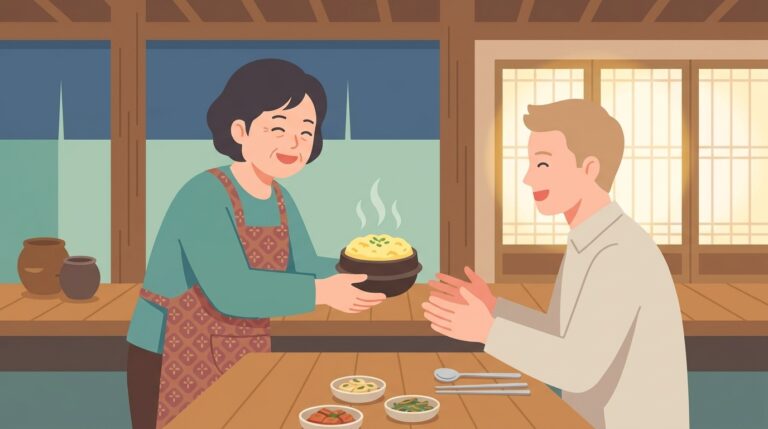
Imagine this: You are sitting at a bustling Korean BBQ joint in Seoul. The smell of roasted pork belly fills the air. You only ordered two servings of meat, but suddenly, the warm, apron-clad restaurant owner—often called Imo (auntie)—brings over a sizzling, fluffy steamed egg and a bottle of cider. You panic a little. You wave your hands and say, “Wait, I didn’t order this!”
She just smiles warmly, pats your shoulder, and says one magic word: “서비스 (Service)!”
If you translate ‘service’ directly, you might think of customer service or a mechanic fixing your car. But in Korea, when a restaurant owner gives you “service,” they are giving you a free gift. It’s the ultimate expression of 정 (Jeong)—a unique Korean concept of warmth, affection, and communal bonding.
If you don’t know this culture, you might awkwardly try to pay for it or refuse it, which can accidentally hurt the auntie’s feelings. But if you know exactly how to react? You instantly go from being a “tourist” to an “insider.” Let’s dive into the heartwarming world of K-Food, Jeong, and the magical restaurant auntie!
Phase 2: Core Expressions Deep Dive
1. 이거 서비스예요 (Igeo seobiseuyeyo)
- Pronunciation: igeo seobiseuyeyo [ee-guh suh-bee-suh-yeh-yo]. (‘suh’ sounds like the ‘u’ in ‘uh-oh’)
- Meaning: (Literal) This is service. / (Real Nuance) This is on the house! A free gift for you!
- K-Culture Moment: You’ll see this in almost every K-Drama featuring a Pojangmacha (street tent bar) or a local neighborhood restaurant. The main character looks sad, so the owner slides over an extra bowl of warm udon soup and says, “It’s service. Eat up and cheer up!”
- Editor’s Insight: This isn’t just a marketing tactic; it’s a gesture of hospitality. The owner gives it because you ordered a lot, you look tired, or simply because they like your vibe.
- Situation Spectrum:
- Casual (To friends): ✅ (You can jokingly say “It’s my service!” when you buy a friend a drink)
- Semi-formal (Restaurants/Cafes): ✅
- Formal (Strict business meetings): 🚫 (Too casual)
- 🤔 Think About It: In many Western countries, “freebies” are often tied to loyalty programs or complaints. Why do you think Korean restaurants give away free food to first-time customers just because they feel like it? How does this reflect the culture of Jeong?
2. 이모님, 너무 맛있어요! (Imonim, neomu masisseoyo!)
- Pronunciation: imonim, neomu masisseoyo! [ee-mo-neem, nuh-moo mah-shee-suh-yo!]
- Meaning: (Literal) Auntie, it is very delicious! / (Real Nuance) Auntie, your food is amazing!
- K-Culture Moment: Picture a K-Pop idol doing a “Mukbang” (eating broadcast) at a traditional market. They take a bite of Tteokbokki, their eyes go wide, and they shout this to the stall owner. The owner usually beams with pride and gives them an extra dumpling!
- Editor’s Insight: Imo literally means “Mother’s sister,” but in local restaurants, it’s a term of endearment for middle-aged female staff. Adding “~님 (nim)” makes it polite. Praising the food is the quickest way to unlock the “Service” achievement!
- Situation Spectrum:
- Casual/Local Restaurants: ✅
- Fine Dining/Michelin Restaurants: 🚫 (Use “저기요” – Excuse me, or “직원분” – Staff, instead)
- 🤔 Think About It: Calling a stranger “Auntie” creates an instant pseudo-family relationship. What does this tell us about how Koreans view their local community?
3. 정말 잘 먹었습니다 (Jeongmal jal meogeotseumnida)
- Pronunciation: jeongmal jal meogeotseumnida [jung-mal jal muh-gut-seum-nee-da]
- Meaning: (Literal) I ate really well. / (Real Nuance) Thank you for the wonderful meal.
- K-Culture Moment: At the end of a team dinner (Hoesik), everyone says this to the boss who paid, or directly to the restaurant staff as they walk out the door.
- Editor’s Insight: This is the most polite and standard way to show gratitude after a meal. If you received “service,” making eye contact and saying this with a bright smile will make the auntie’s day.
- Situation Spectrum:
- Anywhere, to anyone who provided food: ✅
Phase 3: Textbook vs. Real Korean
[Situation 1: Asking for more side dishes (Banchan)]
* 📖 Textbook Korean: 반찬을 더 주시겠습니까? (Would you please give me more side dishes?)
* 🗣️ Real Korean: 이모~ 여기 김치 좀 더 주세요! (Auntie~ Please give us a little more kimchi here!)
* 💡 Why the difference?: Textbook Korean sounds like you are ordering at a 5-star hotel. In a bustling local restaurant, you need to be direct but friendly.
[Situation 2: Reacting to a free “Service” item]
* 📖 Textbook Korean: 무료로 주셔서 감사합니다. (Thank you for giving this to me for free.)
* 🗣️ Real Korean: 우와, 서비스예요? 대박! 잘 먹겠습니다~ (Wow, is this service? Awesome! I will eat it well~)
* 💡 Why the difference?: Using the word “무료” (free of charge) sounds like a legal or business transaction. Using “대박” (awesome/jackpot) and showing genuine excitement honors the Jeong behind the gesture.
Bottom Note: For B2 level learners, using “대박 (Daebak)” is perfectly natural in casual dining settings, but make sure to follow it up with a polite “잘 먹겠습니다 (Jal meokgetseumnida)” to maintain a respectful balance!
Phase 4: Cultural Context — K-Culture Deep Dive
4-1. Non-verbal Communication: The Art of “Nunchi”
When the Imo brings you free food, don’t just stare at it! The Korean culture of Nunchi (reading the room) dictates that you should act pleasantly surprised.
* Slight Bow: While sitting, do a mini head-bow as you receive the dish.
* Eye Contact: Look her in the eyes, smile widely, and say thank you.
* The Follow-up: Take a bite right away and nod enthusiastically. Seeing you enjoy the food is their biggest reward!
4-2. K-Food Connection: The Unlimited Banchan
Why is Korean food so generous? It all stems from a deeply agrarian society where sharing food meant survival and community. This evolved into the modern Banchan (side dish) culture. Unlike Western restaurants where every side of fries costs extra, Korean side dishes are bottomless. You can ask for refills 2 or 3 times!
However, Nunchi applies here too: don’t ask for a 4th refill of the expensive marinated crabs (Gejang) at a cheap BBQ joint. Read the vibe! Also, remember that Korea does NOT have a tipping culture. The excellent service and freebies are genuinely out of hospitality, not for a 20% tip.
Phase 5: Real-Life Roleplay Scenario
- Setting: A rainy Friday evening at a cozy, slightly noisy Jeon (Korean pancake) and Makgeolli (rice wine) restaurant in Hongdae.
- Characters:
- YOU: An expat who loves Korean food, visiting with a friend.
- Imo-nim: The cheerful restaurant owner in her 50s, wearing a floral apron.
YOU: 이모님! 여기 해물파전 하나랑 막걸리 주세요!
(Imonim! Yeogi haemulpajeon hanarang makgeolli juseyo!)
[Auntie! One seafood pancake and makgeolli here, please!]
Imo-nim: 네~ 맛있게 구워줄게요! 비 오니까 많이 먹어~
(Ne~ Masitge guwojulgeyo! Bi onikka mani meogeo~)
[Okay~ I’ll grill it deliciously for you! It’s raining, so eat a lot~]
(15 minutes later, Imo-nim brings the pancake, plus a steaming bowl of clam soup that you didn’t order.)
Imo-nim: 자, 이거 서비스예요! 비 오는 날엔 국물이 있어야지.
(Ja, igeo seobiseuyeyo! Bi oneun naren gungmuri isseoyaji.)
[Here, this is service! You need soup on a rainy day.]
🔀 Your Turn! How do you reply?
* A) “아, 저희 국물 안 시켰는데요? 가져가세요.” (Ah, we didn’t order soup? Please take it away.)
* B) “얼마예요? 팁 드릴게요.” (How much is it? I will give you a tip.)
* C) “우와, 진짜요? 대박! 이모님 최고! 잘 먹겠습니다~” (Wow, really? Awesome! Auntie is the best! I’ll eat it well~)✅ Best Choice: C — Showing enthusiastic gratitude makes the owner happy. “이모님 최고 (Auntie is the best)” is a flattering phrase she will love.
⚠️ Choice A & B Analysis: Choice A is a huge faux pas and will offend her. Choice B is awkward because tipping does not exist in Korea; it might even confuse or subtly insult her pride as a host.
Phase 6: 10-Second Shadowing Drill
Practice this sentence so you can naturally express your gratitude when you get a freebie! Pay attention to the pauses (/) and the emotion tags.
😲 우와~ / 이거 / 서비스예요? (Uwa~ / igeo / seobiseuyeyo?)
🥺 너무 / 감동이에요! (Neomu / gamdongieyo!)
😊 정말 / 잘 / 먹겠습니다! (Jeongmal / jal / meokgetseumnida!)
Phase 7: K-Culture Mini Dictionary
1. 정 (Jeong)
* Romanization: jeong
* English: Warm feeling of attachment, affection, and bonding.
* Context: The invisible social glue of Korea. Giving an extra apple at the market or free soda at a restaurant are physical manifestations of Jeong.
2. 이모 / 이모님 (Imo / Imonim)
* Romanization: imo / imonim
* English: Aunt / Respectful term for Aunt.
* Context: Used lovingly for middle-aged female workers in casual restaurants. If the restaurant is very fancy, do not use this.
3. 서비스 (Seobiseu)
* Romanization: seobiseu
* English: Service (On the house / Freebie).
* Context: Used when a shop owner gives you extra food or goods for free.
4. 단골 (Dangol)
* Romanization: dangol
* English: Regular customer.
* Context: If you visit a restaurant often and the Imo recognizes you, you become a Dangol. Dangols get the best Jeong and the most Service!
Phase 8: Traveler Survival Kit
Are you planning to eat your way through Seoul? Here are your essential phrases for local restaurants and traditional markets!
🆘 Survival Expression #1: “Is this refillable?”
* 🇰🇷 “이거 리필 돼요?” (Igeo ripil dwaeyo?)
* 🗣️ Pronunciation: [ee-guh ree-peel dweh-yo?]
* 📍 Where to use: Local restaurants, K-BBQ places (pointing at side dishes).🆘 Survival Expression #2: “Please give me a little more of this.”
* 🇰🇷 “이거 조금만 더 주세요.” (Igeo jogeumman deo juseyo.)
* 🗣️ Pronunciation: [ee-guh jo-geum-man duh joo-seh-yo.]
* 📍 Where to use: When you want more Kimchi or garlic.🆘 Survival Expression #3: “Please wrap this up (to-go).”
* 🇰🇷 “남은 거 포장해 주세요.” (Nameun geo pojanghae juseyo.)
* 🗣️ Pronunciation: [nah-meun guh po-jang-heh joo-seh-yo.]
* 📍 Where to use: When you have leftover food. Koreans love packing leftovers!
📌 Editor’s Travel Note:
* Call Bells: Most tables in Korea have a little doorbell button. Press it instead of shouting! If there’s no bell, raise your hand and say “저기요!” (Excuse me!).
* NO TIPS! Please remember, no matter how great the “service” was, do not leave money on the table. It is not part of the culture and can cause confusion.
Phase 9: Critical Thinking — “One Step Deeper”
🧠 Think Deeper: Food & Identity (음식과 정체성)
In Korea, eating is rarely a solitary act; it is profoundly communal. The phrase for “family” in Korean is 식구 (Sikgu), which literally translates to “mouths that eat together.” Sharing a boiling pot of stew (Jjigae) or receiving free Service from an auntie blurs the line between a commercial transaction and a familial bond. By giving you free food, the restaurant owner is symbolically treating you as part of their extended community. It’s a physical manifestation of Jeong. Feeding someone is the ultimate expression of care in Korea.
💬 Your Turn: How does your culture view sharing food? Do you have a similar concept to Service or Jeong when dining out? Share your thoughts in the comments!
Phase 10: FAQ & Avoiding Common Mistakes
Q: Can I use “이모님” (Imonim) for male staff?
No! For male staff, especially older gentlemen, you can use “사장님” (Sajangnim – Boss/Owner) regardless of whether they actually own the place. For younger staff of any gender, just use “저기요” (Jeogiyo – Excuse me).
Q: If they give me free food, do I have to eat it all even if I’m full?
It’s polite to taste it and eat as much as you can. If you really can’t finish it, it’s okay! Just make sure to say “배가 너무 부른데 정말 맛있었어요” (I’m so full, but it was really delicious) when you leave.
❌ Common Mistake #1: Trying to leave a tip because you felt guilty about the free food.
✅ Do this instead: Become a Dangol (regular)! Returning to the restaurant with your friends is the highest form of respect and gratitude you can show.❌ Common Mistake #2: Staring blankly and saying nothing when the Service arrives.
✅ Do this instead: Let out a little “우와 (Wow)!” and say “감사합니다 (Thank you).” Your reaction is part of the transaction of Jeong!
Phase 11: Summary & Action Items
- One-Liner Summary: In Korea, “Service” at a restaurant is a heartwarming free gift driven by the culture of Jeong, so receive it with a big smile and a cheerful “감사합니다!”
🎯 Action Mission:
* 🥉 Bronze (Solo): Read the “Textbook vs. Real Korean” phrases out loud 3 times in front of a mirror.
* 🥈 Silver (Online): Go to a K-Drama YouTube clip featuring a restaurant scene and leave a comment explaining the “Service” culture you learned today!
* 🥇 Gold (Real Life): Next time you visit a Korean restaurant, confidently ask for a side dish refill using “이모님, 반찬 좀 더 주세요!”
🌶️ K-Culture Mission:
Watch an episode of a Korean variety show or food vlog (like Street Food Fighter). Count how many times the hosts use the words “이모님” or “서비스”. You’ll be surprised how often it pops up!
Did you ever get “Service” at a Korean restaurant? What did they give you? Tell me your stories below! 👇
Phase 12: Quiz — Interactive Challenge
1. Situational Judgment: You are at a very fancy, expensive Michelin-star Korean restaurant in Gangnam. You need more water. What is the BEST way to call the staff?
* A) “이모님! 물 좀 주세요!”
* B) (Pressing the call bell) “저기요, 물 좀 부탁드립니다.”
* C) “서비스 주세요!”
💡 Click to reveal the answer
Answer: B. In fine dining, using “이모님” is too casual. Use “저기요” (Excuse me) or just make eye contact and raise your hand slightly.
2. True or False – K-Culture Edition: “If an Auntie gives you a free bottle of Coke and says ‘Service’, you should leave a $2 tip on the table when you leave.”
💡 Click to reveal the answer
Answer: False! Korea does not have a tipping culture. Tipping might confuse the staff. Your cheerful “잘 먹겠습니다!” is tip enough.
3. Fill in the Blank:
“Wow! Is this service? Thank you!”
“우와! 이거 _____예요? 감사합니다!”
💡 Click to reveal the answer
Answer: 서비스 (seobiseu)
Frequently Asked Questions (FAQ)
Q: What does "이거 서비스예요 (Igeo seobiseuyeyo)" mean in Korean and how do you pronounce it?
A: In Korean, "이거 서비스예요 (Igeo seobiseuyeyo)" is pronounced [igeo seobiseuyeyo [ee-guh suh-bee-suh-yeh-yo] and means: (Literal) This is service. / (Real Nuance) This is on the house! A free gift for you!
Q: What does "이모님, 너무 맛있어요! (Imonim, neomu masisseoyo!)" mean in Korean and how do you pronounce it?
A: In Korean, "이모님, 너무 맛있어요! (Imonim, neomu masisseoyo!)" is pronounced [imonim, neomu masisseoyo! [ee-mo-neem, nuh-moo mah-shee-suh-yo!] and means: (Literal) Auntie, it is very delicious! / (Real Nuance) Auntie, your food is amazing!
Q: What does "정말 잘 먹었습니다 (Jeongmal jal meogeotseumnida)" mean in Korean and how do you pronounce it?
A: In Korean, "정말 잘 먹었습니다 (Jeongmal jal meogeotseumnida)" is pronounced [jeongmal jal meogeotseumnida [jung-mal jal muh-gut-seum-nee-da] and means: (Literal) I ate really well. / (Real Nuance) Thank you for the wonderful meal.







