

Phase 1: Empathy (Immersive Open)
Hello! I’m the Lead Editor of Daily Hangul.
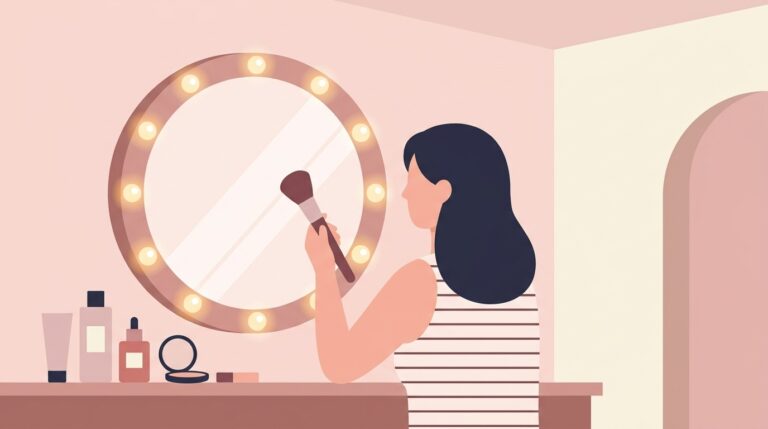
Imagine this: You are sitting in a brightly lit makeup studio in trendy Hongdae. The makeup artist ties a cape around your neck, smiles, and asks what kind of look you want today. Suddenly, you freeze. You want that soft, glowing, K-Drama female lead look—not a heavy, smoky eye—but your mind goes blank. All you can remember from your textbook is “Make me pretty” (예쁘게 해 주세요). Will you end up with neon pink lips?
If you’ve ever watched a K-Drama makeover scene or binged K-Beauty tutorials on YouTube, you know that Korean makeup is an art form. It’s all about the subtle details. Knowing just a few simple phrases can be the difference between looking like a theatrical performer and achieving that coveted ‘glass skin’ glow.
Don’t worry! This guide is built from the real panic moments of my foreign students when they visit Korean salons or Olive Young. Let’s master the magic words of K-Beauty!
Phase 2: Deep Dive into Core Expressions
Let’s look at the top 3 expressions you need for any K-Beauty experience.
1. 자연스럽게 해 주세요. (Please make it look natural.)
- Pronunciation: jayeonseureopge hae juseyo [jah-yeon-seu-reop-ge hae joo-se-yo]
- Meaning: Literal: “Please do it naturally.” / Real Nuance: “I want the ‘no-makeup’ makeup look.”
- K-Culture Moment: This is the holy grail of K-Beauty. When K-Pop idols go to the airport, they ask for this look. It means “I want to look like I woke up perfect.”
- Editor’s Insight: The word 자연스럽게 is your best friend in Korea. You can use it at the hair salon, the nail shop, and the makeup studio. It implies a soft, blended, and sophisticated vibe.
- Situation Spectrum:
- Casual (Friends): ✅ (자연스럽게 해 줘!)
- Semi-formal (Staff/Clerks): ✅ (자연스럽게 해 주세요.)
- Formal (Boss/Elders): ✅
- 🤔 Think About It: K-Beauty heavily praises looking “effortless.” Why do you think Korean society values beauty that looks like it took no effort, even if it actually took 2 hours?
2. 화사하게 해 주세요. (Please make my face look bright/radiant.)
- Pronunciation: hwasahage hae juseyo [hwa-sa-ha-ge hae joo-se-yo] (Tip: ‘hwa’ sounds like blowing out a candle!)
- Meaning: Literal: “Please do it radiantly.” / Real Nuance: “Please use a tone-up effect to make my skin glow.”
- K-Culture Moment: Have you noticed how K-Drama actors always seem to have a halo of light around their faces? That’s ‘화사함’ (radiance). This phrase tells the artist to focus on brightening your skin tone.
- Editor’s Insight: It’s not about making your skin white; it’s about making it look lively and clear, removing any dullness.
- Situation Spectrum:
- Casual: ✅
- Semi-formal: ✅
- Formal: ✅
- 🤔 Think About It: Bright, glowing skin is considered a sign of youth and health in Korea. What is the ultimate beauty standard for skin in your home country?
3. 이거 저한테 어울려요? (Does this suit me?)
- Pronunciation: igeo jeohante eoullyeoyo? [ee-geo jeo-han-te eo-ul-lyeo-yo?]
- Meaning: Literal: “Does this harmonize with me?” / Real Nuance: “Is this the right color/style for my face?”
- K-Culture Moment: You are swatching lipsticks at Olive Young, and the staff approaches. Instead of guessing, just ask this! Koreans are very honest and helpful when it comes to styling.
- Editor’s Insight: At level A2, this is a lifesaver. You don’t need to explain your skin’s undertone. Just point, ask, and trust the expert’s eye!
- Situation Spectrum:
- Casual: ✅ (이거 나한테 어울려?)
- Semi-formal: ✅
- Formal: ⚠️ (Safe, but you wouldn’t usually ask your boss this!)
- 🤔 Think About It: Koreans love the concept of “Personal Color” (warm tone vs. cool tone). Asking for an objective opinion is very common. Do you prefer choosing makeup alone or asking for advice?
Phase 3: Textbook vs Real Korean
[Situation 1: Asking for a natural, subtle look]
* 📖 Textbook Korean: 연하게 화장해 주십시오. (Please put on light makeup.)
* 🗣️ Real Korean: 꾸안꾸 느낌으로 해 주세요. (kku-an-kku neukkimeuro hae juseyo)
* 💡 Why the difference?: ‘꾸안꾸’ is a famous slang meaning “꾸민 듯 안 꾸민 듯” (Like you dressed up, but didn’t). It perfectly captures the modern trend of effortless beauty.
[Situation 2: Asking for glowing skin]
* 📖 Textbook Korean: 빛나는 피부로 만들어 주세요. (Please make my skin shine.)
* 🗣️ Real Korean: 물광 나게 해 주세요. (mulgwang nage hae juseyo)
* 💡 Why the difference?: ‘물’ means water and ‘광’ means light/glow. The beauty industry creates specific, catchy terms like “water-glow” to sell products!
Bottom Note: For an A2 level, saying “자연스럽게 해 주세요” is perfectly fine. But throwing in a word like “꾸안꾸” will make the makeup artist gasp and treat you like a true insider!
Phase 4: Cultural Context — K-Culture Deep Dive
4-1. Non-Verbal Communication: The “Nunchi” of Makeup
When getting your makeup done in Korea, the artist will frequently give you a hand mirror and ask, “마음에 드세요?” (Do you like it?).
Even if you are slightly unsure, do not aggressively shake your head! In Korean culture, saving face is important. Instead, nod slightly, make an “Oh~” sound, and gently say: “예뻐요! 그런데 조금 더 자연스럽게 해 주실 수 있어요?” (It’s pretty! But could you make it a bit more natural?). This polite feedback uses ‘Nunchi’ (social tact) to get what you want without hurting their feelings.
4-2. The K-Drama Makeover Trope
If you’ve watched True Beauty or Crash Landing on You, you’ve seen the classic makeover scene. The protagonist walks into a high-end salon, closes their eyes, and a magical montage happens.
Critical View: In dramas, the artists just know what to do. In reality, communication is key! Korean salons are highly customized. If you don’t speak up using the phrases we just learned, they might apply standard Korean trends (like straight eyebrows or aegyo-sal) that might not fit your personal style.
Phase 5: Interactive Roleplay Scenario
Setting: Saturday morning, 10:30 AM. A sleek makeup studio in Cheongdam-dong. Mirrors with bright LED lights surround you. You are getting your makeup done for a special photoshoot in Seoul.
Characters:
– YOU: A foreign visitor who wants to try authentic K-Beauty but is nervous about looking too pale.
– Ji-a: (28, Makeup Artist) Friendly, trendy, wearing a stylish all-black outfit.
Dialogue:
Ji-a: 안녕하세요! 오늘 어떤 스타일로 해 드릴까요? 😊
(annyeonghaseyo! oneul eotteon seutaillo hae deurilkkayo?)
[Hello! What kind of style shall I do for you today?]
YOU: 안녕하세요! 저는 음… 자연스럽게 해 주세요.
(annyeonghaseyo! jeoneun eum… jayeonseureopge hae juseyo.)
[Hello! I’d like… please make it look natural.]
Ji-a: 네, 알겠습니다! 평소에 화장은 진하게 하시는 편이세요?
(ne, algetseumnida! pyeongsoe hwajangeun jinhage hasineun pyeoniseyo?)
[Okay, understood! Do you usually wear heavy makeup?]
🔀 Your Turn! How will you respond?
– A) 네, 엄청 진하게요! (Yes, very heavy!)
– B) 아니요, 거의 안 해요. (No, I barely wear any.)
– C) 적당히요. 이거 저한테 어울려요? (Moderately. Does this suit me?)✅ Best Choice: C — “적당히요” (Moderately) is a great, safe answer. Then, showing her a reference photo and asking “이거 저한테 어울려요?” (Does this suit me?) is the smartest move!
⚠️ Choice A Analysis: If you say yes, she might assume you want thick eyeliner and bold lips, which strays from the typical K-Beauty look.
(🎭 Stage Direction: Ji-a starts prepping your skin with a toner pad)
Ji-a: 피부가 참 좋으시네요. 베이스는 화사하게 해 드릴까요?
(pibuga cham joeusineyo. beiseuneun hwasahage hae deurilkkayo?)
[Your skin is really nice. Shall I make the base bright/radiant?]
YOU: 네, 너무 하얗지 않게, 예쁘게 해 주세요!
(ne, neomu hayachi anke, yeppeuge hae juseyo!)
[Yes, but not too white, please make it pretty!]
Phase 6: 10-Second Shadowing Drill
Practice speaking like a local! Pay attention to the pauses (/) and the emotion tags.
- 😊 선생님, / 자연스럽게 / 해 주세요.
(seonsaengnim, / jayeonseureopge / hae juseyo) - ✨ 피부는 / 화사하게 / 부탁드려요.
(pibuneun / hwasahage / butakdeuryeoyo) - 🥺 이 립스틱 컬러, / 저한테 / 어울려요?
(i ripseutik keolleo, / jeohante / eoullyeoyo?)
Phase 7: K-Culture Mini Dictionary
Here are 4 must-know keywords for your K-Beauty journey:
1. 꾸안꾸 (kku-an-kku)
* Meaning: Effortlessly chic (Dressed up but looking like you didn’t).
* Context: The absolute core philosophy of modern Korean fashion and everyday makeup.
2. 물광 (mul-gwang)
* Meaning: Water glow / Glass skin.
* Context: Describes skin that looks so deeply hydrated it shines like a mirror.
3. 올영 (ol-yeong)
* Meaning: Short for Olive Young (Korea’s #1 health and beauty store).
* Context: If someone says “올영 가자” (Let’s go to Ol-yeong), grab your wallet!
4. 톤업 (ton-eop)
* Meaning: Tone-up.
* Context: Products designed to instantly brighten the skin tone, very popular in K-Beauty routines.
Phase 8: Traveler’s Survival Kit
Heading to an Olive Young in Myeongdong? Keep these phrases handy!
🆘 Survival Phrases for K-Cosmetic Shopping
– 🇰🇷 “이거 테스트해 봐도 돼요?” (igeo teseuteuhae bwado dwaeyo?)
– 🗣️ English Guide: [Can I test this out?]
– 📍 Where to use: Any makeup store.
– 💡 Pro Tip: In Korea, there are always ‘Tester’ (테스터) stickers on sample products. Feel free to swatch them on the back of your hand!📌 Editor’s Travel Note
– Olive Young Sales (올영세일): These massive sales happen every March, June, September, and December. Plan your trip around them!
– Tax Refund (택스 리펀): Bring your passport! Most Olive Young stores offer immediate tax refunds at the cashier if you spend over a certain amount.
Phase 9: Critical Thinking — “One Step Deeper”
🧠 Think Deeper: Media vs Reality (The “Natural” Illusion)
K-Beauty is globally famous for its “natural” look. However, achieving this “effortless” beauty often requires a 10-step skincare routine, primer, color correctors, foundation, and meticulous blending. It is a highly constructed form of naturalness. This reflects a societal standard where self-care and presenting a neat, polished image are considered basic manners, yet trying too hard visually is frowned upon. It’s the ultimate balancing act of looking flawless without revealing the effort behind it.
💬 Your Turn: How is makeup viewed in your culture? Is bold, colorful makeup celebrated, or is the “natural” look preferred? Share in the comments!
Phase 10: FAQ & Avoiding Mistakes
Q: “Can I use ‘자연스럽게 해 줘’ (Casual) to a makeup artist?”
No! Unless the artist is your close friend, always use the formal “해 주세요” (hae juseyo).
Q: “Why do makeup artists in Korea always ask if I am a ‘Warm Tone’ or ‘Cool Tone’?”
Personal Color Analysis is a huge trend in Korea. They ask this to ensure the makeup matches your natural undertones perfectly. If you don’t know, just ask: “저한테 어울리는 걸로 해 주세요” (Please do what suits me).
❌ Common Mistake #1: Testing lipstick directly on your lips at a store.
✅ Do this instead: Swatch it on the back of your hand, or use the disposable cotton swabs and makeup remover provided near the mirrors!
Phase 11: Summary & Action Items
One-Liner Summary: To get the perfect K-Beauty glow, remember to ask for it “naturally” (자연스럽게) and “brightly” (화사하게)!
Your Action Mission:
– 🥉 Bronze: Stand in front of your bathroom mirror and say “자연스럽게 해 주세요” 3 times.
– 🥈 Silver: Next time you do your makeup, post a selfie on your social media with the hashtag #꾸안꾸.
– 🥇 Gold: Visit a Korean cosmetic store (or Olive Young) and ask a clerk: “이거 저한테 어울려요?”
🌟 Special K-Culture Mission:
Go to YouTube and search for a “Korean makeup tutorial.” Listen carefully—I guarantee you will hear the word “자연스럽게” (jayeonseureopge) within the first 3 minutes!
Phase 12: Interactive Quiz
Test your K-Beauty language skills!
1. You want a subtle, everyday makeup look. What should you say to the artist?
A) 진하게 해 주세요. (Make it heavy.)
B) 자연스럽게 해 주세요. (Make it natural.)
C) 지워 주세요. (Please erase it.)
2. Fill in the blank: “Wow, your skin looks so bright and glowing! You look very ______!”
A) 꾸안꾸 (kku-an-kku)
B) 화사해요 (hwasahaeyo)
C) 어울려요 (eoullyeoyo)
3. True or False: In a Korean makeup store, you can apply tester lipsticks directly to your lips.
(Answers: 1. B, 2. B, 3. False – Always use the back of your hand or a clean cotton swab!)
Frequently Asked Questions (FAQ)
Q: What does "자연스럽게 해 주세요. (Please make it look natural.)" mean in Korean and how do you pronounce it?
A: In Korean, "자연스럽게 해 주세요. (Please make it look natural.)" is pronounced [jayeonseureopge hae juseyo [jah-yeon-seu-reop-ge hae joo-se-yo] and means: Literal: "Please do it naturally." / Real Nuance: "I want the 'no-makeup' makeup look."
Q: What does "화사하게 해 주세요. (Please make my face look bright/radiant.)" mean in Korean and how do you pronounce it?
A: In Korean, "화사하게 해 주세요. (Please make my face look bright/radiant.)" is pronounced [hwasahage hae juseyo [hwa-sa-ha-ge hae joo-se-yo] and means: Literal: "Please do it radiantly." / Real Nuance: "Please use a tone-up effect to make my skin glow."
Q: What does "이거 저한테 어울려요? (Does this suit me?)" mean in Korean and how do you pronounce it?
A: In Korean, "이거 저한테 어울려요? (Does this suit me?)" is pronounced [igeo jeohante eoullyeoyo? [ee-geo jeo-han-te eo-ul-lyeo-yo?] and means: Literal: "Does this harmonize with me?" / Real Nuance: "Is this the right color/style for my face?"







