

Phase 1: Empathy — Lost in Myeongdong
Hello! Daily Hangul Editor here.
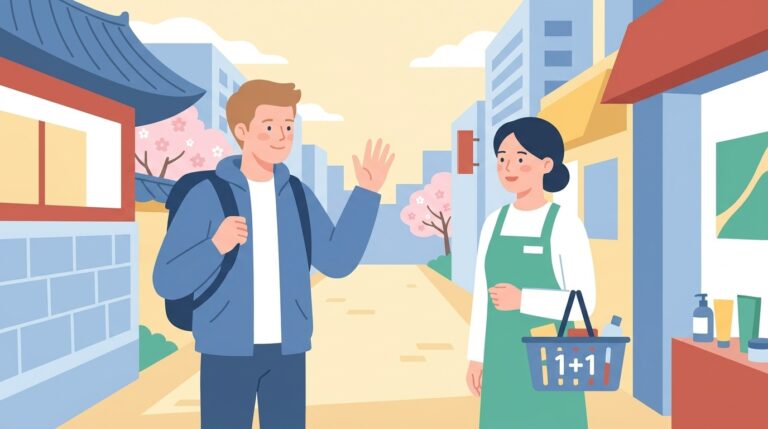
Imagine this: You are walking down the vibrant streets of Myeongdong. The neon lights are blinding, the smell of street food is amazing, and suddenly—a friendly salesperson steps right in front of you. They hand you a shopping basket with a free sheet mask inside, speaking rapidly in Korean: “Come inside! 50% off today!”
You panic. You don’t want to buy anything, but you also don’t want to be rude. If you just say a blunt “No” (아니요 – aniyo) and walk away, it feels a bit cold, doesn’t it? In K-Dramas, you rarely see the main characters just saying a flat “No” when rejecting someone’s kind offer. Instead, they use a magical phrase that softly diffuses the situation while keeping everyone’s feelings intact.
If you don’t know how to politely refuse in Korea, you might end up buying three giant bottles of snail mucin cream you never wanted! Today, I will teach you the ultimate “soft rejection” phrase based on what actual Koreans use every day.
Phase 2: Deep Dive into Core Expressions
1. 다음에 할게요 (I’ll do it next time)
- Pronunciation: da-eu-me hal-kke-yo [da-eu-me (the ‘eu’ sounds like the disgusted sound you make when stepping in gum) hal-kke-yo]
- Meaning: Literal (I will do it next time) vs Real (No thank you, maybe later / Not this time)
- K-Culture Moment: You are in an Olive Young (Korea’s most famous beauty store), and the cashier asks if you want to buy an extra lip balm for a promotional price. You smile slightly, wave your hand, and say this. It’s the perfect, guilt-free exit.
- Editor’s Insight: This phrase is the “Get Out of Jail Free” card in Korean shopping and daily life. It implies, “I appreciate your offer, and I might consider it in the future, just not right now.” It saves the other person from feeling rejected.
- Situation Spectrum:
- Casual / Friends: ✅ (If a friend asks you to join a game and you’re tired)
- Semi-formal / Shops: ✅ (Perfect for stores and street vendors)
- Formal / Bosses: ⚠️ (Be careful! To a boss, you should explain why you can’t do it first)
- 🤔 Think About It: Why do Koreans prefer saying “next time” instead of a direct “no”? Does your culture value directness, or do you also use “white lies” to soften a rejection?
2. 괜찮아요 (It’s okay / I’m good)
- Pronunciation: gwaen-cha-na-yo [gwen-cha-na-yo]
- Meaning: Literal (It is fine) vs Real (No thanks, I’m good)
- K-Culture Moment: A restaurant owner (이모님 – Imonim) tries to give you a mountain of extra rice because you look hungry. You pat your stomach and say, “괜찮아요!”
- Editor’s Insight: English speakers use “It’s okay” to mean “Yes” (e.g., “Is this okay?” -> “Yes, it’s okay”). But in Korean, when someone offers you something and you say “괜찮아요,” it almost always means “No, thank you.”
- Situation Spectrum:
- Casual / Friends: ✅
- Semi-formal / Shops: ✅
- Formal / Bosses: ✅ (Add “감사하지만” – thanks but – in front for extra politeness)
- 🤔 Think About It: Have you ever accidentally accepted something in Korea because you said “괜찮아요” thinking it meant “Yes”?
Phase 3: Textbook vs. Real Korean
Let’s see how textbooks teach refusal versus how Koreans actually speak on the streets of Hongdae!
[Situation 1: Refusing a Salesperson’s Offer]
* 📖 Textbook Korean: 아니요, 안 삽니다. (aniyo, an samnida – No, I do not buy.)
* 🗣️ Real Korean: 아, 다음에 올게요~ (a, da-eu-me ol-kke-yo~ – Ah, I’ll come next time~)
* 💡 Why the difference?: A flat “No” sounds aggressive. Promising a future visit (even if you never go back) maintains social harmony.
[Situation 2: Rejecting a flyer on the street]
* 📖 Textbook Korean: 필요 없습니다. (piryoo eopsseumnida – I don’t need it.)
* 🗣️ Real Korean: 괜찮습니다~ (gwaen-chan-sseum-ni-da – It’s okay~ + slight bow)
* 💡 Why the difference?: Empathy! The person handing out flyers is just doing their job. A polite “괜찮습니다” with a small hand gesture shows respect for their hard work.
Phase 4: Cultural Context — K-Culture Deep Dive
4-1. The Non-Verbal “No” (Body Language)
Language is only half the battle! When saying “다음에 할게요” (I’ll do it next time) or “괜찮아요” (No thanks), you must use the right body language.
– The Hand Wave: Hold your hand up around chest level and wave it side-to-side (like you’re fanning a bad smell, but gently).
– The Apologetic Smile: Don’t glare. Give a slight, soft smile.
– The “Nunchi” (눈치): If the salesperson is super aggressive, breaking eye contact and walking away while saying the phrase is the ultimate polite escape.
4-2. K-Travel Link: The “Service” (서비스) Culture
If you visit a Korean cosmetic store or a traditional market like Gwangjang Market, you will encounter the word “서비스” (seobiseu). In Korea, “service” doesn’t mean a tip or a service charge. It means “On the house” or “Freebies!”
Sometimes, a vendor will offer you extra items. If your bag is full or you really don’t want it, use “괜찮아요, 다음에 올게요” (It’s okay, I’ll come next time).
Critical Viewpoint: While foreigner-friendly spots might push sales harder, traditional markets use “service” as a genuine expression of “Jeong” (정 – Korean warm-heartedness). Knowing when to accept gracefully and when to refuse politely makes you a true insider.
Phase 5: Real-Life Roleplay Scenario
Setting: Saturday afternoon, Myeongdong. The streets are packed. You walk into a brightly lit K-Beauty shop to buy just ONE sheet mask.
Characters:
– YOU: A traveler trying to stick to a budget.
– Salesperson (SP): Enthusiastic, holding a basket full of promotional items.
Dialogue:
SP: 어서 오세요! 찾으시는 거 있으세요?
(eoseo oseyo! chajeusineun geo isseuseyo?)
[Welcome! Are you looking for anything?]
YOU: 아, 그냥 좀 볼게요.
(a, geunyang jom bol-kke-yo.)
[Ah, I’m just looking around.]
SP: 고객님! 오늘 이 세럼 1+1 행사 중이에요! 한 번 발라보세요~
(gogaengnim! oneul i sereum won-ppeul-reoseu-won haengsa jung-ieyo! han beon ballaboseyo~)
[Customer! This serum is 1+1 today! Try it out~]
(🎭 Stage Direction: The SP confidently pumps a blob of serum onto your hand)
YOU: 앗, 네… 촉촉하네요.
(at, ne… chokchokaneyo.)
[Oops, yes… it’s moisturizing.]
SP: 그렇죠? 이거 원래 5만 원인데 오늘만 2만 원이에요! 바구니에 넣어드릴까요?
(geureochyo? igeo wollae oman woninde oneulman iman wonieyo! bagunie neo-eodeurilkkayo?)
[Right? This is originally 50,000 won, but today only 20,000 won! Shall I put it in your basket?]
🔀 Your Turn! How do you answer?
– A) “아니요. 안 사요.” (aniyo. an sayo. – No. I don’t buy.)
– B) “아~ 감사합니다, 그런데 다음에 할게요.” (a~ gamsahamnida, geureonde da-eu-me hal-kke-yo. – Ah~ thanks, but I’ll do it next time.)
– C) “진짜요? 대박! 당장 주세요!” (jinjjayo? daebak! dangjang juseyo! – Really? Awesome! Give it to me right now!)✅ Best Choice: B — Reason: You acknowledged their kindness (“thanks”), but gently closed the door (“next time”). You can smoothly walk away now.
⚠️ Choice A Analysis: Too aggressive. The salesperson might feel embarrassed.
⚠️ Choice C Analysis: Say goodbye to your budget!
Phase 6: 10-Second Shadowing Drill
Let’s practice the magic refusal combo! Say it out loud. Pay attention to the pauses (/) and the emotion!
😊 아~ / 감사합니다! / 🥺 그런데 / 다음에 할게요~
(a~ / gamsahamnida! / geureonde / da-eu-me hal-kke-yo~)
[Ah~ / Thank you! / But / I’ll do it next time~]
Tip: Drag the “아~” (Ah~) a little bit to show you are hesitating, which makes the refusal sound much softer!
Phase 7: K-Culture Mini Dictionary
1. 눈치
* Romanization: nunchi
* English: Emotional intelligence / Reading the room
* Context: The Korean superpower. It’s the ability to gauge others’ moods and know when to back off or when to accept an offer.
2. 서비스
* Romanization: seobiseu
* English: Freebie / On the house
* Context: Free items given by shop owners to show appreciation. Never tip in Korea; instead, enjoy the “service”!
3. 원플러스원 (1+1)
* Romanization: won-ppeul-reoseu-won
* English: Buy one get one free
* Context: The ultimate temptation in Korean convenience stores (CU, GS25) and beauty shops.
4. 호객 행위
* Romanization: hogaek haengwi
* English: Touting / Soliciting
* Context: When vendors on the street actively try to pull you into their stores. A polite “다음에 올게요” is your best defense.
Phase 8: Traveler’s Survival Kit
Shopping and wandering around Seoul? Keep these expressions in your back pocket!
🆘 Survival Phrases for Refusing
– 🇰🇷 “조금 더 생각해 볼게요.” (jogeum deo saenggakae bol-kke-yo)
– 🗣️ English: I will think about it a little more.
– 📍 Where to use: High-end stores or when you actually want to compare prices.
- 🇰🇷 “괜찮습니다.” (gwaen-chan-sseum-ni-da)
- 🗣️ English: I’m fine / No thanks (Formal).
- 📍 Where to use: Refusing flyers on the street or a taxi driver offering a detour.
🇰🇷 “그냥 보는 거예요.” (geunyang boneun geo-yeyo)
- 🗣️ English: I’m just looking.
- 📍 Where to use: When a store clerk follows you too closely.
📌 Editor’s Travel Note
– Personal Space: In busy Korean shopping districts, physical space is tight. If someone hands you something, you do not have to take it. Just smile, wave your hand, and keep walking!
– No Tipping: Remember, if a restaurant gives you a free “service” drink, do not leave a tip. Just say “감사합니다!” (Thank you!).
Phase 9: Critical Thinking — “One Step Deeper”
🧠 Think Deeper: Language & Power (The Indirect “No”)
In Korean culture, preserving “Kibun” (기분 – mood/feelings) and “Chemyeon” (체면 – face/pride) is extremely important. A direct “No” can be perceived as an attack on someone’s Kibun, especially if they are older or offering something with good intentions. Therefore, the Korean language has developed numerous ways to say “No” without actually using the word “No.” Phrases like “I’ll do it next time” or “I’m fine” act as social lubricants. They maintain harmony.💬 Your Turn: Does your culture value a direct “No,” or do you also have phrases to soften the blow? Share your thoughts in the comments!
Phase 10: FAQ & Avoiding Misunderstandings
Q: Can I use “다음에 할게요” to my boss if they ask me to do a project?
A: NO! 🚫 “다음에 할게요” means “I’ll do it next time.” If you say this to a boss, it sounds like you are the one in charge making the schedule! For a boss, you must formally apologize and state your reason: “죄송하지만, 지금 다른 업무가 있어서요…” (I’m sorry, but I have other tasks right now…)
Q: What if I actually want to come back next time?
A: You can say “나중에 다시 올게요!” (najung-e dasi ol-kke-yo! – I will come back later!).
❌ Common Mistake #1: Saying “아니요” (No) to an older person offering food.
✅ Do this instead: Say “감사하지만, 배가 불러서 괜찮습니다” (Thank you, but I’m full so I’m okay). Always acknowledge the kindness first!
Phase 11: Summary & Action Items
One-Liner Summary: To politely reject an offer or a salesperson without ruining the vibe, just smile and say, “다음에 할게요!” (I’ll do it next time!).
Action Mission:
– 🥉 Bronze (Solo): Stand in front of your mirror, hold up your hand in a gentle wave, and say “다음에 할게요” 3 times with a polite smile.
– 🥈 Silver (Online): Find a Korean walking tour vlog on YouTube (like Myeongdong or Hongdae) and imagine yourself using this phrase when they pass by street vendors.
– 🥇 Gold (Real Life): Next time you visit a Korean mart or restaurant and they offer you something extra you can’t eat, use “괜찮아요” or “다음에 할게요!”
K-Culture Mission: Watch any K-Drama today. I guarantee you will hear someone say “괜찮아” (Casual) or “괜찮아요” (Polite) to refuse something. Try to spot it and shout “I know that word!”
Phase 12: Quiz — Interactive Challenge
1. Situational Judgment: You are walking in Gangnam, and someone shoves a plastic surgery flyer into your hand. You don’t want it. What is the BEST response?
– A) 아니요! (No!)
– B) 다음에 할게요. (I’ll do it next time.)
– C) 괜찮습니다~ (I’m fine~ / No thanks~)
(Hint: C is the most natural for flyers. B implies you might get plastic surgery next time! 😆)
2. True or False — K-Culture Edition:
– In Korea, if a restaurant owner gives you a free bottle of Coke and says “서비스예요” (It’s service), you must add a 10% tip to your bill.
– (Answer: FALSE. Tipping does not exist in Korea! Just say thank you.)
3. Fill in the Blank:
Salesperson: “Would you like to buy this 1+1 hand cream?”
You: “Ah, thank you, but ____________.”
(Answer: 다음에 할게요 – da-eu-me hal-kke-yo)
Did you get them all right? Let me know your score in the comments below! See you next time! (다음에 봐요!)
Frequently Asked Questions (FAQ)
Q: What does "다음에 할게요 (I'll do it next time)" mean in Korean and how do you pronounce it?
A: In Korean, "다음에 할게요 (I'll do it next time)" is pronounced [da-eu-me hal-kke-yo [da-eu-me (the 'eu' sounds like the disgusted sound you make when stepping in gum] and means: Literal (I will do it next time) vs Real (No thank you, maybe later / Not this time)
Q: What does "괜찮아요 (It's okay / I'm good)" mean in Korean and how do you pronounce it?
A: In Korean, "괜찮아요 (It's okay / I'm good)" is pronounced [gwaen-cha-na-yo [gwen-cha-na-yo] and means: Literal (It is fine) vs Real (No thanks, I'm good)







