

Phase 1: Empathy (The K-Culture Cold Open)
Hello! I’m your Daily Hangul Editor.
Picture this: You’re walking down the bustling streets of Myeongdong. You spot an optician (안경점, angyeongjeom) with a window display full of those trendy, clear, oversized frames that your favorite K-Drama lead was wearing. You walk in, pick the perfect pair, and then… panic sets in.
“Wait, my flight back home is tomorrow morning! In my country, making prescription glasses takes at least a week or two. Do I even have time for this?”
If you’ve ever felt this rush of anxiety, you are not alone! Many travelers skip buying stylish glasses or colored contacts in Korea simply because they don’t know how to ask, “How long does it take?”
But here’s a little insider secret: Korean opticians are famous for their mind-blowing speed. If you know the right words, you might just walk out with brand-new prescription glasses before your coffee even gets cold. This guide is built from the real experiences of our students who successfully navigated Korean opticians. Let’s learn the magic phrases!
Phase 2: Deep Dive into Core Expressions
1. 얼마나 걸려요? (How long does it take?)
- Pronunciation: [eolmana geollyeoyo?]
(Tip: ‘eo’ sounds like the ‘u’ in ‘uh-oh’. ‘llyeo’ sounds like ‘lyo’ said quickly.)- Meaning: Literal: How much does it hang/take? / Real nuance: How long will this take?
- K-Culture Moment: This is the ultimate “survival phrase” in Korea’s fast-paced society. Whether you’re at an optician, waiting for your food delivery, or asking a taxi driver about traffic, this phrase is your best friend.
- Editor’s Insight: It sounds super natural. It’s polite enough for service staff but casual enough that you don’t sound like a walking textbook.
- Situation Spectrum:
- Friends (Casual): ✅ (Drop the ‘요’ -> 얼마나 걸려?)
- Service Staff/Colleagues (Semi-formal): ✅
- Very Formal/Elders (Formal): ⚠️ (Better to use: 시간이 얼마나 소요될까요?)
- 🤔 Think About It: Why do Koreans ask this so often? In a culture that values efficiency and speed (빨리빨리, Pbali-Pbali), predicting time is a sign of respect for both parties’ schedules. Do people in your country ask this often, or is it considered rude to rush someone?
2. 오늘 받을 수 있어요? (Can I get it today?)
- Pronunciation: [oneul badeul su isseoyo?]
(Tip: ‘으’ (eu) sounds like the disgusted sound you make when stepping in gum. ‘sseo’ sounds like ‘saw’.)- Meaning: Literal: Today receive can? / Real nuance: Can I pick these up today?
- K-Culture Moment: Imagine a K-Drama heroine suddenly needing a makeover for a party tonight. She runs into a shop and asks this exact question. In Korea, same-day service is incredibly common!
- Editor’s Insight: Use this when you are on a tight schedule (like catching a flight). The staff will usually nod and say, “Of course!”
- Situation Spectrum:
- Friends (Casual): ✅ (오늘 받을 수 있어?)
- Service Staff (Semi-formal): ✅
- Formal (Formal): ⚠️
- 🤔 Think About It: “Can I get it today?” might sound demanding in some cultures, but in Korea’s service industry, it’s a standard logistical question. Have you ever been surprised by how fast a service was in Korea?
3. 언제 찾으러 오면 돼요? (When should I come to pick it up?)
- Pronunciation: [eonje chajeureo omyeon dwaeyo?]
- Meaning: Literal: When to look for come is okay? / Real nuance: What time should I come back to pick it up?
- K-Culture Moment: You’ve ordered your glasses, and now you want to grab some street food outside while you wait. This is how you ask when you should return.
- Editor’s Insight: In Korean, we use the verb 찾다 (to find/look for) when we talk about “picking up” an item we ordered or left behind (like luggage, laundry, or glasses).
- Situation Spectrum:
- Friends (Casual): ✅ (언제 찾으러 오면 돼?)
- Service Staff (Semi-formal): ✅
- Formal (Formal): ✅
- 🤔 Think About It: Instead of saying “When will you finish it?” Koreans ask “When should I come pick it up?” How does shifting the subject from the worker’s task to your action change the politeness of the question?
Phase 3: Textbook vs. Real Korean
[Asking about the waiting time]
* 📖 Textbook Korean: 안경이 완성되는 데 시간이 얼마나 소요됩니까? (How much time is consumed for the glasses to be completed?)
* 🗣️ Real Korean: 얼마나 걸려요? (How long does it take?)
* 💡 Why the difference?: Real Korean values brevity. Long, complex sentences sound like news anchors. “얼마나 걸려요” is short, sweet, and covers everything.
[Asking when to come back]
* 📖 Textbook Korean: 몇 시에 다시 방문해야 합니까? (At what time must I visit again?)
* 🗣️ Real Korean: 언제쯤 오면 돼요? (Around when should I come?)
* 💡 Why the difference?: Adding “쯤” (around) softens the sentence, making you sound flexible and polite, rather than demanding an exact minute.
Bottom Note: For an A2 level, just mastering 얼마나 걸려요? will solve 90% of your time-related questions in Korea!
Phase 4: Cultural Context — K-Culture Deep Dive
4-1. Non-verbal Communication
When asking “얼마나 걸려요?” (How long does it take?), your tone matters. If you say it with a flat expression and a sharp tone, it sounds like a complaint: “Why is this taking so long?!”
Tip: Slightly raise your pitch at the end and keep a soft smile. Use your Nunchi (눈치)—if the store is packed with 50 people, maybe don’t expect the famous 15-minute turnaround!
4-2. The “Pbali-Pbali” (빨리빨리) Magic in K-Travel
If you’ve watched K-Dramas, you know Koreans do things fast. But experiencing it at an optician is a whole different level. In many Western countries, you need to book an eye exam weeks in advance, pay a hefty fee, and wait two weeks for the lenses.
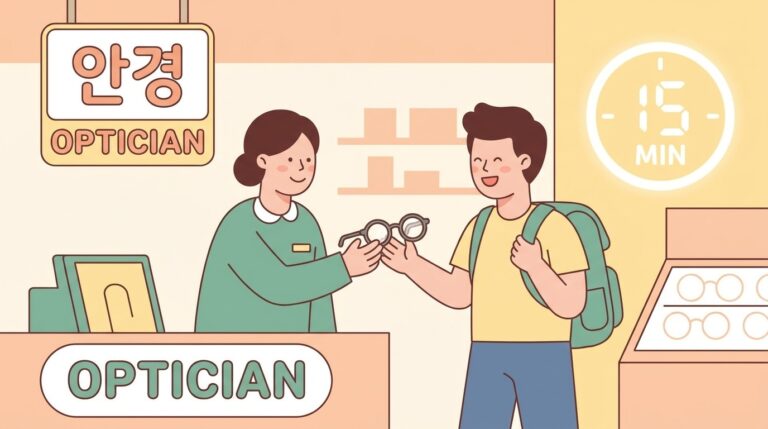
In Korea? You walk in off the street. The eye exam is usually free (if you buy glasses). They check your eyes in 3 minutes. And because most opticians have thousands of lenses in stock right behind the counter, they literally cut the lenses and fit them into your frames while you drink a complimentary cup of mix coffee. It usually takes 15 to 30 minutes. Knowing this transforms buying glasses from a stressful chore into a fun, quick travel activity!
Phase 5: Real-Life Roleplay Scenario
Setting: A brightly lit optician in Hongdae. Walls are lined with hundreds of stylish frames. You’ve picked out a pair of silver, round frames (the classic K-Pop idol airport fashion look). You have a dinner reservation in an hour.
Characters:
– YOU: A traveler who wants cool glasses but is worried about time.
– Optician (안경사, 40s): Friendly, efficient, wearing a crisp white shirt.
Dialogue:
Optician: 손님, 이 테로 하시겠어요? 👓
(sonnim, i tero hasigesseoyo?)
[Customer, would you like to go with these frames?]
(🎭 Stage Direction: The optician gently takes the frames from you to inspect them.)
YOU: 네, 이걸로 할게요. 시력 검사도 할 수 있어요?
(ne, igeollo halgeyo. siryeok geomsado hal su isseoyo?)
[Yes, I’ll take this one. Can I also get an eye exam?]
Optician: 당연하죠! 이쪽으로 오세요.
(dangyeonhajyo! ijjogeuro oseyo.)
[Of course! Please come this way.]
(🎭 Stage Direction: 5 minutes later, after reading numbers off a chart…)
Optician: 시력이 조금 떨어지셨네요. 도수 맞춰 드릴게요.
(siryeogi jogeum tteoreojyeonneyo. dosu matchwo deurilgeyo.)
[Your eyesight dropped a bit. I will adjust the prescription for you.]
YOU: 아, 네. 그런데… 얼마나 걸려요? ⏰
(a, ne. geureonde… eolmana geollyeoyo?)
[Ah, okay. By the way… how long does it take?]
Optician: 15분 정도 걸립니다.
(sibo-bun jeongdo geollimnida.)
[It takes about 15 minutes.]
YOU: 네?! 15분이요? 오늘 받을 수 있어요? 😲
(ne?! sibo-bun-iyo? oneul badeul su isseoyo?)
[What?! 15 minutes? Can I get it today?]
Optician: 네, 바로 해드립니다. 매장에서 기다리시겠어요?
(ne, baro haedeurimnida. maejang-eseo gidarisigesseoyo?)
[Yes, we’ll do it right away. Will you wait in the store?]
🔀 Your Turn! How should you reply?
– A) “아니요, 너무 오래 걸리네요. 갈게요.” (No, that takes too long. I’ll leave.)
– B) “네, 여기서 기다릴게요!” (Yes, I will wait here!)
– C) “빨리빨리 해주세요!!” (Do it quickly quickly!!)✅ Best Choice: B — 15 minutes is incredibly fast! Just say you’ll wait. Grab a free coffee from their machine.
⚠️ Choice C Analysis: Never actually yell “Pbali-Pbali” at service workers. It’s considered extremely rude and demanding. The culture is fast, but you shouldn’t demand it verbally.
YOU: (Choosing B) 네, 여기서 기다릴게요! 고맙습니다. 😊
(ne, yeogiseo gidarilgeyo! gomapseumnida.)
[Yes, I will wait here! Thank you.]
Phase 6: 10-Second Shadowing Drill
Practice these lines out loud to get the natural rhythm and intonation. Follow the pauses (/)!
- 🤔 궁금하게 (Curiously): 저기요, / 이거 / 얼마나 / 걸려요? ↗️
(jeogiyo, / igeo / eolmana / geollyeoyo?) - 🥺 간절하게 (Desperately): 혹시… / 오늘 / 받을 수 / 있어요? ↗️
(hoksi… / oneul / badeul su / isseoyo?) - 😊 친절하게 (Politely): 언제 / 찾으러 / 오면 돼요? ↘️
(eonje / chajeureo / omyeon dwaeyo?)
Phase 7: K-Culture Mini Dictionary
1. 빨리빨리
* Romanization: pbali-pbali
* English: Hurry, hurry / Fast-paced
* Context: The defining characteristic of modern Korean culture. From ultra-fast internet to 15-minute glasses and next-day deliveries, efficiency is key.
2. 안경점
* Romanization: angyeongjeom
* English: Optician / Glasses store
* Context: Unlike clinical optometrist offices in the West, Korean opticians feel like trendy fashion boutiques.
3. 시력 검사
* Romanization: siryeok geomsa
* English: Eye exam / Vision test
* Context: Usually free if you purchase glasses or contacts at the store.
4. 컬러 렌즈
* Romanization: keolleo renjeu
* English: Colored contact lenses
* Context: A massive part of K-Beauty and K-Pop styling. Many tourists flock to stores like ‘Olens’ to buy the exact eye colors worn by K-Pop idols.
Phase 8: Traveler Survival Kit
Planning to get your K-Drama protagonist look? Take these cards with you to the optician!
🆘 Survival Expression #1: Asking the Price
– 🇰🇷 “이거 테만 하면 얼마예요?” (igeo teman hamyeon eolmayeyo?)
– 🗣️ English: How much is it just for the frames?
– 📍 Where to use: When you just want the frames for fashion, without prescription lenses.🆘 Survival Expression #2: Eye Exam
– 🇰🇷 “시력 검사 해주세요.” (siryeok geomsa haejuseyo.)
– 🗣️ English: Please give me an eye exam.
– 📍 Where to use: Right after choosing your frames.🆘 Survival Expression #3: The Fashion Lens
– 🇰🇷 “도수 없는 걸로 주세요.” (dosu eomneun geollo juseyo.)
– 🗣️ English: Please give me ones without a prescription.
– 📍 Where to use: When buying colored contacts or glasses just for style!📌 Editor’s Travel Note
– Freebies: Korean opticians usually give you a really nice hard case and a microfiber cloth for free.
– Tax Refund: Many large opticians in tourist areas (Myeongdong, Hongdae, Gangnam) offer instant Tax Free service. Bring your passport!
– Tips: Absolutely NO tipping. It will confuse them!
Phase 9: Critical Thinking — “One Step Deeper”
Speed & Society (빨리빨리 문화)
The fact that you can get prescription glasses in 15 minutes is a marvel to many visitors. This Pbali-Pbali culture stems from Korea’s rapid economic growth in the late 20th century, where speed equaled survival and success. Today, this translates into world-class convenience—subways arrive precisely on the minute, and 24-hour deliveries are the norm.
However, this convenience comes at a cost. The workers behind the scenes face immense pressure to deliver quickly. As tourists, while we enjoy this incredible efficiency, it’s always wonderful to show extra appreciation with a warm “감사합니다” (Thank you) to those working hard to save our time.
💬 Your Turn: Does your culture prioritize speed and convenience, or patience and process? Share your thoughts in the comments!
Phase 10: FAQ & Avoiding Mistakes
Q: “Can I use ‘얼마나 걸려요’ to ask about physical distance?”
No! This is a very common mistake.
– Time: 얼마나 걸려요? (How long does it take?)
– Distance: 얼마나 멀어요? (How far is it?)
Q: “Do I need an appointment for an optician in Korea?”
Usually, no! Just walk in. Unless it’s a very famous custom-made glasses boutique, regular opticians welcome walk-ins anytime.
Q: “Can I say ‘얼마나 걸려요’ to a boss or professor?”
It’s a bit too casual for a strict boss. If your boss gives you a task and you want to ask how long they think it will take, say: “시간이 어느 정도 소요될까요?” (About how much time will be consumed?)
❌ Common Mistake #1: Pointing at your watch and saying “빨리빨리!” (Pbali-Pbali!)
✅ Do this instead: If you are truly in a rush for a flight, politely ask: “제가 공항에 가야 해서 그런데, 혹시 30분 안에 될까요?” (I have to go to the airport, by any chance can it be done in 30 minutes?)
Phase 11: Summary & Action Items
One-Liner Summary: To find out how long something takes in Korea, just ask “얼마나 걸려요? (eolmana geollyeoyo?)” and prepare to be amazed by the speed!
Action Mission 3 Steps:
– 🥉 Bronze (Solo): Stand in front of your mirror and practice “얼마나 걸려요?” 3 times with a polite smile.
– 🥈 Silver (Online): Comment below: What is one thing in your country that takes a long time, but you wish was Pbali-Pbali?
– 🥇 Gold (Real Life): Next time you order coffee or food at a Korean restaurant (or a local K-town shop), ask the staff “얼마나 걸려요?”!
K-Culture Mission (Optician Edition):
Go on Google Street View (or Naver Map if you’re hardcore) and drop a pin in Myeongdong. Find a store with “안경” (Glasses) or “렌즈” (Lens) on the sign. Imagine walking in and using your new phrases!
Phase 12: Quiz — Interactive Challenge
1. Situational Judgment:
You bought glasses, and the optician says they will be ready tomorrow. You want to know what time you should come back. What do you say?
A) 얼마나 걸려요?
B) 빨리 주세요.
C) 언제 찾으러 오면 돼요?
2. Fill in the Blank:
You want to make sure you can get your glasses before your dinner tonight.
“혹시 ______ 받을 수 있어요?” (Can I get it today?)
3. True or False – K-Culture Edition:
“You must book an appointment two weeks in advance to get an eye exam at a Korean optician.” (T/F)
Answers (Click to reveal!)
- C (언제 찾으러 오면 돼요? – When should I come pick it up?)
- 오늘 (oneul – today)
- False! You can just walk in, get a free eye exam, and often get your glasses in 15-30 minutes!
Frequently Asked Questions (FAQ)
Q: What does "얼마나 걸려요? (How long does it take?)" mean in Korean and how do you pronounce it?
A: In Korean, "얼마나 걸려요? (How long does it take?)" is pronounced [eolmana geollyeoyo?] and means: Literal: How much does it hang/take? / Real nuance: How long will this take?
Q: What does "오늘 받을 수 있어요? (Can I get it today?)" mean in Korean and how do you pronounce it?
A: In Korean, "오늘 받을 수 있어요? (Can I get it today?)" is pronounced [oneul badeul su isseoyo?] and means: Literal: Today receive can? / Real nuance: Can I pick these up today?
Q: What does "언제 찾으러 오면 돼요? (When should I come to pick it up?)" mean in Korean and how do you pronounce it?
A: In Korean, "언제 찾으러 오면 돼요? (When should I come to pick it up?)" is pronounced [eonje chajeureo omyeon dwaeyo?] and means: Literal: When to look for come is okay? / Real nuance: What time should I come back to pick it up?







