

Phase 1: Empathy (Immersion Opening)
Hello! I’m the lead editor of Daily Hangul, your local culture navigator and veteran tutor.
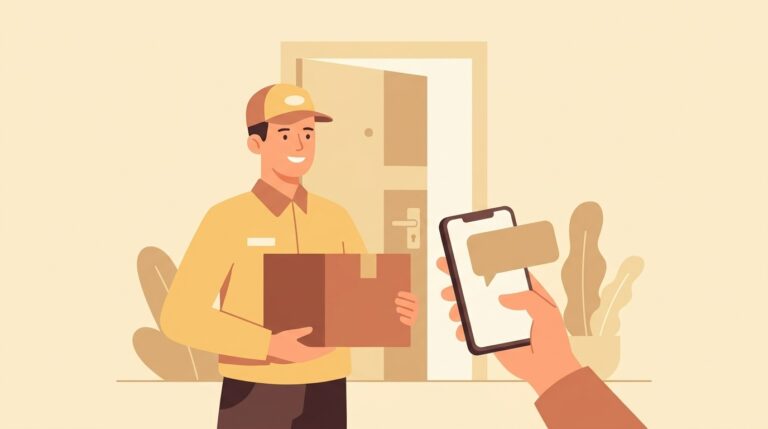
Picture this: You are watching a K-Drama, and the main character rushes home, face glowing with excitement, to find a box waiting perfectly safely in front of their apartment door. Or maybe you finally managed to order that exclusive K-Pop album or K-Beauty skincare haul to your Airbnb in Seoul. You’re checking the tracking app every five minutes. Suddenly, your phone buzzes. It’s a text from the delivery driver asking where to leave the package.
You freeze. You know how to say “Hello” and “Thank you,” but how do you politely tell a hardworking Korean delivery driver to leave your precious box at the door? If you use textbook Korean, you might sound a bit robotic. If you just say “Give it to me,” it sounds demanding.
Don’t worry! This guide is built from the real panic moments of my B1-level students. Today, we are going to learn how to text a 택배 기사님 (Taekbae Gisa-nim / Delivery Driver) like a true local. Not only will you get your packages smoothly, but you’ll also earn major insider points for your politeness!
Phase 2: In-Depth Analysis of Key Expressions
Let’s dive into the holy trinity of Korean delivery texts.
1. 문 앞에 두고 가주세요.
- Pronunciation: [mun ape dugo gajuseyo]
- Sound-alike guide: moon ah-peh doo-go gah-joo-seh-yo
- Meaning: Literal: “Please leave it in front of the door and go.” / Real nuance: “Please just leave it at the door.”
- K-Culture Moment: This is the #1 most used phrase in Korea’s delivery culture. Because of Korea’s high-trust society and the Palli-Palli (hurry up) culture, contactless delivery is the norm. You’ll use this for Coupang boxes, pizza, and late-night fried chicken!
- Editor’s Insight: The grammar here is beautiful for B1 learners. It combines 두다 (to put) + 가다 (to go) + ~아/어 주세요 (please do for me). It acknowledges the driver’s movement—they are busy and need to move to the next place.
- Situation Spectrum:
- Delivery Drivers (Service workers): ✅ Perfect
- Close Friends (Casual): ⚠️ Too formal (Use “문 앞에 둬!” instead)
- Boss (Formal): 🚫 Unnatural context
- 🤔 Think About It: Why does Korean explicitly say “put it and go“? How does this reflect the fast-paced nature of Korean society compared to your home country?
2. 공동현관 비밀번호는 OO입니다.
- Pronunciation: [gongdong hyeongwan bimilbeonhoneun OOimnida]
- Sound-alike guide: gong-dong hyun-gwan bee-mil-bun-ho-neun [number]-im-nee-dah
- Meaning: Literal/Real nuance: “The common entrance password is OO.”
- K-Culture Moment: Almost all Korean apartments and villas have a secure digital lock at the main building entrance. If you don’t give the driver this code, they can’t reach your actual front door!
- Editor’s Insight: Keep it brief! Drivers are reading texts on the go. Often, locals just write “공동현관: *1234#” (Common entrance: *1234#) to be efficient.
- Situation Spectrum:
- Delivery Drivers: ✅ Essential
- 🤔 Think About It: Notice the word 공동 (gong-dong) meaning “communal/shared.” Korean culture has a strong emphasis on communal living spaces. Do you have a similar concept in your housing culture?
3. 수고 많으십니다!
- Pronunciation: [sugo maneusimnida]
- Sound-alike guide: soo-go mah-neu-shim-nee-dah
- Meaning: Literal: “You have a lot of trouble/effort.” / Real nuance: “Thank you for your hard work!”
- K-Culture Moment: In K-Dramas, you always hear people say this when walking out of an office or accepting a delivery. It’s the ultimate polite greeting for someone performing a service or working hard.
- Editor’s Insight: Never use this to someone much older or higher in rank than you (it can sound condescending). But for service workers like delivery drivers or taxi drivers, it shows great empathy and respect for their labor.
- Situation Spectrum:
- Delivery Drivers: ✅ Highly recommended
- Co-workers (Semi-formal): ✅ (Usually “수고하셨습니다”)
- Boss (Formal): 🚫 (Use “고생하셨습니다” or just “감사합니다”)
- 🤔 Think About It: Why does the Korean language have so many ways to acknowledge someone else’s physical or mental labor?
Phase 3: Textbook vs. Real Korean
Let’s see how native speakers actually type on their phones.
[Situation 1: Requesting a drop-off location]
* 📖 Textbook Korean: 제 문 앞에 물건을 놓아주세요. (Please place the item in front of my door.)
* 🗣️ Real Korean: 문 앞에 두고 가주세요~ 감사합니다! (Please leave it at the door~ Thanks!)
* 💡 Why the difference?: Koreans naturally drop the subject and possessive pronouns like “제” (my). Adding the tilde (~) softens the tone so you don’t sound bossy.
[Situation 2: Replying when the driver says “Delivery Complete”]
* 📖 Textbook Korean: 배달해 주셔서 대단히 감사합니다. 안녕히 가세요. (Thank you very much for delivering. Goodbye.)
* 🗣️ Real Korean: 네 감사합니다! 수고하세요 😊 (Yes, thank you! Keep up the good work 😊)
* 💡 Why the difference?: Drivers are still working their shifts. Saying “안녕히 가세요” (Goodbye/Go in peace) implies they are going home. “수고하세요” acknowledges they have more work to do.
Bottom Note: At the
B1(Intermediate)level, using exclamation marks and tildes (~) in text messages is a crucial pragmatic skill. It shows you understand Korean Nunchi (social atmosphere).
Phase 4: Cultural Context — K-Culture Deep Dive
4-1. Non-verbal Texting Culture (Digital Nunchi)
When texting a delivery driver, punctuation is your body language. Ending a sentence with a strict period (e.g., 문 앞에 두세요.) feels cold, almost angry. Adding a tilde (문 앞에 두세요~) or a simple emoji (문 앞에 놔주세요! 😊) instantly adds a friendly, appreciative smile to your text.
4-2. The “High-Trust” Delivery Culture & K-Dramas
Have you ever noticed a scene in a K-Drama where a character finds a mountain of Coupang boxes sitting untouched in their hallway? This isn’t just TV fiction; it’s a reality deeply rooted in Korea’s low-crime, high-CCTV environment. Porch piracy is incredibly rare. You can comfortably text “문 앞에 둬주세요” (Leave it at the door) even if you won’t be home for another 8 hours. The package will wait for you patiently!
Phase 5: Real-life Roleplay Scenario
Setting: It’s 2:00 PM. You are sipping an iced Americano at a bustling cafe in Hongdae. You are expecting a huge K-Beauty skincare haul today. Your phone screen lights up with an SMS.
Characters:
– YOU: A B1 Korean learner, currently exploring Seoul.
– 기사님 (Driver): A fast-paced, efficient delivery driver for CJ Logistics.
Dialogue:
기사님: [CJ대한통운] 고객님, 오늘 오후 3~5시 사이에 택배 배송 예정입니다. 수령 장소를 선택해 주세요. 📦
(gogaengnim, oneul ohu 3~5si saie taekbae baesong yejeongimnida. suryeong jangso-reul seontaekhae juseyo.)
(English) [CJ Logistics] Customer, your package is scheduled for delivery today between 3-5 PM. Please select a receiving location.
(🎭 Stage Direction: You see standard options: 1. Door 2. Security Office 3. Call me)
YOU: 1번 문 앞이요! 공동현관 비밀번호는 *1234# 입니다.
(1beon mun apiyo! gongdong hyeongwan bimilbeonhoneun *1234# imnida.)
(English) Number 1, front door! The common entrance password is *1234#.
기사님: 네, 알겠습니다.
(ne, algetseumnida.)
(English) Yes, understood.
(🎭 Fast forward 2 hours… Your phone buzzes again.)
기사님: 고객님, 문 앞에 택배 두고 갑니다.
(gogaengnim, mun ape taekbae dugo gamnida.)
(English) Customer, I am leaving the package at the door and leaving.
🔀 Your Turn! How should you reply?
– A) 네. (Yes.)
– B) 감사합니다! 수고 많으십니다~ (Thank you! Thanks for your hard work~)
– C) 수고해! (Work hard!)✅ Best Choice: B — It’s the perfect balance of polite and warm.
⚠️ Choice A & C Analysis: Choice A is grammatically correct but feels completely emotionless. Choice C (수고해) is informal (Banmal) and incredibly rude to use with a service worker!
Phase 6: 10-Second Shadowing Drill
Read these sentences out loud, focusing on the pauses (/) and the emotional tags!
- 🗣️
😊 (Polite & Warm)
기사님, / 문 앞에 / 두고 가주세요~ / 감사합니다!
(Gisa-nim, / mun ape / dugo gajuseyo~ / gamsahamnida!) -
🗣️
😤 (Clear & Helpful)
공동현관 / 비밀번호는 / 별 / 일 이 삼 사 / 우물정 / 입니다!
(gongdong hyeongwan / bimilbeonhoneun / byeol / il i sam sa / umuljeong / imnida!)
(Note: 별 = *, 우물정 = #)
Phase 7: K-Culture Mini Dictionary
Here are 4 words you MUST know for Korean delivery culture:
1. 택배 (Taekbae)
* Romanization: taekbae
* English: Delivery service / Parcel
* Context: The general term for package delivery. It’s so integrated into society that “getting a taekbae” is considered a daily source of happiness.
2. 기사님 (Gisa-nim)
* Romanization: gisa-nim
* English: Driver (Respectful title)
* Context: Used for taxi drivers, delivery drivers, and bus drivers. The “nim” adds a layer of deep respect for their profession.
3. 로켓배송 (Rocket Baesong)
* Romanization: roket baesong
* English: Rocket Delivery
* Context: Coupang’s signature guaranteed next-day (or even same-day dawn) delivery service. A lifesaver for Koreans!
4. 반택 (Ban-taek)
* Romanization: ban-taek
* English: Half-price delivery (via convenience stores)
* Context: Short for 반값택배. Instead of home delivery, it goes from one GS25/CU to another. Extremely popular among K-Pop fans for trading photocards cheaply!
Phase 8: Traveler’s Survival Kit
Even if you’re just visiting Korea, you might need to order things to your hotel or Airbnb. Here are the survival phrases:
🆘 Survival Expression #1: “언제쯤 오시나요?”
– 🇰🇷 언제쯤 오시나요? (eonje-jjeum osinayo?)
– 🗣️ English: Around when will you arrive?
– 📍 Where to use: When you need to leave the Airbnb but are waiting for an urgent package.🆘 Survival Expression #2: “착불인가요?”
– 🇰🇷 착불인가요? (chakbul-ingayo?)
– 🗣️ English: Is it cash-on-delivery (pay on arrival)?
– 📍 Where to use: Sometimes, packages require you to pay the shipping fee to the driver directly.📌 Editor’s Travel Note
– Useful Apps: If you live in Korea, the 택배파인더 (Taekbae Finder) app is amazing. If you’re traveling, Coupang works even for foreigners now!
– Delivery to Hotels: ALWAYS ask the hotel front desk first. Some hotels do not accept packages for guests. If they do, tell the driver: “프론트에 맡겨주세요” (Please leave it at the front desk).
Phase 9: Critical Thinking Corner — “A Step Deeper”
🧠 Think Deeper: Language & Power (언어와 권력)
In the past, people often called service workers “아저씨 (Ajeossi / Middle-aged man)” or “아줌마 (Ajumma / Middle-aged woman).” However, modern Korean society has actively shifted toward using professional titles like 기사님 (Gisa-nim / Driver) or 사장님 (Sajang-nim / Boss/Owner), even for small businesses. This shift in the Korean language reflects a growing social movement to respect labor and reduce workplace hierarchy. By choosing the word “기사님,” you aren’t just being polite; you are participating in a modern cultural consensus that honors their hard work.
💬 Your Turn: Does your native language have specific polite titles for service workers, or do you use general greetings like “Sir” or “Ma’am”? Share in the comments!
Phase 10: FAQ & Avoiding Misunderstandings
- Q: “Can I call the driver 아저씨 (Ajeossi)?”
- A: NO. While technically it means “middle-aged man,” it can sound patronizing or rude in a professional context today. Always use 기사님 (Gisa-nim).
- Q: “Do I need to tip the delivery driver in Korea?”
- A: NO. Korea has absolutely no tipping culture. The drivers might actually feel confused or reject it if you offer money. A polite “수고 많으십니다!” text is the best tip you can give!
- Q: “What if I can’t read the Korean text they sent me?”
- A: Pro tip! Take a screenshot and put it into the Papago app’s image translation feature. It’s a lifesaver.
❌ Common Mistake #1: Texting “제 방으로 가져오세요” (Bring it to my room).
✅ Do this instead: Use “문 앞에 두고 가주세요” (Leave it at the door). Drivers do not enter homes for safety and efficiency reasons!
Phase 11: Summary & Action Items
- One-Liner Summary: To master the Korean delivery text, remember to be clear about the location, provide the entrance code, and always end with a warm acknowledgment of their hard work!
-
Action Mission 3 Steps:
- 🥉 Bronze (Solo): Stand in front of your room door and practice saying “문 앞에 두고 가주세요!” out loud 3 times.
- 🥈 Silver (Online): Write a mock text message to a driver in the comments below using today’s expressions.
- 🥇 Gold (Real-world): The next time you order delivery in Korea (even on Yogiyo or Baemin), type “수고 많으십니다 😊” in the delivery request box!
- K-Culture Mission: Go to YouTube and search for “한국 택배 브이로그” (Korean Delivery Vlog). Watch how fast they move, and try to spot the “문 앞” (front doors) where they leave the boxes!
Phase 12: Interactive Challenge (Quiz)
Q1. (Situational Judgment) You receive a text that your package is arriving, but your apartment requires a password to enter the building. Which text is the BEST response?
1. 제 물건을 주세요.
2. 공동현관 비밀번호는 *7777# 입니다. 문 앞에 두고 가주세요~
3. 수고 많으십니다. 안녕히 가세요.
(Answer: 2! It provides the necessary code and clearly states where to leave the package politely. #1 is rude, and #3 doesn’t tell them how to get in!)
Q2. (True or False) If you live in an apartment, it is highly likely someone will steal your package if left at the door all day.
(Answer: FALSE. Korea has a very high-trust culture backed by widespread CCTV. It is extremely common to leave packages out for days without issue.)
Q3. (Fill in the Blank) To show respect to the delivery driver, you should call them __________ instead of 아저씨.
(Answer: 기사님 / Gisa-nim)
Frequently Asked Questions (FAQ)
Q: What does "문 앞에 두고 가주세요." mean in Korean and how do you pronounce it?
A: In Korean, "문 앞에 두고 가주세요." is pronounced [mun ape dugo gajuseyo] and means: Literal: "Please leave it in front of the door and go." / Real nuance: "Please just leave it at the door."
Q: What does "공동현관 비밀번호는 OO입니다." mean in Korean and how do you pronounce it?
A: In Korean, "공동현관 비밀번호는 OO입니다." is pronounced [gongdong hyeongwan bimilbeonhoneun OOimnida] and means: Literal/Real nuance: "The common entrance password is OO."
Q: What does "수고 많으십니다!" mean in Korean and how do you pronounce it?
A: In Korean, "수고 많으십니다!" is pronounced [sugo maneusimnida] and means: Literal: "You have a lot of trouble/effort." / Real nuance: "Thank you for your hard work!"







