

Phase 1: Empathy (Immersive Opening)
Hello! I am the senior editor of Daily Hangul. 👋
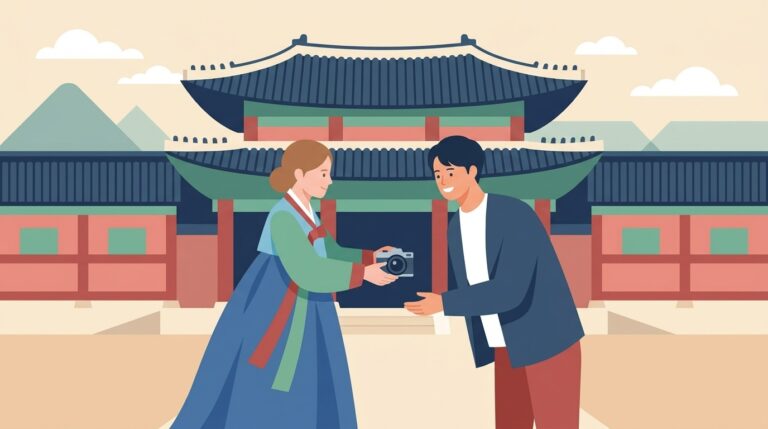
Picture this: You are standing in the heart of Seoul, surrounded by the towering modern skyscrapers of Gwanghwamun. But right in front of you are the majestic gates of Gyeongbokgung Palace. You see couples and friends walking around in beautiful, colorful Hanbok (traditional Korean clothes). It looks exactly like a scene from your favorite historical K-Drama!
You walk into a Hanbok rental shop. You see a stunning pastel skirt you desperately want to try on. The shop owner looks at you, waiting. Do you just point at it and nod? Or do you say the magic words that might just get you a free hair accessory?
Experiencing traditional Korean culture—whether it’s renting a Hanbok, visiting a museum, or making traditional crafts—is the highlight of any trip. But it requires a specific set of survival phrases. Today, we’re going to learn exactly what to say so you don’t just feel like a tourist, but an honored guest. Let’s dive in!
Phase 2: Core Phrases Deep Dive
1. 이거 입어봐도 돼요?
- Pronunciation: igeo ibeobwado dwaeyo? [ee-guh ee-buh-bwa-do dway-yo?]
- Meaning: Can I try this on? (Literal: Is it okay if I try wearing this?)
- K-Culture Moment: You are at a Hanbok rental shop in Bukchon Hanok Village. The racks are full of beautiful clothes. You pick one out, hold it up, and ask the staff this question. They will usually smile and guide you to the fitting room.
- Editor’s Insight: The ending “~아/어 보다” means “to try doing something.” It makes your request sound soft, polite, and curious, rather than demanding.
- Situation Spectrum:
- Casual (Friends): ✅ (Say: 이거 입어봐도 돼?)
- Semi-formal (Shop staff): ✅ (Perfect!)
- Formal (Elders/Boss): ⚠️ (Use ‘입어보셔도 됩니다’ to offer, but you rarely ask this to a boss)
- 🤔 Think About It: Koreans love using “try to [verb]” instead of a direct “Can I [verb]?” It shows respect for the other person’s boundaries. Does your native language have a way to “soften” a request?
2. 사진 좀 찍어주세요.
- Pronunciation: sajin jom jjigeojuseyo. [sa-jin jom jji-guh-ju-se-yo]
- Meaning: Please take a picture of us/me.
- K-Culture Moment: You are inside the palace grounds, posing in your Hanbok. You hand your phone to a passing Korean youth. Spoiler alert: Koreans take photo-taking very seriously. They might even crouch down to make your legs look longer!
- Editor’s Insight: The word “좀” literally means “a little,” but here, it’s a politeness marker. It makes the request sound less like a command and more like a gentle favor.
- Situation Spectrum:
- Casual: ✅ (사진 좀 찍어줘!)
- Semi-formal (Strangers): ✅
- Formal: ⚠️ (Better: 사진 한 장만 부탁드려도 될까요?)
- 🤔 Think About It: Why is it so safe to hand a $1,000 smartphone to a complete stranger in Korea? It’s deeply rooted in Korea’s low petty-crime rate and high social trust.
3. 어떻게 하는 거예요?
- Pronunciation: eotteoke haneun geoyeyo? [uh-ttuh-keh ha-neun guh-ye-yo?]
- Meaning: How do I do this? / How does this work?
- K-Culture Moment: You are at a traditional craft museum (공방) trying to make a mother-of-pearl keychain, or maybe you are trying Tuho (arrow-throwing) in the palace courtyard. You are confused. You look at the instructor and ask this.
- Editor’s Insight: This is the ultimate “I’m ready to learn” phrase. Koreans love it when foreigners show genuine interest in their traditional culture. Saying this will often get you an enthusiastic, step-by-step demonstration.
- Situation Spectrum:
- Casual: ✅ (어떻게 하는 거야?)
- Semi-formal (Instructors): ✅
- Formal: ⚠️ (Better: 어떻게 하는 것인지 여쭤봐도 될까요?)
- 🤔 Think About It: Asking for help is not a sign of weakness in Korean culture; it’s an invitation for connection.
Phase 3: Textbook vs. Real Korean
[Asking a stranger for a photo]
* 📖 Textbook Korean: 저희의 사진을 찍어 주시겠습니까? (Would you please take a photograph of us?)
* 🗣️ Real Korean: 저기요, 사진 좀 부탁드릴게요! (Excuse me, photo please!) OR 하나, 둘, 셋 해주세요~ (Please say 1, 2, 3~)
* 💡 Why the difference?: Textbooks use overly formal endings (-습니까), which sound like a news anchor. Real life relies on polite but casual endings (-요) and the magic word “부탁” (favor).
[Expressing amazement at a cultural site]
* 📖 Textbook Korean: 이것은 매우 아름답습니다. (This is very beautiful.)
* 🗣️ Real Korean: 우와, 진짜 예뻐요! 대박! (Wow, this is really pretty! Daebak!)
* 💡 Why the difference?: Emotional reactions in Korea are usually expressed with high energy and casual exclamations like “대박” (awesome/jackpot) rather than stiff adjectives.
Bottom Note: For A2 learners, mastering the “~요” ending is your golden ticket. It’s polite enough for 99% of strangers you will meet during your travels.
Phase 4: Cultural Context — K-Culture Deep Dive
4-1. Non-verbal Elements: The “Two-Hand” Rule
When you ask someone to take a picture and hand them your phone, never use just one hand. Handing things over with one hand (especially to someone older) is considered rude.
Pro Tip: Use both hands to present your phone. If one hand is occupied, use your right hand to hold the phone, and lightly touch your right elbow or wrist with your left hand. It’s the ultimate “polite Korean” move!
4-2. K-Travel Connection: The “K-Photo” Culture
If you ask a Korean person in their 20s or 30s to take a photo of you at a palace or museum, prepare for a photoshoot. In Korea, taking a “life shot” (인생샷 – the best photo of your life) is a serious cultural phenomenon.
Don’t be surprised if the stranger says, “조금만 왼쪽으로요!” (A little to the left!) or “다리 길게 찍어드릴게요!” (I’ll take it so your legs look long!). Just smile, strike a pose, and trust their artistic vision.
Phase 5: Real-life Roleplay Scenario
Setting: A traditional tea house (한옥 카페) tucked away in a quiet alley of Insadong. You hear gayageum music playing in the background. You just ordered a traditional jujube tea (대추차).
Characters:
* YOU: A tourist exploring Seoul, a bit tired from walking, ready for a cultural break.
* Garam (가람): The friendly tea house staff, wearing a modernized, everyday Hanbok.
Dialogue:
가람: 주문하신 대추차 나왔습니다. 🍵
(jumunhasin daechucha nawatseumnida.)
[Here is the jujube tea you ordered.]
YOU: 우와, 냄새가 정말 좋아요.
(uwa, naemsaega jeongmal joayo.)
[Wow, it smells really good.]
가람: 뜨거우니까 조심해서 드세요.
(tteugeounikka josimhaeseo deuseyo.)
[It’s hot, so please be careful drinking it.]
YOU: 네, 감사합니다. 그런데… 이거 어떻게 먹는 거예요? 🥄
(ne, gamsahamnida. geureonde… igeo eotteoke meongneun geoyeyo?)
[Yes, thank you. By the way… how do I eat this (the garnish inside)?]
가람: 안에 있는 잣은 스푼으로 떠서 드시면 돼요.
(ane inneun jaseun seupuneuro tteoseo deusimyeon dwaeyo.)
[You can scoop up the pine nuts inside with a spoon and eat them.]
YOU: 아, 그렇군요! 해볼게요.
(a, geureokunyo! haebolgeyo.)
[Ah, I see! I will try.]
(🎭 Stage Direction: Garam brings a small plate with a shiny traditional cookie.)
가람: 이건 약과예요. 차랑 같이 드시라고 조금 준비했어요.
(igeon yakgwayeyo. charang gachi deusirago jogeum junbihaesseoyo.)
[This is Yakgwa. I prepared a little for you to eat with the tea.]
🔀 Your Turn! How do you respond?
– A) “얼마예요?” (How much is it?)
– B) “와, 서비스예요? 정말 감사합니다! 잘 먹을게요!” (Wow, is it free service? Thank you so much! I will enjoy it!)
– C) “저는 단 거 안 먹어요.” (I don’t eat sweet things.)✅ Best Choice: B — Why? In Korea, “Service” (서비스) means something given for free on the house. Accepting it happily and saying “잘 먹을게요” (I will eat it well) shows great manners and appreciation for Korean hospitality (정 – Jeong).
⚠️ Choice A Analysis: Asking for the price when someone is offering a gift can accidentally ruin the warm mood.
Phase 6: 10-Second Shadowing Drill
Repeat after me! Pay attention to the pauses (/) and the emotion tags.
- 🥺 저기요, / 이거 / 입어봐도 돼요?
(jeogiyo, / igeo / ibeobwado dwaeyo?)
Excuse me, can I try this on? -
😊 우와! / 정말 / 예뻐요! / 사진 좀 / 찍어주세요!
(uwa! / jeongmal / yeppeoyo! / sajin jom / jjigeojuseyo!)
Wow! It’s really pretty! Please take a picture of me!
Phase 7: K-Culture Mini Dictionary
1. 한복
* Romanization: hanbok
* English: Traditional Korean clothing.
* Context: Renting Hanbok around palaces is a huge trend. Pro tip: If you wear a Hanbok, entry to major palaces like Gyeongbokgung is 100% free!
2. 인증샷
* Romanization: injeungsyat
* English: “Proof shot” / A photo taken to prove you were there.
* Context: Koreans love taking injeungsyat for Instagram at famous exhibitions or cultural sites. If you see a long line of people in front of a wall, they are waiting for their injeungsyat spot.
3. 서비스
* Romanization: seobiseu
* English: Complimentary items / On the house.
* Context: In Korean shops or restaurants, if they like you, they might give you something for free and say “It’s service!”
4. 공방
* Romanization: gongbang
* English: Craft workshop.
* Context: Places where you can experience traditional culture hands-on, like making pottery, traditional rings, or paper crafts.
Phase 8: Traveler Survival Kit
If you are exploring museums and traditional sites, save these phrases on your phone!
🆘 Survival Phrases: Cultural Sights
– 🇰🇷 “매표소 어디예요?” (maepyoso eodiyeyo?)
– 🗣️ English: Where is the ticket office?
- 🇰🇷 “성인 두 명 한 장씩 주세요.” (seongin du myeong han jangssik juseyo.)
- 🗣️ English: Two adult tickets, please.
🇰🇷 “플래시 터뜨려도 되나요?” (peullaesi teotteuryeodo doenayo?)
- 🗣️ English: Can I use the flash? (Important for museums!)
📌 Editor’s Travel Note
– Free Entry: As mentioned, wearing Hanbok gets you free entry into Seoul’s major palaces.
– Rest Days: Most museums and palaces in Korea are closed on Mondays (Gyeongbokgung is closed on Tuesdays). Always check the schedule!
– Tipping: There is NO tipping culture in Korea. Do not tip your Hanbok dresser or tour guide; it will just cause confusion.
Phase 9: Critical Thinking Corner — “One Step Deeper”
🧠 Think Deeper: Media vs. Reality – The Hanbok Experience
When you watch a historical K-Drama, the protagonists walk gracefully, their silk Hanboks flowing perfectly in the wind. But if you visit Gyeongbokgung Palace today, you will see a fascinating reality: tourists wearing bright, sparkly modernized Hanboks, but with comfortable Nike sneakers underneath, running around to catch the perfect golden-hour sunlight. It perfectly captures modern Korea—a society that deeply respects its ancient traditions, but always adapts them for absolute modern efficiency and comfort.
💬 Your Turn: Have you ever tried wearing traditional clothing from another culture? How did it feel compared to what you saw in movies? Share your experience in the comments!
Phase 10: FAQ & Mistake Prevention
Q: Is it okay to ask anyone to take a photo of me?
Yes! But here is an insider secret: Look for young Korean women in their 20s. They are culturally trained to take the most aesthetically pleasing, Instagram-worthy photos. They will make sure the angle, lighting, and your pose are perfect.
Q: Do I need to book Hanbok rentals in advance?
Usually, no. There are dozens of shops near the palaces. You can just walk in, ask “이거 입어봐도 돼요?” and start trying them on.
❌ Common Mistake #1: Pointing with one finger.
✅ Do this instead: When pointing at a dress you want, or asking where the ticket office is, use your entire hand open, palm facing up. It looks much more elegant and respectful!❌ Common Mistake #2: Assuming you can touch ancient artifacts.
✅ Do this instead: In museums, if you see the sign “눈으로만 보세요” (Please look with your eyes only), do not touch! If you are at a hands-on workshop, always ask “어떻게 하는 거예요?” first.
Phase 11: Summary & Action Items
One-Liner Summary: To embrace Korean traditional culture, be polite with your requests, use both hands, and don’t be afraid to ask for that perfect “life shot” (인생샷)!
🎯 Action Mission:
– 🥉 Bronze (Solo): Stand in front of your mirror, hold out your phone with two hands, and practice saying “사진 좀 찍어주세요!”
– 🥈 Silver (Online): Find a beautiful photo of a Korean palace online and post it in your learning community with the caption: “여기에 가서 한복을 입어보고 싶어요!” (I want to go here and try on Hanbok!)
– 🥇 Gold (Real Life): Next time you meet a Korean speaker, show them something you are working on and ask, “어떻게 하는 거예요?”
🎭 K-Culture Mission:
Watch one episode of a historical K-Drama (Sageuk) this week. Look at how they hand items to the King or elders. Notice the “two-hand” rule in action!
What traditional Korean experience are you most excited to try? Let me know in the comments below! 👇
Phase 12: Quiz — Interactive Challenge
1. Situational Judgment: You are at a Hanbok shop. You see a beautiful blue skirt. How should you ask to try it on?
* A) 이거 주세요! (Give me this!)
* B) 이거 입어봐도 돼요? (Can I try this on?)
* C) 저기요! (Excuse me!)
2. True or False – K-Culture Edition:
If you hand your phone to a stranger in Korea to take a picture, there is a high chance they will run away with it.
* (True / False)
3. Fill in the Blank:
You want someone to take a photo.
“저기요, ( ) 좀 찍어주세요.”
(Answers: 1: B, 2: False – Korea is incredibly safe regarding personal belongings!, 3: 사진)
Frequently Asked Questions (FAQ)
Q: What does "이거 입어봐도 돼요?" mean in Korean and how do you pronounce it?
A: In Korean, "이거 입어봐도 돼요?" is pronounced [igeo ibeobwado dwaeyo? [ee-guh ee-buh-bwa-do dway-yo?] and means: Can I try this on? (Literal: Is it okay if I try wearing this?)
Q: What does "사진 좀 찍어주세요." mean in Korean and how do you pronounce it?
A: In Korean, "사진 좀 찍어주세요." is pronounced [sajin jom jjigeojuseyo. [sa-jin jom jji-guh-ju-se-yo] and means: Please take a picture of us/me.
Q: What does "어떻게 하는 거예요?" mean in Korean and how do you pronounce it?
A: In Korean, "어떻게 하는 거예요?" is pronounced [eotteoke haneun geoyeyo? [uh-ttuh-keh ha-neun guh-ye-yo?] and means: How do I do this? / How does this work?







